
Originally published in January 2017 and comprehensively updated/edited in June 2026.
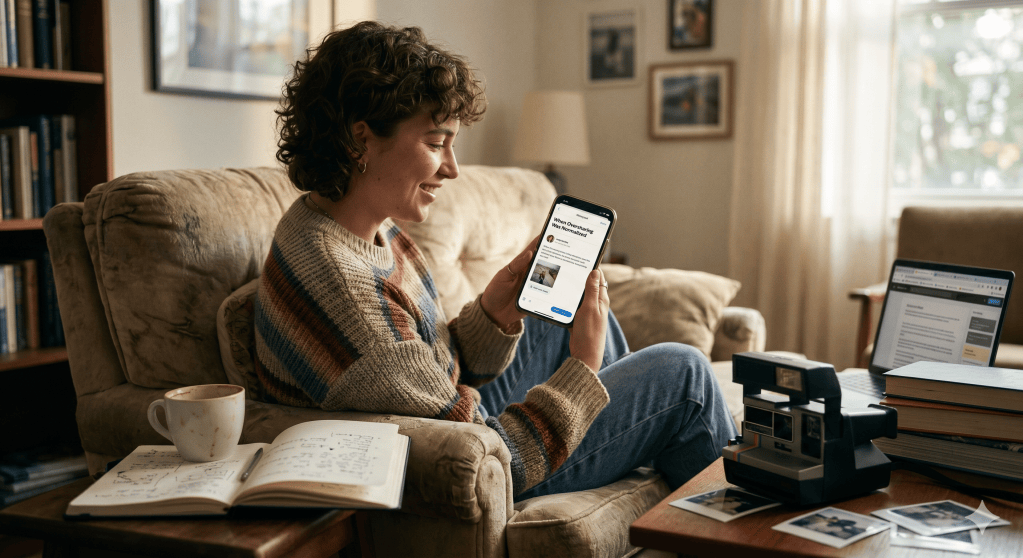
How social media, neuroscience, and therapy culture combined in the 2010s to make personal oversharing a normalized part of everyday life — and what it cost us.
There was a moment — difficult to pinpoint exactly, but somewhere in the early 2010s — when telling strangers about your divorce, your anxiety diagnosis, or your dating history stopped feeling unusual. It just became something people did. On social media, in comment sections, in podcasts, in therapy-speak that migrated from consulting rooms into casual conversation. The line between private and public didn’t disappear all at once. It dissolved, slowly, like something left out in the rain.
Picture a teenager at 2 a.m., posting about self-harm to a few hundred Tumblr followers she’d never met in person. Or a Facebook status announcing a divorce before a person’s own siblings knew. Or someone filming themselves crying in a car, uploading it to TikTok before the engine cooled. None of these moments were unusual by the mid-2010s. That, in itself, is remarkable.
Oversharing became normalized. That’s not a moral judgment — it’s a description of a genuinely strange cultural shift that happened faster than most people noticed and is still reshaping how we relate to each other. To understand it, you have to look at several things happening at once: the architecture of social media platforms, the psychological needs those platforms exploited, a broader cultural movement toward emotional transparency, and what neuroscience tells us about why self-disclosure feels so rewarding in the first place.
This isn’t a story about technology making us worse. It’s a story about what happened when new tools gave humans new ways to be seen — and what we learned about ourselves in the process.
The Psychology of Self-Disclosure
Long before smartphones existed, psychologists were studying why people share personal information. The short answer: it feels good. The longer answer involves a concept called self-disclosure, which researchers have been examining since at least the 1970s, when psychologist Sidney Jourard argued that the willingness to reveal yourself to others was connected to mental health and authentic human connection.
What the research consistently found was that self-disclosure is reciprocal and bonding. When you tell someone something personal, they tend to tell you something personal back. Trust builds. The relationship deepens. This is part of why therapists are trained to listen without sharing their own stories — the dynamic would collapse into something else entirely.
But there’s a neurological dimension too. A 2012 study from Harvard neuroscientists Diana Tamir and Jason Mitchell found that talking about yourself activates the brain’s mesolimbic dopamine system — the same reward circuitry involved in food, sex, and money. Around 30 to 40 percent of everyday conversation is already self-disclosure, the researchers found, and the act itself produces a measurable neurological reward. We are, quite literally, wired to enjoy sharing information about ourselves.
That was true long before the internet. What changed wasn’t human nature. What changed was the availability of audiences.
How Platforms Were Built to Amplify Disclosure
The social media platforms that emerged between roughly 2004 and 2012 — Facebook, Twitter, YouTube, Tumblr, Instagram — weren’t designed with the explicit goal of making people overshare. But they were designed with engagement in mind, and self-disclosure turned out to be one of the most powerful engagement drivers ever discovered.
Consider the basic architecture of a Facebook post. You share something personal. People respond with likes and comments. Those responses trigger the same dopamine reward that Tamir and Mitchell identified. So you share again. The platform’s design — the visible like count, the notification system, the algorithmic amplification of posts that generate reactions — created a feedback loop that consistently rewarded emotional and personal content over neutral or informational content.
Sociologist Nathan Jurgenson described this dynamic as “social photography’s documentary impulse” — the idea that digital platforms encouraged a kind of ongoing documentation of personal life that had no real precedent. Where previous generations might have kept a diary, people were now keeping public diaries, and the audience response was immediate and quantified.
Twitter, with its 140-character limit and public-by-default structure, created a different but related phenomenon. Constraints forced brevity, which pushed people toward the most emotionally immediate kind of self-expression. You couldn’t explain context efficiently. You could announce feelings. The platform’s structure, unintentionally, optimized for emotional disclosure.
Tumblr occupies a specific chapter in this history. Between about 2010 and 2015, it became a space where teenagers and young adults disclosed experiences — mental illness, sexual identity, family dysfunction, trauma — with an intensity that surprised even regular users of the platform. The anonymity was partial (real names weren’t required, but many people became recognizable through their blogs), and the audience was self-selected toward empathy. It functioned as something like a distributed support group, and for many users that was exactly what it felt like. But it also normalized a particular kind of emotional rawness that eventually migrated into other spaces.
The Cultural Context: Therapy Culture Goes Mainstream
Technology doesn’t operate in a vacuum. The same years that saw social media’s rise were also years in which therapy culture, mental health language, and emotional self-awareness became far more central to American life than they had been in previous decades. This shift had roots in earlier movements — the self-help industry, the recovery movement, decades of mental health advocacy — but something accelerated sharply in the 2000s and 2010s.
Celebrities spoke openly about depression and anxiety. Public health campaigns reduced stigma. People who might once have suffered in silence had both permission and language to describe their experiences, which was, by most measures, a genuine improvement. But the mainstreaming of therapy-speak also created something more complicated: concepts developed in clinical contexts — boundaries, triggers, trauma, attachment styles, emotional labor — entered everyday conversation in ways that weren’t always precise. What had been technical vocabulary became social vocabulary, and with that shift came a particular mode of self-presentation: the ongoing narration of one’s emotional interior as a form of identity.
Sociologist Eva Illouz, whose work on what she calls “emotional capitalism” is essential reading for understanding this period, argues that Western culture increasingly came to define the self through its emotional experiences and their public expression. The therapeutic frame — the idea that articulating your pain is the beginning of healing — became so culturally pervasive that it reshaped what people expected of themselves and each other. Vulnerability wasn’t just acceptable; it became aspirational.
Brené Brown’s 2010 TED Talk on vulnerability, which eventually became one of the most-watched TED presentations ever recorded, is a useful marker of where the culture was heading. Brown’s research was genuine and her arguments nuanced, but the talk spread because it crystallized something people were already feeling: that emotional openness was a form of courage, and that the refusal to share was its own kind of failure.
The Audience Problem
Here is where things get complicated. Traditional models of self-disclosure assume a relationship — two people, or a small group, with shared context and mutual accountability. The listener knows you. They remember what you said last week. There are social consequences for betraying a confidence.
Online disclosure doesn’t work this way. The audience is often unknown in size, largely unknown in identity, and absent most of the social mechanisms that regulate face-to-face sharing. Psychologist Sherry Turkle, who spent decades researching human relationships with technology, described this as a “performance of the self” — people weren’t having conversations online so much as broadcasting to an imagined audience.
That imagined audience matters. Research on what’s called the “spotlight effect” — the tendency to overestimate how much other people notice and remember your behavior — suggests that people consistently misjudge how much attention they’re receiving. On social media, the effect runs in a strange direction: metrics make the audience visible in a way it never was before (you can see your follower count, your view count, your engagement rate), which created a novel feedback loop between self-perception and social feedback.
What happened, psychologically, was something researchers describe as context collapse. In normal social life, you modulate how much you share based on context — you tell your doctor things you wouldn’t tell your boss, and you tell your close friends things you wouldn’t tell your doctor. Online, particularly on platforms with broad social networks, all those audiences collapsed into one. The result was either extreme caution (sharing nothing personal) or, for many people, a kind of disclosure calibrated to the most intimate relationships and broadcast to everyone.
Danah Boyd, whose research on teenagers and social media is among the most careful and influential in the field, documented how young people navigated this context collapse in the early 2010s. Many developed sophisticated strategies — coded language, in-jokes, posts that meant different things to different people — to manage multiple audiences simultaneously. Others simply didn’t bother, treating all audiences as equally intimate, or treating the public internet as if it were a private conversation.
When Sharing Becomes Performance
There’s a meaningful difference between authentic self-disclosure and the performance of authenticity, though the line between them isn’t always clear.
Erving Goffman’s foundational work on social interaction, developed in the 1950s and ’60s, introduced the idea that all social behavior involves performance — we present different versions of ourselves in different contexts, and this isn’t dishonesty, it’s just how human interaction works. Social media didn’t create performative self-presentation. It gave it new stages, new metrics, and new incentives.
What’s distinctive about the oversharing era is that emotional rawness itself became a performance category. The confessional post, the vulnerability thread, the “I need to be honest with you all” caption — these developed recognizable formats, aesthetic conventions, and audience expectations. Sharing something painful online came with implicit genre rules: how you framed it, what kind of resolution or insight you offered, how you positioned yourself as someone who had processed the experience enough to share it.
This isn’t cynical. The people doing this weren’t necessarily being fake. But the existence of genre conventions means that even genuine emotion gets expressed through learned templates, and over time those templates can shape the emotion itself. Sociologist Arlie Hochschild’s concept of “feeling rules” — the cultural norms that govern what we’re supposed to feel, and how we’re supposed to express it — applies here. When vulnerability became aspirational, people learned to feel that they should be vulnerable, and to express that vulnerability in the ways the culture recognized and rewarded.
The result was a particular paradox: a culture that valorized authenticity produced a set of very recognizable, very formatted performances of being authentic. The oversharing wasn’t necessarily false. But it was, often, curated.
The Real Costs and Real Benefits
It would be easy, and wrong, to treat the normalization of oversharing as simply a bad thing. The same dynamics that produced performative vulnerability also produced genuine connection, destigmatized mental illness, created communities for people who were isolated, and allowed experiences that were previously unspeakable to find language and witness.
The research on online disclosure and mental health is genuinely mixed. Some studies found that sharing personal struggles online was associated with increased feelings of support and reduced loneliness. Others found that seeking emotional support through social media was associated with greater rumination — the tendency to dwell on problems without resolving them — and that the validation-seeking dynamics of social platforms could interfere with actual emotional processing.
The difference, researchers generally found, came down to the quality of the connection and the purpose of the sharing. Disclosing to a small, trusted audience with the goal of processing an experience was associated with better outcomes. Broadcasting pain to a large, anonymous audience in search of validation was associated with worse ones. This maps onto what therapists would recognize as the difference between working through something and performing distress.
There were also costs that were more structural. Oversharing left digital traces that had real-world consequences — posts from years earlier resurfacing during job applications or relationship conflicts; the loss of the privacy that allows people to grow and change without permanent record; the erosion of the social convention that some things are private not because they’re shameful, but because privacy is part of what makes intimate relationships intimate. But there’s a deeper point here that often gets missed in discussions about privacy as mere data protection. Privacy isn’t simply the absence of sharing. It’s the space in which identity can change without immediate public scrutiny — the room in which a person can become someone different before they have to say so out loud. When oversharing collapsed that space, it didn’t just expose people. It accelerated them, locking in versions of themselves that might otherwise have quietly evolved.
And there were costs to public discourse. When personal emotional experience becomes the primary currency of online communication, it becomes harder to evaluate claims on their merits rather than their emotional weight. The testimonial and the personal story are powerful and humanizing, but they work differently than evidence — and a culture saturated in personal disclosure can struggle to maintain the distinction.
Why This Moment Matters
Looking back from 2026, the normalization of oversharing in the 2010s appears as one of those shifts that seemed dramatic at the time and now just seems like the landscape. We live in a world where political figures, athletes, executives, and celebrities are expected to make emotional disclosures that would have been unthinkable a generation ago. Where human resources departments ask employees about their feelings. Where “authentic personal branding” is a recognized professional category. Where the refusal to share your mental health journey can read as stigma avoidance rather than privacy preference.
The shift has been absorbed so completely that it’s hard to remember how recently it happened. But the consequences continue to unfold. Platform design has evolved to further capitalize on disclosure — short-form video, in particular, added body language, facial expression, and voice to text-based self-presentation, making the performance of authenticity more immediate and harder to modulate. The boundaries between public and private, professional and personal, continue to negotiate themselves in real time.
What the oversharing era revealed, more than anything, is something that sociologists and psychologists had described theoretically but that people got to experience practically: the self is not a fixed thing that pre-exists its social expression. It’s constructed, in part, through the act of sharing — which means that changes in how we share change who we are. Not completely, and not in ways we can fully predict. But meaningfully.
The question isn’t whether disclosure is good or bad. It’s more interesting than that. It’s about what kinds of sharing, with whom, for what purposes — and whether the platforms and cultural norms that shape our disclosure are serving human needs or exploiting them.
That question, asked seriously, still doesn’t have a tidy answer. But the fact that we can ask it more clearly now, with more evidence and more perspective, is itself a consequence of having lived through the moment when oversharing became normalized.
The Ongoing Negotiation
The era of maximum disclosure may already be receding at its edges. By the early 2020s, there were signs of what researchers began calling “privacy rebound” — particularly among younger users who had grown up entirely online and were now more likely than older millennials to use ephemeral formats, private accounts, and smaller groups. The discovery that oversharing had real-world consequences — professional, relational, psychological — produced a generation with a more sophisticated calculus about what to share and what to keep.
This isn’t a return to the way things were before. It’s an adaptation. The tools for broadcasting personal experience are still there, and the cultural permission to use them is still there. What’s changing is the sophistication with which people navigate the choice.
And that sophistication — the developing human capacity to think carefully about disclosure, audience, context, and consequence — may be the most enduring thing the oversharing era produced. We learned, sometimes painfully, that the audience is real, that the record is permanent, and that the line between connection and performance is worth thinking about. Whether that learning translates into wisdom depends, as it usually does, on whether we pay attention to it.









