
Originally published in December 2016 and comprehensively updated and edited in June 2026.
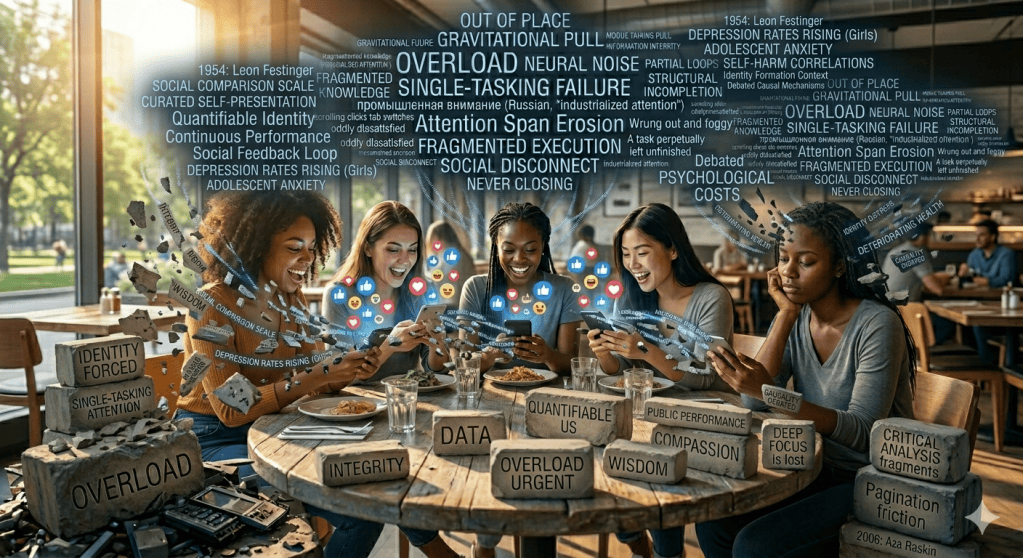
How the social media era disrupted human psychology—from attention and anxiety to identity and shared reality—and what a decade of research reveals about the lasting consequences.
There are moments in history when the psychological ground shifts beneath a society’s feet, and people don’t fully realize it until they’re already off-balance. The years surrounding 2016 were one of those moments. Political upheaval, technological acceleration, and a media environment that had fundamentally restructured the way humans consumed information all converged at the same time. The result wasn’t just social disruption—it was something that cut deeper, into the architecture of individual minds.
This is an essay about what happens to human psychology when the informational environment it evolved to navigate is replaced, almost overnight, by something it was never built for. It is about attention, anxiety, identity, and the strange cognitive cost of living through a period when the baseline simply dissolved.
By baseline, I mean something specific: the set of implicit psychological expectations that allow people to navigate daily life without constant conscious effort. A shared understanding of what is real. A manageable level of perceived threat. Enough confidence in social institutions to treat them as background rather than foreground. And enough cognitive stability to distinguish between genuine emergencies and ordinary noise. Most of the time, people don’t think about any of this. The baseline operates silently, like a gyroscope. You only notice it when it stops working.
The phrase “the mind lost its baseline” is not a diagnosis. It is a description. Something identifiable happened to collective cognition during this period, and understanding it matters not just as historical analysis, but because the dynamics that produced it have only intensified in the decade since.
The Informational Ecosystem That Broke First
How Attention Became a Resource to Be Extracted
To understand what happened to the mind in the mid-2010s, you need to start not with psychology but with economics.
The dominant digital platforms of the era were built around a simple proposition: attention could be measured, captured, and sold. The more time users spent on a platform, the more valuable that platform became. Every design choice, every recommendation system, and every algorithmic adjustment operated within that incentive structure.
This created conditions under which emotionally activating content consistently outperformed emotionally neutral content. Outrage, fear, moral indignation, and conflict generated more engagement than information alone. The algorithms were not designed to make people angry. They were designed to keep people engaged. The anger and anxiety were, in engineering terms, a feature that emerged from the optimization target.
Research accumulated after 2016 reinforced this interpretation. Human attention naturally prioritizes threat-relevant information. What social media accomplished was not the creation of that tendency but its amplification at unprecedented scale. A cognitive bias that evolved to help humans survive became the organizing principle of a multi-trillion-dollar information economy.
The Collapse of Shared Reality
The deeper consequence of this system wasn’t merely emotional activation. It was the erosion of a shared factual baseline.
For most of the twentieth century, large portions of the public consumed overlapping sources of information. People disagreed about meaning and interpretation, but they generally began from a common set of facts.
The personalized media environment of the 2010s fractured that arrangement. Algorithmic recommendation systems increasingly determined what information individuals encountered, creating informational ecosystems that differed dramatically from person to person.
This isn’t simply a problem of misinformation. It is a problem of epistemics—the cognitive infrastructure through which human beings determine what is real.
Shared reality turns out to be more than a political convenience. It is a psychological necessity. People anchor their understanding of the world through interaction with others. When those anchors become unstable, so does the baseline that allows societies to coordinate around common facts.
What Stress Does to a Mind at Scale
The Neuroscience of Chronic Threat Activation
The human nervous system evolved for threats that were immediate, local, and actionable.
The informational threats delivered through social media and the modern news cycle were different. They were chronic rather than acute. They were distant rather than local. Most importantly, they were often impossible for individuals to meaningfully influence.
The result was a form of low-grade but persistent threat activation.
Research on stress physiology demonstrates that prolonged exposure to stress hormones can impair executive function, emotional regulation, and contextual reasoning. In practical terms, chronic stress doesn’t simply affect mood. It affects the cognitive systems responsible for judgment itself.
Research on emotional memory suggests a related problem. Emotional activation improves memory for emotionally charged content while often reducing retention of surrounding context. A person consuming a continuous stream of emotionally activating information may retain the feeling long after the details have faded.
The outrage remains. The facts disappear.
Anxiety as a Cultural Weather System
By the mid-2010s, anxiety had become something close to a cultural atmosphere.
Survey data documented rising stress levels across demographic groups, while news consumption itself increasingly appeared as a source of psychological strain.
There is an important question here about causation. Was the anxiety generated by the informational environment, or was the media merely reflecting real social and economic problems?
The answer is almost certainly both.
Economic insecurity, political polarization, institutional distrust, and cultural conflict were genuine developments. But the informational ecosystem amplified these concerns in ways that made them feel more immediate, more pervasive, and more personally threatening than they often were in everyday life.
The result was a widespread experience of ambient dread—a sense that something was always wrong, always urgent, always demanding attention.
The mind, saturated with stimuli, lost its capacity to triage.
In retrospect, this was one of the clearest signs that the baseline was failing. People were no longer responding primarily to the conditions immediately around them, but to a continuous stream of distant threats, political conflicts, and emotionally charged signals competing for attention. The psychological gyroscope that normally helps individuals distinguish between ordinary concerns and genuine emergencies was increasingly being pulled off-center.
Identity Under Pressure
Tribalism and the Psychology of Group Threat
Humans derive part of their identity from the groups to which they belong. Social identity theory has demonstrated this repeatedly across decades of research.
When group identity feels threatened, distinctions between “us” and “them” become sharper. Ambiguous information is interpreted through group loyalties. Trust declines. Suspicion increases.
The media environment of the 2010s rewarded exactly the kinds of content most likely to trigger these dynamics. Narratives of existential conflict consistently outperformed narratives of compromise or complexity.
This wasn’t a conspiracy. It was an incentive structure.
Its output was predictable: tribalism intensified, political identities became sharper and less cross-cutting, and the willingness to extend good faith to ideological opponents declined.
The Identity Costs of Social Media
Beyond politics, social media altered the conditions under which personal identity developed.
Research on social comparison has long shown that individuals evaluate themselves partly through comparison with others. Social media dramatically increased both the frequency and scale of those comparisons while simultaneously presenting highly curated versions of other people’s lives.
The effects were particularly visible among adolescents and young adults. Identity formation has always been psychologically demanding. The social media environment made it more public, more measurable, and more continuous.
Research conducted in the years following 2016 strengthened concerns that aspects of the social media ecosystem contributed to rising levels of anxiety, depression, and psychological distress among young people. The precise mechanisms remain debated, but the broader conclusion is increasingly difficult to ignore.
The environment in which identity formation occurred had changed.
When the News Became Weather
Information Overload and Decision Fatigue
One useful concept for understanding this period is cognitive load.
Human attention has limits. When those limits are exceeded, thinking becomes less nuanced, less deliberate, and more reactive.
The informational environment of the mid-2010s operated near those limits continuously. News transformed from a periodic activity into an ambient condition. Alerts, updates, commentary, and reaction became a permanent background stream.
The result was not merely distraction but exhaustion.
Many people described a decline in concentration, a sense of mental fatigue, and difficulty engaging deeply with complex problems. These experiences were consistent with what cognitive science would predict from sustained exposure to high-stimulus informational environments.
The Disruption of Long-Form Thinking
A related concern involved the gradual erosion of long-form attention.
Books, extended arguments, and sustained analytical reasoning all require maintaining complex structures in working memory over time. These capacities depend on practice.
A media environment dominated by short-form content trains different habits. Scanning replaces immersion. Reaction replaces reflection.
This shift extended beyond individuals. Journalism adapted to shorter formats. Political communication increasingly favored slogans over arguments. Public discourse became more optimized for immediacy than complexity.
An environment that rewards short, reactive thinking gradually produces a population less practiced in long, deliberate thought.
The Long Shadow
What the Research Has Established Since
The decade since 2016 has complicated some of the earliest narratives about social media and mental health.
The effects are real, but they are also heterogeneous. Platform design matters. Type of use matters. Age matters. Context matters.
It is also worth acknowledging a serious counterargument. Some researchers argue that social media did not fundamentally change human psychology but merely exposed tendencies that already existed. Tribalism, confirmation bias, and emotional reasoning long predate the internet.
There is truth in that argument.
The research does not support a story in which social media invented human irrationality.
What it does support is the idea that these systems amplified existing tendencies at extraordinary scale and speed. Higher anxiety, greater polarization, and the weakening of shared informational foundations are difficult to understand without accounting for the role of platform design.
The mirror metaphor often used by defenders of social media ultimately falls short.
Mirrors don’t have recommendation algorithms.
The broader picture that has emerged is not one of technology as inherently toxic, but of technologies powerful enough to amplify both the best and worst tendencies of human social cognition before societies had developed mechanisms to manage them.
Claims about declining attention spans remain difficult to establish cleanly. The stronger evidence points toward declining self-reported capacity for sustained focus and a media ecosystem increasingly structured around shorter forms of engagement.
What 2016 made legible that had not been fully legible before was the degree to which psychological health depends upon informational health.
Mental health is not only personal. It is also social and ecological.
Just as clean water and clean air support physical health, stable informational environments support psychological health. When that environment becomes saturated with distortion, outrage, uncertainty, and chronic threat signals, the effects are felt not only politically but cognitively and emotionally.
A polluted informational ecosystem produces consequences for minds that are analogous, in important ways, to the consequences a polluted physical environment produces for bodies.
The Question of Recovery
The years after 2016 saw the emergence of practices aimed at restoring some measure of informational stability.
People experimented with reducing social media use, limiting news consumption, and deliberately cultivating long-form reading and reflection. Researchers generally found modest but meaningful improvements in well-being among those who sustained such practices.
Institutional responses have been slower. Regulators, researchers, and technology companies have all attempted reforms with varying degrees of success.
Whether those efforts will ultimately prove sufficient remains uncertain.
What seems clearer is that the relationship between human cognition and attention-capturing technologies changed fundamentally during this period.
The mind that emerged from the 2010s was not identical to the mind that entered it.
More fragmented. More vigilant. More practiced in reaction than reflection.
That condition is not permanent. Minds remain adaptive.
But adaptation requires recognition.
This essay is an attempt at part of that recognition.
Conclusion: Recovering the Baseline
The mind lost its baseline not through weakness or stupidity but through exposure to conditions it was neither evolved nor trained to handle.
The vulnerabilities exploited by the modern information ecosystem were not defects in human cognition. They were features. Negativity bias, tribal loyalty, social comparison, and attentional limitations evolved because they were useful in very different environments.
What distinguished the 2010s was not the existence of those tendencies but the emergence of systems extraordinarily effective at activating them continuously and at scale.
Understanding that reality does not require villainizing technology companies or their designers. It requires understanding incentives, systems, and consequences.
The deeper significance of this period may not be fully understood for decades.
What can be said now is that it marked the beginning of a sustained confrontation between human cognitive nature and technologies designed to capture and monetize attention.
The baseline can be rebuilt.
But first it has to be recognized as lost.









