
Originally published in February 2017 and comprehensively updated/edited in June 2026.
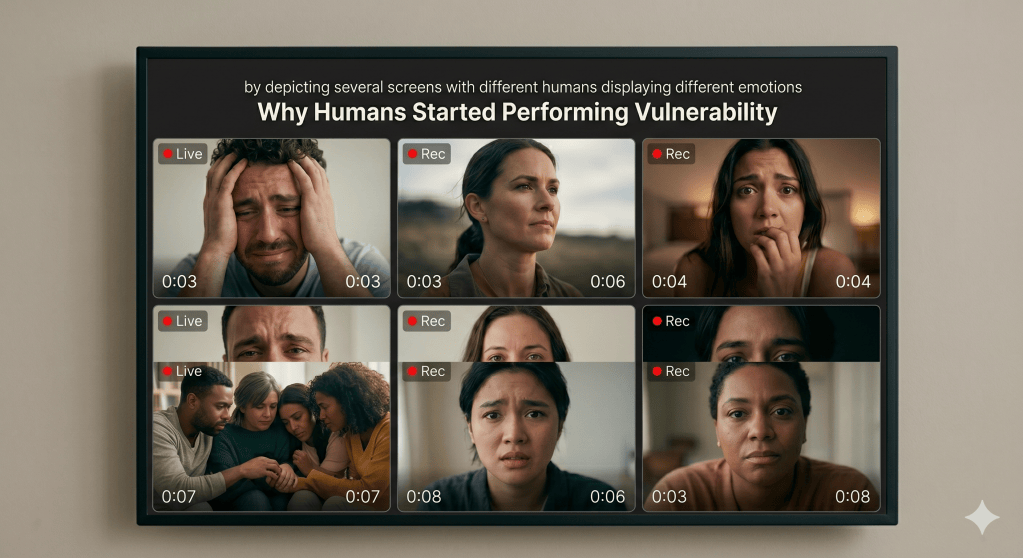
Why did vulnerability become a social performance? Explore the psychology, neuroscience, and cultural forces behind humanity’s shift toward public emotional openness.
There was a moment, somewhere around 2010, when the word vulnerability stopped being a private experience and became a public value. It crept into TED Talks, therapy-speak, corporate leadership retreats, and Instagram captions. People began announcing their struggles not just to close friends but to followers. Emotional openness — once considered a liability — started being rebranded as strength. And almost nobody stopped to ask: is this genuine, or is this a performance?
That question is worth taking seriously, not because the answer is damning, but because it reveals something genuinely interesting about how human beings navigate identity, belonging, and trust in a world that changed faster than our psychology could adapt. The story of why humans started performing vulnerability is not really a story about inauthenticity. It’s a story about culture, neuroscience, social pressure, and the complicated ways we signal who we are to people we’ve never met.
The Psychological Roots of Vulnerability
Before trying to understand the performance, it helps to understand what vulnerability actually is — not as a buzzword, but as a psychological and biological phenomenon.
At its core, vulnerability is the experience of being exposed to possible harm. That harm can be emotional: rejection, ridicule, or abandonment. It can be social: loss of status or belonging. Psychologically, vulnerability arises in the gap between what we want to conceal and what we are forced — or choose — to reveal.
Brené Brown’s 2010 TED Talk on shame and vulnerability — eventually one of the most-watched in the platform’s history — was less a cause of this shift than a symptom of it. The talk resonated so widely because it articulated something people were already beginning to feel: that emotional concealment was expensive, and that the cultural pressure to appear invulnerable was costing people something real. Brown was a useful marker of the moment, not its architect.
The underlying psychology she was drawing on had deeper roots. Research in attachment theory, which traces back to the developmental psychologist John Bowlby in the mid-20th century, has long established that human beings are wired for connection. Infants who are not securely attached to caregivers develop strategies for managing that uncertainty — some become anxious and hypervigilant, others shut down and withdraw. These early patterns tend to persist into adulthood, shaping how people relate to intimacy, trust, and self-disclosure. The capacity for vulnerability — and the fear of it — is not a personality quirk. It’s embedded in how the human nervous system learns to navigate other people.
What the Brain Does With Emotional Risk
When a person chooses to reveal something personal, the brain is doing a rapid cost-benefit calculation. The anterior cingulate cortex and the amygdala — regions associated with social pain and threat detection — are active during moments of anticipated rejection. Social exclusion, neuroscientists have found, activates some of the same neural pathways as physical pain. This is not metaphor. It’s physiology.
At the same time, disclosure — genuine self-revelation to someone who responds with empathy — triggers the release of oxytocin, a neuropeptide associated with social bonding, trust, and attachment. The human brain, in a sense, rewards vulnerability when it goes well, and punishes it when it doesn’t. This creates a tension that every person navigates constantly, often without being aware of it: how much to reveal, to whom, and when.
For most of human history, this calculation was made in relatively small, stable social groups. People shared vulnerability with those they had known for years, whose trustworthiness had been tested through accumulated experience. The risks were real but bounded.
Then the digital world arrived, and the context changed entirely.
Why Vulnerability Creates Trust
Before asking why vulnerability became a performance, it’s worth asking something more fundamental: why does vulnerability work as a social signal at all? Why does revealing weakness so often generate trust rather than contempt?
The answer has less to do with sentiment than with logic. In evolutionary psychology and signaling theory, a disclosure that costs the discloser something is harder to fake than one that costs nothing. This is sometimes called a “costly signal” — an act that functions as credible evidence of an underlying quality precisely because it carries real risk. A peacock’s tail is the standard biological example: it is so metabolically expensive and so dangerous to carry around that only a genuinely healthy bird can afford one. The cost is what makes it credible.
Vulnerability operates on a similar principle in social life. In many social contexts, a person who openly admits to failure, fear, or uncertainty is still voluntarily surrendering a degree of status. They are making themselves easier to dismiss, easier to underestimate. That sacrifice is what makes the disclosure legible as sincere. If you were primarily interested in projecting strength, you would not be telling this particular story.
This helps explain a pattern that shows up across cultures and contexts: disclosing weakness is often a more effective trust-building strategy than displaying competence. Research in social psychology has found that people who admit to mistakes or limitations are frequently rated as more trustworthy and more likeable than those who project consistent capability — provided the admission is genuine and contextually appropriate. The vulnerability functions as evidence that the person is not managing your perception of them, which paradoxically makes them more persuasive.
It also signals something about group membership. In small social groups, sharing a secret or admitting a fear implicitly communicates: I trust you enough to give you this. The disclosure creates an asymmetry that binds people together. Anthropologists have noted that rituals of mutual vulnerability — confessions, initiations, shared ordeals — appear across human societies as mechanisms for establishing loyalty and cohesion. Vulnerability has always been social technology.
None of this means vulnerability is primarily strategic. Most of the time, people disclose because they are in genuine need of connection or support, and the trust-signaling function operates in the background. But from the audience’s side, there is also something important happening: vulnerability reduces uncertainty. It reveals information that polished self-presentation is specifically designed to conceal — about motives, character, and the gap between how someone appears and who they actually are. That is why observers so often respond to genuine disclosure with not just sympathy, but relief. The person in front of them has suddenly become easier to understand. But understanding that the signal works — and why it works — is important context for what happened when social media arrived and the incentive structure for signaling changed at scale.
The Social Media Inflection Point
The shift toward performing vulnerability didn’t emerge in a vacuum. It emerged from a specific historical moment — the decade between roughly 2007 and 2017 — in which the infrastructure of social life was radically reorganized.
For the first time in history, billions of people carried a broadcast network in their pocket. Facebook’s News Feed algorithm rewarded emotional content. Twitter collapsed the distance between public figures and ordinary people. YouTube made confessional video a mainstream genre. And then Instagram made even the most mundane personal moment into a broadcast.
These platforms didn’t just change what people communicated. They changed the social incentive structure for self-disclosure.
In a face-to-face conversation, vulnerability is a gift exchanged between specific people. It’s contextual and intimate. On social media, self-disclosure happens in front of an audience whose size, composition, and reaction you cannot fully predict. The social psychologist Erving Goffman wrote in the 1950s about the way people manage “impression management” — the ongoing work of presenting ourselves strategically in social situations. He described social life as a kind of theater, with front-stage performances for public consumption and backstage authenticity reserved for trusted insiders.
Social media didn’t create impression management. But it dramatically expanded the stage and blurred the line between front and back.
When vulnerability is performed in front of an audience, something subtle changes. The emotional disclosure is still real — the feeling underneath it may be entirely genuine — but the act of sharing it publicly introduces an additional layer of calculation. How will this land? What response am I hoping for? What does revealing this say about who I am?
This is not cynicism. It’s social cognition. Human beings are social animals, and awareness of how we appear to others is a fundamental feature of our psychology, not a bug. But the scale and speed of digital social life created conditions that hadn’t existed before, and people were developing new social norms in real time.
The Validation Economy
One of the most significant structural features of social media was the introduction of visible, quantifiable social feedback. Likes, shares, comments, followers — these were not just metrics. They were, for many users, proxies for social approval. And the brain treats approval as a reward.
Research in behavioral neuroscience has shown that variable, unpredictable rewards — the kind produced by social media notifications — are particularly effective at driving compulsive behavior. The same dopaminergic pathways activated by gambling or unexpected treats are engaged when a person posts something and waits to see how people respond. The result, for many users, was an environment where emotional disclosure was actively reinforced.
Posts about pain, loss, struggle, and growth reliably generated more engagement than posts about ordinary contentment. “I’m having a great week” is not a compelling narrative. “Here’s the dark thing I’ve been carrying, and here’s what I’ve learned from it” is a story with emotional stakes, a narrative arc, and an implicit invitation for the audience to respond with recognition and affirmation.
This created a feedback loop. Vulnerable content got rewarded. People learned — consciously or not — that emotional disclosure was socially productive. And gradually, the performance of vulnerability became a recognizable genre with its own conventions, phrases, and aesthetic signals.
What made this especially significant was that vulnerability turned out to be one of the safest forms of self-promotion available. Traditional status displays carry social risk. Wealth generates envy. Visible success invites comparison and resentment. Beauty creates insecurity in observers. But vulnerability — framed correctly — tends to generate approval. It signals humility rather than superiority. It positions the discloser not as someone who has more than you, but as someone who has struggled just as you have. In a media environment where conventional status displays were becoming tiresome and transparent, public vulnerability offered a route to visibility that felt — and often genuinely was — disarming rather than alienating. That’s historically unusual, and it goes a long way toward explaining why the genre spread so quickly.
The Authenticity Paradox
Here is where the story gets genuinely complicated, and where most popular analyses of “performative vulnerability” go wrong.
The easy critique is that public self-disclosure is fake — that someone sharing their mental health struggles or family trauma on social media is manipulating their audience for engagement, and that the whole enterprise is therefore hollow. But this critique mistakes complexity for dishonesty.
Most people performing vulnerability are not being dishonest. The feelings are real. The experiences are real. What is performed — carefully shaped and edited and timed — is the presentation of those feelings. And that performance is not unique to social media. It is what human beings have always done.
Think about what happens when someone tells a story at a dinner party about a difficult experience they went through. They choose which details to emphasize. They time the pauses. They watch their audience for cues about how the story is landing. They are performing — not in the sense of deceiving, but in the sense of actively shaping a communication event for an audience.
The philosopher Charles Taylor wrote about what he called the “ethics of authenticity” — the modern Western ideal that genuine selfhood requires expressing what is uniquely true about who you are. This idea, which has deep roots in Romantic philosophy, positions authenticity as a moral value. Being fake is not just socially awkward; it feels wrong, like a betrayal of the self.
But authenticity and performance are not opposites. The performance of vulnerability can be authentic in the sense that it reflects genuine emotion while still being strategically shaped for an audience. The question is not whether the performance is real but what function it serves.
When the Performance Stops Serving Connection
Most performed vulnerability is harmless — and, as we’ll see, often genuinely useful. But there is a point where the performance stops serving connection and starts serving something else: emotional regulation, the management of anxiety, the accumulation of reassurance. At that point, what looks like openness starts functioning more like defense.
Someone who shares endlessly about their pain but cannot tolerate being truly seen — who uses disclosure as a broadcast rather than an exchange — is engaged in something that looks like vulnerability but forecloses the very reciprocity that makes vulnerability valuable. They are, in effect, controlling the interaction by controlling the emotional stakes.
Research on what psychologists call “oversharing” bears this out. Disclosure that is more intimate than the relationship warrants, or that treats the audience as a container for unprocessed emotion rather than a genuine conversational partner, tends to produce the opposite of its intended effect. Rather than creating connection, it creates discomfort, distance, or the quiet sense that the discloser is performing for an audience rather than actually talking to you.
This is the meaningful line — not between authentic and inauthentic, but between disclosure that invites the other person in and disclosure that keeps them at arm’s length while appearing not to.
Cultural Forces That Made Vulnerability Desirable
The performance of vulnerability didn’t emerge solely from technology. It was shaped by broader cultural shifts that made emotional openness not just acceptable but aspirational.
The Therapeutic Turn and the Prestige of Self-Knowledge
Beginning in the latter half of the 20th century, psychological language started migrating out of clinical settings and into ordinary life. By the 1990s and 2000s, concepts like trauma, healing, emotional intelligence, and the inner child had become part of everyday conversation. This wasn’t just a broadening of vocabulary. It was a reorganization of what counted as sophistication.
Psychological literacy — the ability to name what you were feeling, to trace it to its origins, to speak about inner experience with precision and self-awareness — became a form of cultural capital. It signaled that you were a particular kind of person: reflective, emotionally developed, not asleep to your own interior life. In social contexts where that signal mattered, admitting to struggle became a way of displaying depth. Saying “I’ve been working through some anxiety about this” communicated not just emotional honesty but a whole orientation toward the self — one that was, in the circles where this language was spoken, quietly prestigious.
This is distinct from simply noting that stigma decreased (though it did). The point is that psychological self-disclosure was elevated into a marker of a certain kind of intelligent, self-aware personhood. Vulnerability, in this context, became social currency — and like all currencies, it could serve both authentic and strategic purposes.
What made this shift more than just a loosening of norms was that it involved a moral inversion. For most of modern history, emotional restraint was treated as a mark of maturity. The composed adult was expected to regulate feeling rather than display it — to manage difficulty privately and present a steady face to the world. Stoicism, in the popular sense, was not merely a coping style. It was a signal of character. By the early 21st century, that equation had partially reversed. In many professional and cultural environments, emotional openness began to signal psychological health, while excessive restraint came to be reinterpreted as repression, avoidance, or a failure of self-awareness. Vulnerability didn’t simply become acceptable. It became evidence of inner work done — and its absence became quietly suspicious.
The Authenticity Market
At the same time, a reaction against the perceived superficiality of consumer culture was building. The early 21st century saw a growing cultural premium on “authenticity” — raw, unfiltered, real. Craft beer over corporate lager. Farmers markets over supermarkets. Unpolished Instagram posts over airbrushed advertising.
In personal presentation, this translated into a valorization of imperfection. The carefully curated image — the one that showed only the highlights, the success, the beach vacation — came to feel dishonest, even oppressive. What felt more real, and therefore more trustworthy, was the admission of struggle. The “real talk” post. The “what nobody tells you about” article. The “here’s what I’m actually going through” caption beneath the ordinary photo.
Whether or not any individual instance of this genre was genuinely authentic, the genre itself became a recognized mode of personal branding. And once vulnerability has a recognized format and a predictable reward, it becomes, at least partly, a performance.
Why the Performance Can Still Be Valuable
It would be easy, at this point, to land on a cynical conclusion: that performed vulnerability is inauthentic, manipulative, or meaningless. But that conclusion misses something important.
Social performances often serve real functions, even when — especially when — they are shaped by cultural norms and social incentives.
The performance of vulnerability in public life has, despite its complications, helped normalize conversations about mental health that were previously stigmatized. It has created spaces where people who felt isolated in their suffering discovered that others shared their experience. It has pushed back against the ideal of invulnerable self-sufficiency that did — and still does — cause real harm, particularly for men socialized to suppress emotional expression.
There is research to support this. Studies in social psychology have found that witnessing others engage in self-disclosure can lower the threshold for disclosure in observers — a phenomenon sometimes called the “disclosure reciprocity effect.” When public figures or peers share their struggles openly, it creates permission for others to do the same. The performance, even when it is partly strategic, can produce genuine social effects.
There is also something to be said for the way that putting an experience into words — even for an audience, even in a shaped and edited form — can be part of how people make meaning of difficult experiences. Narrative psychology, a field that examines how people construct stories about their lives, has found that the act of constructing a coherent narrative around painful events is often part of the process of integrating and recovering from them. The performative disclosure and the psychological work are not always separate.
The Longer View
By the time this essay was first drafted in 2017, performed vulnerability had become a recognizable cultural phenomenon. The decade since has complicated the picture in ways that are still being worked out.
The backlash against social media performance culture intensified through the late 2010s and into the 2020s. Terms like “trauma dumping,” “vulnerability fatigue,” and “performative activism” entered the cultural vocabulary — signals that audiences had become more sophisticated and more skeptical about public emotional disclosure. The genre of the raw, authentic confession began to be gamed so predictably that it generated its own parody. The aesthetic of “unfiltered” became a carefully constructed aesthetic.
At the same time, research continued to accumulate showing that genuine vulnerability — in close relationships, in therapeutic settings, in communities of mutual accountability — remained one of the most reliable pathways to psychological health and relational depth. The problem was never with vulnerability itself. It was with what happened when vulnerability was scaled to audience sizes and social incentive structures that the human nervous system was not built to navigate.
The distinction that matters — the one that social psychology, neuroscience, and lived experience all point toward — is not between authentic and performed vulnerability, but between disclosure that invites genuine engagement and disclosure that substitutes for it. The first is risky, specific, and oriented toward the other person. The second is managed, general, and primarily oriented toward its own reception.
Human beings have always performed. They have always shaped their self-presentations for social effect. What changed in the early 21st century was the scale of the stage, the speed of the feedback, and the degree to which emotional disclosure became enmeshed with systems of quantified social reward.
Understanding that process is not an argument against openness. It is an argument for being thoughtful about why we open up, to whom, and what we are actually hoping will happen when we do. The vulnerability that connects is not the vulnerability that performs — although sometimes, in the best cases, it is both.









