
Originally published in March 2017 and comprehensively updated/edited in June 2026.
How did the internet become emotional theater? Explore the psychology, algorithms, and cultural forces that turned online life into a stage for performed feeling.
Something changed about the internet somewhere around 2012, and it wasn’t the technology. The infrastructure had been building for years — broadband penetration, smartphone adoption, the social graph. But by the early 2010s, something subtler had shifted in how people were using it. The internet had become a place where emotions were not just expressed but performed. Where grief, outrage, joy, and fear were staged for audiences that could number in the thousands, and where the quality of the performance was measured in real time by likes, shares, and comments.
This wasn’t purely cynical. The feelings were often genuine. The performances often served real social functions. But something about the architecture of the platforms — the visibility, the metrics, the algorithmic amplification of feeling — had created a new kind of public emotional life that didn’t map neatly onto anything that had come before. People were doing something that looked like sharing and something that looked like performing, and often it was both simultaneously.
When this essay uses the word “internet,” it mostly means the social platforms that came to dominate online life during the 2010s — Facebook, Twitter, YouTube, Instagram, and their successors. That’s where the emotional theater was staged. Understanding it means asking not just what people feel, but how those feelings get shaped, displayed, and rewarded in digital public life — and what that process does to the feelings themselves.
The Stage Before the Stage
To understand what the internet became, it helps to understand what emotional public life looked like before it.
For most of human history, emotional expression was contextual and contained. You grieved with family. You celebrated with neighbors. You expressed outrage in a town square or a church or a union hall, in front of people who knew you and whom you would face again tomorrow. The social contexts that governed emotional expression were stable and legible. Everyone in the room understood the norms, the stakes, and the relationship between performer and audience.
The 20th century began expanding that context. Radio, and then television, introduced the possibility of emotional performance at a distance — a broadcaster speaking into a microphone to an audience of strangers who could not respond. But the transmission was one-directional. The audience received; it did not participate. A televised funeral or a political speech or a celebrity breakdown was something you watched. It was not something you joined.
The internet changed the fundamental structure of that relationship. For the first time, audiences could respond — publicly, immediately, and at scale. A person expressing grief or outrage or joy online was not broadcasting into a void. They were opening a stage, and the audience could step onto it.
That shift created something genuinely new: a form of emotional expression that is simultaneously private and public, spontaneous and calculated, sincere and performative. The sociologist Erving Goffman spent much of his career in the 1950s and 60s describing social life as a form of theater, with front-stage performances for public consumption and backstage authenticity reserved for trusted insiders. What the internet did was collapse that distinction in ways Goffman could not have anticipated. The backstage became a set. The audience became participants. And the performance became permanent — searchable, shareable, and archived.
What Algorithms Did to Feeling
The emotional character of the internet was not entirely accidental. It emerged from systems designed to maximize engagement, which consistently meant amplifying emotionally activating content.
The major social platforms of the 2010s were built around an engagement model: the more time users spent on the platform, the more advertising inventory could be sold. Engagement, in this context, meant clicks, scrolls, shares, comments, and time on site. And the content that reliably drove engagement was emotional content — not calm, informational content, but content that produced a reaction strong enough to interrupt whatever else a person was doing and compel a response.
Research published from Facebook’s own data science team in 2014 — in a study that generated significant controversy because it involved manipulating users’ feeds without their knowledge — found that emotional content was contagious in measurable ways. When people were exposed to more positive posts, they posted more positively. When exposed to more negative content, they posted more negatively. The emotional environment of the platform was not a neutral reflection of what users felt. It was an active influence on what users felt and expressed.
This was not entirely surprising to researchers who had been studying emotional contagion — the tendency for emotions to spread from person to person through behavioral and expressive cues. Studies going back decades had shown that people unconsciously mimic the facial expressions, postures, and vocal tones of those around them, and that this mimicry feeds back into their own emotional experience. What the Facebook study suggested was that this process worked even in the absence of face-to-face interaction, even through text, and even when the contagion was deliberately engineered.
The algorithms amplified this effect. Content that generated strong emotional responses — particularly anger, but also awe, amusement, and anxiety — tended to receive more engagement, which caused the algorithm to show it to more people, which generated more engagement. The result was a feedback loop that systematically favored emotional intensity over emotional accuracy — one that platforms had strong economic incentives to maintain and little incentive to correct.
The Asymmetry of Negative Emotion
Not all emotions were amplified equally. The research on social media engagement consistently found that negative emotions — particularly outrage — spread faster and further than positive ones.
This reflects something deep in human psychology. Negativity bias, a well-documented tendency in cognitive science, describes the fact that negative information commands more attention, is processed more thoroughly, and is remembered longer than positive information of equivalent intensity. This asymmetry evolved for obvious reasons: in an uncertain environment, threats require faster and more sustained attention than opportunities. The cost of missing a threat is typically higher than the cost of missing an opportunity.
Social media platforms didn’t create negativity bias. But they created an environment where that bias could be exploited at scale, and where the content most likely to spread was content most likely to trigger the alarm centers of the human brain. Political content, moral outrage, stories of injustice or threat — these circulated because they activated something ancient in the human nervous system, not because they were most informative or most true.
By the mid-2010s, the platforms increasingly rewarded and normalized the expression of strong feeling — and where that reward was no longer just social but numerical.
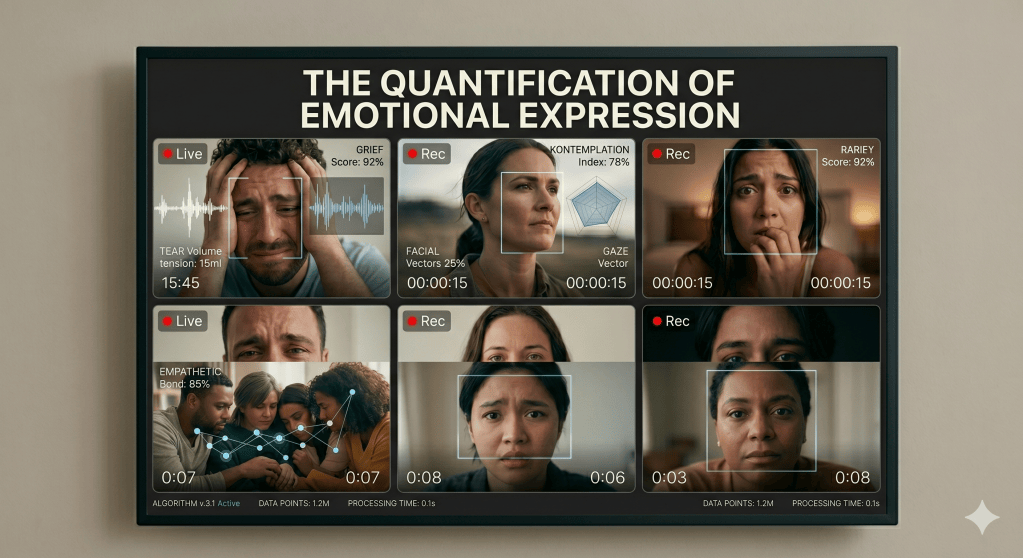
This is worth pausing on, because it represents something genuinely new in the history of emotional public life. A stage actor knows whether applause happened. A person posting on social media knows exactly how much applause happened, how it compares to yesterday, and how it compares to everyone else performing on the same stage. Likes, shares, comments, and follower counts transformed social approval from something felt into something measured. The qualitative experience of being responded to — which had always carried emotional meaning — acquired a quantitative layer that it never had before. You could rank your grief. You could track your outrage’s reach. You could watch, in real time, whether your expression of solidarity was landing. That visibility changed not just how people performed emotion but how they evaluated their own emotional life — attaching numbers to experiences that had previously resisted measurement.
Performance, Sincerity, and the Problem of Both at Once
The language of “performance” when applied to online emotional expression tends to imply inauthenticity — that the person expressing grief or outrage or solidarity is somehow faking it. This is usually wrong, and it misses the more interesting question.
Most people who express strong emotion online are not lying about what they feel. The grief is real. The outrage is real. What is performed — shaped, timed, edited, calibrated for an audience — is the presentation of that emotion. And that distinction matters, because it is the same thing that human beings have always done in social situations. Emotional expression has always been a communication act, which means it has always been, to some degree, shaped for an audience.
What the internet changed was the scale, the permanence, the visibility of audience reaction, and the feedback mechanism. A person expressing grief at a funeral shapes that expression for the people in the room — people they know, in a context governed by shared norms. A person posting about a loss on social media shapes that expression for an audience of hundreds or thousands, including acquaintances, near-strangers, and people whose relationship to them exists primarily online. The context is radically different, and the shaping that the expression undergoes is correspondingly different.
The psychologist James Pennebaker spent decades studying the relationship between emotional expression and wellbeing, finding that putting difficult experiences into words — even in private — tends to have measurable psychological benefits. Writing about painful events helps people make sense of them, integrate them, and move forward. The act of narrating an experience is part of how humans process it.
What happens when that narration is public? The research is more complicated. Some studies suggest that public expression of negative emotion can reinforce rather than resolve it — that performing grief or outrage for an audience can keep a person in an activated emotional state rather than helping them move through it. Other research suggests that the social support received in response to public disclosure can be genuinely beneficial. The picture is not clean, and the outcome likely depends heavily on what kind of expression is happening and what kind of response it receives.
The Audience Effect
One thing the research does consistently show is that the presence of an audience changes emotional expression in ways that extend beyond the immediate social moment.
Studies in social psychology have found that people who know they are being observed tend to display emotions more intensely than they would in private, and that this intensification can feed back into the subjective experience of the emotion itself. The performance and the feeling are not separate things happening in parallel. They interact. Expressing an emotion more dramatically, for an audience, can amplify the felt intensity of that emotion.
On social media, this dynamic operates continuously. Every post is created with the awareness — implicit or explicit — that it will be seen and evaluated. That awareness shapes not just what is posted but what is felt before, during, and after the posting. The audience is present even when no one has responded yet, because the anticipation of response is itself a psychological event.
The Moral Dimension: Outrage as Participation
Of all the emotions that found expression on the internet, outrage has been the most structurally significant. It spread fastest, it generated the most engagement, and it did the most to shape the emotional character of digital public life.
Part of this is the negativity bias described earlier. But outrage also serves a specific social function that goes beyond individual emotional expression. Moral outrage — anger directed at perceived injustice or norm violation — is, in evolutionary terms, a group-coordination mechanism. It signals to other group members that a norm has been violated, calls for collective response, and identifies the person expressing outrage as someone who takes the group’s values seriously.
In small social groups, this function is relatively contained. Outrage is expressed, others respond, the norm is enforced or negotiated, and social life continues. On the internet, the mechanism is amplified to a scale where the coordination function can overwhelm everything else.
Researchers at Yale and elsewhere have found that moral outrage expressed online tends to become more extreme over time, partly because the audience rewards increasingly intense expressions of disapproval. A person who expresses mild concern receives less engagement than someone who expresses strong condemnation. Someone who condemns receives less than someone who calls for consequences. The incentive structure systematically pushes expression toward the extreme end of the emotional register.
This has a name in the research literature — audience-driven extremism — and it operates even when no individual actor is being deliberately provocative. The structure of the platform produces the escalation, not the bad faith of the participants.
When the Performance Becomes the Point
There is a further complication. When outrage becomes a recognizable genre with its own conventions, rewards, and aesthetic signals, participation in that genre can become decoupled from the underlying emotion it is supposed to express.
Research on what some social psychologists call “virtue signaling” — though the term has become politically loaded — explores the degree to which moral expression online functions primarily as a form of identity display rather than a sincere communication of felt moral concern. The argument is not that the concern is always fake, but that the expression of moral concern has become sufficiently socially rewarding that it can be produced and circulated even when the underlying feeling is weak or absent.
This is structurally similar to what happened with vulnerability, which was explored in an earlier essay in this series. Once a mode of emotional expression becomes recognizably prestigious — once it reliably generates approval, status, and social belonging — it becomes available as a performance independent of the emotional state it is meant to represent. The emotion becomes a genre.
None of this means every expression of outrage is performative in a dishonest sense. Most is not. But the presence of the genre — the recognizable format, the expected phrases, the predictable rewards — creates a context in which performance and sincerity become genuinely difficult to distinguish, and in which the performer may not always know which one they are doing.
The same process applied to emotions that were not angry at all. Grief, recovery, joy, and solidarity each developed their own recognizable online formats. The cancer survivor’s update. The sobriety anniversary post. The coming-out announcement. The communal mourning thread. These were not cynical productions — the experiences behind them were real and the communities that formed around them were often genuinely supportive. But they were also genres, with established conventions, expected narrative arcs, and predictable audience responses. What made outrage distinctive was its velocity and its capacity for harm. What made it representative was something it shared with all these other forms: the logic of the platform had turned emotional expression into a medium with its own aesthetic standards, its own successful formats, and its own metrics for measuring whether a feeling had landed.
What It Did to Emotional Life Off the Screen
The internet as emotional theater had consequences that extended beyond the platforms themselves.
One of the more consistent findings in research on social media use from the mid-2010s onward was that heavy use was associated with emotional dysregulation — difficulty managing and modulating emotional responses in daily life. The relationship was correlational rather than clearly causal, and the picture was complicated by the fact that people already prone to emotional dysregulation tended to use social media more intensively. But the bidirectional relationship between social media exposure and emotional instability was documented across enough studies to be taken seriously.
Part of the mechanism may involve what psychologists call emotional habituation — the gradual diminishment of response to stimuli that are repeatedly encountered. In an environment of constant emotional intensity, the threshold for feeling something rises. What would have been shocking or moving in a lower-intensity media environment becomes ordinary. This may explain a phenomenon that many people reported subjectively during this period: the sense of emotional exhaustion that came not from any single upsetting event, but from continuous exposure to a stream of high-affect content.
Another mechanism involves the disruption of the normal cycle of emotional arousal and resolution. In face-to-face social life, emotional events have a natural arc: something happens, you feel it, you express it, others respond, and the event concludes. On social media, events can recirculate indefinitely. A story that made you angry resurfaces a week later with new commentary. An argument you thought was over comes back with new participants. The emotional event never fully resolves because the platform has no mechanism for closure.
The Collapse of Emotional Context
Perhaps most significantly, the internet as emotional theater eroded the contextual norms that had historically governed emotional expression.
Different social contexts have always had different emotional rules. What is appropriate to express at a funeral differs from what is appropriate at a job interview. What you show to close friends differs from what you show to acquaintances. These distinctions are not arbitrary. They reflect the fact that emotional expression serves different functions in different relationships and that calibrating expression to context is a form of social intelligence.
Social media — and the internet more broadly — collapsed many of these contexts into a single stream. A post addressed to close friends was visible to colleagues. A comment made in the heat of a political moment was archived and searchable years later. The emotional norms appropriate to one context were applied — or violated — in contexts they were never designed for.
The sociologist danah boyd described this as “context collapse” — the condition in which a communication intended for one audience is received by many audiences simultaneously, each with different expectations and interpretive frameworks. In an environment of context collapse, people face an impossible calibration problem: they must somehow express themselves in a way that is appropriate for every audience at once, or accept that some audiences will misread or misuse what they say.
The response to this, for many users, was either self-censorship — retreating from public expression to avoid the risk of misinterpretation — or a kind of emotional flattening, in which expression was calibrated not to any specific audience but to an imagined aggregate of all possible audiences. Neither produced rich or nuanced emotional communication.
The Functions the Theater Served
It would be easy, given all of this, to conclude that the internet as emotional theater was simply harmful — a machine for manufacturing agitation, rewarding performance over sincerity, and degrading the quality of human emotional life.
That conclusion would be incomplete.
The same platforms that amplified outrage also allowed people to find others who shared experiences they had thought were uniquely their own. The same feedback loops that rewarded emotional intensity also rewarded the kind of honest personal disclosure that, for many people, had previously had nowhere to go. The same environment that produced context collapse also allowed people in isolated circumstances — geographically remote, socially marginal, in communities where their experiences could not be named — to connect with others who understood them.
Research on the role of online communities in supporting people with stigmatized identities, rare health conditions, grief experiences, and minority perspectives consistently finds genuine benefit. The emotional theater, for these users, was not a distortion of their emotional life but an extension of it — a space where feelings that had been invisible became visible and where expression that had no audience suddenly had one.
This doesn’t resolve the tension. The same structural features that made the internet valuable for isolated people — the reach, the scale, the algorithmic amplification of emotional content — were the features that made it toxic in other contexts. The theater served both functions simultaneously, and the net effect differed depending on how, where, and by whom it was used.
A Decade Later
By the time this essay was first drafted in 2017, the emotional character of the internet was already being widely described as a crisis. The decade since has not resolved that description so much as complicated it.
The platforms that defined the emotional theater of the 2010s have aged. Facebook’s grip on social attention loosened. Twitter became X and changed in ways that many of its users experienced as a degradation. New platforms emerged — TikTok, in particular — that introduced video as the primary emotional medium, raising new questions about the relationship between performed emotion and the camera, between face and feeling.
Research on the psychological effects of social media use became more sophisticated, and the picture that emerged was less uniformly dire than early commentators had suggested. The effects were real but heterogeneous: heavily negative for some populations — particularly adolescent girls, according to a body of work that remains contested in its methodology but consistent in its direction — and more neutral or even positive for others. The theater, it turned out, affected different audience members very differently.
What did not change was the underlying dynamic: platforms built around engagement continue to be platforms built around emotion, because emotion is what drives engagement. The specific emotions may shift — the outrage cycle of the mid-2010s gave way to anxiety, irony, and a more diffuse sense of ambient unease — but the structural relationship between the platform’s economic incentives and the user’s emotional life remains intact.
Understanding the internet as emotional theater is not a diagnosis of a problem to be solved. It is a description of an environment to be navigated. Human beings have always performed emotion in public spaces. They have always calibrated expression to audience. They have always used emotional displays to build trust, signal belonging, and coordinate with others. What the internet did was scale those ancient behaviors into a new kind of public arena — one with different rules, different rewards, and consequences that are still being worked out.
The most distinctive feature of that arena may not be that people perform for audiences. They always have. It may be that for the first time in history, the audience’s reaction arrives instantly, is numerically quantified, and stays visible indefinitely. Previous generations of performers knew, in a general way, whether they had connected. This generation can see the count. That difference — between feeling that you resonated and knowing precisely how much — may be the deepest structural change the internet introduced to emotional life. The theater is not going anywhere. But the scoreboard is new.









