
Originally published in April 2017 and comprehensively updated/edited in June 2026.
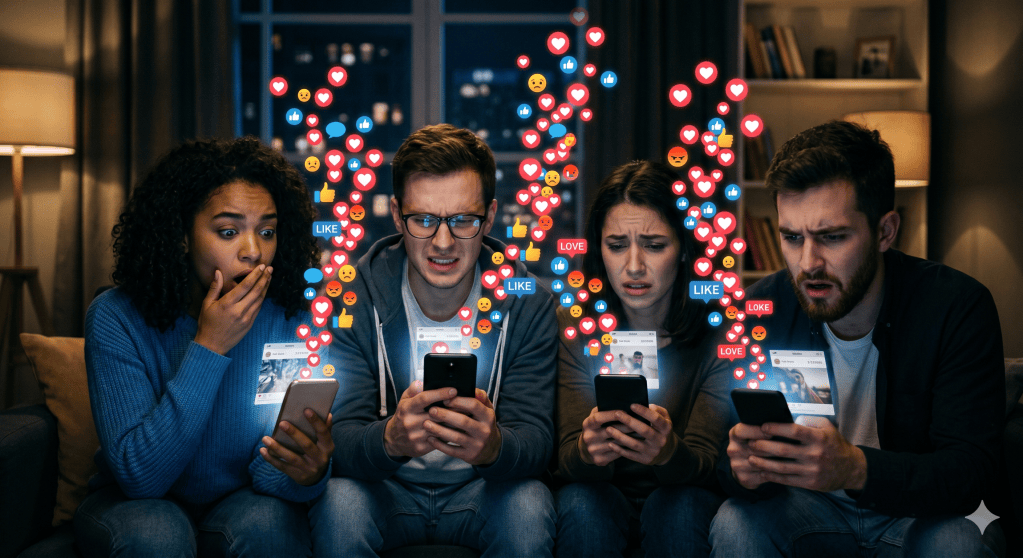
How social media turned emotional reactivity into a measurable, optimizable variable — and what the large-scale cultivation of reactive states cost human judgment and public life.
There is a specific kind of feeling that social media in the mid-2010s reliably produced — a low-grade agitation that was hard to name and harder to put down. You opened an app to check on something trivial and emerged twenty minutes later tense, vaguely angry, and unsure why. The content hadn’t necessarily been about anything that directly affected you. But it had been affecting all the same. Something in the feed had gotten under your skin in ways that an equivalent twenty minutes of television or newspaper reading typically didn’t.
This wasn’t a coincidence. It was, in a meaningful sense, the product.
The platforms that dominated this period — Facebook, Twitter, YouTube, and their successors — were not designed to make people feel bad. They were designed to keep people engaged. But engagement and emotional agitation turned out to be closely linked, and the systems built to maximize one reliably produced the other. The result was a new kind of media environment: one that could, for the first time in the history of mass communication, measure a person’s emotional response to content in real time, and use that measurement to decide what to show them next.
This essay is about how that worked. It draws on psychology, neuroscience, and behavioral research to explain why certain kinds of content spread while others don’t, what emotional reactivity does to human judgment and behavior, and what the large-scale cultivation of reactive states across millions of people simultaneously actually costs. The story involves engineering decisions and business models, but at its core it’s a story about the human nervous system — and what happens when an entire media ecosystem learns to play it like an instrument.
What Emotional Reactivity Actually Is
The term “emotional reactivity” gets used loosely, so it’s worth being precise about what it means and what it doesn’t.
In psychology, emotional reactivity refers to the intensity and speed with which a person responds emotionally to a stimulus — how quickly and powerfully feelings are triggered, and how long they persist. Everyone has a baseline level of emotional reactivity; it varies by individual, by circumstance, and by the type of stimulus involved. A loud noise produces a startle response in almost everyone. A piece of unwelcome news affects some people briefly and others for days. These differences reflect genuine variation in how nervous systems are tuned.
What researchers in this field consistently find is that emotional reactivity is not a fixed trait but a state that can be modulated by environment, context, and, crucially, by repeated exposure. A person who spends extended time in a high-stimulation, emotionally charged environment tends to become more reactive over time — more easily triggered, more prone to strong emotional responses, more likely to interpret ambiguous situations as threatening. This is at least partly neurological. The brain’s threat-detection systems, centered on the amygdala, appear to become more readily activated with frequent use — though the precise mechanisms remain an active area of research. The behavioral pattern, however, is well documented: sustained exposure to emotionally activating environments tends to lower the threshold for emotional responses, like a smoke alarm that keeps going off until it starts triggering on things that don’t warrant it.
This matters for understanding social media because the platforms of the 2010s were, in effect, high-stimulation environments engineered for frequent emotional activation. Not because their designers were trying to sensitize the population to threats, but because emotionally activating content was what kept people on the platforms — and keeping people on the platforms was the business.
The Neuroscience of Contagious Emotion
Before examining how platforms exploited emotional reactivity, it’s useful to understand why emotions spread in the first place. The answer involves mechanisms that are far older than the internet.
Human beings are what researchers sometimes call “ultra-social” animals. Unlike most species, we live in large groups of non-kin, cooperate on complex tasks with strangers, and organize much of our behavior around the emotional states of those around us. The capacity to rapidly detect and respond to others’ emotional signals — to catch fear from a frightened face, to feel unease when the crowd around you grows tense — was probably adaptive for most of human evolutionary history. It’s faster than reasoning. It doesn’t require explanation or deliberation. It runs below the level of conscious thought.
The neuroscientist Elaine Hatfield and her colleagues formalized this under the concept of emotional contagion: the tendency for people to automatically and continuously mimic and synchronize their emotional states with those of others. This happens through facial expression, tone of voice, body posture, and, it turns out, through text and images on a screen. The mechanism isn’t fully understood, but it appears to involve the same neural systems that support empathy and social cognition more broadly, including what are sometimes called mirror neuron circuits — systems that activate both when we perform an action or feel an emotion and when we observe someone else doing so.
Emotional contagion at the individual level is well established. What the social media era made possible was emotional contagion at scale. A single emotionally charged post could trigger sympathetic responses in hundreds of thousands of people within hours. The feeling didn’t have to be manufactured — one genuine expression of outrage, fear, or grief could propagate across a network and induce something resembling the original emotional state in people who had no direct connection to whatever prompted it.
A striking demonstration of this came in a 2014 experiment conducted by Facebook’s data science team. Researchers manipulated the News Feed of roughly 700,000 users to show either more positive or more negative emotional content, without the users’ knowledge. They then measured the emotional valence of what those users subsequently posted. The results showed that people exposed to more negative content posted more negatively, and those exposed to more positive content posted more positively. The experiment generated significant ethical controversy, but its central finding was important: the emotional environment of the feed measurably influenced what users later expressed. The feed wasn’t a neutral conduit. It was an emotional environment, and environments shape behavior.
Why Negative Emotions Travel Faster
Not all emotions are equally contagious online. Negative emotions — particularly anger, fear, and disgust — tend to spread faster and further than positive ones. Understanding why requires a brief detour into what psychologists call negativity bias.
Human beings are wired to pay more attention to threatening or negative information than to neutral or positive information. This is not a quirk or a flaw; it’s a feature of a nervous system that evolved in an environment where ignoring threats had more severe consequences than ignoring opportunities. The cost of missing a predator was death. The cost of missing a berry patch was hunger. The asymmetry in consequences produced an asymmetry in attention: we scan for the bad more vigilantly than we scan for the good.
This bias is pervasive. It shows up in how quickly people detect threatening faces in a crowd. It shows up in how much more impact a loss has compared to an equivalent gain — Daniel Kahneman and Amos Tversky documented this extensively in their work on prospect theory. It shows up in how news organizations have long known that bad news sells better than good news.
Online, negativity bias shapes what gets shared. The Wharton researchers Jonah Berger and Katherine Milkman found in their 2011 study of viral content that high-arousal negative emotions — anxiety, anger, awe — drove sharing more reliably than low-arousal emotions like contentment or sadness. Anger was particularly powerful because it’s what psychologists call an “approach” emotion: rather than making people withdraw, as fear or sadness often does, anger motivates action. An angry person wants to respond, to push back, to tell others. On social media, that impulse translates directly into shares, comments, and replies — the signals that recommendation algorithms interpret as engagement.
The result is a selection pressure on information. Content that provokes strong negative emotional responses travels faster through networks than content that informs, amuses, or reassures. This isn’t because people are irrational. It’s because the cognitive systems that prioritize threatening information are doing exactly what they evolved to do. The environment just changed faster than the systems could adapt to.
The Feed as an Emotional Environment
What distinguished social media platforms from earlier media was not simply that they carried emotionally provocative content — tabloids and cable news had done that for decades. What distinguished them was the degree to which they could personalize the emotional experience, measure the emotional response, and optimize the delivery in real time.
Traditional media worked with rough audience demographics. A television network knew, in general terms, that its audience responded to certain kinds of stories, and it got ratings data weeks after broadcast. Social media platforms received immediate feedback from every user for every piece of content: how long they lingered, whether they reacted, what they shared, how quickly they scrolled past. This created an extraordinarily granular feedback loop between content and response, and the algorithms that managed that loop were trained, over time, to optimize for engagement.
The target was attention. Emotional reactivity turned out to be one of the most reliable routes to it. A post that made someone angry was more likely to generate a comment than a post that made someone think. A story that frightened people was more likely to be shared than one that merely informed them. The algorithm wasn’t selecting for emotion — it was selecting for engagement signals, and engagement signals were themselves heavily shaped by emotional activation. The distinction matters, because it means the effect wasn’t a design choice so much as an emergent property: no one decided to build an outrage machine; they decided to maximize engagement, and the outrage followed.
Facebook’s introduction of reaction buttons in 2016 made the emotional dimension of this explicit. Internal research, later reported by The Wall Street Journal, indicated that the Angry reaction was particularly predictive of future engagement. Angry users came back, argued, and drew others into the argument. The algorithm, dutifully optimizing for engagement signals, learned to surface more of what provoked them.
What the platforms had built — without necessarily intending to — was the first media infrastructure capable of treating emotional responses as data, feeding that data back into content selection, and closing the loop in real time. Earlier media could provoke emotion. Only this generation of platforms could measure it, store it, and use it as a targeting signal. That’s a qualitative change, not just a quantitative one.
From Emotional State to Emotional Trait
There’s an important distinction between emotional reactivity being exploited by platforms and emotional reactivity being cultivated by them. The first is a story about design and incentives. The second is a story about psychology and adaptation — and both things happened.
Research on emotional regulation suggests that how we respond emotionally is shaped by practice and reinforcement. Emotions that are frequently expressed, that bring social rewards, and that are embedded in regular behavioral routines tend to become stronger and more automatic over time. Social media created conditions under which expressing anger and outrage was both easy and rewarding. A post expressing fury at a political opponent or a news event could generate likes, supportive comments, and the visceral satisfaction of being seen and validated. The social rewards for performed outrage were real and immediate. The rewards for expressing nuance, uncertainty, or equanimity were considerably smaller.
This is how an externally designed incentive structure becomes an internalized emotional disposition. The person who begins expressing outrage partly because outrage gets attention may, over time, become someone who experiences more outrage — because the neural pathways associated with expressing it can become reinforced through repetition and reward, because the social feedback loop makes it feel natural, and because the information environment they inhabit keeps curating increasingly provocative content in their direction.
Psychologists who study emotion regulation refer to this as the difference between state and trait. A state is a temporary emotional condition; a trait is a stable characteristic. Extended periods of elevated emotional reactivity can push people along a continuum from state to trait — making higher baseline reactivity the new normal. Whether social media use produced meaningful trait-level changes in emotional reactivity across the population is a question researchers were still working to answer conclusively as of the mid-2020s. But the directional evidence was consistent, and the mechanism was plausible enough that dismissing it required more evidence than was available.
One measurable consequence of this shift was a widening gap between people’s perception of the world and the world as it actually existed. Surveys throughout the 2010s showed that people dramatically overestimated the frequency of violence, crime, and social conflict relative to what statistical measures indicated. They weren’t simply misinformed. They had been systematically exposed to a media environment that overrepresented threatening phenomena because threatening phenomena generated more engagement — and a population habituated to high emotional activation was primed to find that overrepresentation credible.
Reactivity and the Collapse of Considered Judgment
One of the more consequential effects of sustained emotional reactivity is what it does to deliberative thinking.
The psychologist Daniel Kahneman’s distinction between “System 1” and “System 2” thinking is useful here. System 1 is fast, automatic, and emotionally driven — the mode of thinking that produces instant reactions, gut feelings, and snap judgments. System 2 is slow, deliberate, and effortful — the mode that evaluates evidence, considers counterarguments, and revises initial judgments. Both systems are necessary. The problem arises when conditions favor System 1 in situations that require System 2.
High emotional arousal tilts the balance toward System 1. Under conditions of fear, anger, or disgust, people process information faster, rely more heavily on stereotypes and heuristics, and are less likely to engage in careful evaluation of evidence. This is adaptive in genuinely threatening situations. It is maladaptive in situations that feel threatening but require collective reasoning to navigate well.
An information environment engineered for emotional reactivity is, in these terms, one that systematically degrades the conditions for deliberative thinking precisely when deliberative thinking is most needed. The topics that most required careful reasoning — public health, economic policy, geopolitical conflict, institutional trust — were also the topics most likely to be mediated through content selected for emotional provocation. People encountered these subjects already activated, already in a cognitive mode better suited to defense than to analysis. Arguments became shorter and more categorical. Nuance reached fewer people not because it was censored, but because it was less emotionally activating and therefore traveled less far. Complex tradeoffs got flattened into clear villains and obvious victims.
None of this required that any individual become less intelligent or less capable. It required only that the conditions consistently favored one mode of thinking over another.
The Measurement Problem and What It Obscured
There is a particular irony at the center of this history: the platforms most responsible for shaping emotional reactivity were also the platforms generating the most data about human behavior — and that data was used almost entirely in service of engagement optimization rather than wellbeing.
The metrics platforms tracked — daily active users, time on site, click-through rates, shares — were excellent proxies for attention. They were poor proxies for anything resembling psychological flourishing. A person who spent three hours a day on a platform, agitated and arguing, registered identically in engagement metrics to a person who spent three hours finding genuine community and useful information. The numbers didn’t distinguish between these outcomes because the business model didn’t need to.
What was less debated in the academic literature was the directional finding: passive consumption of emotionally activating content — scrolling without interacting, absorbing the emotional valence of the feed without the social benefits of real connection — was associated with worse emotional outcomes than active, socially engaged use. The problem wasn’t simply that people were on their phones. It was that the specific mode of engagement the feed was designed to produce — reactive, consuming, scrolling — was among the least beneficial ways to spend time on the platform, and it was the default mode. Engagement was what the system ran on. Emotional reactivity was the most efficient fuel it found. Emotional depletion was a side effect it had no mechanism to account for.
What the Optimization Actually Produced
It’s worth stepping back from the mechanics to name what was actually happening at the level of media history.
Earlier communication technologies were not emotionally neutral, but they had structural features that modulated their emotional impact. Print is slow; you read at a fixed pace, and you can reread. Radio and television are passive; they don’t require or reward your reaction. They can produce emotional states, but they don’t harvest those states or use them to determine what you see next. The feedback loop between audience emotion and content selection was absent.
Social media closed that loop — and closing it changed everything. Previous media could provoke emotion at scale. Only this generation of platforms could measure it, store it, and use it as a targeting signal in real time, individually, for each person in the network.
For most of human history, emotions were essentially private experiences. They influenced behavior and sometimes showed on faces, but they couldn’t be systematically measured, aggregated, or fed back into the production of new experiences designed to elicit more of them. The social media era changed this. Emotional reactions became data points. Once they could be measured, they could be refined. Once they could be refined, they could be sold. The content was the vehicle. The emotional response it generated was the variable being measured, optimized, and ultimately monetized.
The deeper question this period raised, and that subsequent years continued to wrestle with, is whether communication systems whose revenue depends on sustained emotional arousal can ever be genuinely compatible with the kind of low-temperature, high-trust discourse that functional public life requires. The two goals are not obviously reconcilable. And the evidence so far suggests that when they come into conflict, the optimization wins.









