
Originally published in April 2017 and comprehensively updated/edited in June 2026.
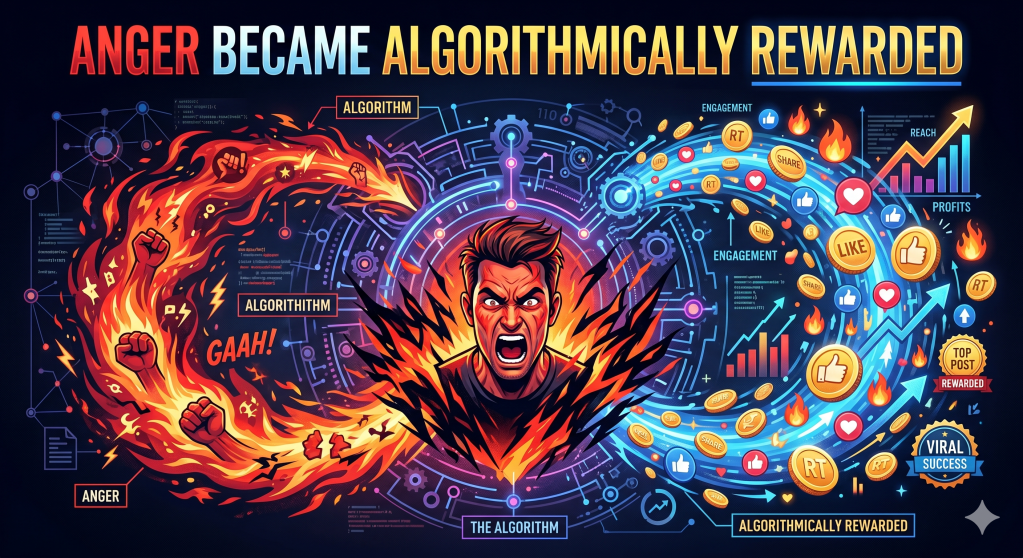
How social media platforms learned that anger drove engagement, the behavioral science behind it, and the social consequences of algorithmically rewarded outrage.
Something shifted in the mid-2010s that was difficult to name at the time. Political conversations that had once been merely tedious became charged. Family dinners grew tense. People who had previously been mild-mannered seemed to develop a hair-trigger for outrage. Commentators blamed polarization, cable news, or whatever political figure they happened to oppose. But those explanations missed something more structural — something happening at the level of the machines mediating nearly every conversation Americans were having.
The shift wasn’t simply that people became angrier. People have always been angry. What changed was that anger became useful in a new and very specific way: it kept eyes on screens. Platforms discovered this, built systems that fed it, and then — and this is the part that tends to get skipped — people learned to produce it on demand. Outrage stopped being a reaction. It became a genre.
This was not the first time a media business discovered that outrage sold. Yellow journalism, partisan newspapers, talk radio, and sensationalist television had all found audiences through provocation. But something genuinely different was now happening: for the first time, communication systems could algorithmically identify which specific content made which specific person angry, amplify it to them personally, and monetize that response at massive scale. The economics of outrage had always existed. What was new was the precision, the personalization, and the speed.
Understanding how that happened, and what it cost, requires looking at the engineering, the behavioral science, and the moment ordinary people figured out the rules of the game.
The Attention Economy and What It Wanted From You
To understand why anger became so central to online life, you have to start with a basic economic fact: the major social platforms of the 2010s — Facebook, Twitter, YouTube — were not selling a product to their users. They were selling their users’ attention to advertisers. The more time a person spent on the platform, the more ads they saw, the more revenue flowed in. Every design decision, from notification timing to feed curation, was ultimately in service of that one metric: time on site.
This wasn’t a secret. The term “attention economy” had been circulating in media theory since at least the late 1990s, when Herbert Simon and later Michael Goldhaber articulated the idea that human attention was becoming the scarce resource that markets would organize around. What nobody fully anticipated was how efficiently algorithms could be trained to exploit it.
The key insight, which platform engineers arrived at partly through data and partly through behavioral research, was that emotional content drove engagement. People didn’t just passively consume emotionally charged posts — they reacted, shared, and argued. And of all the emotions that drove engagement, anger was among the most reliable.
What the Research Said About Anger and Sharing
The behavioral science here predates social media by decades. Psychologists had long understood that anger is what’s called an “approach” emotion — unlike fear or sadness, which tend to make people withdraw, anger motivates action. An angry person wants to do something. In the context of social media, that meant commenting, sharing, and picking fights.
A 2011 study by Jonah Berger and Katherine Milkman at the Wharton School examined which New York Times articles were most likely to be emailed to others. They found that articles evoking high-arousal emotions — awe, anxiety, and especially anger — were significantly more likely to go viral than articles evoking low-arousal emotions like sadness. Anger activated a drive to share that calmer emotional states simply didn’t.
Neuroscience offered a complementary explanation. The amygdala, the brain region most associated with emotional processing, responds to threatening or provocative stimuli faster than the prefrontal cortex — the seat of deliberate reasoning — can evaluate them. Outrage-inducing content essentially gets a head start in the brain. It grabs attention before analytical thought has a chance to weigh in.
Platform engineers didn’t necessarily read academic papers to arrive at these conclusions. They had something more direct: data. A/B tests, engagement metrics, and recommendation algorithms trained on user behavior all pointed in the same direction. Content that provoked strong reactions kept users on the platform longer. Algorithms learned to favor it.
How the Feed Became a Furnace
The mechanism by which this happened wasn’t a single decision made by a villain in a boardroom. It was the accumulated result of many individually reasonable-sounding choices, each optimizing for engagement.
Facebook’s News Feed algorithm was regularly adjusted based on what kept users scrolling. In the mid-2010s, the platform introduced reaction buttons — Love, Haha, Wow, Sad, Angry — partly to give users more expressive options and partly to gather richer data about emotional responses. What followed was documented in reporting by The Wall Street Journal and in leaked internal Facebook research: the algorithm learned that Angry reactions predicted future engagement better than Likes did. Angry users came back. They commented. They drew others into arguments. For a system designed to maximize time on site, that was a signal worth amplifying.
Twitter’s architecture produced similar effects through different means. The retweet function, introduced in 2009, had been designed as a simple sharing tool. But it created what researcher Zeynep Tufekci described as a “virality machine” that rewarded provocation. A tweet that sparked outrage could reach hundreds of thousands of people in hours, while a measured take on the same subject might reach a few hundred. The incentive structure was legible to anyone paying attention: be outrageous, be retweeted.
YouTube’s recommendation algorithm, optimized for watch time, developed a well-documented tendency to funnel viewers toward increasingly extreme content. A person who watched a moderate political video would frequently be recommended something more provocative. The logic was purely mechanical — extreme content held attention better than moderate content — but the social effect was to gradually normalize positions that would have seemed fringe a decade earlier.
None of this required bad intentions from the people building these systems. The engineers were solving the problem they’d been given: maximize engagement. The algorithms were doing exactly what they were trained to do. The problem was that nobody had fully thought through what optimizing for engagement, at scale, would do to the texture of public discourse.
The Moment Creators Learned the Rules
Here is where the story stops being about algorithms and starts being about culture.
As the dynamics of platform recommendation became better understood — partly through explicit documentation, partly through trial and error — a new kind of media literacy emerged. Not literacy about evaluating information, but literacy about producing content that spread. And what spread, reliably and measurably, was anger.
Political commentary channels on YouTube discovered that framing opponents as not merely wrong but evil drove better watch time than nuanced analysis. News organizations with digital presences found that their most provocative headlines reliably outperformed their most accurate ones. Podcasters, influencers, and eventually political figures adapted their rhetoric — consciously or not — to the emotional frequencies the platforms rewarded. The A/B test had spoken. Outrage converted.
This is the turning point that tends to get underweighted in accounts of this period. The algorithm didn’t just reward anger that already existed. It taught people to produce anger as a craft. Once creators learned that a measured take on a controversy might earn a thousand views while a furious one earned a hundred thousand, the choice to be furious stopped feeling like a choice. It felt like the obvious thing to do. The professionally rational thing.
But there’s something deeper here than creators gaming the algorithm. What actually happened during this period was a fundamental inversion in anger’s social economics. Historically, anger carried costs. In most social contexts — workplaces, civic spaces, polite company — expressing anger risked reputation, strained relationships, and marked the person expressing it as unstable or aggressive. It was a liability to be managed, not an asset to be deployed.
Online, under the specific conditions created by engagement-optimized platforms, that calculus reversed. Anger could now generate attention, audience growth, social approval, revenue, and political influence. The people who expressed it most reliably weren’t penalized — they were rewarded with followers, donations, and influence. The emotion that had historically cost something now paid. What was once a social liability had become a career strategy.
What emerged from this inversion was something that deserves its own name: outrage as genre. Not outrage in the sense of a spontaneous emotional response, but outrage as a learned communicative style with conventions, expectations, and a reliable audience. The host who was perpetually scandalized. The thread that opened with “I can’t believe this.” The video thumbnail with the open mouth and the red arrow. These weren’t accidents of personality. They were formats that had been tested, validated by data, and then deliberately replicated.
Once anger became rewarded at scale, it ceased being merely an emotional response and became a performance. And like any performance, it could be rehearsed, refined, and delivered on cue.
The Psychology of Outrage as Social Currency
The platforms supplied the incentive structure. Creators supplied the content. But ordinary users had to supply the daily engagement — and they did, for reasons that behavioral science had been mapping for years.
Outrage functions as a powerful signal of group membership. Moral psychologist Jonathan Haidt and his colleagues have argued that moral emotions like indignation serve partly as social displays — ways of showing your tribe that you share its values. When you post an outraged reaction to something a political opponent said, you aren’t just expressing a feeling. You’re performing an identity. You’re saying: I’m one of you. I see what they did. I’m not one of them.
Expressing anger also, for a time, feels good. Research on moral outrage suggests it produces something resembling a reward response. A study published in Nature Human Behaviour in 2021 found that people who regularly expressed moral outrage on social media were positively reinforced by the social responses they received — likes, supportive comments, the validation of peers. Over time, this conditioned people to seek out things to be angry about, because anger had become a reliable path to social reward.
There’s a complication, though. Research on anger rumination suggests that repeatedly expressing anger tends to maintain or amplify the emotional state rather than dissipate it. The folk belief that venting provides emotional release — a “hydraulic” model of emotion borrowed loosely from Freud — is not well supported by the evidence. Social media, with its endless scroll of provocations and its social rewards for expressing indignation, was an engine for sustained, self-reinforcing anger. The more you expressed it, the more you felt it. The more you felt it, the more the feed gave you reasons to.
Outrage Inflation and the Shifting Baseline
The feedback loop between platform incentives, creator behavior, and user psychology had one predictable long-term consequence: escalation.
There’s a term from neuroscience — habituation — that describes what happens when a stimulus is repeated. The response diminishes. To achieve the same effect, the stimulus has to become more intense. Something analogous appears to have happened across social media during this period. As outrage became the ambient condition of the feed rather than an exceptional response to exceptional events, the baseline of what registered as provocative shifted upward.
Platforms rewarded outrage. Creators produced more of it. Users, their feeds increasingly populated with angry content, were gradually calibrated to expect higher and higher levels of emotional provocation. What had seemed extreme in 2012 seemed ordinary by 2016. What seemed extreme in 2016 was almost nostalgic by 2020.
This inflation had practical consequences for anyone trying to communicate something without performing anger. Calm, qualified reasoning didn’t just fail to go viral — it increasingly failed to register at all. The signal-to-noise problem was real: in a feed optimized for emotional intensity, the most emotionally restrained content became, in a functional sense, invisible. Nuance wasn’t penalized by any deliberate policy. It was simply drowned out by the volume of everything else.
The Polarization Engine
These dynamics scaled into something much larger: the acceleration of social and political polarization, and specifically the variety researchers call affective polarization — not just disagreeing with the other political party, but actively distrusting and disliking its members.
Some caution is warranted here. Polarization in American political life predates social media significantly. The political scientists Nolan McCarty, Keith Poole, and Howard Rosenthal documented rising partisan polarization in Congress beginning in the 1970s. Cable television and talk radio had been amplifying partisan grievance since the early 1990s. And researchers like Levi Boxell, Matthew Gentzkow, and Jesse Shapiro found that polarization increased most rapidly among older Americans — the demographic least likely to be heavy social media users — which complicated simple causal stories.
But social media appeared to add something qualitatively different from what came before. It wasn’t just exposure to more partisan content. It was embeddedness in social networks that punished deviation from group norms — publicly, immediately, and at scale. The reputational cost of being seen to agree with the wrong side on anything was now visible to everyone in your network.
Christopher Bail and colleagues at Duke University demonstrated this in a striking 2018 field experiment: participants who were shown opposing viewpoints on Twitter became more partisan, not less. The platforms weren’t exposing people to the reasonable version of the other side’s argument. They were surfacing the most extreme, most outrage-optimized examples — because those were the posts with the highest engagement. The encounter with the opposing tribe came prepackaged with all the reasons to fear and dislike them.
Surveys by the Pew Research Center documented the result: rising percentages of both Republicans and Democrats viewing the opposing party with not just disagreement but fear and contempt. Whether social media caused this shift or merely accelerated it remains genuinely contested. But it was certainly the medium through which the contempt was expressed, amplified, and made to feel like consensus.
Misinformation as a Structural Feature
Misinformation spread more efficiently in this environment not because users were unusually credulous, but because the same properties that made angry content viral — emotional charge, narrative simplicity, clear villains — made false content viral. The two categories overlapped substantially.
Researchers at MIT’s Media Lab quantified this in a landmark 2018 study in Science. Tracking a decade of Twitter data, they found that true stories rarely reached more than a thousand people, while the most viral false stories routinely reached ten thousand or more. The effect was strongest for political content. And critically, it was driven by humans, not bots — people chose to share content that was emotionally compelling regardless of whether it was accurate.
The information problem and the anger problem were the same problem. A platform optimized for emotional engagement would naturally surface the most emotionally engaging content, and emotional resonance and factual accuracy were not reliably correlated. Corrections and fact-checks tended to be dry, qualified, and emotionally inert. They didn’t travel far. The asymmetry was structural, not accidental.
What Was Lost in the Noise
One underappreciated casualty of this period was what the sociologist Erving Goffman might have called the “backstage” of social life — the informal spaces where people processed opinions in progress, changed their minds, and spoke imprecisely without it becoming part of a permanent record. Social media collapsed the distinction between public and private speech. Everything was potentially a broadcast. The awareness of being observed and judged made people more performative and more defensive, and less likely to engage in the kind of genuine uncertainty that precedes learning.
This mattered because the performative version of a political opinion and the privately held version are often different. People are frequently less certain, more conflicted, and more open to revision than their public statements suggest. The public-private collapse that social media produced didn’t reveal people’s real views more accurately. It pushed their expressed views toward the most defensible, most tribal, most emotionally legible version — which was not always the most honest one.
Researchers studying political psychology observed increasing rates of what they termed “belief superiority” — the conviction that one’s own views were not just correct but obviously correct, and that people who disagreed were not merely mistaken but morally deficient. This is the attitudinal end state that algorithmically optimized outrage produces at scale. It makes productive disagreement feel not just difficult but pointless.
Where It Led
By the time the 2016 electoral cycle concluded in the United States, the dynamics described in this essay had become visible to a much larger public. Concerns about algorithmic curation, misinformation, and online radicalization moved from academic journals to congressional hearings.
The platforms responded, over the following years, with a series of adjustments: algorithm changes intended to reduce the reach of inflammatory content, content moderation systems, labels on disputed posts, reduced distribution for sensational headlines. Some of these measures helped at the margins. None resolved the fundamental tension between engagement optimization and the health of public discourse, because resolving that tension would require platforms to accept less engagement — which is to say, less revenue.
The structural incentives remained largely intact. And the world those incentives had helped build — more polarized, more outrage-saturated, more mistrustful — proved remarkably resistant to repair. Not because people were malicious, but because the emotional dispositions cultivated over years of algorithmically optimized content don’t simply switch off when engineers adjust a ranking parameter. The outrage had been internalized. The genre had become the expectation.
The Larger Pattern
Looking back from 2026, the period from roughly 2013 to 2020 now looks like a large and largely uncontrolled experiment in what happens when a society’s major channels of public communication are handed over to systems optimized for engagement rather than understanding. The results were not uniformly bad — this era also produced genuine solidarity movements, remarkable creative communities, and forms of political organizing that had no precedent. But the net effect on public trust and civic epistemics was largely negative, and the damage accumulated quietly before most people recognized what was happening.
The story is not simply one of technology gone wrong. It’s a story about the collision of human psychology, economic incentives, and engineering decisions made at speed and at scale. The behavioral tendencies that these systems exploited — our responsiveness to threat, our drive to signal group membership, our susceptibility to emotional contagion — are real and deep features of human nature. They are not bugs. They evolved for reasons. They are not going to be fixed by a better algorithm.
What changed in this period was the environment those tendencies operated in. Anger itself was not new. What was new was its economics. A set of systems, built by engineers trying to solve a revenue problem, discovered that anger was the most efficient fuel available and built the infrastructure to produce it at industrial scale. In doing so, they quietly completed a transformation that would have been unrecognizable to any prior generation: they turned a social liability into a social asset. For the first time in any mass medium, the person who was angriest — most reliably, most performatively, on the widest possible stage — was also frequently the most rewarded.
The deeper question — the one this period raised and that later years continued to wrestle with — is not whether platforms can be designed to reduce anger. It’s whether communication systems whose revenue depends on sustained emotional arousal can ever be genuinely compatible with the kind of low-temperature, high-trust discourse that functional democratic life seems to require. The two goals are not obviously reconcilable. And so far, the evidence suggests that when they conflict, the business model wins.









