
Originally published in June 2017 and comprehensively updated and edited in June 2026.
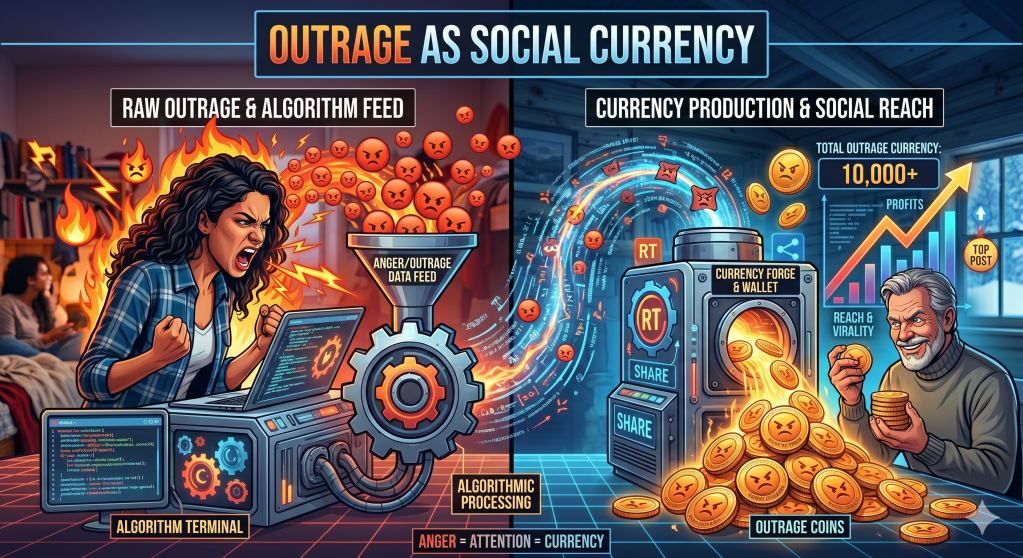
How social media transformed moral outrage into a form of social currency — and what psychology, neuroscience, and behavioral research reveal about the costs.
Something shifted in the mid-2010s that was hard to name at the time but impossible to ignore. Public discourse started to feel less like debate and more like performance. Arguments that might once have faded after a news cycle instead escalated into coordinated pile-ons. People began broadcasting their moral positions with an urgency that seemed almost theatrical — not just expressing displeasure, but advertising it. Outrage became something you displayed, shared, and accumulated.
By 2017, when this essay was first drafted, social media platforms had fundamentally reorganized how emotional expression traveled through communities. Anger didn’t just spread — it paid dividends. It attracted attention, generated solidarity, and signaled group membership in ways that calmer, more measured responses simply didn’t. A decade later, the dynamics have only deepened. The infrastructure has changed, but the underlying psychology has remained consistent: in networked environments, outrage functions less like a private emotion and more like a form of social currency.
This essay examines how that happened, why the human brain is particularly susceptible to it, and what the behavioral research tells us about the long-term costs of living inside an economy where moral anger is the dominant medium of exchange.
The Platform Architecture That Rewarded Anger
To understand outrage as social currency, you have to start with the environment that made it profitable.
Before social media, emotional expression was largely local. You might complain to a friend, write a letter to a newspaper, or shout at a television screen. These reactions had almost no social reach. The audience was small, the feedback was delayed, and the rewards for performing anger in public were minimal. The emotional experience was real, but it stayed contained.
Social media changed the feedback loop entirely. Platforms built in the early 2010s were optimized around engagement — a term that sounds neutral but in practice meant anything that made users stay, react, and share. Engineers discovered early on that content provoking strong emotions performed dramatically better by their metrics than content that was merely informative or pleasant. Anger, in particular, drove shares. Fear drove clicks. Moral indignation drove both.
This wasn’t a conspiracy. It was an optimization problem. Platforms were maximizing engagement, and human emotion — specifically the high-arousal, negative emotions — turned out to be extraordinarily effective fuel. The design decisions that followed, including the like button, the retweet, the algorithmic amplification of content with high interaction rates, all systematically rewarded emotional content over measured content. Outrage got promoted. Nuance got buried.
Researchers at NYU’s Center for Social Media and Politics, along with teams at MIT, began documenting these patterns empirically. A widely cited 2018 study published in Science by Soroush Vosoughi and colleagues found that false news stories spread roughly six times faster than accurate ones on Twitter, largely because false stories tended to be more novel and emotionally provocative. A separate body of research on moral-emotional language — words that combine ethical judgment with emotional charge — found that each additional moral-emotional word in a tweet increased its retweet rate by approximately 20 percent. Anger, in other words, wasn’t just popular. It was algorithmically amplified.
The Attention Economy and Emotional Real Estate
The broader concept at work here is what economists and media scholars call the attention economy. When human attention becomes a scarce resource that platforms compete for, the content that commands attention most reliably wins. And for reasons rooted deeply in our evolutionary history, threatening and morally charged information commands attention more reliably than almost anything else.
The psychologist Daniel Kahneman’s work on cognitive systems helps explain part of this. The fast, intuitive System 1 thinking that governs most of our moment-to-moment mental activity is highly sensitive to threat and social violation. Content that triggers that system — content that says, in effect, something is wrong and someone is responsible — activates a kind of mental override. The slower, more deliberate System 2 thinking, which handles nuance and probabilistic reasoning, requires effort and gets bypassed when the emotional signal is strong enough.
Whether intentionally or not, the incentives they created overwhelmingly favored System 1 responses over System 2 reflection. And System 1, when confronted with morally charged content about in-group betrayal or out-group threat, tends to react before it reasons.
The Neuroscience of Moral Anger
Outrage isn’t just a social behavior. It has a distinct neurological profile that makes it particularly compelling and, under certain conditions, addictive.
When we experience moral anger — the kind triggered by perceived injustice or norm violation — the brain activates a cluster of regions associated with both threat detection and reward processing. The amygdala, which processes emotional significance and initiates threat responses, ramps up activity. So does the anterior insula, which is associated with disgust and the visceral feeling that something is wrong. But here’s what makes moral outrage neurologically distinctive: the reward circuitry also activates.
Research using fMRI imaging has shown that punishing norm violators — even at a cost to oneself — produces activation in the ventral striatum, the same region involved in pleasure and reward. This phenomenon, sometimes called altruistic punishment, suggests that moral anger isn’t purely aversive. There’s something genuinely rewarding about being outraged, about identifying wrongdoing, and especially about seeing it addressed. The brain treats moral enforcement like a kind of victory.
This creates an interesting problem in digital environments. When someone posts an expression of moral outrage on social media and receives positive feedback — likes, shares, supportive replies — the reward signal is reinforced. The behavior gets paired with social validation in a way that closely resembles the variable reward schedules that behavioral psychologists have identified as particularly effective at shaping behavior. Think of how a slot machine works: intermittent, unpredictable rewards are more addictive than consistent ones. Social media feedback on emotional content follows a similar pattern. Sometimes a post goes viral. Sometimes it gets five likes. The unpredictability intensifies the engagement.
The neurological reward is only part of the story. Moral outrage also serves a social function: it signals group membership. When you publicly condemn a behavior, a person, or an institution, you’re not just expressing a private feeling — you’re announcing your values and demonstrating loyalty to the community that shares them. Social psychologist Jonathan Haidt has described a related mechanism as a “hive switch,” a mode in which individuals temporarily subordinate self-interest to group identity. Shared outrage flips that switch reliably. It creates rapid cohesion, which feels good, but it also tends to suppress independent judgment — dissent from within the group becomes a threat rather than a contribution. Sociologist Émile Durkheim called something like this collective effervescence: the heightened emotion that emerges when a community participates in shared ritual. What social media created was a version of that ritual running continuously, organized around moral transgression. Someone always had to be condemned. The condemnation itself became the point.
Outrage Cycles and the Problem of Escalation
One of the more troubling features of outrage as social currency is how it escalates.
Any economy with a currency faces inflation pressure, and outrage is no exception. When the baseline level of expressed moral anger in an environment is high, individual expressions have to compete for attention and credibility. Mild displeasure registers as indifference. To be heard, to be seen as genuinely committed, the expression has to be sharper, more urgent, more extreme than the ambient noise. This creates a ratchet effect — the currency inflates, and everyone has to spend more to get the same return. Researchers tracking the moral-emotional language in social media posts over time have documented this shift quantitatively: more posts invoke moral language, the language within those posts grows more extreme, and the shift isn’t explained by the events being covered. It’s explained by the changing norms of expression within the environment itself.
Escalation also affects how communities treat individual targets. When a person or institution is selected for condemnation, the collective pressure can amplify dramatically beyond what any individual would apply alone. Each participant’s contribution seems small relative to the whole, and each assumes others are exercising judgment about proportionality. The aggregate can be genuinely destructive, but the distributed nature of the action means no single participant feels fully responsible for the outcome — a kind of inverse bystander effect. The psychologist Molly Crockett has noted that the low cost of online outrage expression, combined with its high social rewards, may cause people to engage in more moral condemnation than they would in contexts where condemnation required real effort or real risk.
The Currency Metaphor Examined
Calling outrage a “social currency” is more than a rhetorical flourish. The economic metaphor holds up under scrutiny in ways that reveal something important about how the dynamic works.
Currency, in any economy, is a medium of exchange. It’s not valuable in itself but is valuable because it can be traded for other things — goods, services, status, influence. Outrage, in networked social environments, functions similarly. It can be exchanged for attention, for social approval within a community, for a sense of moral authority, and for the particular satisfaction of shared condemnation. In some cases — particularly for media figures, politicians, and online influencers — it can be exchanged for literal economic value through clicks, subscriptions, and donations.
Currency also requires a social agreement about its value. The dollar is valuable because people agree it’s valuable. Outrage is valuable as currency only in environments where the community agrees to treat it as a signal of moral seriousness. This means the value is context-dependent: in some communities, performative outrage is credible; in others, it reads as manipulation or weakness. The currency only works inside the system that recognizes it.
And like any currency, outrage is subject to counterfeiting. When the social rewards for expressing moral anger are high, there’s an incentive to express it regardless of whether you actually feel it — or to amplify felt anger beyond its genuine intensity. This is where the dynamic gets psychologically interesting. By the early 2020s, researchers studying online moral behavior were observing something that went beyond strategic performance: outrage had become, in many communities, a kind of obligatory script. The expected response to certain events wasn’t a matter of individual emotional reaction but of group protocol. You expressed outrage because your group expressed outrage — because failing to do so carried social costs, because the performance of anger had become a form of dues-paying.
This is ritual outrage, and it’s distinct from the calculated kind. Ritual outrage doesn’t require insincerity; many people feel genuine discomfort about the things they’re supposed to feel discomfort about. But the feeling and the performance have become so entangled that participants often can’t distinguish between them. The social script shapes the emotional experience as much as the emotional experience shapes the script. Anticipated outrage — knowing in advance that something will require a public response — becomes a self-fulfilling state. The currency gets spent whether or not the underlying asset is real.
The broader cost of this system is signal degradation. Outrage is theoretically a useful alarm: it tells communities that a norm has been violated and that something may need to be addressed. But when the alarm goes off constantly — when everything is outrageous — it loses its informational value. Genuine moral emergencies become harder to distinguish from manufactured controversies. Sustained attention becomes harder to maintain when the emotional register is already pinned near its maximum. And for individuals, the cumulative effect is a kind of compassion fatigue — a deadening of the very moral sensibility the outrage economy purports to serve.
What Changed Between 2017 and 2026 (and What Didn’t)
By the mid-2020s, the specific platforms that drove the 2017 outrage economy had shifted considerably. Twitter became X, Facebook lost younger users to TikTok and Instagram, and new platforms rose and fell. But the underlying dynamics — algorithmically amplified emotional content, social rewards for expressed outrage, escalation pressure — persisted across nearly all of them. Those dynamics weren’t specific to any platform’s ideology. They were specific to the incentive structure of engagement-optimized social media, and that structure remained essentially intact wherever engagement was the metric.
What changed was efficiency. Short-form video introduced new vectors for emotional contagion. AI-generated content increased the volume of inflammatory material. Recommendation algorithms grew more precise at identifying and delivering the emotional triggers that kept individual users engaged longest. The structural incentives that reward outrage expression in networked environments haven’t been substantially altered. The reward circuitry in the human brain hasn’t changed at all. The mismatch between our evolved psychology and the environment we’ve built for ourselves remains essentially what it was.
Individual Costs of Living in the Outrage Economy
The systemic effects of outrage as social currency are concerning, but they’re somewhat abstract. The individual costs are more concrete — and more insidious, because they arrive gradually rather than all at once.
Most people don’t notice the shift as it happens. It’s less dramatic than burnout and harder to trace than a single bad experience. What accumulates instead is a low-grade distortion: a growing sense that everything is urgent, that everyone on the other side is operating in bad faith, and that resolution of almost any disagreement is effectively impossible. The world starts to feel like it’s getting worse faster than it actually is.
Research on the psychological effects of sustained moral outrage exposure paints a fairly consistent picture. Studies by Pew Research and academic teams have found that frequent social media users — particularly those who spend significant time on politically and morally charged content — report higher levels of anxiety, depression, and what researchers call “political exhaustion.” They are more likely to feel that things are getting worse, that the other side is malicious rather than merely wrong, and that civil resolution of disagreements is impossible.
Some of this effect is explained by the simple fact that the content people encounter in high-outrage environments is systematically selected to be disturbing. If you spend several hours each day reading about norm violations, injustice, and bad-faith actors, your ambient sense of the world will reflect that content. The information is technically accurate — bad things do happen — but the selection is not representative. The world you encounter in an outrage-optimized feed is worse, in a statistically significant sense, than the actual world outside it.
There’s also a documented effect on the capacity for nuanced thinking about complex issues. Exposure to high-intensity moral framing tends to promote binary thinking — in-group versus out-group, righteous versus corrupt, hero versus villain. This framing is emotionally satisfying but analytically impoverished. It makes the world legible in the way a morality play is legible, at the cost of the messiness and ambiguity that real situations usually involve.
Psychologist Paul Bloom, in his work on empathy and moral judgment, has argued that what he calls “rational compassion” — a deliberate, evidence-based approach to moral decision-making — is frequently undermined by emotional flooding. Intense moral emotion narrows the focus to the immediate and the vivid, often at the expense of the statistical and the distant. This may be adaptive in some face-to-face social contexts, but in networked environments where the emotionally vivid is artificially amplified, it can systematically distort judgment.
What the Research Suggests About Disengagement and Recovery
Given these costs, a reasonable question is whether and how individuals can disengage from the outrage economy without simply disengaging from civic life altogether.
The research here is still developing, but several findings are worth noting. Studies on “news avoidance” — a phenomenon that grew substantially in the early 2020s — suggest that many people have attempted to reduce their exposure to distressing content, with mixed results. Avoidance reduces anxiety in the short term but can produce feelings of guilt and social disconnection. It also doesn’t address the underlying environment; the person who leaves an outrage-driven social media platform often returns to find the same dynamics waiting.
More promising, according to researchers like Crockett and others studying online moral behavior, are deliberate changes in engagement behavior rather than complete withdrawal. This might mean distinguishing between reading and reacting — consuming information without immediately broadcasting emotional responses. It might mean deliberately seeking context and counterarguments before sharing. It might mean applying a simple time delay between emotional reaction and public expression, which several studies suggest substantially reduces impulsive sharing of unverified or extreme content.
These are individual-level responses to what is fundamentally a structural problem. They help, but they don’t resolve the underlying incentive architecture.
Conclusion: A Currency in Need of Revaluation
Outrage, like any currency, is a social technology. It exists because it solves a real problem: it communicates that something is wrong, it mobilizes communities to respond, and it enforces norms that hold groups together. These are genuine functions, and the emotion that drives them is real. The issue is not that moral anger exists. It’s that the environments we built in the 2010s — and refined in the 2020s — converted that emotion into a commodity and then optimized for its production.
The consequences of that optimization are now reasonably well-documented. Outrage inflation has degraded the signal. Escalation has normalized extreme positions. The social rewards for performing anger have attracted strategic performance alongside genuine feeling, and over time the distinction has become hard to maintain even from the inside. And the cumulative effect on individual psychology — on anxiety, on binary thinking, on the capacity for deliberate judgment — is measurable.
None of this is to say that there is nothing to be outraged about, or that the things people were angry about in 2017 and remain angry about today were not real. The claim is narrower and more structural: that when outrage becomes currency, the economy warps around it in ways that ultimately undermine the purposes moral anger is supposed to serve.
Looking forward, the path toward a healthier information environment likely requires changes at multiple levels simultaneously — in platform design, in regulatory frameworks, in civic education, and in individual habit. Research on how to restructure engagement incentives without simply suppressing speech is ongoing and genuinely difficult. But the first step in any redesign is an accurate diagnosis. Understanding outrage as a social currency, with its own inflationary pressures and distorting effects, is part of that diagnosis.
The emotion is human. The economy built around it is a choice.









