
Originally published in July 2017 and comprehensively updated/edited in June 2026.
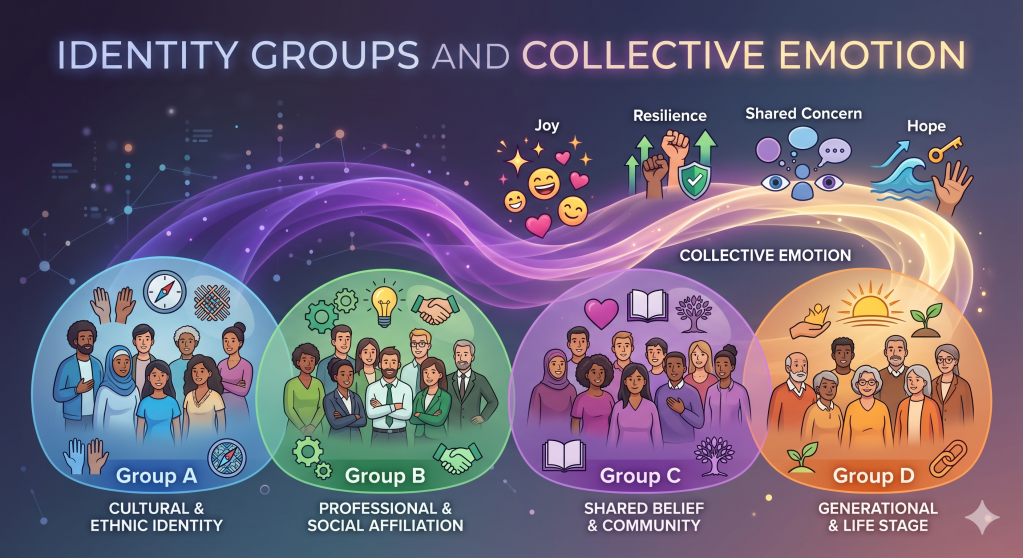
How identity groups shape collective emotion — exploring the psychology, neuroscience, and social dynamics that drive group behavior from 2017 to the present.
Something shifted in the social atmosphere around the mid-2010s, and most people who lived through it felt the change even if they couldn’t quite name it. Conversations about politics, culture, and identity became more emotionally charged. Online spaces that once felt like open forums began to harden into territories. People started sorting themselves — and being sorted — into increasingly defined groups, and those groups started feeling things together in ways that were difficult to ignore and harder still to explain.
This wasn’t simply a story about politics, though politics was certainly part of it. Nor was it simply a story about social media, though technology played a central role. It was, at its core, a story about a very old human tendency — the tendency to form groups, to bond within them, and to feel emotions that are shaped and amplified by the people around us — playing out at a scale and speed that human psychology had never encountered before.
Understanding what happened, and why, requires looking at the science of group psychology, the mechanics of emotion, and the ways that identity and belonging shape how we think, feel, and behave. What that science reveals is something counterintuitive: when a person belongs to a strongly felt identity group, they are no longer feeling entirely on their own. In a meaningful sense, they are feeling through the group. It also requires a kind of intellectual honesty about the fact that these dynamics don’t belong to any particular side of any particular debate. They are features of human nature itself.
What We Mean When We Talk About Identity Groups
Before exploring the emotional dynamics of groups, it helps to be clear about what an identity group actually is. An identity group is any collection of people who share a characteristic — racial, ethnic, religious, political, professional, cultural, or otherwise — and who derive some part of their sense of self from belonging to that collection.
Not every group is an identity group in this sense. People who happen to prefer the same brand of coffee are a category, not a community. What distinguishes an identity group is that membership carries emotional weight. Belonging feels meaningful. Being perceived as an outsider feels threatening. The group’s reputation, status, and wellbeing become intertwined with one’s own.
Identity groups have existed throughout human history. Tribes, clans, religious communities, nations — these are all identity groups, and they have always generated powerful emotions. What changed in the modern era, and particularly in the digital age, was the proliferation of identity categories available to people, the ease with which group membership could be signaled and reinforced, and the speed at which group-based emotional contagion could spread.
The Psychological Roots of Group Identity
Social Identity Theory, developed by Henri Tajfel and John Turner in the 1970s and 1980s, remains one of the most influential frameworks in social psychology — and its core insight is deceptively simple: people derive a significant part of their self-esteem from the groups they belong to. We are not just individuals; we are members of categories, and we care deeply about how those categories are perceived. When our group is valued, we feel better about ourselves. When it is threatened or disparaged, we feel that threat personally.
This creates a predictable set of behaviors. People tend to favor their own group (known as in-group bias) even in situations where group membership is trivially assigned. In one famous experiment, Tajfel showed that people would allocate more resources to strangers who had been randomly sorted into the same arbitrary group as themselves, even when there was no rational reason to do so. The mere act of categorization — being told “you are in Group A” — was enough to trigger preferential treatment toward other Group A members.
What this means in practice is that the emotional investment people have in their identity groups is not necessarily proportional to the importance of the group or the depth of the relationship. The group could be nearly meaningless on paper and still generate genuine loyalty, pride, and defensiveness. The psychology is relatively automatic, and it kicks in quickly.
Collective Emotion: How Groups Feel Together
We tend to think of emotions as private events — things that happen inside a single mind, in response to a single person’s experience. But this picture is incomplete in an important way. Many emotions are partly social phenomena, generated not just by individual circumstances but by the emotional climate of the group a person inhabits. Identity groups don’t literally possess minds. And yet they can generate emotional states — collective fear, collective pride, collective outrage — that are real and powerful and that shape the behavior of everyone inside them. In that sense, an identity group behaves less like a collection of separate individuals and more like a distributed emotional system, one in which feelings arise and circulate across many people simultaneously, often with an intensity that none of those people would have reached on their own.
This is not a metaphor. It is a description of documented psychological mechanisms.
Anyone who has been in a stadium during a championship game, or at a protest, or at a funeral with hundreds of strangers mourning a shared loss, knows that something happens to emotional experience when it occurs within a group. Feelings intensify. They synchronize. They take on a quality that solo experience rarely achieves. Psychologists call this emotional synchrony, and it has been documented across cultures and contexts. When people are physically or socially close, their emotional states begin to converge. They read each other’s facial expressions, postures, and vocal tones, and their own bodies respond in kind.
A well-documented mechanism underlying this is emotional contagion — the process by which emotions spread from person to person through mimicry and feedback. People automatically and unconsciously mimic the facial expressions and body language of those around them, and this mimicry feeds back into their own emotional experience. You don’t just observe someone’s sadness — your face begins to mirror it, and your brain begins to feel something similar.
The Amplifying Effect of Shared Identity
What makes collective emotion in identity groups particularly striking is that emotional contagion does not spread equally in all directions. It moves much more readily through in-group channels than across group boundaries. We are more attentive to the emotional expressions of people we perceive as similar to us, more trusting of their emotional signals, and more willing to update our own emotional state based on theirs.
The result is that an identity group functions as an emotional amplifier. One person’s fear or outrage or grief becomes many people’s fear or outrage or grief, and the collective expression of that emotion reinforces and intensifies the individual experience. An emotion that might have remained mild in isolation — a flicker of unease, a passing irritation — can become acute and consuming inside a charged group context. The individual is, in a real sense, feeling with more than just their own nervous system. They are feeling through the group.
Jonathan Haidt, the social psychologist and author of The Righteous Mind, has described humans as “90 percent chimp and 10 percent bee” — meaning that we are mostly self-interested individuals but also possess a capacity, triggered by certain circumstances, to become genuinely hive-like in our behavior. We can “lose ourselves” in a group in ways that feel meaningful and even sacred. Haidt calls this the “hive switch,” and he connects it to experiences of collective emotion at religious gatherings, military units, sports events, and political movements.
The hive switch served genuine adaptive functions throughout human evolution — building cohesion, enabling collective action, reinforcing social bonds. But it is also relatively indiscriminate. It can be triggered by shared threat, shared ritual, shared symbol, or shared enemy. And once triggered, it tends to override individual critical thinking in favor of group solidarity.
The Role of Threat, Moral Emotions, and Outrage
Not all collective emotions are created equal. Some — shared joy, shared awe, shared grief — can be unifying across group boundaries. But others, particularly those triggered by perceived threat or injustice, are more likely to be experienced specifically within an identity group, and they tend to be far more socially consequential.
Moral emotions are a distinct category of human emotion — feelings like disgust, contempt, righteous anger, and indignation that are connected to judgments about right and wrong. Unlike fear or sadness, which are responses to personal circumstances, moral emotions are responses to perceived violations of shared values. They are fundamentally social; they orient us toward others and toward collective action.
Research by Jesse Graham, Haidt, and others has found that different groups tend to have different moral foundations — different sets of values that they treat as sacred and non-negotiable. What counts as a profound moral violation to one group may barely register as an issue to another. This helps explain why political and cultural conflicts can feel so incomprehensible across group lines: the parties are not simply disagreeing about policy, they are often responding to entirely different moral signals.
When a moral emotion fires within an identity group, it spreads through the group’s emotional network and intensifies. Outrage, in particular, is highly contagious. Psychologist Molly Crockett, whose research examines moral outrage in digital environments, found that online outrage expression is often performative — people express anger partly to signal their group membership and values to others — and that digital platforms actively reward this expression with attention and engagement.
Why Outrage Spreads So Readily Online
This is where technology enters the story in a significant way. Social media platforms, as they developed from roughly 2010 onward, were not designed with collective emotion in mind. They were designed to maximize engagement. But engagement, it turned out, was deeply entangled with emotion — and with moral emotion in particular.
Research published in Science in 2018 by Soroush Vosoughi and colleagues analyzed the spread of true and false news stories on Twitter over more than a decade. Their finding was striking: false stories spread significantly faster, farther, and more broadly than true stories. And the primary mechanism was emotion — false stories were more likely to be novel and emotionally arousing, particularly evoking fear, disgust, and surprise. Humans, it turns out, share emotional content more readily than purely informational content.
This means that platforms optimizing for engagement were, unintentionally, optimizing for the spread of emotionally charged content. And emotionally charged content in a politically and culturally polarized environment often means morally loaded, identity-relevant material. The algorithmic architecture of social media created conditions that were, in effect, ideal for the amplification of collective emotion within identity groups.
At the same time, social media enabled something that had never been possible before at scale: the formation of identity groups among people who had no geographic connection. People who had previously felt isolated — politically, culturally, ideologically, or in terms of niche interests — could now find each other, form communities, develop shared vocabularies, and cultivate shared emotional cultures. This was, in many ways, a genuine social good. It was also a mechanism for the rapid consolidation of group identities and the intensification of intergroup differences.
Intergroup Emotion Theory and the Psychology of Us Versus Them
The idea that identity groups function as distributed emotional systems becomes clearest when you look at what happens to individuals who strongly identify with a group. Intergroup Emotion Theory, developed by Eliot Smith and Diane Mackie in the early 2000s, offers a precise account of the mechanism. The theory proposes that people who strongly identify with a group experience emotions on behalf of that group — not just about it, but as part of it. When your group is insulted, you feel personally insulted. When your group achieves something, you feel proud. When your group is perceived as threatening or threatened, you feel fear.
Think about what this means structurally. The individual becomes, in effect, an emotional node in a larger network. Signals that enter the network anywhere — a news story, a political speech, a viral video — generate emotional responses that propagate across the group’s members. The group doesn’t need a central nervous system for this to happen. The shared identity is enough to wire the nodes together.
This “group-based emotion” is distinct from simply feeling emotions about a group-related event. It involves a fusion of self and group identity such that events that happen to the group are experienced as happening to you personally. The psychological stakes of group membership become much higher. Minor symbolic acts — a perceived slight, an off-hand comment, a policy decision — can generate intense emotional responses in group members because they are processed not as distant events but as personal affronts.
Research consistently finds that the stronger someone’s group identification, the more intensely they experience group-based emotions, and the more motivated they are to take action in defense of or on behalf of the group. High group identification is associated with greater willingness to participate in collective action, greater in-group solidarity, and — in certain conditions — greater hostility toward perceived out-groups.
Dehumanization and the Outer Edge of Group Emotion
At the extreme end of intergroup emotional dynamics lies dehumanization — the process by which out-group members come to be perceived as less than fully human. It is not an anomaly or an aberration. It is a recurring feature of intense intergroup conflict, and psychological research suggests it emerges more readily than we might like to think. Brain imaging studies have found that under certain conditions, people show reduced neural activity in regions associated with social cognition when viewing images of out-group members perceived as extremely low status — as if the brain were briefly failing to engage its person-processing machinery.
Most of us have robust capacities for empathy and perspective-taking that normally counteract this tendency. But those capacities can be suppressed under conditions of threat, fear, moral outrage, and intense in-group pressure — precisely the conditions that collective emotional dynamics tend to create.
Identity, Narrative, and the Construction of Collective Memory
One dimension of group identity that deserves attention is the role of narrative. Identity groups are not just collections of people who share a characteristic; they are communities of interpretation — groups that share stories about who they are, where they come from, what has happened to them, and what it all means.
These shared narratives are not simply historical records. They are emotionally loaded frameworks that shape how group members interpret new events. A group with a strong narrative of historical persecution will tend to interpret ambiguous actions by out-groups as threats. A group with a narrative of exceptional achievement will tend to react to criticism with defensiveness. The narrative creates an emotional lens through which present experience is filtered.
Psychologist Dan McAdams, who studies narrative identity, has argued that the stories we tell about ourselves — individually and collectively — are not just descriptions of who we are but active constructions of identity that shape behavior and emotion going forward. The narrative and the identity co-create each other.
This helps explain a phenomenon that becomes particularly visible during periods of social upheaval: the contest over history. When groups fight about how to interpret the past, they are not just having an academic dispute. They are fighting over the emotional and interpretive frameworks that will govern present-day group identity. Control the narrative and you shape the emotional life of the group.
From 2017 to 2026: What Changed, What Didn’t
Looking back at the social and political landscape from the vantage point of nearly a decade later, some things have changed and some have remained stubbornly constant. The emotional intensity of intergroup dynamics that characterized the mid-to-late 2010s did not simply dissipate. In many respects it deepened, evolved, and was absorbed into the structural fabric of daily life in ways that make it harder to see clearly.
The platforms that turbocharged collective emotion in the 2010s have themselves been transformed — by regulation, by competition, by shifts in user behavior, and by the arrival of generative AI, which introduced entirely new complications into the information environment. Identity group dynamics migrated from Twitter and Facebook to TikTok, Substack, podcasts, and hybrid digital-physical spaces in ways that researchers are still working to understand.
What didn’t change is the underlying psychology. Human beings still form identity groups. They still experience group-based emotions. They still show in-group favoritism and out-group suspicion. They are still vulnerable to moral contagion and to the hive-switch dynamics that Haidt described. None of the neuroscience or psychology has been revised in ways that suggest these tendencies are weakening. If anything, the evidence base for them has grown.
What has changed, arguably, is the degree of awareness. The years since the mid-2010s produced a significant body of popular writing, journalism, and public education about these dynamics. Terms like “in-group bias,” “echo chambers,” “outrage culture,” and “tribal epistemology” moved from academic papers into general discourse. People began, to at least some degree, to develop a vocabulary for what was happening to them.
Whether awareness translates into behavioral change is a more complicated question. Research on cognitive biases suggests that simply knowing about a bias does not reliably reduce it — the machinery runs below the level of conscious awareness. But awareness does seem to create some capacity for pausing, questioning, and choosing more deliberately. It may not rewire the psychology, but it opens a door.
What the Science Suggests About Living With Group Identity
None of the research surveyed here points toward the conclusion that identity groups are pathological or that group belonging is something to be overcome. The evidence is, if anything, in the opposite direction. Belonging to meaningful social groups is associated with better physical and mental health, greater resilience under stress, and higher reported wellbeing. People need communities. The question is not whether to have group identities but how to hold them.
What the research does suggest is that certain conditions tend to make identity group dynamics more destructive. High perceived threat, intense moral framing, dehumanizing language, zero-sum competition, and algorithmic amplification of outrage all push the dynamics in harmful directions. These are not inevitable features of group life; they are variables that can, at least in principle, be modulated.
Research on contact theory — the body of work pioneered by Gordon Allport in the 1950s and extended by decades of subsequent research — suggests that meaningful contact between members of different identity groups, under conditions of relative equality and cooperation, tends to reduce intergroup hostility and foster more accurate and positive perceptions. It doesn’t always work, and the conditions matter greatly. But the general finding has been replicated enough times to take seriously.
Equally important is what researchers call epistemic humility about group narratives — the willingness to hold your group’s story loosely enough to allow revision in light of evidence or other perspectives. This is genuinely difficult; group narratives are emotionally loaded and socially enforced. But the alternative — treating the group’s narrative as sacred and unquestionable — creates conditions that are ripe for the worst outcomes of collective emotion.
Conclusion: The Mirror We Live Inside
Identity groups and collective emotion are, in the end, expressions of something genuinely valuable in human nature: the capacity for deep belonging, for shared meaning-making, for the kind of solidarity that makes collective action possible. A world without group identity would be a world without community, without culture, without the social fabric that makes human life livable.
But the same mechanisms that make group belonging feel profound and meaningful also create the conditions for tribalism, for moral exclusion, for the hardening of boundaries that divides human communities into categories of us and them. The psychology doesn’t come with a built-in limiter. The intensity can escalate, and the escalation can happen faster than we realize.
What the science offers is not a solution but a kind of mirror — a clearer view of the mechanisms that are operating when we feel the pull of group emotion, when we find ourselves certain that our group is right and the other group is wrong, when the outrage feels not just justified but righteously necessary. That clarity doesn’t make the feelings less real. But it may make it slightly more possible to ask whether the feelings are being generated by something we actually believe, or by the social and technological machinery we are embedded in.
In the years ahead, as technology continues to reshape the conditions of social life, as identity categories continue to multiply and collide, and as the challenges of a complex, interconnected world continue to create fertile ground for group-based fear and anger, that mirror may be among the most important things we have.









