
Originally published in September 2017 and comprehensively updated/edited in June 2026.
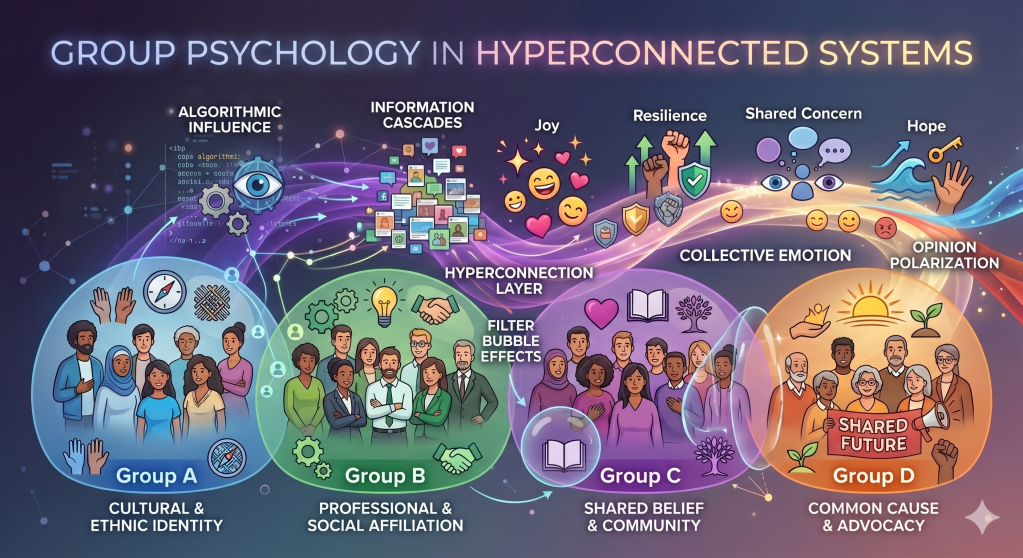
How ancient human group psychology behaves in digital networks — conformity, emotional contagion, tribal identity, and social proof at algorithmic scale.
There is a peculiar kind of anxiety that many people began describing in the mid-2010s and that appears to have deepened since. It is not quite the anxiety of loneliness, though it resembles it. It is the anxiety of being constantly surrounded by other people — their opinions, their outrage, their approval, their silence — while still feeling fundamentally disconnected from them. People began to sense that something had shifted in the social atmosphere, that the invisible rules governing how humans behave in groups had been quietly rewritten, and that no one had quite thought to announce it.
By 2017, when this essay was first drafted, the broad outlines of that shift were already visible. Social media platforms had passed through their novelty phase and were now structural facts of daily life. Political polarization was accelerating in measurable ways. People were observing, with some bewilderment, that their neighbors, colleagues, and family members seemed to inhabit entirely different informational universes. The psychological literature on group behavior — on conformity, tribal identity, and collective emotion — suddenly felt less like academic material and more like an operating manual for something that had already gone wrong.
What follows is an attempt to examine what happens to human group psychology when it is transplanted into networked, hyperconnected systems — and why the results have been so consistently surprising, and so consistently difficult to manage.
The Ancient Architecture of Group Behavior
To understand what the internet did to group psychology, it helps to understand what group psychology looked like before the internet. Human beings are, as the biologist E.O. Wilson observed, obligatorily social creatures. We did not merely choose to live in groups; our survival as a species depended on it, and our psychology was shaped accordingly over hundreds of thousands of years of evolution.
One of the most well-documented features of that psychology is what researchers call in-group/out-group bias. The basic finding is disarmingly simple: people favor members of their own group over members of other groups, often in ways they are not fully aware of. Henri Tajfel’s foundational research in the 1970s demonstrated that this bias emerges almost immediately after group membership is assigned — even when the groups are arbitrary, even when the participants know the assignment was random. Simply being told you belong to “Group A” is enough to make you more generous toward other members of Group A and more suspicious of Group B.
The evolutionary logic is not hard to reconstruct. In small-scale societies, group membership determined access to food, protection, mates, and social learning. Getting it wrong — trusting the wrong people, failing to cooperate with the right ones — had serious consequences. The brain’s tendency to sort the world into “us” and “them” was not a design flaw; it was a survival mechanism.
What is worth noting, though, is that this system evolved in a particular kind of social environment: small, face-to-face groups of roughly 100 to 200 people, with relatively stable membership and direct physical contact. Robin Dunbar’s research on primate brain size and social group size suggests that the human neocortex evolved to manage relationships with roughly 150 people — a figure now commonly known as Dunbar’s number. This is not a hard ceiling on social acquaintance, but it does mark a meaningful threshold beyond which close social tracking becomes cognitively expensive.
The internet did not respect this threshold. It did not simply give people more connections within their existing social architecture. It created an entirely different kind of social environment, one that the human brain had no specific preparation for — and then placed billions of people inside it simultaneously.
What Changes When Groups Scale to the Network
One of the most consequential things that social networks did was to blur the distinction between small, interpersonal groups and large, anonymous aggregates. A tweet or a post can be seen simultaneously by your six closest friends and by six hundred thousand strangers. A comment thread can involve people from a dozen different countries with radically different cultural contexts, all nominally participating in the same conversation. The platform interface presents all of this as a unified social space — as if you were all in the same room — while concealing the vast differences in relationship, context, and intent among the participants.
The sociologist danah boyd gave this phenomenon a name: context collapse. In ordinary social life, people manage multiple audiences by adjusting what they say and how they say it depending on who is present. You speak differently to your mother than to your colleagues, differently to close friends than to acquaintances, not because you are being dishonest but because communication has always been calibrated to context. Social networks collapsed those audiences into one. The same post is read by your employer, your high school friends, your political opponents, and strangers from other countries — simultaneously and permanently. The result is a kind of communicative paralysis for some and a constant low-level performance anxiety for many others, as people attempt to address an audience that cannot be coherently imagined.
Context collapse also changes what group membership means. Offline, you belong to different groups in different settings — family, neighborhood, professional community, social circle — and those memberships rarely come into direct contact. Online, they collide constantly. The group identities that people carry into networked spaces are not simply transported; they are exposed to each other in ways that generate friction, and they harden in response.
This matters because human social cognition is calibrated for the smaller-scale, context-specific environment. When we see social signals — approval, disapproval, visible consensus, expressed emotion — we tend to process them as if they were coming from known peers in a shared context. The mechanisms that evolved for navigating small-group dynamics do not automatically downgrade when the social environment becomes arbitrarily large and context-free. We feel the pressure of visible likes and shares the way we might feel the pressure of nods and frowns from people we know, even when the sources are strangers who barely share our frame of reference.
This brings us to what may be the deepest structural difference between offline group life and its networked counterpart: not just scale, but visibility — and a particular kind of visibility that has no real precedent in human social history. For most of human existence, social judgments were local and transient. What your neighbors thought of you mattered; what people in the next village thought mattered less; what strangers in distant places thought barely registered. And even local social judgments faded. People forgot, contexts shifted, reputations could be rebuilt.
Hyperconnected systems transformed social judgment into something persistent, searchable, measurable, and globally visible. A comment made in a moment of anger does not simply fade; it is indexed. A position taken years ago in a different context can be retrieved and reframed. Metrics quantify what was once qualitative — not just whether people approved or disapproved, but precisely how many did, and how quickly, and in what ratio. The social environment increasingly became a searchable record whose contents could be revived long after the original context had disappeared — and human beings who evolved for an environment of local and transient judgment are now navigating something fundamentally different.
Social Proof at Machine Scale
One well-studied mechanism that takes on new dimensions in networked systems is social proof — the tendency to use other people’s behavior as evidence about what is correct, appropriate, or desirable. The logic is adaptive in most environments: if everyone around you is running, it is probably wise to run too, even before you know what they are running from. If most people in a community follow a particular practice, there is likely some accumulated wisdom embedded in it, even if you cannot reconstruct it from first principles.
In hyperconnected systems, though, social proof interacts with algorithmic amplification in ways that distort rather than transmit genuine social information. Engagement metrics — likes, shares, comments, retweet counts — are made highly visible and are designed to drive further engagement. The result is that small initial differences in a post’s reception get amplified rapidly, making already-popular content appear far more universally endorsed than it actually is. Experimental research has confirmed what this implies: artificially inflating early vote counts on social content significantly increases its ultimate popularity. What looks like the crowd’s genuine judgment is often, in part, the echo of an initial noise event, magnified by the system itself.
Conformity, Dissent, and the Costs of Visibility
One of the most striking results in the psychology of conformity comes from Solomon Asch’s experiments in the 1950s. Asch showed that a substantial proportion of people — roughly a third, across many replications — would publicly agree with an obviously wrong answer about the length of a line if everyone else in the room had already agreed with it. The psychological pressure of visible group consensus was enough to override direct sensory evidence.
What Asch also found, and what is less frequently cited, is that the presence of even a single dissenter dramatically reduced conformity. When just one other person in the room gave the correct answer, the participant’s likelihood of caving to group pressure dropped sharply. Social unanimity is the key ingredient. Introduce visible disagreement, even from a single source, and the spell weakens.
This finding has an uncomfortable implication for hyperconnected systems, and it connects directly to the visibility problem. The design of most major social platforms tends to suppress ambiguity and emphasize visible consensus. Metrics count agreement far more prominently than disagreement. Algorithms optimize for engagement, which tends to mean emotional resonance and content that triggers strong in-group reactions — not content that introduces productive dissent or represents the full distribution of opinion. A platform that makes consensus visible and disagreement invisible is, in effect, a conformity-amplifying machine.
The deeper consequence is a distortion of collective self-knowledge. When expressing a minority view carries visible social costs — losing followers, attracting pile-ons, seeing the counter tick downward — people conceal their actual opinions and publicly conform to the apparent majority. If enough people do this, the apparent majority no longer reflects the actual distribution of private beliefs. The group’s public face becomes detached from its private reality. This is not a new observation about human psychology; it is a new observation about the scale and speed at which platforms can produce it.
Emotion as a Networked Phenomenon
Emotional states are contagious in face-to-face environments. People automatically and unconsciously mimic the emotional expressions of those around them, and that mimicry feeds back into actual experience — mood spreads through a room the way a cold does, below the threshold of conscious awareness. Research has confirmed that some version of this process operates through text as well, even without direct interpersonal contact. The emotional temperature of a networked environment can shift collectively, and the mechanism requires no deliberate persuasion.
In offline life, emotional contagion is bounded by the emotional temperature of your immediate environment — the people around you at work, at home, in your neighborhood. That boundary is a kind of psychological buffer. In a networked environment, it dissolves. Your emotional exposure is determined not by geography or relationship but by an algorithm, one specifically tuned to surface content that generates engagement. And the content that generates the most engagement is, consistently, content that provokes moral outrage.
Here is where the group dimension becomes important in a way that is easy to miss. Moral outrage is not simply an individual emotion that many people happen to feel simultaneously. It is a fundamentally social signal — one that evolved to broadcast norm violations, coordinate group responses, and enforce collective standards. Expressing outrage publicly is an act of group membership as much as an expression of private feeling. It says: I see what that person did, I know it violates our shared values, and I am aligned with the group in condemning it.
In a face-to-face world, this signal is constrained by the limited supply of genuinely outrage-worthy events in your local environment, and by the social costs of performing outrage badly — misjudging the situation, targeting the wrong person, escalating beyond what the group considers appropriate. Online, the supply is effectively unlimited and the feedback is immediate. The social rewards for expressing outrage are visible and quantified: likes, shares, replies, the numerical confirmation of in-group alignment. The risks of misjudgment are often lower, because the target is usually distant and the audience is already sympathetic. What results is not simply more outrage but outrage optimized for group performance — which is a somewhat different thing from outrage that accurately tracks moral reality.
Identity Under Persistent Observation
Social psychology has long recognized that people derive a significant portion of their self-concept from the groups they belong to. We do not just have group memberships the way we have email addresses; we partly are our groups, and threats to the group’s reputation feel like threats to our own sense of worth. This is why challenges to in-group beliefs activate motivated reasoning rather than open inquiry, and why members who publicly deviate from group norms are often treated with particular harshness — their visible dissent threatens something that feels personal.
But digital networks introduced a complication that social identity theory, developed in the 1970s and 1980s, did not anticipate: the audience became persistent.
In offline social life, people are observed intermittently. You are seen by your coworkers during work hours, by your family at home, by your friends when you choose to be with them. These audiences are largely separate, and they observe you across time — which means they also forgive across time. Behavior in one context does not automatically follow you into another. This is not merely a logistical accident; it is a feature of how human social life is structured that allows people to experiment with identity, to hold contradictory roles, to grow and change without every past version of themselves being permanently on record.
Online, observation became continuous and cumulative. Your social identity is not expressed in a series of separate, context-specific performances but constructed in public, in real time, for a collapsed audience that includes everyone you have ever connected with — and potentially many people you have not. Every post is a data point. Every position taken is on record. The audience is not just present; it is watching, counting, reacting, and remembering.
The psychological consequence is that identity becomes something increasingly managed rather than simply expressed. People learn, consciously or not, to perform their group membership rather than simply inhabit it — to signal affiliation legibly, to make their in-group loyalty visible, to preemptively defend against potential out-group readings of their words. This is not hypocrisy; it is a rational adaptation to an environment where audience and permanence are inescapable. But it does mean that much of what circulates in networked social spaces is not the raw expression of private belief but a performance calibrated for a persistent, collapsed audience.
This has a notable effect on how group polarization works in digital environments. The process by which groups shift toward more extreme positions when members deliberate among like-minded others is well-documented, and it operates online as it does offline. But when identity is being performed for a permanent audience, the incentive structure changes. Moderation can read as disloyalty. Expressing uncertainty can look like weakness. The group member who publicly hedges or updates their view risks the appearance of defection, while the group member who escalates receives visible validation. The audience doesn’t just observe group polarization; it accelerates it.
The Design of Attention and Its Psychological Consequences
One dimension of hyperconnected systems that did not receive adequate attention in 2017 but has become much clearer since is the role of deliberate design in shaping group psychology. Social platforms are not neutral communication channels. They are architectures built by organizations with specific goals — primarily the capture and monetization of attention — and these goals shape the psychological environment in which group behavior occurs.
The variable reward schedule embedded in social media interfaces — the unpredictable delivery of likes, comments, and notifications — was recognized early on, including by people who helped design it, as structurally similar to the intermittent reinforcement mechanisms that make slot machines compulsive. More relevant for group psychology is what gets rewarded: engagement correlates strongly with emotional arousal, novelty, controversy, and in-group/out-group conflict. These are not incidental features of the online social environment; they are the outputs of optimization processes that have been running for well over a decade. The environment in which group behavior unfolds has been deliberately shaped, and it shapes behavior in return.
By 2026, a generation has now grown up in this environment. Longitudinal research on adolescent mental health and social media use has produced a complicated and contested picture. What is less contested is that the social environment in which young people are doing the developmental work of identity formation and peer group navigation looks substantially different from any prior historical period — not just in scale, but in the particular combination of persistent visibility, collapsed contexts, and algorithmic amplification that characterizes it.
Toward Understanding, Not Resolution
One of the temptations when examining group psychology in hyperconnected systems is to reach for a clean narrative — either a techno-utopian story about how connectivity empowers individuals and democratizes information, or a techno-pessimist story about how algorithms have weaponized tribal psychology and degraded public discourse. Neither story is quite right, and both tend to flatten the genuine complexity of what is happening.
Human group psychology is old and powerful. Its basic architecture — the in-group favoritism, the conformity pressure, the emotional contagion, the identity fusion between self and group — long predates any technology. What digital networks have done is provide a new substrate for these ancient dynamics to operate on, one with three novel properties: unprecedented scale, persistent visibility, and deliberate optimization for engagement. The combination of these three is what makes hyperconnected systems genuinely different from all the media environments that preceded them, not any one of them alone.
The same dynamics that enable viral outrage also enable rapid organization for social goods and the coordination of legitimate collective action. The technology does not determine outcomes — it shifts the relative ease of different kinds of behavior and shapes the emotional environment in which group psychology plays out. But that shaping is real, and its effects compound over time.
What seems clear, looking back from 2026, is that the period from roughly 2012 to the present represents a kind of uncontrolled experiment in human social psychology at scale. We took evolved psychological machinery designed for small, face-to-face groups with transient and local social judgment, placed it in an environment of global reach and searchable memory, optimized that environment for engagement, and watched what happened. The results have been illuminating in ways that decades of laboratory social psychology could not have fully anticipated — and in some respects alarming in ways that are still being worked out.
The question was never whether ancient tribal instincts would survive in digital networks. They clearly do, operating through the same mechanisms they always have. The harder question — the one that remains genuinely open — is whether human reflection can scale as quickly as the systems that now amplify them.









