
Originally published in August 2017 and comprehensively updated/edited in June 2026.
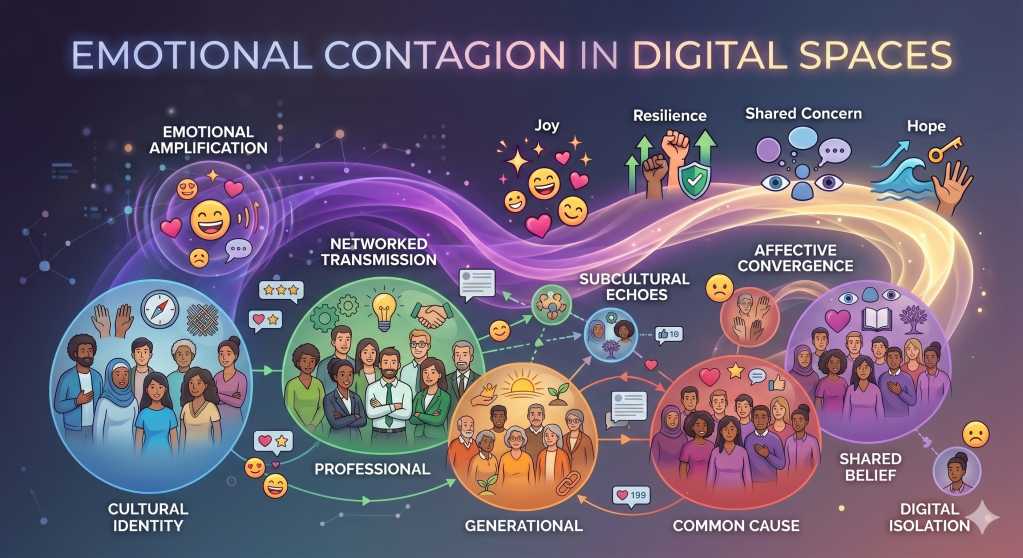
Emotional contagion in digital spaces — how social media algorithms systematically shape your emotional state, what the research shows, and why it matters more than ever.
There is a peculiar experience that most people who use social media have had but rarely examine: you open an app in a neutral mood, scroll for ten minutes, and close it feeling vaguely angry, anxious, or sad — without being able to point to a specific reason why. No single post upset you. Nothing particularly bad happened. Yet something shifted. The emotional texture of your day changed, almost without your awareness, because of what you were exposed to on a screen.
This is not a glitch. It is not a personal weakness. It is a well-documented psychological phenomenon playing out at an unprecedented scale — emotional contagion, transmitted through digital spaces and turbocharged by algorithmic systems designed to maximize engagement at almost any cost.
In the years since 2017, when early versions of this essay first appeared, the conversation around social media and psychology has matured considerably. What was once speculative has been confirmed, qualified, and complicated by a growing body of research. What has not changed is the fundamental reality: the platforms where hundreds of millions of people spend enormous portions of their waking hours are environments that actively shape emotional states, and they do so in ways that most users never consciously recognize.
Understanding how and why this happens — the psychology behind it, the neuroscience that makes it possible, and the design decisions that amplify it — is increasingly important. Not as an indictment of technology, but as a matter of basic self-understanding in a world where the boundary between online life and inner life has largely dissolved.
What Emotional Contagion Actually Means
The term “emotional contagion” has a specific meaning in psychology, and it is worth being precise about it. Psychologists Elaine Hatfield, John Cacioppo, and Richard Rapson, whose 1993 book Emotional Contagion helped formalize the concept, described it as the tendency to automatically mimic and synchronize expressions, vocalizations, postures, and movements with those of another person — and as a result, to converge emotionally.
In plain terms: emotions spread between people, and they spread automatically, largely outside of conscious awareness. When you watch someone wince in pain, something in your own nervous system responds. When you see a person laughing genuinely, you are pulled toward laughter. This is not empathy in the deliberate, reflective sense — it is something faster and more primitive. It happens before conscious thought intervenes.
The mechanism is often attributed to mirror neurons, though the science here is more contested than popular accounts suggest. What is on firmer ground is the broader observation that humans influence one another emotionally through multiple pathways — facial mimicry, vocal matching, postural imitation, social signaling — and that this synchronization shapes mood even when people are unaware it is happening. Dozens of studies across several decades have demonstrated that exposure to emotional expression reliably influences the emotional state of observers.
For most of human history, this process operated within the natural constraints of physical proximity. You could only catch someone’s emotional state if you were close enough to see their face, hear their voice, or read their body language. That constraint no longer applies.
The 2014 Experiment That Changed the Conversation
In June 2014, Facebook published a study in the Proceedings of the National Academy of Sciences that ignited a genuine public controversy. Researchers at Facebook and Cornell University had, without users’ knowledge or explicit consent, manipulated the News Feed content of approximately 689,000 users. One group was shown fewer positive posts; another was shown fewer negative posts. The researchers then analyzed whether users’ own subsequent posts shifted in emotional tone to match what they had been exposed to.
They did. Users who had been shown more negative content produced more negative posts. Users shown more positive content became more positive in their own expressions. The effect sizes were modest, but the implications were significant: emotional contagion could occur through text-based social media, without face-to-face contact, and — this was the detail that most unsettled observers — it could be deliberately engineered.
The backlash to this disclosure was substantial, focusing primarily on the consent issue. Users had not been told they were research subjects, and many felt that having their emotional states manipulated by a corporation crossed a line that the platform’s existing terms of service could not ethically cover. Facebook’s chief operating officer at the time offered what was widely characterized as a tepid apology, and the company’s internal review board procedures came under scrutiny.
But the psychological finding itself — that curated text and image content could shift the emotional valence of what people wrote and felt — was significant independent of the ethics of how it was studied. It was, in some ways, merely a confirmation of what researchers had been observing in narrower laboratory contexts for years. The novelty was the scale, the naturalistic setting, and the deliberate manipulation.
The significance was not that Facebook could influence emotions. Newspapers, television, and advertising had always done that. The significance was that emotional influence could now be personalized, measured, automated, and continuously optimized — applied differently to each of hundreds of millions of users, in real time, with no human editor making decisions. That is a genuinely different kind of thing.
What the study also revealed, though this received less attention at the time, was that Facebook already possessed the technical capability to change how its users felt — and that it was routinely exercising that capability through the ordinary operation of its algorithm, which had been optimizing for engagement metrics from its earliest versions.
How Platforms Shape Emotional Environments
To understand why digital spaces are such efficient vectors for emotional contagion, it helps to understand what social media feeds actually are. They are not neutral archives of what the people you know have said. They are editorially curated outputs, shaped by machine learning systems whose objective function is to keep you on the platform as long as possible.
This creates a predictable distortion. Emotional content — and especially content that generates strong emotional responses — tends to drive more engagement. People comment on things that make them angry. They share things that frighten or excite them. They linger on content that produces a strong feeling. The algorithm reads these behavioral signals and serves more content like what caused them.
The result is what researchers have sometimes called “affective amplification” — a systematic tilt in the emotional environment of any given platform toward content that produces intense reactions. This is not necessarily the most accurate content, the most constructive content, or the most representative sample of what people actually think and feel. It is the content that generates the strongest responses.
Jonah Berger, a marketing professor at the Wharton School, conducted research on what makes content go viral and found that high-arousal emotions — both positive ones like awe and excitement, and negative ones like anger and anxiety — were much stronger predictors of sharing than low-arousal emotions like sadness or contentment. This finding fits neatly with what engagement-optimizing algorithms would discover independently: intensity spreads, and intensity keeps people on the platform.
The implications for emotional contagion are significant. If you spend time in an environment that is systematically biased toward high-arousal emotional content, the cumulative exposure shifts your own emotional baseline. It is the same principle that makes it hard to maintain a calm disposition when you spend time around an anxious person — except the digital environment can expose you to hundreds of emotionally activated people simultaneously, and it selects for the most activated ones.
Anger as the Dominant Currency
Of the emotions that travel most efficiently through digital networks, anger deserves particular attention. Research published in journals including PNAS and Psychological Science has repeatedly found that moral outrage, indignation, and anger spread faster and wider on social media than almost any other emotional content. A 2021 study by William Brady and colleagues at Yale, published in Nature Human Behaviour, found that each moral-emotional word added to a tweet increased its retweet rate by approximately 17 percent.
Anger is especially effective as a social transmission mechanism because it is both highly arousing and socially bonding. It tends to identify an in-group (the righteous) and an out-group (the target of the anger), creating a sense of shared purpose and solidarity among those who participate in it. This is as true for a mob sharing a grievance on a social platform as it was for communities gathering around a common enemy in pre-digital contexts. The mechanism is ancient. The amplification is new.
Part of what makes this dynamic so consequential is that negative emotions are not merely common online — they are structurally advantaged. Fear spreads faster than reassurance. Outrage spreads faster than nuance. Threat captures attention more effectively than calm. This is not a coincidence or a quirk of platform design; it reflects something deep about human attention. We are wired to prioritize potential dangers over neutral or positive signals, a tendency that served survival well in ancestral environments and serves engagement metrics well today. The result is a systematic asymmetry: the emotional content least conducive to clear thinking and considered judgment is also the content most likely to be amplified, shared, and absorbed.
What changes in digital environments is the feedback loop. When you post something angry and it receives strong engagement — likes, comments, shares — you receive a social reward signal. Platforms are, in effect, paying you in social currency for emotional expression. This creates conditions in which emotional expression, and particularly high-arousal negative expression, can become habitual and self-reinforcing, independent of whether it serves your actual interests or accurately reflects your actual emotional state.
Psychologist Lisa Feldman Barrett, whose work on constructed emotion has reshaped how researchers think about feelings, has pointed out that emotions are not simply reactions to external events — they are predictions built by the brain based on prior experience and current context. What this suggests for digital environments is something worth sitting with: if your repeated experience of a platform is emotionally heightened, your brain begins to anticipate emotional intensity as the baseline. The digital environment literally trains your emotional prediction system.
The Particular Vulnerabilities of Adolescents
The conversation about emotional contagion in digital spaces cannot honestly proceed without addressing the population most affected: young people, and especially adolescents.
Adolescence is a period of intense neurological development, particularly in the prefrontal cortex — the part of the brain responsible for impulse control, emotional regulation, and the ability to weigh consequences. This region does not fully mature until the mid-twenties. During the adolescent years, the brain’s reward systems are especially sensitive and the social comparison circuits especially active. Peer acceptance and rejection have outsized consequences, both emotionally and neurologically, during this window.
Social media entered the daily lives of teenagers at precisely the moment when this neurological vulnerability is most acute. The platforms are designed to engage reward circuitry — likes, follower counts, public validation — in ways that map directly onto what adolescent brains are most sensitive to. The emotional contagion effects that are measurable but relatively modest in adults are likely amplified significantly in younger users, who have less developed capacities for emotional regulation and perspective-taking.
Researcher Jean Twenge has documented shifts in adolescent mental health that correlate chronologically with the rise of smartphone-mediated social media use. Rates of depression, anxiety, and loneliness among teenagers rose significantly in the years after approximately 2012, when smartphone ownership became widespread in that age group. The correlational nature of this data has been a subject of genuine scientific debate — correlation is not causation, and there are rival explanations for these trends. But the convergence of multiple data sources, including longitudinal studies and real-time experience sampling research, has strengthened the case that the relationship is not coincidental.
The mechanism is not necessarily direct exposure to distressing content alone. Social comparison — seeing curated presentations of other people’s lives and measuring yourself against them — is a major driver of adolescent distress on these platforms. Exclusion, whether witnessing social events you were not invited to or being visibly ignored in comment sections, carries a social pain that the adolescent brain registers intensely. And the emotional contagion from a network of peers who are themselves anxious, angry, or distressed compounds the effect.
The Architecture of Engagement and Its Emotional Costs
By 2017, the outlines of a significant problem were visible to researchers and to some of the people who had built these systems. By 2026, many of those builders had spoken publicly about what they understood and when. Sean Parker, one of Facebook’s founding presidents, said in a 2017 interview that the platform had been designed to exploit “a vulnerability in human psychology.” Tristan Harris, a former Google design ethicist, developed an influential framework characterizing the attention economy as a competition for human consciousness — one that platforms were winning using psychological techniques that users had not consented to and largely were not aware of.
The core design features that matter for emotional contagion are not hidden. Variable reward schedules — the unpredictable pattern of whether a given scroll will yield something rewarding — are the same mechanism that makes slot machines so compelling. Infinite scroll removes the natural stopping points that discrete pages provide. Notification systems create intermittent interruptions that train attention toward the platform across the day. None of these features are accidents. They are engineering choices made with considerable knowledge of behavioral psychology.
What they produce, in aggregate, is an environment in which emotional intensity is chronically elevated and emotional recovery is structurally impeded. The emotional contagion that would naturally dissipate when you leave a distressing social situation is renewed whenever you pick up your phone — which, for the average user, is dozens of times per day.
This is a design outcome, not an inevitable feature of digital communication. Text messages, email, and even earlier social platforms did not produce the same dynamics, largely because they lacked the algorithmic amplification and the infinite scroll. The specific combination of features matters, and understanding that allows for the possibility that different design choices could produce different outcomes.
What the Research Says and What It Doesn’t
Science is rarely as clean as headlines suggest, and the research on social media and emotional contagion is no exception. A few important qualifications are worth stating clearly.
The effects documented in most studies are real but typically modest in size. The Facebook emotional contagion study showed detectable effects, but the differences in emotional tone between experimental groups were small. Most research in this area deals with averages across large populations, and individual variation is substantial. Some people appear to be much more susceptible to emotional contagion than others; some platforms and uses are more problematic than others.
There is also a meaningful distinction between passive consumption — scrolling through a feed — and active, connected engagement, such as direct messaging, participating in a focused community, or creating content. Research consistently suggests that the former is more reliably associated with negative emotional outcomes, while some forms of the latter can provide genuine social connection and support. The blanket claim that social media is simply bad for mental health is not what the evidence shows. The more accurate claim is that specific patterns of use, in specific populations, under specific design conditions, produce specific risks.
Additionally, the causal arrows in this research are genuinely difficult to establish. People in worse emotional states may seek out social media differently, producing correlations that do not reflect simple environmental causation. Researchers have developed increasingly sophisticated methods — experience sampling, natural experiments, randomized trials — to address this, and these methods generally support the conclusion that the relationship is bidirectional but real.
What the science does not support is the opposite error — the dismissive claim that digital environments are emotionally neutral and that concerns about them are exaggerated panic. The evidence is too consistent across too many methods and research groups for that position to be credible.
Toward a More Intentional Relationship with Digital Environments
The framing of this as a problem to be solved by individual willpower has genuine limitations. When the environment is designed by teams of engineers and behavioral scientists whose explicit goal is to maximize time-on-platform, the burden placed on individual users to resist is structurally unfair. Blaming people for being affected by systems specifically engineered to affect them is roughly analogous to blaming people for finding processed food more palatable than vegetables — it ignores who designed the food and why.
That said, understanding the dynamics creates real possibilities for more intentional choices. Awareness of emotional contagion as a mechanism — knowing that your emotional state is being shaped by your digital environment just as reliably as by your physical one — changes how you might think about platform use in the same way that nutritional literacy changes how you might think about eating.
The most consistent finding from research on this topic is that the quality of digital interaction matters more than the quantity. Passive consumption of an algorithmically curated feed carries different risks than direct, personal communication with people you care about. Short bursts of engagement with a clear purpose carry different risks than extended, aimless scrolling. These distinctions are actionable at the individual level without requiring anyone to abandon the genuine goods that digital communication provides.
At the systemic level, the years since 2017 have brought meaningful changes, though not transformative ones. Platform companies have faced significant regulatory pressure in the European Union and, more recently, in the United States and elsewhere. Disclosure requirements have increased. Some design features — particularly those specifically targeting younger users — have been modified. But the fundamental economic incentive structure that makes emotional amplification attractive to these companies has not changed. Engagement remains the primary metric, and emotional intensity remains one of the most reliable drivers of engagement.
Conclusion: Living Inside the Machine
The concept of emotional contagion is ancient — philosophers from Aristotle onward recognized that emotions spread between people and shape communities. What is genuinely new is the infrastructure through which this now happens: opaque algorithms, global scale, and design choices made by a relatively small number of companies operating with limited accountability.
The emotional texture of daily life for hundreds of millions of people is now partly determined by systems they did not design, do not fully understand, and largely cannot opt out of without significant social cost. This is a genuinely novel situation in human experience, and it deserves serious, unsentimental analysis rather than either panic or dismissal.
What has changed since 2017 is that this is no longer invisible. The mechanisms are better documented, more widely understood, and more actively debated. Some of the engineers who built these systems have spoken candidly about the tradeoffs they made. Regulators are taking the question seriously. None of this has resolved the problem — but clarity is a precondition for any meaningful response. Understanding that the intensity of online emotional experience is partly a design artifact, rather than a reflection of the world’s actual state, does not make you immune to contagion. It gives you something more modest and more valuable: the possibility of a more deliberate stance.









