
Originally published in October 2017 and comprehensively updated/edited in June 2026.
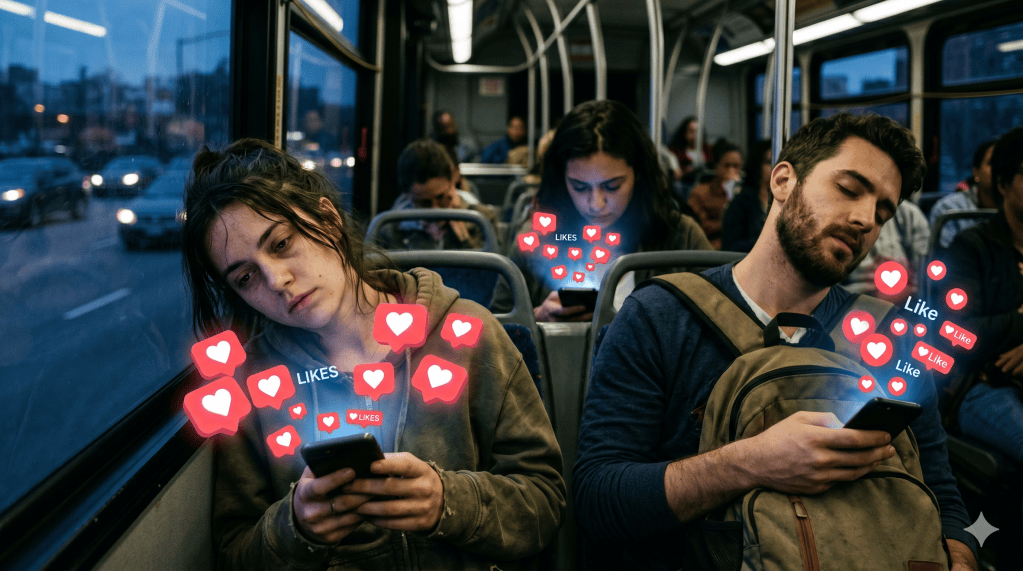
Why did everyone feel mentally drained in 2017? This essay examines the psychological, neurological, and technological forces that converged to exhaust a generation.
For many people, 2017 carried an exhausted edge that was difficult to name but almost impossible to ignore. A tiredness that sleep couldn’t fix. Many therapists described increasing demand for their services. Productivity writers published pieces about why no one could focus. Social media feeds overflowed with memes about anxiety, burnout, and the vague, nagging feeling that something was deeply off.
This wasn’t imaginary, and it wasn’t simply the result of any single news event or cultural moment. What people were experiencing in 2017 was the convergence of several powerful forces — technological, political, neurological, and social — that were colliding in real time. Understanding why everyone felt mentally drained that year requires looking at each of those forces and, more importantly, understanding how they amplified each other.
The story is about more than politics or social media, though both play central roles. It’s really a story about how the human brain handles overload, what happens when our social environments become chronically unpredictable, and how the tools we built to connect us ended up taxing us in ways we hadn’t anticipated.
The Brain’s Bandwidth Problem
The human brain is remarkably capable, but it operates within real limits. One of the most important concepts in cognitive psychology is the idea of cognitive load — the total amount of mental effort being used at any given moment. Think of it like RAM on a computer. You can have a powerful machine, but if too many programs are running simultaneously, everything slows down.
In 2017, cognitive load was running high for a large portion of the population, and for reasons that were structural rather than personal. It wasn’t that people had somehow become less resilient or less mentally tough. The environment had genuinely changed.
Psychologists distinguish between two broad types of mental stress. The first is acute stress — a single, intense event that activates the body’s fight-or-flight system and then resolves. The second is chronic stress — a persistent, low-grade activation of that same system that never quite turns off. Acute stress is something humans evolved to handle well. Chronic stress is something we handle very poorly.
Research from neuroscientist Amy Arnsten at Yale and others working in the field of stress and prefrontal cortex function has shown that sustained stress impairs the very parts of the brain responsible for clear thinking, decision-making, and emotional regulation. The prefrontal cortex — the region most associated with rational thought and impulse control — becomes less effective under prolonged stress exposure. The amygdala, which processes fear and threat, becomes more reactive. In plain terms: when you’re chronically stressed, you become worse at thinking clearly and more sensitive to perceived threats. This is not a character flaw. It’s biology.
By 2017, a significant portion of the American population — and, to varying degrees, populations in other countries dealing with their own versions of political and cultural turbulence — was showing signs of this kind of chronic activation. A survey conducted by the American Psychological Association in early 2017 found that stress levels had risen measurably compared to previous years, with significant percentages of respondents citing the political climate and the constant news cycle as primary sources.
The Attention Economy Grows Up
To understand why 2017 felt so specifically exhausting, you have to understand what had happened to information consumption in the preceding decade. The internet had always been distracting, but by the mid-2010s, the major platforms had become extraordinarily effective at capturing and holding human attention — not by accident, but by design.
The business models of companies like Facebook, Twitter, and Google depend on engagement. More time on platform means more advertising revenue. So these companies invested enormous resources in understanding what kept users scrolling, clicking, and returning. The answer had a lot to do with emotion — specifically, with outrage and anxiety.
Humans have what psychologists call a negativity bias: we pay more attention to threatening or negative information than to neutral or positive information. It’s an evolutionary adaptation that the platforms learned to exploit. Content that provokes outrage or fear spreads faster and generates more engagement, so algorithms optimized to surface that content relentlessly. The result was an information environment systematically biased toward upsetting material — not because upsetting things were all that was happening, but because upsetting things were what the platforms were built to amplify.
This created what some researchers called “outrage fatigue” — a state in which people were simultaneously exhausted by constant emotional provocation and unable to look away. The compulsive quality of social media use had been documented in psychological research before 2017, with the dopamine-driven loop of checking feeds compared to variable-reward schedules — the same mechanism that makes slot machines so difficult to walk away from.
The Notification Trap
Compounding the problem was the simple, relentless fact of notifications. By 2017, the average smartphone user received dozens of push notifications per day. Each one is a small interruption — a micro-demand on attention that pulls the brain out of whatever it was doing and redirects it elsewhere.
Research by Gloria Mark at the University of California, Irvine, and others studying workplace attention found that regaining full concentration after an interruption can take many minutes — far longer than most people would guess. When interruptions arrive continuously throughout the day, deep focus becomes nearly impossible. The brain ends up spending enormous energy on task-switching rather than sustained thought, which is cognitively expensive and leaves people feeling drained without having accomplished as much as they intended.
This wasn’t just a productivity issue. The fragmentation of attention had psychological consequences. Sustained reading, deep conversation, and contemplative thought all require uninterrupted cognitive bandwidth. When that bandwidth is perpetually occupied, people reported feeling scattered, restless, and unable to fully engage with anything — including the things they actually wanted to engage with.
News That Never Stopped
The political environment of 2017 introduced a particular quality of uncertainty that psychologists would recognize as distinctly corrosive to mental well-being. It wasn’t merely that the news was bad — bad news has always existed. It was that the news was unpredictable in a specific, structural way. The pace of significant events accelerated dramatically, and the tone of public discourse shifted in ways that made it difficult for people to predict what was coming next.
Psychological research on uncertainty is consistent: humans handle known bad outcomes better than they handle prolonged uncertainty. When the future is predictably difficult, people adapt. When it is genuinely unpredictable, the brain’s threat-detection systems remain on high alert indefinitely — the neurological equivalent of a smoke detector that can’t be turned off because you can never be sure whether there’s actually a fire.
This was the lived experience of many people in 2017. The news cycle was not just busy but volatile. Major stories broke not weekly but daily, sometimes hourly. The boundaries between political news, cultural commentary, social media drama, and serious policy developments collapsed. A tweet could generate as much coverage as a legislative vote. It became genuinely difficult to calibrate — to know what mattered and what didn’t, what was historically significant and what was noise.
That calibration failure had a measurable cost. When everything seems urgent, nothing is. But the emotional response to perceived urgency — the cortisol spike, the heart rate elevation, the narrowing of focus — doesn’t distinguish between real and manufactured emergencies. The body responds to the sensation of crisis regardless of whether the crisis is real.
The Moral Injury Dimension
One aspect of 2017’s exhaustion worth naming is what some clinicians described as collective moral injury — the specific demoralization that sets in when people are repeatedly confronted with events they find deeply unjust and feel powerless to change. Psychologists studying learned helplessness — the state that develops when a person’s actions consistently fail to affect outcomes — have found that it produces symptoms that overlap significantly with depression: passivity, emotional numbing, and a kind of motivational collapse. When the news cycle delivers fresh outrages faster than any individual response can register, something similar happens at scale. It is the fatigue of caring without leverage. That experience doesn’t fit neatly into standard categories of stress or anxiety, which is part of why it was so difficult to name at the time.
Social Fragmentation and the Loss of Shared Reality
Mental well-being is not a purely individual phenomenon. Humans are social animals, and our psychological health is deeply intertwined with our sense of belonging to communities with shared norms and shared understandings of reality. One of the most disorienting aspects of 2017 was the degree to which that shared reality seemed to be dissolving.
The fracturing of the media landscape over the previous two decades had created what researchers described as “filter bubbles” and “echo chambers” — environments in which people were exposed primarily to information and perspectives that confirmed existing beliefs. The mechanisms behind this were partly algorithmic (platforms optimized for engagement tend to show you more of what you already like) and partly sociological (people seek out communities that validate their worldview).
By 2017, these dynamics had matured to the point where many Americans were consuming entirely different versions of events. This wasn’t merely a matter of political disagreement — those have always existed. It was a more fundamental divergence, in which people were operating from incompatible sets of facts. Conversations that might previously have involved arguments about values or policy were now arguments about basic reality.
That experience — of talking to someone and realizing that you are not simply disagreeing but inhabiting different factual universes — is deeply disorienting. Sociologists and psychologists who study group cohesion note that shared factual frameworks are foundational to social trust. When those frameworks fragment, the social fabric frays in ways that are difficult to repair and that take a real psychological toll on individuals who experience the fraying directly.
What Loneliness Was Already Doing
The fragmentation of 2017 was arriving on top of a loneliness trend that had been building for years. Younger generations — who had grown up with social media — reported some of the highest rates of loneliness despite being the most technically “connected.” Research by John Cacioppo at the University of Chicago found that chronic loneliness activates many of the same stress pathways as physical pain, impairing sleep and degrading cognitive function over time. By 2017, loneliness was already functioning as a kind of chronic background stressor for a significant portion of the population. The events of that year, which deepened social divisions and made many public spaces feel hostile, only added to the load.
The Biology of Exhaustion
It would be a mistake to treat the exhaustion of 2017 as purely a mental or emotional phenomenon. The mind and body are not separate systems, and the chronic stress of that period had physical dimensions that reinforced and amplified the psychological ones.
Cortisol — the primary stress hormone — has well-documented effects on physical health when chronically elevated. It disrupts sleep architecture, impairs immune function, increases blood pressure, and over time contributes to a range of health problems. Perhaps most relevant to the experience of mental fatigue, chronic cortisol elevation also interferes with memory consolidation and executive function.
Sleep, in particular, is worth examining. Sleep is not simply rest — it is when the brain consolidates memories, processes emotions, clears metabolic waste products through the glymphatic system, and restores the cognitive resources depleted during waking hours. Research consistently shows that even mild sleep deprivation — losing an hour or two per night — significantly impairs performance on tasks requiring attention, working memory, and decision-making.
In 2017, many people were sleeping with their phones. The blue light emitted by screens suppresses melatonin production, making it harder to fall asleep. But perhaps more significantly, checking the news or social media before bed or in the middle of the night guaranteed a cortisol spike that made restful sleep difficult. People were entering the day already depleted, reaching for their phones immediately upon waking, and spending the day in a state of low-level threat activation that made genuine rest or recovery nearly impossible.
Coping at Scale
One interesting phenomenon of 2017 was the way people collectively searched for coping strategies, and how those strategies were themselves shaped by the platforms and cultural trends that were causing the problem.
Mindfulness and meditation — practices with genuine empirical support for stress reduction — saw enormous growth in popularity during this period. Meditation apps proliferated. “Self-care” became a cultural buzzword, sometimes trivially (bath bombs and face masks) and sometimes substantively (genuine attention to sleep, exercise, and social connection). The therapy-speak vocabulary that would become so prevalent by the early 2020s was beginning to enter mainstream conversation.
There is something revealing about this collective turn toward psychological self-help. It suggested a growing recognition that the environment itself was the problem — that the exhaustion people were feeling was not a personal failing to be overcome through willpower, but a response to genuinely overwhelming conditions that required active countermeasures.
At the same time, many of the coping behaviors people adopted were themselves mediated by the same platforms and devices that were driving the problem. Scrolling through wellness content on Instagram, joining Facebook groups for support, or reading articles about burnout on a smartphone are all, at some level, self-defeating loops. The solution was being sought in the instrument of the injury.
The Longer Arc
Looking back from 2026, the exhaustion of 2017 was not an anomaly. It was an early, particularly intense moment in what would become an extended period of collective psychological stress — one that would be further intensified by the events of 2020, sustained by the structural features of the digital information environment, and gradually metabolized into a broader cultural reckoning with attention, mental health, and the costs of permanent connectivity.
The years following 2017 would see genuine shifts in how people talked about mental health — a significant destigmatization, a broader cultural recognition that psychological well-being required active cultivation, and eventually some regulatory and institutional attention to the role of technology companies in shaping the information environment. These were meaningful changes, even if incomplete.
What 2017 made clear, for those who were paying attention, was that the conditions for collective psychological distress were structural rather than incidental. The algorithms were not going to spontaneously become less attention-maximizing. The political environment was not going to become less volatile on its own. The loneliness epidemic was not going to resolve itself. Addressing these things would require deliberate choices — by individuals, by institutions, and by societies — about what kind of information environments to build and inhabit.
The mental drain people felt in 2017 was real, and it was a signal. In many ways, 2017 was one of the first years when large numbers of people began experiencing the psychological consequences of the digital environment as a public-health phenomenon rather than a personal problem.









