
Originally published in November 2017 and comprehensively updated and edited in June 2026.
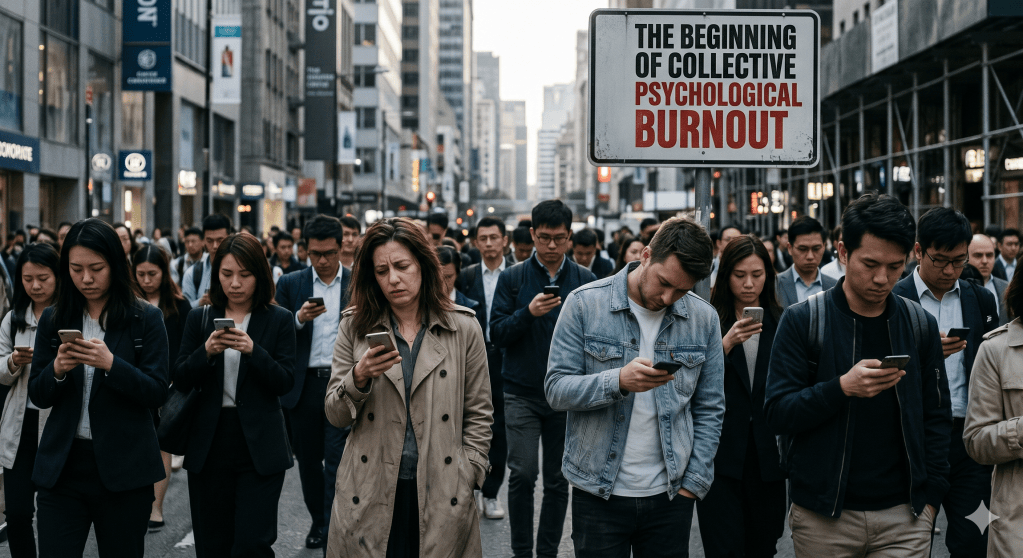
By late 2017, many people were waking up exhausted before the day had even begun. Not physically exhausted — psychologically exhausted.
They were checking phones before getting out of bed, following political crises before breakfast, carrying dozens of unresolved anxieties into every hour, and ending each day feeling as though they had been mentally working since before they rose. Sleep wasn’t fixing it. Weekends weren’t fixing it. The depletion had a different texture than ordinary tiredness, and it wasn’t responding to ordinary remedies.
What many of them were experiencing was an early form of collective psychological burnout.
The year 2017 wasn’t the beginning of the pressures that caused it. But it was the year those pressures became impossible to ignore. Political institutions were visibly straining under the weight of polarization. Social media had fully matured into an engine of constant provocation. The news cycle had compressed into something almost frictionless — always on, always urgent, always arriving on a device within arm’s reach. Underneath all of it, a generation of younger adults was entering a world that looked structurally less stable than the one their parents had navigated. Something larger was happening: billions of people were now participating in the same real-time emotional environment, reacting simultaneously to the same crises, conflicts, and streams of information — and the psychological cost was only beginning to become visible.
This article traces how that happened — examining the psychological mechanisms behind burnout, the social and technological conditions that allowed it to spread collectively, and why 2017 marked a meaningful inflection point in that story.
What Burnout Actually Is
The word “burnout” has been used so broadly in popular culture that it can lose precision. In clinical contexts, it has a more specific meaning. The psychologist Herbert Freudenberger first described it in a 1974 paper as a state of exhaustion brought about by devotion to a cause or relationship that failed to produce the expected reward. Christina Maslach later developed the most widely used framework, identifying three core components: emotional exhaustion, depersonalization (a growing detachment or cynicism toward one’s environment), and a diminished sense of personal accomplishment. Her Maslach Burnout Inventory became the standard measurement tool in occupational settings.
For most of its clinical history, burnout was understood as an individual condition tied to work. But researchers began noticing something that didn’t fit that framework. Symptoms were showing up in people who weren’t overworked in any traditional sense — college students, parents, retirees — people who were physically rested but emotionally depleted. What they shared wasn’t excessive workload. It was excessive exposure to a relentless, unpredictable stream of stressors that demanded ongoing emotional processing and offered little resolution.
This distinction matters. Burnout driven by chronic emotional labor is physiologically different from ordinary fatigue. Neuroimaging research has shown that sustained emotional stress activates the amygdala — the brain’s threat-detection center — while degrading activity in the prefrontal cortex, which governs rational decision-making and emotional regulation. The more frequently this stress response fires without adequate recovery, the more sensitized it becomes. Over time, the threshold for activation drops. Things that would once have been minor irritants begin registering as genuine threats. The capacity to disengage, to feel calm, erodes. In 2017, the conditions for producing this kind of neurological wear were being generated at a scale arguably unlike anything previously documented.
Information Overload and Nervous System Stress
Understanding collective burnout requires understanding what smartphones and social media platforms actually did to human attention and emotional processing. Information overload is often treated as a minor inconvenience — too many emails, too many tabs open. What researchers were documenting in this period was something more fundamental: a structural transformation in how stress was being delivered to the nervous system, at a scale and consistency not previously possible.
By 2017, global smartphone penetration had passed two billion active devices. Surveys consistently found that adults in the United States and Western Europe checked their phones between 50 and 150 times per day, many doing so within minutes of waking. Social media platforms — primarily Facebook, Twitter, and the rapidly growing Instagram — had been deliberately engineered to maximize this behavior through variable reward schedules, social validation signals, and algorithmically curated feeds designed to surface content that triggered strong emotional reactions.
The platforms didn’t only show people content they wanted to see. They showed people content that made them feel something strongly — and anger, fear, and moral indignation were reliably more engaging than contentment or mild interest. Research published in the Journal of Marketing Research by Jonah Berger and Katherine Milkman had demonstrated by 2012 that emotionally arousing content was significantly more likely to be shared. The platforms had operationalized this finding at enormous scale.
What this produced, cognitively, was a state of near-constant low-level arousal. The brain’s threat-detection systems, which evolved to handle intermittent acute stressors, were now being triggered dozens of times per day by content ranging from geopolitical crises to interpersonal conflicts between strangers. Each micro-activation carried a physiological cost — a small release of cortisol, a brief heightening of vigilance. Individually, each activation was trivial. Cumulatively, their effect on baseline stress levels was significant. And because the threat never resolved — the news cycle simply moved to the next one — there was no moment of safety or closure, no signal telling the nervous system it could stand down.
Social Media Anxiety and the Fragmentation of Attention
There was also a subtler cost that compounded everything else: the fragmentation of attention itself. Notifications, alerts, and the habitual pull of the feed didn’t only create emotional overload — they made sustained concentration increasingly difficult. Researchers studying what some called “continuous partial attention” found that constantly switching between tasks and stimuli degraded the brain’s ability to recover between activations. People were not only emotionally overwhelmed; they were losing the capacity for the deep, absorbing focus that normally provides a mental counterweight to stress. Rest requires disengagement. But disengagement had become structurally difficult in an environment designed to recapture attention the moment it wandered.
Political Volatility as Emotional Workload
2017 was an exceptionally turbulent year in political terms across much of the Western world. In the United States, the first year of the Trump administration produced a near-continuous stream of dramatic developments — executive orders, political controversies, institutional confrontations, and genuine uncertainty about the stability of democratic norms. In Europe, the aftermath of Brexit was generating similar disorientation, with long-established political alignments fragmenting and reshaping in real time.
Political engagement has never been emotionally neutral, but the combination of media saturation, social media amplification, and perceived high stakes created something qualitatively different. The resulting social media anxiety wasn’t simply about politics — it was the experience of being continuously embedded in a high-stakes emotional environment with no clear exit. The American Psychological Association’s annual Stress in America survey, conducted in 2017, reported that the current political climate was a significant source of stress for 63 percent of Americans — a figure that cut across party lines. What struck researchers was the trap this created: high levels of news consumption correlated with higher stress, but disengaging felt, to many people, morally irresponsible. The mental exhaustion this produced had a specific character — not the tiredness that follows effort, but the depletion that follows sustained vigilance without resolution. The result was a form of trapped vigilance: people couldn’t look away, and looking didn’t make them feel better.
This dynamic connects to a concept from psychological literature: moral injury. The term originated in the study of combat veterans — soldiers who experienced psychological harm not from fear alone but from witnessing events that violated their moral framework. By 2017, researchers were beginning to apply the concept more broadly. Sustained exposure to events perceived as unjust, combined with a sense of helplessness in the face of harm one cannot prevent, creates a specific kind of psychological wound that depletes moral and emotional resources over time. For large numbers of politically engaged people in 2017, this is precisely what was accumulating — not a single traumatic event, but a sustained sense of moral emergency felt both compelled and largely powerless to resolve.
Generational Pressure and Structural Anxiety
Burnout doesn’t develop in a psychological vacuum. It develops when sustained stress exceeds available coping resources, and one of the most important of those resources is a basic sense of stability — economic, social, existential. By 2017, for a significant portion of the population, particularly younger adults, that foundation had been substantially eroded.
The Millennial generation had entered adulthood during or immediately following the 2008 financial crisis. The recovery that followed was real but uneven. Home ownership rates among people under 35 had declined sharply. Student loan debt constrained financial decision-making for millions. The gig economy, celebrated in some quarters as liberated entrepreneurship, had for many workers meant the erosion of benefits, job security, and the predictable income that allows long-term planning.
Research by Jean Twenge and others had begun documenting rising rates of anxiety, depression, and loneliness among younger cohorts, tracking closely with the period of widespread smartphone adoption. Twenge’s work, while contested in some of its causal claims, documented measurable shifts in how younger people were spending their time and connected these to changes in psychological wellbeing. What resulted was a generation managing the ordinary stressors of early adulthood — relationships, career, identity formation — against a backdrop of structural insecurity and a media environment that offered an endless supply of additional things to worry about. Because burnout is, at its core, what happens when demand consistently exceeds resources, the conditions by 2017 were close to textbook.
The Social Fragmentation Problem
One of the most important — and least discussed — factors in collective burnout is the erosion of social connection. Robust social bonds are among the most effective buffers against stress. People with strong support networks recover from stressors more quickly, maintain lower baseline cortisol levels, and show greater resilience under adversity. Loneliness, conversely, is associated with physiological consequences — chronic inflammation, disrupted sleep, impaired immune function — that some researchers have compared in magnitude to heavy smoking.
By 2017, loneliness was already being described as an epidemic by public health researchers. Robert Putnam’s work in Bowling Alone had documented the long decline in civic participation and community membership across preceding decades. But something new had been added: the paradox of hyper-connectivity. People were more digitally connected than at any point in human history — and reporting feeling more isolated than their parents had.
The explanation is fairly straightforward. Digital social interaction is not equivalent to in-person contact in its effects on wellbeing. Face-to-face interaction activates social reward systems more fully, engaging eye contact, physical proximity, nonverbal cues, and the neurochemistry of shared presence that digital communication cannot replicate. Social media connections, meanwhile, often involve performance rather than intimacy: the carefully curated presentation of a life rather than the unguarded experience of sharing one.
The same platforms that were supposed to connect people were, by 2017, actively sorting them into ideological communities with diminishing contact between them. Filter bubbles — the tendency of algorithmic curation to reinforce existing views — had intensified political and cultural tribalism. Communities that once shared cultural touchstones, institutions, and physical spaces were increasingly inhabiting separate informational worlds. This fragmentation made broad social solidarity, one of the key buffers against collective stress, much harder to sustain.
The Physiology of Sustained Stress
To understand why 2017 was a meaningful turning point, it helps to understand one concept from stress biology: allostatic load.
Allostasis is the body’s ability to maintain stability through change. When a stressor appears, the body mobilizes — cortisol is released, heart rate rises, attention narrows. When the stressor passes, these systems return to baseline. Allostatic load is the cumulative wear from repeated or chronic activation of this response. When it becomes too high, the system begins to malfunction: baseline cortisol remains elevated, sleep is disrupted, the immune system produces chronic low-grade inflammation associated with depression, cardiovascular disease, and accelerated cellular aging. Burnout, at its physiological core, represents a dysregulation of this system — stress-response machinery that has been activated too consistently for too long to return to a normal resting state.
What made 2017 significant was the accumulation. Both a geopolitical crisis and a hostile exchange on social media can activate overlapping threat-detection pathways in the brain — the context differs, but the physiological mobilization is similar enough to matter. In 2017, the average politically engaged adult with a smartphone was encountering dozens of potential threat signals every day — most unresolvable, most emotionally amplified by algorithmic curation, most arriving on the same device meant for social connection, entertainment, and work. The result was a population accumulating allostatic load with few structural opportunities to discharge it.
When the Individual Becomes the Collective
Burnout is typically discussed as an individual experience, but when large numbers of people within a culture are simultaneously experiencing high stress and diminished emotional reserves, the effects compound. Depleted individuals have less to offer one another. Social trust erodes. Collective action — which requires exactly the reserves of energy, optimism, and social connection that burnout depletes — becomes harder to sustain.
Sociologists have a concept for this: social capital. It refers to the networks of relationships, shared norms, and mutual trust that enable effective cooperation. When it depletes — through economic disruption, institutional distrust, or the erosion of shared spaces — communities become less resilient and more susceptible to the fragmentation and cynicism that perpetuates the problem. By 2017, evidence of this depletion was visible across multiple domains. Institutional trust in government, media, healthcare, and science was declining across much of the Western world. Civic participation was shifting toward lower-commitment, performative forms — sharing a post, signing an online petition — and away from the sustained, face-to-face engagement that builds actual social bonds. The individuals caught in this environment were less equipped to reverse it, because the conditions depleting social capital were simultaneously depleting the individual resources needed to rebuild it.
What Came After
Understanding 2017 as a beginning rather than a peak matters for making sense of what followed. The patterns established in that period — the compulsive news consumption, the ambient political anxiety, the erosion of social connection, the physiological wear of chronic low-level stress — didn’t resolve. They intensified.
The COVID-19 pandemic arrived in early 2020 into a population that had already been accumulating allostatic load for several years. The isolation, economic disruption, grief, and institutional stress of those years landed on psychological foundations that were already strained. The mental health consequences — dramatic increases in anxiety, depression, and what many clinicians called pandemic burnout — were severe and widespread. They were also, in retrospect, more comprehensible when viewed against what had been building since at least 2016 and 2017.
By the mid-2020s, burnout had moved from a clinical concern associated primarily with healthcare workers to something approaching a default condition for significant portions of the population. The World Health Organization formally recognized burnout as an occupational phenomenon in 2019, though its clinical presentation had long since expanded well beyond any occupational context. Researchers were documenting a cumulative, structural weariness that resisted ordinary recovery interventions precisely because it wasn’t being generated by any single addressable cause. There were signs of adaptation — growing interest in digital minimalism, employers taking workforce mental health more seriously, expanded research funding — but none of these reversed the underlying conditions. They represented, at most, an emerging awareness that something important had shifted.
What This Means
The story of collective psychological burnout is not simply a story about technology, or politics, or economics, or changing social structures. It’s a story about what happens when multiple destabilizing forces converge simultaneously, when they are mediated through systems designed to maximize emotional activation, and when the normal recovery mechanisms — social connection, physical rest, genuine disengagement, a sense of agency — are undermined by the same conditions producing the stress.
The human stress response system is not poorly designed. It is extraordinarily well-designed for the environment in which it evolved — one characterized by intermittent acute threats, strong social bonds, physical activity, and natural rhythms of engagement and rest. What it was not designed for is the chronic stress produced by continuous low-grade threat signaling across a digital network, social comparison at a scale of millions, and a political environment that presents every news cycle as a potential civilizational emergency. Digital overload is sometimes described as a productivity problem. It is more accurately a nervous system problem.
The gap between what the human nervous system is built to handle and what modern informational environments demand of it is not a small gap. In 2017, that gap became, for a critical mass of people, no longer manageable through individual coping strategies alone. That was the beginning of collective psychological burnout — not a dramatic event, but a threshold quietly crossed, with consequences that are still unfolding.
Burnout — whether individual or collective — is not a permanent state. It is a signal. It indicates that the current arrangement of demands and resources is unsustainable, and that something needs to change. The harder question, and the one that will define much of the next several decades, is whether those changes will be structural — in how platforms are designed, how work is organized, how communities are built — or whether the response will remain individual, asking people to manage at the personal level what is fundamentally a collective problem. That question was already present in 2017. It has not yet been answered.
Research Notes and Further Reading
Burnout research: Christina Maslach and Susan E. Jackson, “The Measurement of Experienced Burnout,” Journal of Occupational Behavior, 1981. Maslach’s Burnout Inventory remains the most widely used clinical instrument for measuring burnout across occupational and non-occupational contexts. Herbert Freudenberger’s original clinical description appeared in “Staff Burn-Out,” Journal of Social Issues, Vol. 30, No. 1, 1974.
Emotional contagion and content sharing: Jonah Berger and Katherine L. Milkman, “What Makes Online Content Viral?” Journal of Marketing Research, Vol. 49, No. 2, 2012. The study analyzed nearly 7,000 New York Times articles and found that content eliciting high-arousal emotions — including anxiety, awe, and anger — was substantially more likely to be shared than content producing weaker emotional responses.
Political stress data: American Psychological Association, Stress in America: Coping with Change, 2017. The annual survey documented that 63 percent of Americans identified the political climate as a significant source of stress — the first time the survey had included political environment as a measured stressor category.
Allostatic load: Bruce McEwen and Eliot Stellar, “Stress and the Individual: Mechanisms Leading to Disease,” Archives of Internal Medicine, Vol. 153, No. 18, 1993. McEwen’s subsequent work expanded the allostatic load framework into one of the most cited models in stress biology.
Social connection and loneliness: Robert Putnam, Bowling Alone: The Collapse and Revival of American Community, Simon & Schuster, 2000. For physiological effects of loneliness, see John Cacioppo and William Patrick, Loneliness: Human Nature and the Need for Social Connection, W. W. Norton, 2008.









