
Originally published in April 2018 and comprehensively updated/edited in June 2026.
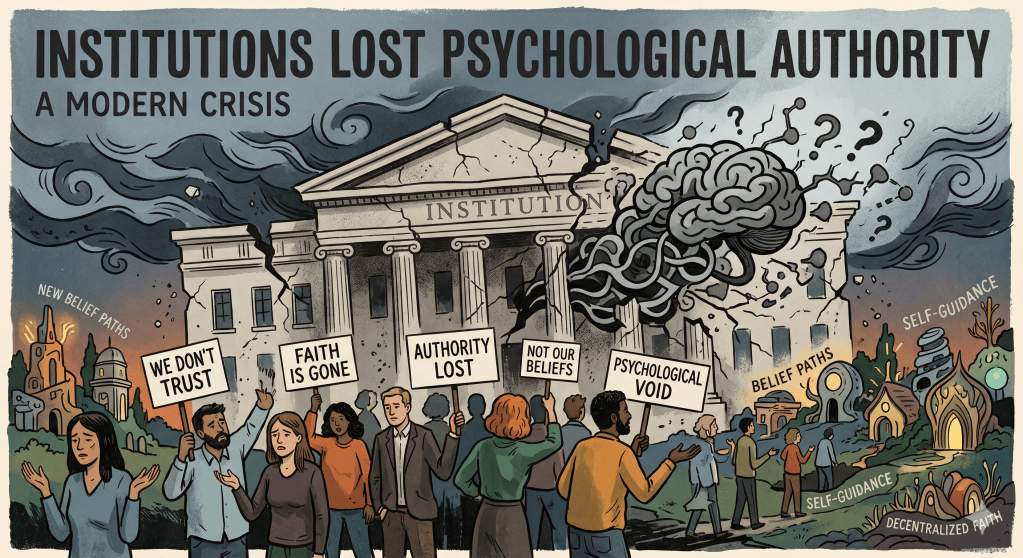
How decades of real institutional failures, amplified by digital media and psychological dynamics, caused a profound collapse in public trust — and what it means.
There was a moment — not a single day, but a slow accumulation of moments — when people stopped believing that the institutions running their lives actually knew what they were doing. It didn’t happen all at once. Trust eroded the way a riverbank erodes: gradually, then suddenly, and by the time anyone looked closely, the ground had already shifted.
This is the story of how institutions — governments, universities, churches, media organizations, medical authorities, and financial systems — lost something more important than credibility. They lost psychological authority: the unspoken human belief that the people and structures in charge are competent, honest, and working in the public’s interest. When that belief collapses, its effects ripple far beyond politics. It changes how people think, what they feel, how they make decisions, and who they turn to for guidance.
Understanding why that collapse happened requires looking at psychology, sociology, neuroscience, and history together. It’s not enough to say people “lost trust.” The deeper question is: what psychological mechanisms were at work, and why did they prove so powerful?
What Psychological Authority Actually Means
Before examining the collapse, it helps to understand what institutional authority rests on in the first place.
Psychologists have long distinguished between two kinds of compliance: surface compliance, where people follow rules because they fear punishment, and genuine deference, where people follow authority because they believe in its legitimacy. The second kind — legitimate authority — requires something deeper than fear. It requires what sociologist Max Weber called legitimacy, the shared belief that an authority has the right to make demands. When people believe a doctor’s diagnosis, accept a court’s ruling, or act on a government’s public health guidance, they’re not just obeying power. They’re expressing a form of psychological trust.
This kind of trust, researchers have found, operates partly through what psychologists call epistemic authority — the tendency to defer to others when we believe they know more than we do. We all rely on this constantly. You don’t personally verify that your airplane’s engines were properly inspected. You trust the regulatory system that overseers that process. Every day, in thousands of ways, people extend this kind of deference to institutions and experts. It’s an essential feature of complex societies.
But epistemic deference is conditional. It depends on a running background assumption that the authorities in question are both competent and honest. When evidence accumulates that they are neither, the psychological machinery of trust begins to break down — not just for one institution, but often for the entire category.
The Long Erosion: Decades of Institutional Failure
The loss of institutional psychological authority didn’t begin in the social media era, though technology dramatically accelerated it. The foundation was laid across decades of visible, documented failures.
When the Authorities Got It Wrong
The late twentieth century produced a string of institutional failures that, taken together, did significant damage to public confidence. The Vietnam War — prosecuted by two administrations with misleading public justifications and revealed in detail by the Pentagon Papers — showed that governments were capable of sustained, systematic deception about matters of life and death. Watergate confirmed it. So did the Iran-Contra affair, the savings and loan crisis, and a long series of intelligence failures culminating in the Iraq War’s missing weapons of mass destruction.
Medical and scientific authorities made their own contributions. The opioid crisis — which killed hundreds of thousands of Americans over three decades — was substantially enabled by regulatory failures, pharmaceutical industry deception, and medical practitioners who prescribed addiction-forming drugs in good faith based on fraudulent research. Pharmaceutical companies like Purdue Pharma deliberately misrepresented OxyContin’s addiction risk, the FDA approved it, physicians prescribed it in good faith, and patients ultimately bore the consequences.
The Catholic Church’s sexual abuse scandal, exposed in the early 2000s and continuing to generate revelations for decades afterward, shattered the moral authority of one of the world’s oldest religious institutions. What made it psychologically devastating wasn’t only the abuse itself, but the systematic institutional cover-up — the revelation that the Church as an organization had consistently protected itself over the children in its care.
The 2008 financial crisis followed a similar logic. Banks, ratings agencies, regulators, and government economists had all — whether through negligence, capture, or complicity — either failed to see the collapse coming or failed to stop it. Ordinary people lost their homes and retirement savings while the institutions responsible received bailouts. The gap between what institutions said (the system is sound, the experts have it under control) and what happened was simply too large to ignore.
The Psychological Weight of Betrayal
Social psychologists have documented what happens when trust is violated by a high-status authority. The experience is not simply disappointment. Research on what psychologist Jennifer Freyd calls betrayal trauma — originally developed to understand abuse by caregivers — describes how violations by figures we depend on carry a particular psychological punch. When we are in a relationship of dependence and trust, and the trusted party harms or deceives us, the psychological damage is often more severe than harm inflicted by a stranger.
Institutional relationships aren’t exactly like personal ones, but the research is suggestive. People don’t just update their beliefs when institutions fail them — they often restructure their entire relationship to authority. A person who feels betrayed by medical institutions after a family member was harmed by an over-prescribed opioid may not simply distrust that one pharmaceutical company. They may develop a broader skepticism toward pharmaceutical medicine, health regulators, and medical expertise in general.
Psychologists call this generalization of distrust, and it’s a well-documented phenomenon. When one member of a category (institutions, experts, authority figures) is caught deceiving, we update our assessments of the whole category. The generalization is often irrational — cardiologists are not more suspect because financial regulators failed — but the mechanism is deeply human, and it’s not without its own logic. If the system as a whole vouched for the things that failed, then perhaps the system as a whole warrants scrutiny.
The Information Revolution and the Collapse of Information Gatekeepers
The internet didn’t cause institutional distrust, but it transformed it. Before the digital age, the same institutions that exercised authority over public life also largely controlled the flow of information about themselves. Television networks, major newspapers, academic journals — these were themselves institutional actors with their own authority structures and gatekeeping functions.
The internet dismantled traditional gatekeeping faster than new, comparably stable systems could form.
The Democratization of Disclosure
Beginning in the 1990s and accelerating sharply after 2000, information that would previously have taken years to surface — if it surfaced at all — began circulating publicly within days. Whistleblowers found new platforms. Investigative journalists could publish without going through institutional filters. Internal documents, subpoenaed emails, and leaked diplomatic cables became searchable public record.
This was, in many ways, genuinely beneficial. But it created a particular psychological problem: the sheer volume of exposé overwhelmed people’s ability to calibrate. When every week brings a new revelation about some institution’s misconduct, it becomes difficult to distinguish the catastrophic from the minor, the systemic from the isolated, the verified from the rumored. The human brain compounds this through a well-documented negativity bias — we are wired to weight negative information more heavily than positive. In an information environment flooded with institutional failure stories, bad news becomes disproportionately salient regardless of base rates, and the cumulative impression is worse than any single event warrants.
Social Media and the Architecture of Outrage
Social media platforms accelerated these dynamics with particular force after roughly 2010. Facebook, Twitter, and YouTube were not designed to optimize for accurate information or measured judgment. Their engagement algorithms — which determined what content users saw — were effectively optimized for emotional response, and particularly for the emotions that drive the most engagement: outrage, fear, moral indignation, and tribal solidarity.
Research from the MIT Media Lab and elsewhere found that false information spreads faster and further on social media than true information, partly because false information is often more emotionally provocative. Stories confirming that trusted authorities were corrupt, incompetent, or malicious performed well by the metrics the platforms rewarded. Corrective, nuanced, or exculpatory information did not.
This created an environment where institutional failures were amplified far beyond their actual scope, while institutional competence and success went largely unreported. And when the platforms themselves became the subject of scrutiny — the Cambridge Analytica scandal revealed that Facebook had enabled the harvesting of user data on a massive scale — they joined the roster of institutions that had violated public trust.
Expertise Under Pressure
One of the more subtle casualties of this period was the concept of expertise itself. As institutional failures accumulated and became more visible, a parallel cultural shift occurred: expertise became politically contested. This was not entirely unreasonable — some domains that had claimed expert authority had indeed proven themselves unreliable. But the skepticism spread beyond its defensible limits.
There is an important distinction between appropriate epistemic humility (recognizing that experts can be wrong, that consensus can be corrupted, that conflicts of interest exist) and epistemic nihilism (treating all expert claims as equally suspect regardless of evidence). The latter is a psychological defense mechanism more than an epistemological position. When trust collapses across categories, it’s psychologically easier to discount expertise altogether than to do the hard work of evaluating each domain on its own merits.
Psychologists who study motivated reasoning find that people are quite good at constructing post-hoc rationalizations for conclusions they’ve already reached on emotional or tribal grounds. In an environment where institutional distrust had become a tribal marker for certain communities — a signal of independence, authenticity, and resistance to manipulation — motivated skepticism became its own kind of epistemic trap.
The Social Psychology of Institutional Collapse
What happens to people when the authorities they relied on stop feeling reliable? Social psychologists have studied the psychological consequences of institutional distrust, and the findings are consistent: it doesn’t just change opinions. It changes behavior, cognition, and social connection in ways that are often self-reinforcing.
The Turn Toward Parallel Structures
One of the most consistent findings in the research is that when people lose trust in formal institutions, they don’t simply become atomized skeptics. They turn toward alternative structures — informal networks, online communities, alternative media ecosystems, charismatic individuals — that offer the same psychological functions institutions once provided: information, identity, certainty, and belonging. Research in social identity theory helps explain why these substitutes become sticky so quickly. People form deep attachments to groups that affirm their worldview, and when a skeptical community becomes a core part of someone’s identity, updating one’s beliefs in ways that challenge its consensus carries real social costs. The community provides belonging and a coherent narrative about how the world works. Those are powerful human needs, and they don’t go unmet for long.
Uncertainty, Anxiety, and Conspiratorial Thinking
Institutional distrust creates a particular psychological challenge: it generates uncertainty without resolving it. When the official narrative is distrusted and no credible alternative has taken its place, people are left in a state of epistemic ambiguity about important questions. And ambiguity, research consistently shows, is psychologically uncomfortable. The brain has a drive toward closure — toward coherent, complete explanations that resolve uncertainty.
Conspiratorial thinking offers a particular kind of closure. A well-developed conspiracy theory is, structurally, a very satisfying kind of explanation. It is comprehensive — it explains many events at once. It is unfalsifiable — disconfirming evidence can always be incorporated as further evidence of the cover-up. And it provides a clear narrative structure, with identifiable agents and motives, that gives meaning to otherwise chaotic or threatening events.
Psychologists have found that conspiratorial thinking is more prevalent under conditions of social stress, uncertainty, and perceived loss of control — exactly the conditions that institutional failure creates. This doesn’t mean everyone who distrusts institutions becomes a conspiracy theorist, or that all skepticism of official narratives is conspiratorial. But it does mean that the psychological conditions created by institutional failure are fertile ground for conspiratorial frameworks.
The Polarization Effect
Institutional distrust also interacted powerfully with political polarization — and the relationship was bidirectional. Distrust of institutions fueled polarization, and polarization deepened distrust of institutions, in a feedback loop that became increasingly difficult to interrupt.
Research by political scientists Shanto Iyengar, Sean Westwood, and others documented the rise of what they called affective polarization — not just disagreement on policy, but deep mutual hostility and distrust between partisan groups. As this divide deepened, people’s trust in institutions became increasingly sorted by political identity. Democrats trusted scientific agencies; Republicans distrusted them. Republicans trusted certain media outlets that Democrats viewed as propaganda, and vice versa.
This sorting had a corrosive effect on shared epistemic ground. When the same institution can be trusted by one half of the population and distrusted by the other, based largely on partisan alignment rather than evidence, the institution’s ability to function as a shared authority effectively collapses. It becomes just another player in a tribal information war.
The Compounding of Crises
The decade between 2015 and 2025 put these dynamics under extraordinary stress. The election of Donald Trump in 2016 — an event that represented, among other things, a massive vote of no confidence in institutional politics — was both a product of the distrust landscape and an accelerant of it. The COVID-19 pandemic, beginning in 2020, provided the most dramatic possible test of institutional authority: a genuine global health crisis where the quality of public response would literally determine who lived and who died.
The pandemic revealed, in unsparing clarity, both the importance of functional institutions and the extent to which the conditions for institutional trust had eroded. Public health agencies provided guidance that was sometimes contradictory, sometimes wrong, and sometimes shaped by political pressures as much as evidence. The natural and understandable uncertainties of a novel pathogen were communicated in ways that, in the new information environment, looked like institutional failure or deliberate deception to large portions of the public. The gap between institutional communication and public response was vast and, in many places, fatal.
At the same time, institutional scientists did something genuinely remarkable: they developed safe and effective vaccines against a novel coronavirus in less than a year. The fact that vaccine hesitancy remained high — driven substantially by accumulated distrust rather than any specific failure of the vaccines themselves — illustrated the core problem with precision. The institutions were capable of performing. The public’s willingness to believe that had already been spent.
What Comes After
The loss of institutional psychological authority is not a problem that can be solved with a better communications strategy or a targeted media campaign. It was built over decades of genuine failure, and it won’t be undone by acknowledging that failure or promising to do better.
Not every challenge to institutional authority was irrational — medical establishments did dismiss patient experiences, regulatory agencies did get captured by the industries they regulated, financial institutions did take on catastrophic risk while assuring the public everything was sound. A generation came of age for whom skepticism toward official claims was the only historically defensible posture.
Closing the gap between what institutions claim and what they deliver is the only thing that can restore what was lost.









