
Originally published in April 2018 and comprehensively updated/edited in June 2026.
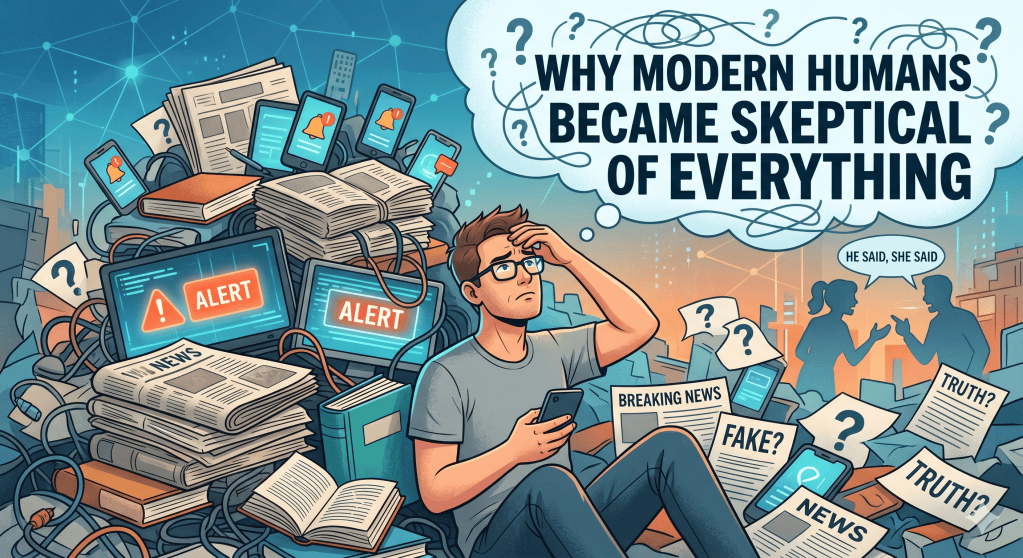
Why did modern humans become skeptical of everything? Explore the psychology, history, and technology behind the rise of institutional distrust — from Watergate to social media.
There is a particular kind of mental exhaustion that has become normal in the twenty-first century. It shows up when you read a headline and your first instinct isn’t curiosity — it’s suspicion. When a friend shares a study and your immediate thought is, who funded that? When you watch a press conference and find yourself parsing every word for what isn’t being said. When you can’t quite tell, anymore, whether your skepticism is protecting you or slowly eating you alive.
This is not the skepticism of scientists and philosophers — a disciplined, evidence-based habit of questioning that leads toward better understanding. What spread through modern culture in the early decades of the twenty-first century was something different: a broader, more ambient distrust that didn’t always discriminate between the deserving and undeserving targets. It attached itself to institutions, to media, to expertise, to government, to corporations, and eventually, in its more corrosive forms, to the idea that shared truth was even possible.
Understanding how this happened requires looking at several converging forces — historical betrayals of public trust, the architecture of the internet, the psychology of how human minds handle uncertainty, and the social dynamics that made distrust feel not just rational, but virtuous. None of these forces acted alone. Together, they reshaped the psychological baseline of an entire era.
The Foundation Was Already Cracking
To understand the skepticism of the 2010s and beyond, you have to understand what came before it. Distrust of powerful institutions didn’t emerge from nowhere. It was built, brick by brick, through a series of genuine failures that occurred over decades and left lasting marks on collective memory.
The Vietnam War and the Watergate scandal of the 1970s were pivotal. A generation watched their government lie systematically about the conduct and progress of a war that killed tens of thousands of Americans and millions of Vietnamese. They watched a president obstruct justice and resign in disgrace. These weren’t conspiracy theories. They were documented. The Pentagon Papers, leaked in 1971, confirmed that the Johnson administration had deliberately deceived the public and Congress about the scope and likelihood of success in Vietnam. Trust in the federal government, which had been remarkably high in the postwar era, began a long decline from which it never fully recovered.
The decades that followed added more layers. The savings and loan crisis of the 1980s, the opioid epidemic and the pharmaceutical industry’s role in stoking it, the Catholic Church’s systematic concealment of clergy abuse — each of these represented institutions that had been extended enormous social trust, and had used that trust badly. When the 2008 financial crisis hit, revealing that major banks had packaged and sold mortgage products they knew to be toxic while regulators either didn’t understand or didn’t care, it confirmed a suspicion many people had been nursing: the systems designed to protect ordinary people were sometimes working against them.
These weren’t paranoid delusions. They were, to a significant degree, accurate readings of what had happened. The problem is that accurate distrust in specific institutions tends not to stay contained. Psychologically, it spreads.
How Distrust Spreads in the Brain
Researchers in psychology and neuroscience have spent considerable effort studying how trust is formed and lost — and why lost trust is so hard to rebuild. One of the most consistent findings is that the human brain is wired with what psychologists call a “negativity bias.” Bad information, threatening information, information that signals potential danger receives more cognitive weight than positive or neutral information. This was adaptive for our ancestors: overlooking a threat was potentially fatal; overlooking an opportunity was merely unfortunate.
This asymmetry means that a single high-profile betrayal of trust can do far more damage to an institution’s reputation than years of reliable, trustworthy behavior can repair. Studies have shown that it takes roughly five positive interactions to counterbalance the emotional weight of one negative one — and that’s in personal relationships. For large, abstract institutions, where people have no personal contact and rely entirely on media representations, the math may be even more unfavorable.
There’s another mechanism at work, too. Cognitive scientists distinguish between two general modes of thinking, often called System 1 and System 2, following the framework popularized by psychologist Daniel Kahneman. System 1 thinking is fast, automatic, and emotional — the kind of thinking that produces instant impressions and gut reactions. System 2 is slow, deliberate, and analytical. The critical insight is that System 1 is the default. We don’t consciously choose to engage System 2; it requires effort, and the brain tends to conserve that effort.
Chronic exposure to potential deception — a condition that became normal in the internet age — tends to push people toward System 1 processing of social and political information. When you’ve been burned before, when the environment signals that trust is dangerous, pattern-matching and fast emotional responses feel like better survival strategies than slow, careful analysis. The result, at a population level, can look like widespread, reflexive distrust that doesn’t always respond to evidence or reasoning.
There’s a deeper neurological layer worth understanding here. The brain is fundamentally a prediction engine — it doesn’t passively receive information so much as it constantly models the environment, generating expectations and updating them when reality doesn’t match. Uncertainty is expensive for this system. It consumes cognitive resources, prolongs the period before the brain can settle on a stable model of what’s happening, and registers as mild but persistent stress. This is one reason why conspiracy narratives and sharply simplified explanations can feel so psychologically appealing, even when they’re wrong: they resolve uncertainty. A complex, ambiguous account of why institutions failed — involving structural incentives, regulatory capture, diffuse incompetence, and bad luck — is cognitively demanding. A narrative in which deliberate deception explains everything is far easier to hold. It closes the loop. The brain rewards closure, even at the cost of accuracy.
The Internet Changes Everything — And Then Changes Again
The early internet carried an enormous amount of utopian expectation. The premise was that connecting people to more information, and to each other, would naturally produce better-informed, more engaged citizens. In some respects, this happened. Access to primary sources, academic research, historical documents, and diverse perspectives genuinely expanded. The Arab Spring of 2010 and 2011, whatever its complicated aftermath, showed that networked communication could enable ordinary people to coordinate around shared grievances in ways previously impossible.
But the architecture of the internet as it actually developed — particularly after social media became dominant — turned out to have properties that no one fully anticipated. The business model of platforms like Facebook, Twitter, and YouTube depended on maximizing engagement, and it turned out that the content most likely to generate engagement was content that provoked strong emotion. Outrage, fear, and moral indignation spread faster and further than calm, measured analysis. Platforms optimized for these emotions, not as a deliberate conspiracy, but as an emergent consequence of their incentive structures.
The effects were significant. Research published in the journal Science in 2018 by Soroush Vosoughi and colleagues at MIT found that false news stories spread on Twitter significantly faster and further than true ones — and that this was driven primarily by human sharing behavior, not bots. People shared false stories more often, in part because false stories tended to be more novel and emotionally provocative than accurate ones. This wasn’t a flaw in individual human reasoning; it was the predictable output of a system that had been tuned, at enormous scale, to exploit psychological vulnerabilities.
Compounding this was what researchers called “context collapse” — the way social media flattened the distinction between different audiences and modes of communication. A tweet written for one context could go viral in a completely different one. A video clip could be stripped of its surrounding context and shared as evidence of something it didn’t actually demonstrate. The very speed and scale that made the internet powerful also made it a machine for manufacturing misunderstanding.
By the mid-2020s, a further complication arrived. Generative AI made it possible to produce persuasive text, images, audio, and video at unprecedented scale and at negligible cost. The challenge was no longer simply determining whether information was biased or incomplete. Increasingly, people were forced to ask whether it was authentic at all — whether the voice on the recording was real, whether the photograph had been taken or generated, whether the article had been written by a person or assembled by a system trained to sound like one. The question “is this true?” had always been difficult. Now even “is this real?” required effort to answer.
The Rise of the Fact-Check — and Its Limits
One response to the spread of misinformation was the explosion of fact-checking organizations and initiatives. By the mid-2010s, major news outlets had created dedicated fact-checking units, and independent organizations had proliferated specifically to evaluate the accuracy of public claims. The premise was straightforward: if misinformation was the problem, more rigorous verification of claims should help.
The results were complicated. Research suggested that correcting factual errors didn’t always produce belief revision, and that identity-threatening corrections sometimes produced defensiveness rather than reconsideration — a dynamic well-supported by social psychology even if its precise contours were debated. More fundamentally, fact-checking could not function as a simple antidote to misinformation in a high-distrust environment. When people distrusted the institutions doing the fact-checking, presenting their verdicts as authoritative had limited effect. The question was no longer just “is this true?” but “who is deciding, and why should I trust them?”
Expertise Under Pressure
One of the more striking cultural developments of the 2010s was a widespread questioning of expertise itself. This wasn’t new — populist suspicion of elites and professionals has recurred throughout history — but it found unusual breadth in this period. Politicians ran explicitly on anti-expert platforms. Social media allowed fringe theories that would previously have circulated only in marginal publications to reach millions of people. The phrase “do your own research” became both a rallying cry and, to its critics, a punchline.
It’s tempting to dismiss this as simple ignorance, but that framing misses something. Sociologist Tom Nichols argued in The Death of Expertise (2017) that some of the distrust of experts reflected genuine failures in how expertise was being communicated — including by experts themselves. Studies with small sample sizes were covered as if they represented transformative discoveries. Experts spoke with more confidence than the evidence warranted, and then were caught being wrong. The problem was not that people questioned expertise; it was that they replaced institutional authority with alternative authorities — websites, influencers, online communities — that were often even less reliable, but which felt more trustworthy because they confirmed existing beliefs and came without the uncomfortable baggage of complexity.
When Skepticism Becomes Identity
Somewhere in this process, skepticism stopped being primarily a tool for evaluating claims and became, for many people, an identity marker. Being a skeptic — of official narratives, mainstream media, established science — signaled independence, critical thinking, and resistance to manipulation. It placed you in a community of people who prided themselves on seeing through what ordinary, credulous people accepted.
This is where social psychology becomes especially relevant. Henri Tajfel’s research on social identity theory demonstrated that humans derive significant portions of their self-concept from group membership, and that we tend to evaluate information in ways that reflect well on the groups we belong to. If skepticism of institutions is core to how you see yourself and your community, then accepting an official explanation — even a well-supported one — feels like a kind of surrender, a loss of identity. Maintaining the skeptical position, on the other hand, reinforces your sense of who you are and strengthens your connection to others who feel the same way.
The internet made this dynamic more powerful by making it easier to find and inhabit communities organized around shared skepticism of particular targets. Researchers who study online radicalization have documented how these communities can create feedback loops — where skepticism is continuously amplified, where any willingness to credit official explanations is treated as evidence of naivety or corruption, and where the community’s shared suspicion becomes the primary lens through which its members interpret reality.
This is not a politically one-sided phenomenon. Skepticism of establishment institutions, corporate power, and mainstream media has deep roots on the political left. Skepticism of government overreach and elite agendas has roots on the right. The technology and social dynamics of the internet didn’t create partisan distrust; they supercharged it across the spectrum, often in different directions.
The Pandemic as a Pressure Test
No event tested these dynamics more severely than the COVID-19 pandemic. Beginning in early 2020, a global public health crisis demanded exactly what the preceding decade had made most difficult: coordinated action based on evolving scientific knowledge, communicated through institutions whose credibility had been eroding for years, in a media environment optimized for conflict and outrage.
What made the pandemic uniquely revealing was not simply that misinformation spread — it was that the pandemic forced ordinary people to evaluate genuine scientific uncertainty in real time, without the luxury of waiting for the evidence to settle. Epidemiologists were learning about a novel pathogen as they issued guidance. Transmission dynamics, mask efficacy at the population level, the risk profiles of different demographics — these were open empirical questions being resolved in public, week by week. In a high-trust environment, that process might have been understood as science working correctly: updating as evidence accumulates. In the environment that actually existed, each revision read as evidence that the authorities had been wrong, or worse, had been concealing what they knew.
This connects directly to the psychological dynamics described earlier. System 1 thinking doesn’t process “updated guidance based on new evidence” as a reassuring sign of scientific rigor. It processes it as inconsistency, which the threat-detection circuitry of the brain flags as potential deception. The very transparency that should have built trust — publicly working through uncertainty — could be experienced as its opposite. Platforms that had spent years monetizing outrage were well-positioned to supply the interpretation that felt most emotionally satisfying: that the uncertainty wasn’t scientific, it was strategic.
What Healthy Skepticism Actually Looks Like
It’s worth being clear about what the problem is and isn’t. Skepticism — the principled, evidence-based questioning of claims — is not the problem. It is, in fact, essential to the functioning of democratic societies and scientific progress. The history of reform movements, investigative journalism, and scientific revolution is a history of people asking hard questions about things they were supposed to accept on authority.
What went wrong in this period was not that people started asking questions. It was that for many people, the framework for evaluating answers collapsed. Healthy skepticism says: I will question this claim, examine the evidence, consider the source, and revise my view if the evidence warrants it. The distorted version says: I will question this claim, and if the official answer conflicts with what I already believe, that is evidence of deception.
The difference matters enormously. The first approach is open to evidence; the second is, paradoxically, closed. Paradoxically, because the people most committed to seeing through deception — who take pride in their refusal to be fooled — can become immune to updating based on evidence, which is itself a form of being fooled.
Psychologists who study epistemic cognition — how people form and revise beliefs — emphasize the importance of what they call “actively open-minded thinking”: a genuine willingness to consider evidence that challenges your current beliefs, to seek out disconfirming information, to hold your conclusions proportionally to the strength of the evidence. This is teachable, but it runs against some deep-seated cognitive tendencies and has to be actively cultivated.
Where This Leads
The question that matters most is not how we got here, but what it means for how societies function going forward. Democratic institutions depend on a baseline of shared reality — not agreement about everything, but agreement about at least some facts and about the processes by which disagreements can be resolved. When distrust becomes generalized enough that large portions of the population can’t agree on what happened or what is true, those institutions face strains they weren’t designed to handle.
This doesn’t mean the situation is hopeless, or that distrust is always unjustified. The corrective to excessive cynicism is not naive credulity. It is, rather, the development of more calibrated judgment — the ability to ask not just should I trust this? but how much should I trust this, based on what, and compared to what alternatives? That’s a harder and less emotionally satisfying question than blanket trust or blanket distrust. It requires holding uncertainty without resolving it prematurely in either direction.
The deeper challenge is institutional. The credibility of institutions is rebuilt slowly, through demonstrated trustworthiness over time — and it can be destroyed quickly by a single spectacular failure. Institutions that want to rebuild public trust after this era face the difficult work of becoming actually more transparent, more accountable, and more honest about their own uncertainty and error — not as a communications strategy, but as a genuine change in how they operate. Whether that happens, and how quickly, will shape the social and political landscape for decades.
Modern humans became skeptical of everything through a combination of genuine historical betrayals, structural features of new media environments, well-documented psychological tendencies, and social dynamics that made distrust feel like intelligence. Understanding those forces doesn’t dissolve the distrust, but it does something useful: it turns the same questioning instinct back on itself, asking not just why shouldn’t I trust them? but also why do I trust my skepticism?
In every era, humans have worried about being deceived. What changed in the twenty-first century was the scale, the speed, and the sophistication of the environment doing the deceiving — and the degree to which the tools built to help us navigate that environment turned out to be part of the problem. The challenge going forward may not be learning how to distrust power. We have become remarkably good at that. The harder, less rewarding, and more necessary challenge may be learning to apply the same rigor to our own certainty — to question not just what we’re told, but what we’ve concluded, and to hold the difference between the two with a little more care.









