
Originally published in December 2018 and comprehensively updated and edited in June 2026.
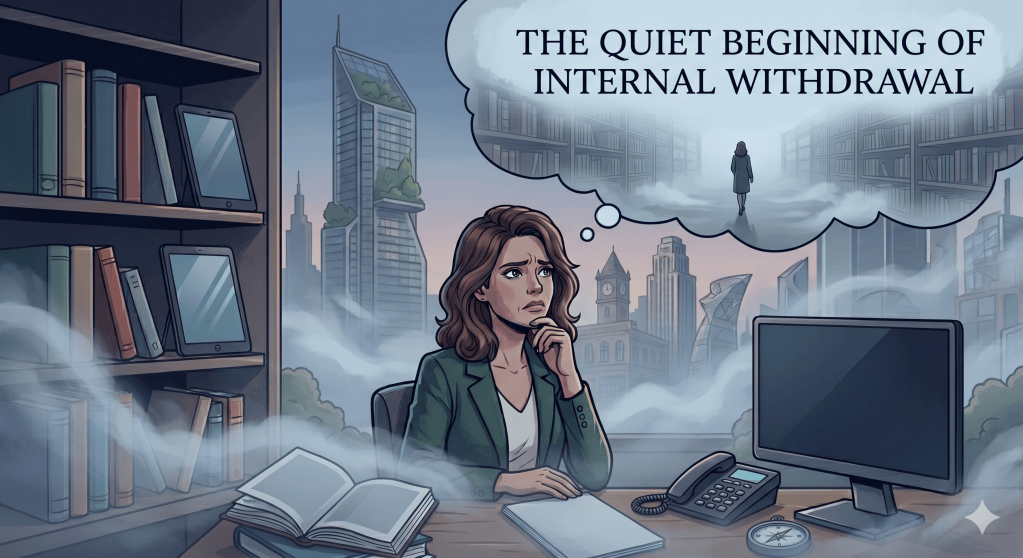
Explore the psychological, cultural, and neurological roots of internal withdrawal — how hyperconnection, economic anxiety, and digital design quietly reshaped human social behavior.
There is a specific kind of silence that settled over social life in the years following the mid-2000s — not the silence of absence, but the silence of people sitting together while their attention drifted somewhere else entirely. You’ve probably seen it at a dinner table: everyone present, nobody quite there. Phones face-down but never fully forgotten. Conversation interrupted by the reflex to check. The moment you looked up and realized that you had been somewhere else too, and that nobody seemed to think this was strange.
What was happening wasn’t simply distraction. People were beginning to retreat — not geographically, but psychologically. They were pulling the perimeter of their social world inward, spending more time inside their own heads, in curated online spaces, in the comfortable buffer of mediated communication rather than the messier friction of direct human contact. Researchers, clinicians, and sociologists would spend the following decade trying to measure what many people were already feeling on an instinctive level: that something important about how humans connected with each other was changing.
Some causes were heavier than others, and they didn’t arrive in order. Platform design and cognitive overload were the most direct force — the thing that created the initial conditions for retreat at scale. Economic precarity after 2008 deepened the risk aversion that made withdrawal feel not just comfortable but rational. Cultural narratives around introversion and “coziness” arrived later and gave the retreat a flattering name, though plenty of people had already been living it for years before the vocabulary caught up. And parasocial relationships quietly filled the space left by receding social contact, providing just enough warmth to reduce the urgency of seeking the real thing. These forces did not operate as a system. They were more like weather patterns that happened to be moving in the same direction — reinforcing each other where they overlapped, indifferent to each other where they didn’t, and producing effects that no single cause could explain on its own.
The Primary Engine: Attention Architecture
A System Designed to Exhaust
By the late 2000s and into the 2010s, more people were technically connected to more other people than at any point in human history. A person could maintain ongoing contact with hundreds of acquaintances, follow the daily movements of public figures, and participate in global conversations about politics, culture, and science — all from a couch. The optimists predicted this would produce a richer social world. Instead, for many people, it produced an exhausting one.
The volume of incoming human signal — opinions, updates, crises, controversies, performances of happiness and outrage — became something the brain simply wasn’t built to handle at scale. Anthropologist Robin Dunbar’s research on social group sizes suggested that humans are neurologically calibrated to maintain meaningful relationships with roughly 150 people. Beyond that, the cognitive costs of tracking individual relationships and investing emotionally begin to compound. Social media didn’t stretch that number — it shattered it. Survey data from the period consistently showed people reporting feeling overwhelmed by their social feeds while simultaneously feeling more isolated, a pairing that initially seemed contradictory and turned out to be entirely predictable.
The platforms themselves were not neutral conduits. Their business models were built on engagement: the longer a person spent on a platform, the more advertising revenue it generated. This created a powerful incentive to design environments that were compelling in the short term regardless of what they produced in the long term. Features like variable reward schedules — the unpredictable delivery of likes, comments, and notifications — exploited the same dopaminergic mechanisms that make slot machines hard to walk away from. Former engineers at major technology companies began speaking publicly about this in the mid-2010s, describing the deliberate application of behavioral psychology research to maximize time-on-platform. Connection was useful to them primarily as a mechanism for generating it.
Platforms made low-effort social contact frictionless, so the frequency of interaction increased while the depth tended to decrease. Broadcasting replaced dialogue. Consider what happened to the phone call: by the early 2010s, many people in their twenties had stopped making them almost entirely, defaulting to text — not because they were busier, but because a text could be composed, edited, and sent at their own pace, with no demand for real-time response. Whether this shift caused a decline in conversational skill or simply revealed a preference that had always been latent is genuinely difficult to untangle. Probably both. But the environment that resulted — one where nearly every social exchange had an edit function and an exit option — was unlike anything humans had previously inhabited, and it seems unlikely to have left behavior unchanged.
The Interior Life Under Pressure
The brain’s default mode network — the set of regions that activate during daydreaming, self-reflection, and internal narrative — was identified and studied extensively during the 2000s and 2010s. Neuroscientists found that it does important psychological work: processing experience, constructing a coherent sense of self, imagining future scenarios. It is the neurological home of the interior life, and it requires a particular kind of mental quiet to function.
The uncomfortable irony is that the same devices drawing people away from genuine social contact also appeared to disrupt their capacity for that quiet. Sustained, undirected internal thought — the kind that requires sitting without reaching for stimulation — seemed to atrophy in people who spent large portions of their day in high-stimulation digital environments. The platform had trained them out of both deep social engagement and genuine solitude. What remained was something in between: a state of low-grade connectivity that satisfied neither.
The Secondary Driver: Economic Precarity and Social Risk
The 2008 financial crisis and its prolonged aftermath produced a generation of young adults navigating job markets that were more precarious, more competitive, and less forgiving than those their parents had entered. A 25-year-old in 2013 was likely spending a larger share of their income on rent than their parents had at the same age, working without benefits or job security, looking at a housing market that had placed homeownership functionally out of reach. What that meant socially was less visible but equally consequential: the social infrastructure that stable geography provides — the standing dinner with the same people, the block where you know your neighbors’ names — quietly disappeared when people couldn’t afford to stay in one place long enough to build it.
Economic stress and social withdrawal have a well-documented relationship in psychology. When resources feel scarce and the environment feels threatening, people tend to contract their social world rather than expand it. Trust in institutions, strangers, and even neighbors declines. Robert Putnam had already tracked this pattern at a civilizational scale in his 2000 book Bowling Alone, documenting the steady erosion of civic participation, voluntary association, and informal neighborly contact across the latter half of the twentieth century. The 2010s deepened those trends with fresh material.
For younger people, economic anxiety and social media performance culture created a specific bind: social life had never been more visible or more apparently abundant, and yet the experience of genuine social belonging — being part of a stable community with reciprocal obligations and shared history — had rarely felt more elusive. The visibility made it worse. Watching others perform connection while feeling excluded from it generated not motivation to engage but motivation to retreat further. Many responded by managing their expectations downward, socializing less, and investing in online relationships that offered the appearance of connection with fewer of its more demanding requirements.
The Cultural Amplifier: Naming the Retreat
How Introversion Became an Aesthetic
Susan Cain’s 2012 book Quiet arrived at exactly the right cultural moment. It sold millions of copies and generated years of conversation about the undervalued introverted personality. The underlying science was real — people do vary meaningfully in how much social stimulation they find rewarding versus draining, and that variation has neurological roots. But the cultural resonance of the book went beyond its scientific claims. It offered something people were hungry for: a framework that made withdrawal feel not just acceptable but principled.
The concept of introversion was followed by “highly sensitive person,” “social battery,” and eventually an entire vocabulary of self-categorization that framed social limits as identity rather than circumstance. For many people, this language was genuinely clarifying. But it also functioned, for others, as permission — a way of framing avoidance as self-knowledge, and retreat as wisdom. The line between knowing your limits and refusing to stretch them is a real one, and the cultural conversation of the period often blurred it.
The “cozy” aesthetic that spread across social media platforms in the mid-2010s — the candles, the blankets, the hot drinks, the deliberate smallness of the domestic interior — was the visual expression of the same impulse, and it did something specific: it converted avoidance into identity. Staying in wasn’t a failure to show up; it was a considered choice made by someone who knew themselves. The bedroom with fairy lights became a symbol of intentional retreat, which made retreat easier to sustain and harder to examine. When withdrawal has an aesthetic, it also has a community, and when it has a community, the pressure to question it disappears. This is how a coping mechanism becomes a personality trait, and how a personality trait becomes a lifestyle, and how a lifestyle stops feeling like a response to anything at all.
The Feedback Loop: Parasocial Substitution
The final layer that locked the pattern in place was the most subtle. As people withdrew from direct social engagement, they didn’t typically experience emptiness. They experienced a different kind of fullness — one provided by parasocial relationships.
Parasocial relationships are one-sided connections in which a person develops genuine feelings of affection and familiarity with a public figure who doesn’t know they exist. They are not new — audiences have always formed attachments to performers and authors. But the scale and intimacy of parasocial connection expanded dramatically in the podcast and YouTube era, where creators spoke directly to their audiences in a conversational register, shared personal details, responded to comments, and built the texture of ongoing relationship. Someone who found direct social engagement draining could spend hours in the company of voices that felt warm, familiar, and safe — with no reciprocal demands whatsoever.
Research on parasocial relationships found they could reduce loneliness, provide a sense of belonging, and even model healthy social behavior — and those findings are probably accurate as far as they go. The harder question is what happens at the margin: when someone’s need for warmth and recognition is being met well enough by a podcast host who doesn’t know their name, how much does that reduce the pressure to seek connection that requires actual reciprocity? The research here is less settled. But the behavioral logic is straightforward enough — people tend to take the path that satisfies the need at lower cost — and there were millions of people for whom parasocial relationships made the distance between where they were and where they might have been feel less urgent.
What Happens to the Brain When It Withdraws
John Cacioppo spent decades studying loneliness and its physiological consequences. His findings changed how scientists understood social isolation: loneliness isn’t merely an emotional experience. It activates the body’s stress response systems, elevates cortisol, disrupts sleep, suppresses immune function, and accelerates cognitive decline over time. The subjective feeling of being lonely, Cacioppo argued, is evolution’s signal to the organism that it needs to reconnect — the social equivalent of hunger. When that signal is chronically ignored or suppressed, the physiological consequences accumulate.
The critical distinction in his work was between objective social isolation and subjective loneliness. You could be surrounded by people and feel profoundly disconnected. You could be physically alone and feel little loneliness at all. What registered was not the quantity of social contact but its perceived quality — the sense of being genuinely known and cared for by others. And it was precisely this quality that was eroding even as the surface metrics were rising. Part of the explanation may lie in the nature of platform-mediated interaction itself: when you are broadcasting to many people at once, nobody is really receiving you. The social contact is real in some sense — someone liked your post, someone replied — but the brain’s circuitry for belonging appears to be calibrated to something more specific than that, to exchanges that feel mutual and attentive rather than diffuse.
The separate science of avoidance helps explain why the pattern entrenched itself. In behavioral psychology, avoidance maintains anxiety. When a person sidesteps a situation they find uncomfortable — social situations, in this case — they experience short-term relief, which reinforces the avoidance. The underlying anxiety isn’t resolved; it typically intensifies, because the person never has the experience of successfully navigating what they feared. Over time, the zone of comfortable social engagement narrows. Psychologist Sherry Turkle documented this with troubling specificity in her 2015 book Reclaiming Conversation: young people describing not just a preference for text over phone calls, but genuine anxiety around unscripted social situations — conversations they couldn’t edit before sending, interactions they couldn’t exit cleanly. The technology hadn’t created that anxiety from nothing, but it had built an environment in which avoidance was always easier than engagement, and the easier choice had consequences.
Population-level data from the 2010s reflected something shifting. Rates of anxiety disorders, depression, and reported loneliness were rising across much of the developed world, with particularly sharp increases among adolescents and young adults. The causes were debated — social media use, changing diagnostic practices, economic stressors, reduced outdoor activity — and were almost certainly multi-causal. But the retreat from face-to-face social engagement, and the atrophy of the social skills that sustained it, was a mechanism that kept surfacing in the research.
The Open Question
The quiet beginning of internal withdrawal was not an ending. The COVID-19 pandemic, when it arrived in 2020, operated as an amplifier: it took tendencies that had been developing gradually and accelerated them with sudden, mandatory force. The habits of withdrawal that had been forming — preference for mediated over direct contact, the atrophy of spontaneous socializing, the retreat into domestic and digital space — became the only available option for much of the world. When restrictions lifted, many people found that the transition back was harder than anticipated. The internal landscape had been reorganized.
What remains genuinely unresolved — and this is harder to sit with than any of the mechanisms described above — is whether awareness of this process changes it. The research is widely available. The former engineers have given their interviews. The loneliness data has been reported in mainstream outlets, cited by surgeons general, discussed in congressional hearings. People broadly understand, at least abstractly, that something has been lost. And yet the conditions producing the withdrawal haven’t changed. The attention architecture is more sophisticated now, not less. The economic precarity that made social risk feel unaffordable didn’t reverse. The cultural vocabulary that made retreat legible is fully embedded. The parasocial ecosystem is larger and more immersive than it has ever been.
This is the part that the model can’t explain: why knowing the mechanism doesn’t reliably disrupt it. People who understand avoidance reinforcement still avoid. People who know that parasocial warmth is not the same as genuine connection still prefer it, because genuine connection is harder and the outcome is less certain. This may be where the story of internal withdrawal stops being a sociology problem and becomes something more difficult — a question about whether the conditions under which people are willing to be uncomfortable with each other can be rebuilt once they’ve been dismantled, or whether withdrawal, at sufficient scale and duration, stops being a deviation from the norm and simply becomes the norm.
That question doesn’t have an answer yet. The beginning was quiet. It’s less clear what comes next.









