
Originally published in November 2018 and comprehensively updated/edited in June 2026.
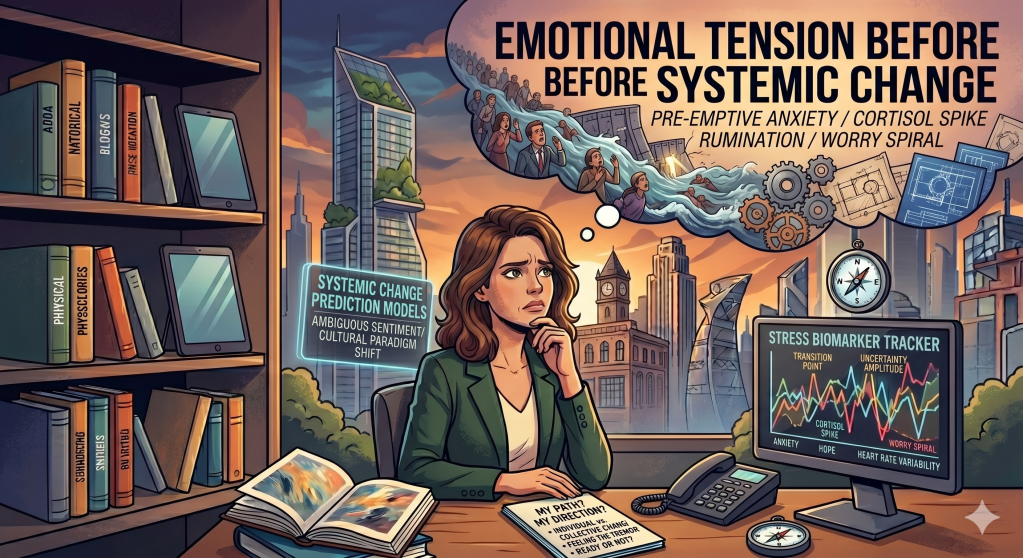
How psychology, neuroscience, and sociology explain the emotional tension people experienced before major systemic change — and why that tension was both predictable and meaningful.
There are moments in history when the atmosphere changes before anything official does. The rules haven’t shifted yet. The institutions are still standing. But something underneath has given way — and nearly everyone can feel it, even if they can’t quite name it. The years surrounding 2018 were exactly that kind of moment. And understanding what was happening psychologically and socially during that window helps explain a great deal about what came after.
This essay is about that in-between state: the emotional texture of a society under pressure, on the edge of significant change but not yet through it. It draws on research from psychology, neuroscience, and sociology to examine why periods of systemic transition feel the way they do — and why the anxiety, anger, and disorientation people experience in these times are not signs of dysfunction, but rather predictable human responses to a world in flux.
A note on scope: “2018” here is a shorthand for a set of pressures that intensified across several years and that played out differently across different societies, demographics, and political contexts. The United States was not Britain was not Brazil. Working-class deindustrialized communities were not living through the same experience as urban professional-class ones. The essay treats this period as a loose constellation of converging conditions, not as a single unified moment that everyone experienced the same way.
This essay approaches that constellation through three overlapping lenses: cognitive, institutional, and informational. Each captures a real dimension of what was happening. Each operates at a different level of explanation. They interact and reinforce one another, but they are not the same kind of claim — and keeping them distinct matters if we want to understand the period rather than just describe the feeling of it.
The experience of living through a systemic transition is distinct from ordinary stress. It’s less like a storm you can wait out and more like the ground subtly shifting beneath you. The old maps no longer match the terrain, but the new ones haven’t been drawn. That’s the condition this essay explores — and at the center of it is a single mechanism worth understanding clearly before everything else.
The Cognitive Lens: Why Illegibility Feels Like Threat
The Prediction Error at the Center of It All
Start with a narrow claim from cognitive science, because it generates a surprising amount of downstream explanation. Karl Friston’s predictive processing framework — influential in neuroscience and cognitive science, though still debated in its fuller implications — proposes that the brain is fundamentally a prediction machine. It doesn’t passively receive the world; it continuously generates models of what’s about to happen and updates those models when reality departs from them. The gap between prediction and outcome is called a prediction error, and the brain treats persistent, unresolvable prediction errors as a signal that something in the environment demands attention.
This framework is most clearly established at the level of perception and motor control, where the evidence is strong. Extending it to account for complex social behavior requires considerably more caution. But at a moderate level of generality, it offers something useful: a way of understanding why illegibility — the sense that the world no longer follows the rules you thought it did — registers as discomfort rather than neutral confusion. When the social environment stops behaving predictably over a sustained period, the result isn’t just uncertainty. It’s something that functions like low-grade threat, because the predictive system that keeps behavior organized is persistently failing.
This matters because it connects a cognitive mechanism to a social outcome without requiring the brain to “know” anything about politics or history. The mechanism is indifferent to the cause of illegibility. It responds the same way whether the prediction errors arise from a collapsing marriage or a collapsing institution.
From Illegibility to Closure
What does a mind under persistent prediction error tend to do? Research in social psychology describes a predictable pattern. When people experience diffuse, hard-to-source threat, they move toward what psychologists call need for cognitive closure — a strong preference for definite answers over ambiguous ones, for clear group boundaries over blurry ones, for familiar frameworks over novel ones. This isn’t pathology; it’s a documented response to cognitive overload and ambient uncertainty. Arie Kruglanski, who developed much of this research, showed that closure-seeking increases when people are under time pressure, when they’re mentally fatigued, and when the environment feels chaotic.
Here is where the cognitive mechanism connects to the political sociology — but the connection is not direct, and the gap matters. Widespread closure-seeking doesn’t translate into political polarization by itself. What determines which closure strategies actually become available to people, which identities they can plausibly sort into, which explanatory narratives are on offer — those are institutional and structural questions. A person experiencing cognitive overload in a political system with strong mediating institutions, a functioning cross-partisan media, and stable economic pathways may resolve that discomfort differently than someone experiencing the same internal state in a context where those things have eroded. The cognitive mechanism sets up the demand; the social environment supplies the available responses.
This is the missing step that pure cognitive accounts of polarization tend to skip over. In the period around 2018, several structural conditions were simultaneously narrowing the range of available closure strategies toward more polarized ones. Media ecosystems were amplifying conflict narratives over compromise ones because conflict generates more engagement. Economic precarity was making identity-based group membership more psychologically attractive because formal institutions — unions, professional associations, civic organizations — were no longer providing as much of that function. Political entrepreneurs, operating rationally within their incentive structures, had learned that delivering clarity and enemies was more electorally productive than delivering complexity and tradeoffs.
The cognitive mechanism doesn’t explain any of that. What it explains is why people were primed to accept what those structures were offering. People sort into groups that offer clear identities and clear enemies, tolerance for ambiguity declines, political movements that provide crisp explanations become more appealing — not because they are more accurate, but because they resolve persistent uncertainty at low cognitive cost. That’s a real dynamic. But it operates on material that institutions and incentive structures have already shaped.
This is one mechanism among several, and a partial one. It doesn’t explain everything about polarization, which has causes operating at multiple levels. It does suggest, though, that some of what looked like ideological radicalization in this period was being produced by the interaction between a cognitive tendency under stress and a structural environment that was channeling that tendency in particular directions. The move toward certainty is not irrational given the conditions that produce it — but those conditions are not just psychological.
The Institutional Lens: What Was Actually Collapsing
The Ground Beneath the Feeling
The cognitive response described above doesn’t occur in a vacuum. It’s triggered by something real in the social environment. The institutional lens is where we ask: what had actually become illegible, and why?
It’s worth being more precise here than the word “illegibility” on its own allows, because different things were becoming hard to read in different ways. There is epistemic illegibility — uncertainty about what is actually true, which sources can be trusted, which version of contested events is accurate. There is institutional illegibility — uncertainty about who has legitimate authority to decide things, how processes will resolve, whether rules will be enforced consistently. And there is social illegibility — uncertainty about where you belong, what your group membership means, whether the social categories you’ve navigated by still hold. These three kinds of uncertainty feel different from the inside, and they operate through different mechanisms. Blending them under a single term can make the period seem more unified than it was — a monoculture of confusion — when in practice people were experiencing different combinations of these strains depending on their circumstances.
What the years around 2018 were unusually characterized by was all three types occurring in overlapping, mutually reinforcing ways, across many societies simultaneously. That overlap is what made the period feel so disorienting to so many people in such different situations. But it’s worth holding the distinctions even while noting their convergence.
The institutional variety was perhaps the most structurally significant. The years around 2018 were marked by the simultaneous erosion of authority across multiple institutional domains. Major institutions — political parties, media organizations, religious bodies, financial systems — were losing the credibility they had long held. Pew Research surveys from this period showed declining trust in government, press, and civic organizations across the United States and much of Western Europe. Crucially, this wasn’t simply partisan in character. Both left and right expressed declining confidence in core institutions, though they directed that distrust at different targets and drew different conclusions from it.
When institutions lose authority, they lose a specific function: they stop reliably organizing expectations. People can no longer predict how political processes will resolve, how information will be adjudicated, how professional norms will be enforced. The social rules that had, in the background, structured daily life become contested. This is the macro-level source of the institutional prediction errors described above — not a single dramatic rupture, but a gradual degradation of the scaffolding that makes the question who decides? answerable.
Status Anxiety and the Collapse of Work as Identity
Alongside institutional uncertainty, this period was characterized by a particular kind of social strain: widespread anxiety about position, recognition, and belonging. Sociologists use the term status anxiety to describe the distress people experience when they feel their social standing is threatened or unclear.
Economic data from the decade leading into 2018 had revealed something important about how inequality was playing out in lived experience. While overall GDP figures in many countries had recovered from the financial crisis of 2008, the benefits of that recovery were distributed in ways that felt deeply unequal to large segments of the population. Real wages for middle and working-class earners had remained largely stagnant while asset prices — homes, stock portfolios — had climbed substantially, concentrating gains among those who already held them.
But status anxiety isn’t only about money. Sociologist Robert Sennett and others have written extensively about how the nature of work itself had been changing — from stable, predictable employment toward more contingent, gig-based arrangements. That shift wasn’t just financial. It also disrupted the sense of identity and social membership that steady work had historically provided. Work, in most modern societies, is one of the primary ways people answer the question: who am I? When work becomes unstable or is automated away, the identity scaffolding it provides becomes unstable too. And identity disruption is its own source of prediction error — because if you don’t know who you are in relation to others, you can’t predict how social interactions will go.
The Informational Lens: How the Media Environment Changed the Conditions of Thought
The Attention Economy Comes of Age
By 2018, social media platforms had become the primary environment through which many people experienced public life. Facebook had more than two billion monthly active users. Twitter had become the de facto space for public discourse and breaking news. YouTube, Instagram, and a growing ecosystem of podcasts and news aggregators had fragmented the shared media landscape that had held through the twentieth century.
The psychological effects of this transformation were just beginning to be understood. Early research on social media use had been broadly optimistic — platforms could connect isolated individuals, facilitate civic organizing, distribute information rapidly. But a more complicated picture was emerging. Studies published in the Journal of Social and Clinical Psychology and elsewhere were finding correlations between heavy social media use and elevated rates of depression and anxiety, particularly among adolescents and young adults. The causal mechanisms were being debated, but several hypotheses had strong support: social comparison effects, disrupted sleep from blue-light exposure and evening engagement, reduced face-to-face social interaction, and the particular psychological toll of what researchers called “passive consumption” — scrolling without actively engaging.
Beyond individual mental health, something more structural was happening. The business model of attention-based platforms — generating revenue through advertising sold against user engagement — created powerful incentives to serve content that provoked strong emotional reactions. Outrage, fear, indignation, and tribal solidarity all generate clicks, shares, and dwell time. The algorithmic systems optimizing for engagement were, in effect, optimizing for emotional arousal, which is not the same thing as optimizing for accurate information or reflective thinking.
The Stratification of Epistemic Authority
This is not a claim that platforms were malevolent. It’s a structural observation about incentives and outcomes. The result, by the late 2010s, was an information environment characterized by what researchers sometimes call epistemic fragmentation — the erosion of shared factual authority across networks. People were increasingly consuming news and information from sources that confirmed existing beliefs, surrounded by social networks that reflected back similar views. This phenomenon, often called the filter bubble, was perhaps somewhat overstated in its early framing, but the broader dynamic was real: the social context in which information was received had become deeply important to whether or how that information was believed.
What this did to public discourse was significant, but it’s worth being precise about what actually happened. Shared reality didn’t simply collapse — that framing is too dramatic and obscures an important structural point. What eroded was shared epistemic authority: agreement about which sources, institutions, and processes had the standing to adjudicate contested claims. The factual disagreements that became so visible in this period were often downstream of that more fundamental shift. When people couldn’t agree on which sources were credible, they couldn’t agree on which facts to accept. Disagreements that once had a shared empirical foundation became disagreements about the foundation itself — and that’s a different kind of problem than ordinary factual dispute, because it’s harder to resolve through more information.
Social psychologist Tali Sharot has written about how deeply beliefs are anchored in social identity. We don’t evaluate information only on its logical merits; we evaluate it in the context of who is telling us and what our social group believes. This isn’t irrationality — it’s a well-documented tendency that likely served useful functions in smaller, slower social environments. In the high-velocity, algorithmically mediated information environment of 2018, it contributed to a kind of epistemic tribalism that made shared public deliberation increasingly difficult.
Notice how the informational lens connects back to the cognitive one. Epistemic fragmentation generates its own prediction errors — people encountered information that contradicted what their social networks believed, or discovered that trusted sources were behaving unreliably, or found themselves unsure which version of a contested event was accurate. The informational environment wasn’t just confusing in a general sense; it was specifically producing the kind of persistent, unresolvable uncertainty that, at the cognitive level, triggers the closure-seeking described earlier. And it was doing so while simultaneously narrowing the range of available closure narratives toward more tribal ones, because those are the narratives that perform best in engagement-optimizing media systems. The three lenses aren’t independent explanations — they’re interlocking feedback loops, with structure shaping where the cognitive tendencies land.
Collective Stress and the Body Politic
Social Contagion and Emotional Climate
One of the more striking findings from social psychology in recent decades is the degree to which emotions spread through social networks much as viruses do — through contact, often below conscious awareness. This is called emotional contagion, and it operates at both small and large scales. In a workplace, the mood of a team leader measurably affects the emotional state of team members. Across a society, the aggregate emotional tone of public culture influences individual psychological states even among people who don’t directly engage with political media.
By 2018, the aggregate emotional tone of public culture in many countries had become distinctly elevated. This wasn’t simply a matter of political disagreement; political disagreement had always existed. It was more that the emotional register in which disagreement was conducted had shifted toward the high end of the arousal spectrum. Anger, contempt, and fear were increasingly the dominant currencies of public communication.
Psychologist James Gross, whose work on emotion regulation is foundational in the field, has written about how different social environments either support or undermine effective emotional regulation. Environments characterized by chronic high-arousal, threat-focused communication tend to make sustained, reflective thinking harder for individuals operating within them. The effect isn’t mysterious: when attention is repeatedly captured by urgent, emotionally intense content, it becomes more difficult to maintain the kind of patient, ambiguity-tolerant processing that complex social problems require. The social environment of high emotional intensity wasn’t just unpleasant — it may have been systematically degrading the cognitive conditions that the kind of political thinking democracies depend on requires.
The Exhaustion Nobody Named
Something else was happening in 2018 that was harder to measure but widely reported in qualitative accounts: a kind of accumulated exhaustion that wasn’t quite depression and wasn’t quite burnout, but partook of both. Therapists and counselors were reporting that clients were describing a general feeling of being worn down by the pace of events — news cycles, social controversies, cultural conflicts — without being able to point to a specific cause.
This experience maps onto what psychologist Christina Maslach’s research on burnout describes: emotional exhaustion arising not from a single overwhelming event but from sustained low-to-moderate demands that never fully relent. The always-on information environment, the sense that something significant was happening at all times and that it required attention and response, produced exactly the kind of sustained demand that Maslach’s framework would predict leads to depletion.
There was also a generational dimension to this. Research from Jean Twenge, whose work on generational psychology is both widely cited and actively debated, suggested that young adults coming of age in the mid-to-late 2010s showed elevated rates of anxiety and depression compared to prior generations at the same age. The causes were multiple and contested — smartphone adoption, economic precarity, weakened social institutions, delayed traditional life milestones — but the pattern itself was consistent across multiple datasets. The psychological condition of young adults during this period was significantly different from that of earlier cohorts at comparable stages of life.
Movements, Moments, and the Chemistry of Collective Action
When Private Pain Goes Public
One of the defining features of this period was the way in which experiences that had historically been private — particularly experiences of workplace abuse, sexual harassment, and racial discrimination — became subjects of public, often viral, reckoning. The #MeToo movement, which gained significant momentum in late 2017 and continued through 2018, is the clearest example. Similar dynamics were visible in movements organized around racial justice, economic inequality, and political representation.
From a sociological perspective, these eruptions of collective action weren’t spontaneous. They followed patterns well documented by sociologists like Charles Tilly and Sidney Tarrow, who describe how social movements emerge not simply from grievance (which is often widespread and persistent) but from a particular confluence of grievance, organizational capacity, and a cultural moment that makes the grievance newly legible and urgent. Social media platforms, for all their documented downsides, had created some of the organizational infrastructure that older models of collective action relied on: rapid communication, network effects, the ability to identify and connect with people sharing similar experiences.
There’s also a psychological component. Research on collective emotion suggests that experiencing shared feelings with others — recognizing that your private pain has public resonance — can produce effects that are simultaneously cathartic and energizing. The discovery that you are not alone in an experience that felt isolating can shift the emotional orientation from shame or defeat toward something closer to solidarity and agency. This was a recurring theme in accounts from people who participated in these movements.
The Paradox of Heightened Consciousness
But collective movements in this period also produced their own psychological pressures. As conversations about systemic injustice expanded — about racism, sexism, economic inequality, climate change — many people experienced what researchers have called heightened moral consciousness: an expanding awareness of the ways in which social systems produce harm, often in ways that implicate ordinary behavior. This is psychologically complex.
Expanded moral awareness can be motivating. It can orient people toward meaningful action. But it can also produce a form of chronic guilt or moral overwhelm — what philosopher Kate Manne has called the experience of confronting demands that exceed any individual’s capacity to respond fully. When the scale of systemic problems becomes visible, the gap between the problem and what any single person can reasonably do about it can produce paralysis rather than action.
This dynamic contributed to a cultural atmosphere that was simultaneously characterized by high moral energy and significant psychological strain. Both were real; neither fully explained the other.
What Systemic Change Actually Feels Like From the Inside
The Long Prelude
History, viewed at a distance, tends to look cleaner than it felt at the time. We identify inflection points, turning years, decisive moments. But people living through periods of systemic transition rarely experience that clarity. What they experience instead is usually a prolonged, uncomfortable in-between — old structures losing coherence before new ones have formed, familiar certainties dissolving without immediate replacements.
This is what sociologists call a liminal period, borrowing the term from anthropologist Victor Turner’s work on ritual transitions. The word comes from the Latin for threshold: a liminal space is neither the room you’ve left nor the room you’re entering. Turner observed that liminal periods are characteristically disorienting, anxiety-provoking, and prone to social conflict — not because something has gone wrong, but because transition itself produces these conditions.
What’s important about Turner’s framework is that it destigmatizes the distress of transition. Disorientation, conflict, and emotional intensity during a liminal period aren’t symptoms of social dysfunction — they’re features of the process. A society undergoing significant change is supposed to be unsettled. The question isn’t how to eliminate the distress but how to navigate it well enough to reach the other side.
The Difference Between Reaction and Response
At the individual psychological level, this distinction matters enormously. Research on resilience — particularly the work of George Bonanno at Columbia University and others — suggests that what differentiates people who navigate stressful transitions relatively well from those who become stuck isn’t the absence of distress. It’s the presence of certain capacities: the ability to maintain flexible thinking under pressure, to draw on social connection, to tolerate ambiguity without collapsing into premature certainty, and to act despite incomplete information.
These same capacities matter at a collective level. Societies navigating threshold moments well tend to maintain spaces — institutional, cultural, interpersonal — where the discomfort of uncertainty can be held without immediately resolving into conflict or rigidity. Where those spaces collapse, the transition becomes more turbulent.
In 2018, some of those spaces were under significant pressure. But they weren’t entirely gone. Communities of practice, local institutions, informal social networks, and certain kinds of journalism and public intellectual culture were still functioning as containers for difficult collective thinking. Understanding that those spaces exist and matter is part of what makes a historical moment more legible — not in retrospect, but as it’s happening.
Looking Forward From the Edge
The years surrounding 2018 were not an anomaly in historical terms. Periods of rapid technological change, economic restructuring, and cultural transformation have regularly produced the conditions described here: institutional distrust, status anxiety, epistemic fragmentation, heightened collective emotion, and the particular exhaustion of living in a liminal moment. What was somewhat novel in this period was the speed and scale at which these pressures operated — accelerated by digital communication, amplified by global interconnection, and experienced simultaneously across many societies at once, even as those societies were living through versions of the same pressures that differed considerably in content and intensity.
Understanding this period through the lens of psychology and social science doesn’t resolve the political questions it raised. Those were genuine disagreements about values, interests, and the future organization of society — and science doesn’t adjudicate those. What the three lenses examined here can do is illuminate the conditions under which those disagreements were taking place. The cognitive lens explains why illegibility triggers closure and sorting. The institutional lens explains what had actually become illegible. The informational lens explains how the media environment was amplifying both.
Together they suggest something more precise than a simple cognitive explanation of political conflict. The disagreements of this period were real — about values, interests, power, and the future organization of society. The cognitive and structural conditions described here didn’t manufacture those disagreements. What they did was modulate the form they took: making them harder to hold with nuance, more likely to express as sorting and exclusion, more resistant to the kinds of deliberative processes through which disagreements can sometimes be navigated rather than merely intensified. That’s a meaningful claim, but a more limited one than saying the conflict was primarily a product of psychological stress. The stress shaped how the conflict was conducted; it didn’t create what the conflict was about.
And that is perhaps where the honest assessment has to leave things. Understanding the pattern doesn’t dissolve it while you’re inside it. Knowing that liminal periods produce disorientation doesn’t make the disorientation go away. Recognizing the mechanism behind closure-seeking doesn’t inoculate against it. What the framework offers is not a way out of the discomfort but a way of seeing it more clearly — which is a different and more limited thing. Whether clarity is enough depends on what comes next. That, at the time of writing, remained an open question.









