
Originally published in April 2019 and comprehensively updated/edited in June 2026.
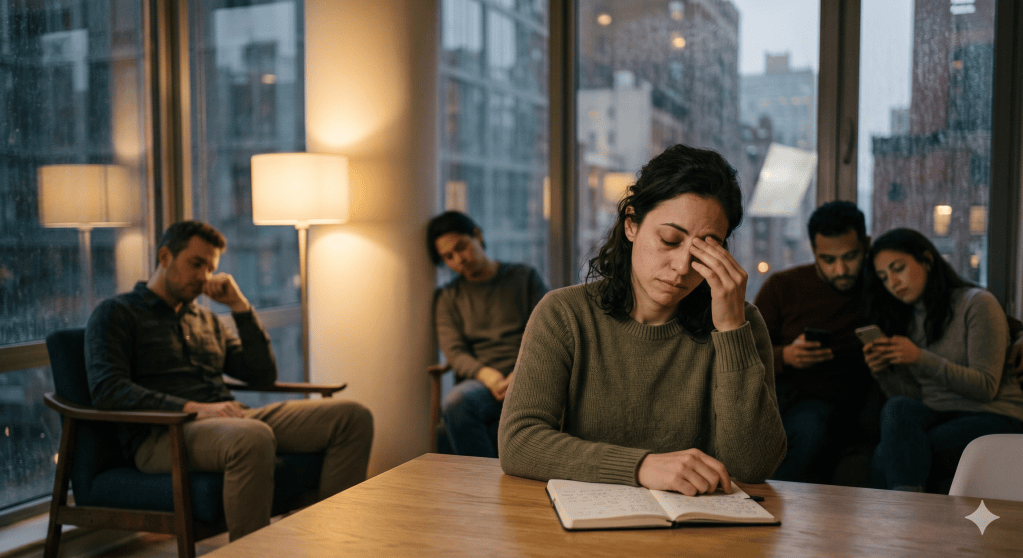
Why did so many people feel burned out in 2019? This essay examines the psychological, neurological, economic, and technological forces behind collective exhaustion — and what it revealed about modern life.
There was a peculiar exhaustion in the air around 2019. Not the kind that comes from running a marathon or pulling an all-nighter before a deadline. This was something heavier and more diffuse — a bone-deep weariness that many people felt but couldn’t quite name. Conversations kept circling back to it. “I’m so burned out,” people would say, almost apologetically, as if the feeling were a personal failing rather than a shared condition. Social media feeds filled with memes about needing a nap, avoiding obligations, and fantasizing about canceling plans. The exhaustion had become a cultural joke, and like most jokes, it was covering something real.
What was actually happening? Why, in a period of relative economic recovery, declining violent crime, and unprecedented access to entertainment and convenience, did so many people feel simultaneously overwhelmed and depleted? The answer turns out to involve a convergence of forces — psychological, technological, economic, and neurological — that had been building for years before they crystallized into a recognizable phenomenon. Understanding that exhaustion requires looking at what was quietly happening inside people’s brains, inside their workplaces, and inside the devices they carried everywhere.
The Word Everyone Was Using: Burnout
In 2019, the World Health Organization formally classified burnout as an “occupational phenomenon” in its International Classification of Diseases. It was a significant moment — institutional recognition that something widespread and measurable was affecting workers across industries and income levels. Importantly, the WHO did not classify burnout as a medical disorder but as an occupational syndrome associated with chronic workplace stress — a distinction that matters, because it locates the problem in the conditions of work rather than in the psychology of the individual worker. The WHO described it as resulting from chronic workplace stress that hadn’t been successfully managed, characterized by three dimensions: feelings of energy depletion or exhaustion, increased mental distance from one’s job, and reduced professional efficacy.
But even that clinical framing felt too narrow for what people were experiencing. Burnout was spilling outside of work. Parents reported it. Students reported it. People between jobs reported it. The concept had escaped its occupational container.
When a Clinical Term Goes Mainstream
Part of what made 2019 such a pivotal moment was a widely shared essay by journalist Anne Helen Petersen, published in January of that year, which argued that millennials in particular had been raised to think of themselves as human capital — optimized, productive, always improving — and that this orientation had made basic life tasks feel insurmountable. The piece struck a nerve because it described something a lot of people recognized: the inability to complete simple errands that had been sitting on a mental to-do list for weeks or months, not from laziness, but from a kind of cognitive paralysis rooted in permanent low-grade overload.
The timing was not accidental. Petersen was writing about millennials, a generation that had entered the workforce during or just after the 2008 financial crisis, in many cases carrying student debt and navigating a labor market that demanded more flexibility, more availability, and more self-promotion than any previous generation had been expected to manage. The informal contract between employers and employees — stability in exchange for loyalty — had been dissolving for decades, replaced by a model in which workers were expected to treat themselves as brands, constantly networking, upskilling, and demonstrating value.
What Stress Does to the Brain Over Time
To understand why chronic low-grade stress produces such profound exhaustion, it helps to understand what stress actually does to the brain — not the acute burst of adrenaline that gets you through a crisis, but the sustained, ambient kind that never fully resolves.
The human stress response evolved for a specific purpose: to mobilize energy quickly in dangerous situations. When the brain perceives a threat, the hypothalamus activates the sympathetic nervous system, triggering the release of cortisol and adrenaline. Heart rate increases, digestion slows, attention narrows. The body is primed to fight or flee. This system is extraordinarily effective for short-term crises. It becomes a problem when it’s activated chronically, for threats that don’t resolve because they’re not physical predators but financial anxiety, social comparison, workplace pressure, and the constant low hum of a 24-hour news cycle.
Research from neuroscientists including Robert Sapolsky, whose work on stress in primates and humans has been deeply influential, established that prolonged exposure to cortisol has measurable effects on the brain — particularly on the hippocampus, which is involved in memory and learning, and the prefrontal cortex, which governs decision-making, impulse control, and what psychologists call executive function. When those regions are chronically bathed in stress hormones, their performance degrades. People find it harder to concentrate, harder to make decisions, harder to begin tasks. They feel overwhelmed by things that wouldn’t normally overwhelm them.
This is not weakness. It is biology operating exactly as designed, just in an environment it wasn’t designed for.
The Attention Economy and Its Costs
Layered on top of workplace stress was something relatively new: the smartphone-mediated attention economy. By 2019, the average American was spending somewhere between three and four hours per day on their phone, with a significant portion of that time spent on social media platforms that had been deliberately engineered to be difficult to put down.
The mechanics of this engineering have since been documented extensively, including in testimony before Congress and in books by former tech industry insiders. Platforms like Facebook, Instagram, and Twitter used variable reward schedules — the same psychological mechanism that makes slot machines compelling — to keep users checking and refreshing. Likes, comments, and notifications delivered small, unpredictable doses of social validation that activated the brain’s dopamine system. This created habitual checking behaviors that were difficult to interrupt even when users consciously wanted to stop.
The cognitive cost of this constant interruption was substantial. Researchers studying attention fragmentation found that it took, on average, around 23 minutes for a person to fully return to a task after being interrupted. If a person checked their phone several times per hour — which many people did — they might never reach the state of deep focus that makes complex intellectual work feel manageable and satisfying. Everything stayed on the surface. The day ended without the feeling of having accomplished anything substantial, even if many tasks had technically been completed.
There was also the less-discussed cost of emotional labor involved in navigating social media. Every time a person opened Twitter or Facebook, they were exposed to a stream of content that included interpersonal conflict, outrage, political argument, and distressing news. Processing this content required emotional resources. Cognitive scientists use the term “ego depletion” — now somewhat contested in its original formulation but still useful as a conceptual frame — to describe the way in which willpower, decision-making capacity, and emotional regulation all draw on a common pool of mental resources. When that pool is repeatedly drained by digital friction and ambient social stress, people arrive at the end of the day with less available for their actual lives.
The Burden of Constant Choice
Underneath the attention economy problem was a quieter one that rarely got named directly: decision fatigue. The term comes from research in psychology and behavioral economics — work by Roy Baumeister, Jonathan Levav, and others — suggesting that the quality of human decision-making deteriorates after a person has made many decisions in a row. The mental resources required for choosing are finite, and they deplete across the day in ways that are measurable and predictable.
This had always been true of human cognition. What changed in the modern era was the sheer volume of decisions that daily life demanded. Food choices alone had multiplied enormously — a typical American supermarket in 2019 stocked tens of thousands of individual products, and meal delivery apps had expanded the options further still. Financial decisions had grown similarly complex: investment platforms offered thousands of options, subscription services required constant evaluation of whether the value justified the cost, and the gig economy turned every freelancer into a one-person accounting department. Career decisions, once relatively stable, had become perpetual — in a labor market that expected continuous upskilling, job-switching, and personal branding, there was never a moment when professional strategy could be set aside.
Beyond those domains, people in the late 2010s were also expected to optimize their health through nutritional choices and fitness regimens, curate their online presence across multiple platforms, manage their social lives through an array of messaging apps, and stay informed across a news landscape that had fragmented into hundreds of competing outlets and newsletters. Each of these decisions carries some cognitive weight. Individually, trivial. Cumulatively, exhausting.
Some of the more dramatic findings in this research area have faced replication challenges, but the underlying principle — that deliberative capacity is a limited resource subject to depletion — is supported by enough converging evidence to be taken seriously. By the late 2010s, many people were effectively running a cognitive deficit from early morning, before they’d encountered the significant demands of their day.
The Economics of Exhaustion
The fatigue of the late 2010s wasn’t only psychological. It had material roots that were easy to overlook in a period when unemployment numbers looked favorable.
The post-2008 labor market had restructured in ways that shifted risk and uncertainty downward, onto individual workers. Gig economy platforms had grown significantly, offering work arrangements that provided flexibility while removing benefits, predictability, and the social protections that traditional employment carried. Even workers in conventional jobs faced increasing demands: more was expected, often with no corresponding increase in compensation when adjusted for inflation.
Research by economists like Lawrence Katz and Alan Krueger suggested that the growth of “alternative work arrangements” — independent contracting, on-call work, temporary agency work — had accounted for a substantial share of employment growth in the decade following the financial crisis. This shift meant more people were managing their own schedules, their own taxes, their own insurance, and their own career development simultaneously. Each of these administrative burdens is individually manageable; together, they constitute a significant cognitive and logistical load.
The Mental Load Nobody Talked About
Inside households, a parallel phenomenon was receiving increasing attention: the concept of the “mental load,” sometimes called “cognitive labor” or “the invisible workload.” This referred to the behind-the-scenes management work involved in running a household and a family — remembering appointments, tracking supplies, anticipating needs, coordinating schedules, researching decisions. Unlike physical housework, this kind of labor is invisible in the sense that it produces no visible artifact when it’s done well, only visible failures when it isn’t.
Sociologists had studied unequal distributions of household labor for decades, but the mental load concept added a new dimension: even in households where physical chores were shared relatively equitably, the planning, monitoring, and worrying tended to remain concentrated. The French cartoonist Emma had popularized the concept in a widely-shared 2017 comic strip, and researchers including Allison Daminger at Harvard published academic work examining how this invisible cognitive labor was distributed along gendered lines. The finding — that women disproportionately carried not just the doing but the remembering and the anticipating — helped explain a specific and pronounced dimension of why everyone was tired, and why women, statistically, reported higher levels of exhaustion than men during this period.
The Optimization Imperative
Running through both the economic and personal dimensions of this exhaustion was a cultural logic that had become so pervasive it was nearly invisible: the expectation of continuous self-optimization. The idea wasn’t entirely new — self-improvement has been an American theme since at least the era of Benjamin Franklin — but the late 2010s version had a different quality. It wasn’t just about being a better person. It was about being a more efficient one.
The language was everywhere. Productivity culture had developed its own genre of books, podcasts, and apps. The quantified self movement encouraged people to track sleep, steps, heart rate variability, caloric intake, and mood through wearable devices and smartphone apps, turning the body into a system to be monitored and tuned. Side hustles were widely discussed not as economic necessity but as personal branding opportunities — ways to develop skills, build audiences, and diversify income streams in preparation for a labor market that could not be relied upon. Networking was reframed as relationship capital. Relationships themselves were sometimes discussed in the language of portfolio management.
This orientation created a specific kind of exhaustion that was hard to articulate because it arrived even when things were going well. People who were technically succeeding — hitting professional benchmarks, maintaining fitness routines, building their platforms — often reported feeling just as depleted as those who were struggling. In some ways, more so. The optimization imperative had eliminated the concept of good enough. Every domain of life became a project, and projects require management.
Psychologists who study motivation make a useful distinction between intrinsic motivation — doing something because you find it meaningful or enjoyable — and extrinsic motivation, doing something for external rewards or to avoid external consequences. Research consistently finds that extrinsic motivation crowds out intrinsic motivation over time. When exercise becomes a data point to track, when cooking becomes content for Instagram, when reading becomes a metric on a Goodreads profile, the activities lose some of their restorative quality. They become performance. Performance is tiring in ways that genuine rest and genuine engagement are not.
The News as a Source of Chronic Stress
In any period, news carries some amount of distressing content. What changed in the late 2010s was the delivery mechanism and the volume.
The 24-hour news cycle had been a feature of American media since the rise of cable news in the 1990s, but social media had effectively broken the dam. By 2019, news didn’t wait for scheduled broadcasts or even for a person to seek it out — it arrived constantly, embedded in feeds alongside pictures of friends’ children and advertisements for shoes. The algorithm-driven nature of these feeds meant that the most emotionally activating content tended to be amplified, because emotionally activating content generated more engagement. Outrage, fear, and moral indignation drove clicks and shares.
The American Psychological Association had been conducting an annual survey on stress in America since 2007. By 2017 and 2018, its findings showed a notable uptick in stress levels associated specifically with news consumption. A majority of Americans reported that following the news caused them stress, and yet a substantial portion said they felt compelled to keep up with it anyway — a pattern that researchers described as a kind of compulsive monitoring in the face of perceived ongoing threat.
There is an evolutionary logic to this compulsion. The human brain, shaped by millions of years of selection pressure, treats social information as extremely important. Knowing what’s happening in your community — who has power, where danger might be coming from — was historically essential to survival. The problem is that a brain calibrated for a village-sized social world is poorly equipped to process the volume of threat-relevant information that modern media delivers. The monitoring instinct activates; the resolution never comes.
Compassion Fatigue and Secondary Trauma
Mental health researchers had long documented a phenomenon they called compassion fatigue — a state of emotional and physical exhaustion that can develop in people who are regularly exposed to the suffering of others. It was originally studied in nurses, social workers, and emergency responders. By the late 2010s, some researchers were beginning to examine whether regular exposure to distressing news and social media content might produce something analogous in the general population.
The evidence was preliminary, but the direction was consistent. A 2019 study published in the journal Health Communication found that heavy news consumption was associated with higher levels of stress, anxiety, and fatigue, even when controlling for other factors. The researchers noted that this wasn’t simply a matter of anxious people being more likely to consume news — the relationship held in both directions. Exposure itself had measurable effects.
Sleep: The Variable Everything Else Depended On
Running through all of this like a structural fault line was the question of sleep. Sleep science had undergone something of a renaissance in the 2010s, with researchers publishing increasingly compelling evidence that chronic sleep deprivation — not just acute exhaustion but the steady, grinding insufficiency of getting six hours when the body needs seven or eight — had profound effects on cognitive function, emotional regulation, physical health, and immune response.
Matthew Walker’s 2017 book Why We Sleep brought much of this research to a general audience and created a moment of widespread, if short-lived, public concern about sleep habits. Walker argued, drawing on a substantial body of peer-reviewed research, that insufficient sleep impaired virtually every system in the human body — that the brain used sleep not as passive rest but as an active process of memory consolidation, cellular repair, and metabolic waste clearance. The discovery of the brain’s glymphatic system, which appears to flush out toxic metabolic byproducts during sleep, had added a new biological dimension to what had previously seemed like a behavioral issue.
The practical problem was that the same technologies and social pressures driving daytime stress were also disrupting sleep. The blue light emitted by smartphone and laptop screens suppresses melatonin production, delaying sleep onset. Social media use in the hour before bed keeps the mind in a state of arousal inconsistent with falling asleep easily. And the ambient anxiety of the period — financial worry, social uncertainty, political tension — meant that many people lay awake processing rather than resting. The result was a feedback loop: stress disrupted sleep; sleep deprivation amplified stress.
Why “Self-Care” Didn’t Fix It
The mainstream response to the exhaustion of the late 2010s was largely framed around individual solutions. The self-care industry — encompassing wellness apps, meditation platforms, therapy culture, fitness regimens, journaling, and an enormous market in sleep aids, supplements, and relaxation products — grew substantially during this period. Between 2015 and 2019, the global wellness industry expanded to an estimated $4.5 trillion, according to the Global Wellness Institute.
There was nothing wrong with meditation, therapy, or exercise. Research consistently supported their benefits for stress reduction and mental health. The issue was one of framing: presenting these practices as solutions implied that the problem was individual, correctable through sufficient personal effort and the right products. For many people, the exhaustion they were experiencing was less a failure of self-management than a rational response to genuinely difficult structural conditions — insufficient wages, economic insecurity, inadequate institutional support for caregiving, and media environments designed to capture and exhaust attention.
Telling someone to practice mindfulness when they’re working two jobs to cover rent addresses a real need — stress reduction is valuable in any context — but it doesn’t address the source of the stress. This tension between individual coping and structural change would become an increasingly prominent theme in conversations about mental health, burnout, and inequality in the years that followed.
The Pandemic and What It Revealed
In retrospect, the collective exhaustion of 2019 looks like a prelude. When COVID-19 arrived in 2020 and upended virtually every aspect of daily life, the fatigue that had been ambient and partially masked became impossible to ignore. The pandemic concentrated and magnified everything: the blur between work and home, the cognitive overload of constant uncertainty, the emotional burden of collective grief and social isolation, the disruption of sleep and routine.
The term “pandemic fatigue” entered common usage as early as 2020, describing the exhaustion of living under prolonged restrictions and continuous uncertainty. But for researchers and clinicians, what was striking was how much the pandemic had clarified. It had made visible a set of vulnerabilities that existed before March 2020: the fragility of caregiving infrastructure, the unsustainability of always-on work culture, the psychological costs of information overload, and the consequences of treating rest as a productivity variable rather than a biological need.
Post-pandemic surveys conducted in 2022 and 2023 consistently found elevated rates of burnout across occupations, with healthcare workers, teachers, and caregivers reporting particularly high levels. But the phenomenon was not confined to those sectors. A Gallup global workplace survey found that employee engagement and wellbeing metrics had declined across multiple industries and regions. The recovery from pandemic-era exhaustion was proving slower and more complicated than early predictions had suggested.
What We Learned About Human Limits
The extended cultural reckoning with burnout and exhaustion that began around 2019 and deepened through the pandemic years has produced some shifts in how organizations and individuals think about work, attention, and rest — though the changes remain uneven and contested.
Experiments with four-day workweeks, conducted by companies and research groups in multiple countries including the United Kingdom, Iceland, and Japan, have generally found that reducing working hours doesn’t reduce productivity and often improves it, along with employee wellbeing. These findings challenge a core assumption of modern work culture: that time spent working and value produced are directly proportional, and that more hours reliably yield better outcomes.
The psychology of rest has also received more serious attention. Research by scholars like Alex Soojung-Kim Pang, author of Rest: Why You Get More Done When You Work Less, argues that the relationship between rest and productivity isn’t a trade-off but a partnership — that the brain’s default mode network, active during rest and mind-wandering, plays a crucial role in creative problem-solving, consolidating learning, and emotional processing. Treating rest as wasted time may be one of the most consequential errors in how modern work culture operates.
The Significance of Naming the Thing
One of the underappreciated developments of the 2019 moment was simply the act of naming the experience. When Anne Helen Petersen’s burnout essay went viral, or when the WHO’s classification was reported in the news, something happened that isn’t captured in clinical or economic analysis: people recognized themselves. They had a word for something they’d been experiencing as personal failure.
There’s a psychological literature on the importance of labeling difficult emotional states — research by neuroscientist Matthew Lieberman and colleagues found that putting feelings into words reduced activity in the amygdala, the brain’s threat-response center, and increased prefrontal engagement. Naming something activates the cognitive systems involved in understanding and managing it. This might sound like a small thing, but in a culture that had long framed exhaustion as a character flaw or a sign of insufficient willpower, the collective recognition that burnout was real, measurable, and widely shared had genuine effects on how people talked to their doctors, their employers, and themselves.
The question, as of 2026, is what has been built on that recognition. The cultural conversation about burnout and mental health has expanded enormously. Workplace wellness programs have proliferated. Therapy has become less stigmatized, particularly among younger generations. But the structural conditions that produce exhaustion — economic precarity, inadequate social support systems, the attention economy, the erosion of protected time — remain largely in place.
In retrospect, the exhaustion of 2019 was less a mystery than a message. Millions of people were discovering the limits of systems that assumed human attention, emotional energy, and time were effectively infinite. They weren’t. The tiredness was the signal. The question was whether society would treat it as data or dismiss it as weakness.









