
Originally published in May 2019 and comprehensively updated and edited in June 2026.
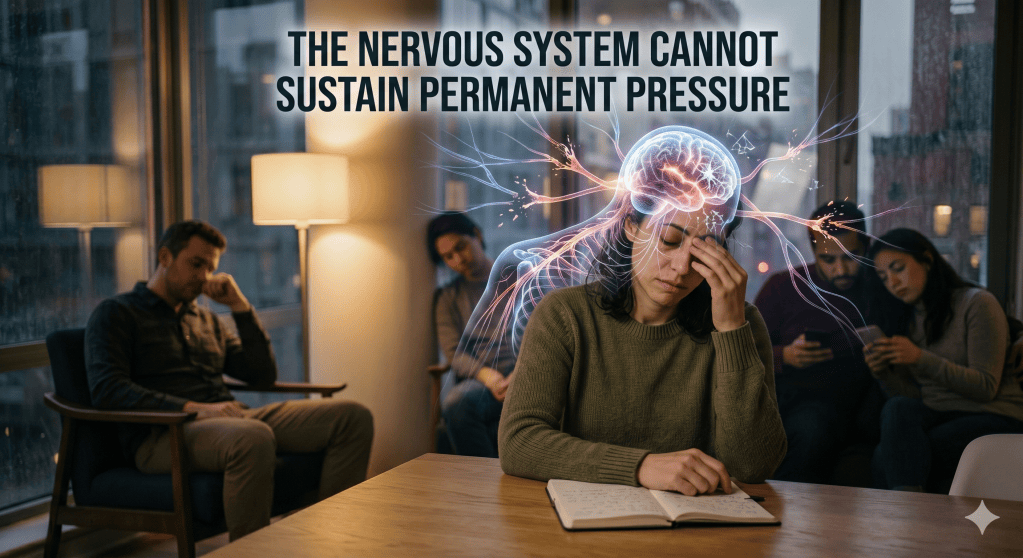
The nervous system cannot sustain permanent pressure indefinitely. This essay examines the stress physiology, neuroscience, and social consequences of the chronic pressure of the 2019–2020s era.
There is a point in sustained stress where the body stops treating the pressure as temporary and begins treating it as the new normal. Physiologically, this is one of the most consequential shifts a human nervous system can make. Psychologically and socially, it helps explain an enormous amount about how people behaved during the years surrounding 2019 — and how the consequences of that era continued unfolding long afterward.
The period beginning roughly around 2016 and extending through the early 2020s was defined, for millions of people, by a quality of pressure that felt genuinely inescapable. It was not simply that events were difficult. Many previous periods in history had been objectively more dangerous, more violent, more uncertain in terms of material survival. What distinguished this era was the combination of unrelenting information exposure, social fragmentation, and the erosion of shared interpretive frameworks — the collective story people tell themselves to make sense of what is happening and why.
This essay is about what that kind of sustained, ambient pressure does to the nervous system — and therefore to behavior, relationships, judgment, and social life. It draws on decades of research in stress physiology, neuroscience, social psychology, and behavioral science. Its argument is not that the pressure was imagined or that people were weak. It is that the nervous system cannot sustain permanent pressure without cost, and that understanding those costs is essential to making sense of the human behavior that defined the era.
What Stress Actually Is
Before examining what sustained pressure does to people, it helps to be precise about what stress is in the first place — because the word has been used so loosely that it has lost much of its explanatory power.
The physiological stress response is one of the oldest and most conserved systems in vertebrate biology. It exists to solve a specific problem: something in the environment requires immediate physical response. The hypothalamic-pituitary-adrenal axis — a chain of signaling between the brain and the adrenal glands — releases cortisol. The sympathetic nervous system releases adrenaline. Heart rate increases. Blood sugar rises. Blood flow is redirected toward the large muscle groups. The immune system is temporarily suppressed. Digestion slows. Attention narrows.
This is an extraordinarily effective short-term solution. The lion appears; the body does what is needed to run or fight; the lion is gone; the body returns to baseline. What the system was not designed to handle is a lion that never leaves.
Robert Sapolsky, the Stanford neuroendocrinologist who has spent decades studying stress in both baboons and humans, made this point clearly in his book Why Zebras Don’t Get Ulcers. Zebras, he observed, have the same stress response humans do. But when the chase is over, it’s over. Humans have the unique capacity to activate the stress response not just in response to immediate physical threats, but in response to thoughts, anticipations, social comparisons, and symbolic threats. We can worry about something that happened three years ago and something that might happen three years from now, simultaneously, while also reading about twelve other things we have no control over. The stress response does not distinguish between these categories. It responds to perceived threat, whatever the source.
The Architecture of Chronic Stress
When stress becomes chronic — sustained over weeks, months, or years — the biology changes in ways that are qualitatively different from short-term stress, not just quantitatively more of the same.
Chronically elevated cortisol affects the hippocampus, a brain region central to memory formation and emotional regulation. Research going back to the work of Bruce McEwen at Rockefeller University showed that prolonged cortisol exposure causes the dendrites of hippocampal neurons to atrophy — they literally shrink and lose connections. This impairs the hippocampus’s ability to perform one of its most important regulatory functions: telling the rest of the stress-response system that the threat is over and things can calm down. In other words, chronic stress progressively impairs the brain’s ability to stop the stress response, making the condition self-reinforcing.
The amygdala, by contrast, tends to become more reactive under chronic stress. This is the structure most associated with threat detection, fear responses, and the rapid emotional tagging of experience. An overactive amygdala means more things are perceived as threatening, more quickly, with less nuance. It means the emotional response arrives before the analytical one. This is not a character flaw in the people experiencing it. It is a predictable neurological consequence of the environment they were operating in.
The prefrontal cortex — the part of the brain most associated with deliberate reasoning, long-term planning, impulse control, and the capacity to consider perspectives other than one’s own — is particularly vulnerable to chronic stress. When the stress response is active, the prefrontal cortex is functionally downregulated. The body, in its evolutionary wisdom, has decided that in a crisis, fast pattern-matching and rapid reaction are more useful than careful deliberation. The problem, again, is that this is a short-term solution applied to a long-term situation.
The subjective experience of these changes rarely feels neurological. It feels like becoming less patient. Less curious. Less able to tolerate ambiguity. Small frustrations feel larger. Complex problems feel exhausting. People become quicker to certainty because certainty consumes less energy than uncertainty. None of this announces itself as biology. It announces itself as the world being genuinely more irritating and difficult than it used to be — which, conveniently, is also something the stressed brain is primed to believe.
What this means practically is that people living under chronic stress — regardless of the specific stressor — tend to show more reactive emotional responses, more difficulty with complex reasoning, more reliance on heuristics and tribal signals to evaluate information, and a reduced ability to hold multiple competing perspectives in mind at once. These are not moral failures. They are the predictable output of a nervous system that was built for a different kind of environment than the one it now inhabits.
The Information Environment as Stressor
The years around 2019 introduced a variable that Sapolsky’s baboons never had to contend with: the smartphone-mediated news and social media environment at full saturation. Understanding the stress physiology of this period requires taking this seriously as a biological input, not just a cultural observation.
The human brain is exquisitely tuned to threats that involve other people. Social threats — exclusion, status loss, public humiliation, moral condemnation, group conflict — activate many of the same neural circuits as physical threats. The same structures that respond to a predator respond to the discovery that your peer group has turned against you. This is not metaphorical. The overlap in neural activation is real, measurable, and well-documented in social neuroscience research.
Social media platforms, particularly in their algorithmic configurations circa 2016–2022, were optimized for engagement. Anger, outrage, fear, and moral indignation are among the most engaging emotional states. They drive clicks, shares, and comment activity at rates that positive or neutral content rarely matches. This was not initially a deliberate design choice by any particular actor; it emerged from optimization processes responding to human behavioral patterns at scale. But the effect was to create an information environment that continuously surfaced social threat stimuli to hundreds of millions of people, many of whom were accessing it dozens of times per day.
Naomi Torres-Mackie and colleagues at Lenox Hill Hospital found in research conducted during this period that higher levels of news consumption were associated with significantly greater rates of anxiety, depression, and stress — an association that remained even when controlling for the actual severity of events being reported. It was not simply that bad things were happening. The exposure pattern itself was contributing to the stress load.
Psychologist Steven Pinker had spent years making the case, in books like The Better Angels of Our Nature and Enlightenment Now, that objective conditions in the world — rates of violence, poverty, disease — had improved dramatically over the long arc of history. He was largely correct on the empirical merits. And yet this period saw widespread subjective psychological deterioration, particularly among younger adults who had grown up with social media as a primary mode of social reality. The divergence between objective conditions and subjective experience is itself an important data point. It suggests that the stress people were experiencing was not primarily driven by the actual state of the world, but by the relentlessness of exposure to threatening information about it.
Allostatic Load and What It Does to People
The concept of allostatic load, developed by Bruce McEwen and Eliot Stellar in the 1990s, provides a useful framework for thinking about what sustained pressure does to the body and mind over time. Allostasis is the process by which the body maintains stability through change — adapting to new conditions rather than simply returning to a fixed setpoint. Allostatic load is the cumulative biological cost of that adaptation.
Under normal conditions, allostasis is healthy. The body responds to stressors, manages them, and recovers. The problem arises when the adaptation is never followed by recovery. When stressors are chronic, overlapping, or unpredictable, the biological systems involved in managing stress — cortisol, adrenaline, inflammatory markers, blood pressure — are kept in states of chronic activation or dysregulation. The costs accumulate.
Research on allostatic load has linked it to accelerated cellular aging (measured via telomere length), increased inflammatory activity, cardiovascular changes, impaired immune function, and altered metabolic processes. But perhaps most relevant to the period in question are the psychological consequences: impaired concentration, reduced working memory capacity, difficulty with emotional regulation, heightened interpersonal reactivity, and a characteristic flattening of positive affect even when objectively positive events occur.
That last phenomenon — the dulling of the capacity to experience positive events as positive — is called anhedonia in clinical contexts, but it appears in subclinical forms in people who have been under sustained pressure for long periods. The stress response prioritizes threat detection. Over time, the motivational and reward systems recalibrate accordingly. People living under chronic stress often report feeling emotionally numb, easily irritated, unable to enjoy things they used to enjoy, and persistently braced for the next crisis even when one is not immediately apparent. This is not depression in the clinical sense, necessarily. It is the nervous system having adapted to an environment in which relaxation has come to feel unsafe.
Social Consequences: Polarization Through a Biological Lens
The social fragmentation and political polarization that characterized the late 2010s has been analyzed extensively from political, sociological, and media-studies perspectives. What is less often discussed is the degree to which it was also, in part, a predictable consequence of mass chronic stress.
When the amygdala is chronically sensitized and the prefrontal cortex is chronically underperforming, the conditions are set for increased in-group/out-group thinking. Henri Tajfel’s social identity theory, developed in the 1970s, established that humans are remarkably quick to form group identities and to begin favoring in-group members over out-group members even on the most arbitrary bases. Under low-stress conditions, people can hold group identities lightly and navigate multiple overlapping affiliations. Under high-stress conditions, group identity tends to become more rigid, more exclusive, and more central to self-concept.
Jonathan Haidt and colleagues, in research on moral psychology, have shown that moral reasoning is often post-hoc rationalization of intuitive moral reactions rather than the reverse. We feel that something is wrong or threatening, and we construct the reasoning to explain it afterward. Under chronic stress, the intuitive moral reactions are more intense and more rapid, leaving less time and cognitive bandwidth for the post-hoc reasoning to introduce nuance or correction. This is not a diagnosis of any particular political group or viewpoint. It is a description of a general human tendency that becomes more pronounced when people are operating under sustained pressure.
The result, played out across a society simultaneously experiencing elevated stress loads and an information environment optimized for outrage, is a population in which large numbers of people are operating with diminished capacity for complexity, heightened threat sensitivity, and strong in-group/out-group cognition — while simultaneously generating enormous amounts of social information that feeds back into each other’s stress responses. The loop becomes difficult to interrupt.
Why We Normalize the Pressure
One of the most important and underappreciated aspects of chronic stress is that people adapt to it in ways that make it increasingly difficult to recognize. When the nervous system has been under sustained pressure for long enough, the elevated state begins to feel normal. Baseline, for all practical purposes, has shifted.
This is partly physiological. The body habituates to chronic stressors in ways that reduce the subjective sense of stress even as the biological costs continue accumulating. Cortisol awakening response patterns shift. Sleep architecture changes. The emotional responses that would once have flagged an environment as unsustainable become muted because the nervous system has downregulated its sensitivity in an attempt to cope.
It is also social. Norms are defined by what is common. When everyone around you is operating at the same elevated baseline, when exhaustion, cynicism, chronic low-grade anxiety, and emotional reactivity are universal, there is no external reference point that says this is not how things are supposed to be. The comparison class disappears. Stress researcher Arie Shirom found in organizational research that burnout — which shares many features with chronic stress — is particularly difficult for individuals to recognize in themselves when the organizational culture normalizes the conditions that produce it. The same principle scales to entire social environments.
The practical consequence is that people who were chronically stressed during this period often did not describe themselves as stressed. They described themselves as paying attention, staying informed, caring about what mattered, being realistic about a genuinely difficult situation. All of these self-descriptions could be accurate. But they also functioned as normalizations of a physiological state that was, by any biological measure, far outside the range in which the nervous system operates optimally.
Recovery, Resilience, and What the Research Actually Shows
Resilience is a word that gets used carelessly, often in ways that imply the solution to chronic stress is simply to be tougher or more positive. The research on stress resilience tells a more nuanced story.
Psychological resilience is real and measurable, but research by George Bonanno and others makes clear it is not simply a matter of attitude or willpower. People with strong social support networks, a genuine sense of agency over their circumstances, adequate material resources, and access to recovery — rest, privacy, economic stability — accumulate allostatic load more slowly and bounce back more reliably. The stress of this era was not uniformly distributed. Stress physiology is not neutral with respect to social structure.
Recovery from chronic stress, when conditions allow it, is also real and well-documented. The hippocampal changes caused by chronic cortisol exposure are partially reversible. Neuroplasticity — the brain’s capacity to reorganize its connections in response to experience — means that a change in environmental conditions, combined with behavioral changes that promote recovery, can gradually restore more typical function. This typically takes longer than the stress was sustained, and it is not automatic. It requires actual reduction in the stressor load, not just better coping techniques applied to an unchanged environment.
The Long Tail
By the time the initial draft of this essay was written in 2019, the pressure had already been sustained long enough to produce measurable population-level effects. Rates of anxiety and depression among young adults, particularly adolescents, had been rising steadily since roughly 2012 — a shift Jean Twenge documented extensively in her research on what she called the iGen cohort. The relationship between social media use and psychological well-being, while contested in its precise magnitude, showed consistent directional effects across multiple large-scale studies.
What 2019 could not fully anticipate was that the years immediately following would add, in sequence, a global pandemic, its associated social disruptions and economic consequences, multiple acute political crises, and then the longer unresolved anxieties about the stability of social and institutional structures. For the nervous system trying to calculate when it might safely begin the work of recovery, the signal never quite arrived. The lion never fully left.
The behavioral and social consequences of this extended period of collective stress are still being worked through. The erosion of institutional trust — in media, government, science, healthcare — reflects in part the ways in which an amygdala-dominant, prefrontal-underperforming population processes authority and complexity. The difficulty sustaining long-form attention, the volatility of public discourse, the collapse of shared interpretive frameworks, the profound difficulty of productive disagreement across political or cultural lines — all of these have multiple causes, but stress physiology is part of the picture that is too often left out of the analysis.
Understanding that the nervous system cannot sustain permanent pressure without cost is not a counsel of despair or passivity. It is a prerequisite for thinking clearly about what conditions would actually make things better. That thinking requires exactly the kind of deliberate, nuanced, perspective-taking cognition that chronic stress impairs — which is its own kind of irony, and its own kind of reason to take the problem seriously.
The history of the late 2010s and early 2020s will be written in many ways by many people with many different frameworks. But any account that leaves out what was happening in hundreds of millions of nervous systems simultaneously, and what that meant for the behavior, relationships, and collective life of the people in them, will be missing something essential.









