
Originally published in June 2019 and comprehensively updated and edited in June 2026.
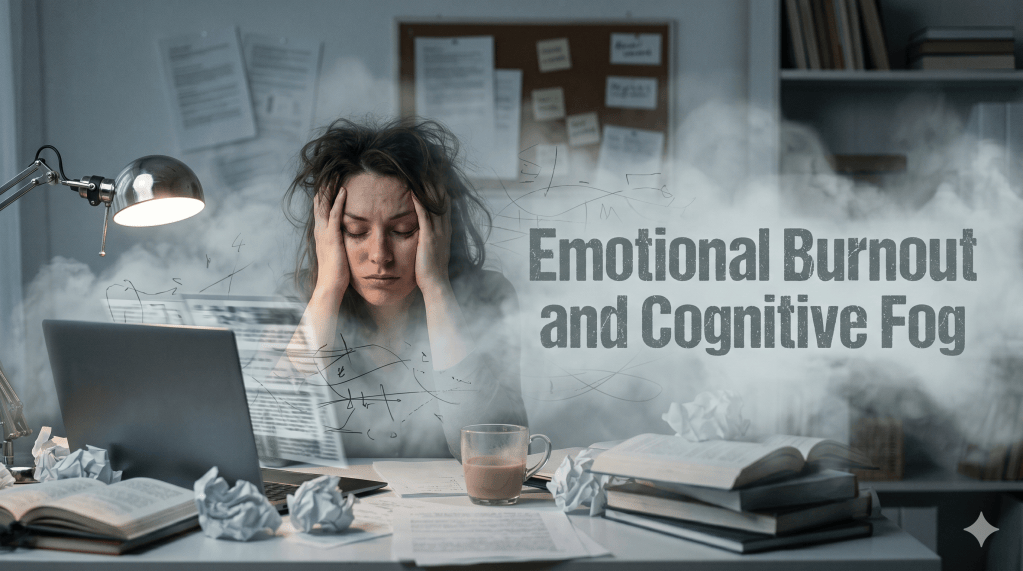
Emotional burnout and cognitive fog explained through psychology and neuroscience — what causes them, what they do to the brain, and what recovery actually requires.
There is a particular kind of exhaustion that doesn’t show up on any blood test. It doesn’t leave visible bruises, and it rarely comes with a clean diagnosis. You wake up tired. You stare at a screen and the words won’t quite connect. Simple decisions feel heavier than they should. You forget things — not in a dramatic, alarming way, but in a low-grade, persistent way that makes you feel like you’re moving through the world with a slight delay. You’re present, technically, but something has gone dim.
This is the lived experience of emotional burnout, and the cognitive fog that almost always travels with it.
By the late 2010s, burnout had moved from the margins of occupational psychology into mainstream conversation. The conditions that enabled it had been building for years: an always-connected workforce, the slow erosion of work-life separation by smartphones and remote communication tools, rising rates of anxiety across age groups, and a cultural premium placed on productivity. Then came a period of sustained collective stress — a global pandemic, social upheaval, economic instability — and what had been a widespread but often-dismissed problem became something harder to ignore. By 2026, discussions of burnout and brain fog have expanded well beyond the workplace and into conversations about parenting, caregiving, chronic illness, and the cumulative weight of living in perpetual uncertainty.
This article explores what burnout actually is, why cognitive fog accompanies it, what chronic stress does to the brain, and what modern research suggests about recovery.
What Burnout Actually Is — And What It Isn’t
The word “burnout” gets used loosely enough that it’s worth being precise. In clinical and research contexts, it is not simply stress, not depression, and not ordinary fatigue. It is a specific syndrome that emerges from chronic, unresolved stress — most commonly occupational, though researchers have increasingly applied the concept to caregivers, students, and people navigating long-term adversity of any kind.
The psychologist Christina Maslach, whose work beginning in the 1970s became foundational to the field, identified three core dimensions: emotional exhaustion, depersonalization (detachment or cynicism toward the work and people involved in it), and a reduced sense of personal accomplishment. In 2019, the World Health Organization gave the syndrome formal recognition in the International Classification of Diseases — significant, though the WHO stopped short of classifying it as a medical condition, a distinction that affects how it gets treated and covered by healthcare systems.
What separates burnout from ordinary stress is the chronic, cumulative nature of it. Acute stress — a deadline, a difficult conversation, a sudden crisis — activates the body’s fight-or-flight response and then resolves. The nervous system returns to baseline. Burnout happens when that stress response never fully deactivates. The demands keep coming, recovery doesn’t happen, and eventually the system that was designed to respond to threats stops responding much to anything at all. The protective cynicism and emotional numbness that define advanced burnout are, in a biological sense, defensive adaptations. In effect, the brain is conserving what little energy it has left.
Burnout doesn’t arrive suddenly. The early stages often look like high performance — pushing harder, staying later, saying yes to more. These behaviors get rewarded before they become unsustainable. By the time emotional numbness and cognitive impairment set in, the person experiencing them may have spent years being told their intensity was an asset.
Cognitive Fog: When the Brain Runs Low
Cognitive fog — also called brain fog, though that term doesn’t appear in any clinical diagnostic manual — refers to a cluster of symptoms affecting thinking, memory, and concentration. People describe it as a persistent sense of mental cloudiness: difficulty holding a train of thought, trouble retrieving words, slowed processing, poor short-term memory, and an inability to focus even when the environment is quiet and the stakes are high.
Cognitive fog is not unique to burnout. It appears in depression, anxiety disorders, chronic fatigue syndrome, autoimmune conditions, long COVID, and as a side effect of many medications. But the version associated with burnout has a specific character: it tends to be most pronounced in situations that require sustained cognitive effort, planning, or the management of complex social information — exactly the kinds of tasks that demanding jobs, parenting, or caregiving require most.
What’s Happening in the Brain
The neuroscience here is still developing, but enough has been established to give a reasonably clear picture of what burnout does to the brain.
The prefrontal cortex — the region responsible for executive function, planning, decision-making, impulse control, and working memory — is particularly vulnerable to the effects of chronic stress. Under normal conditions, the prefrontal cortex acts as a kind of conductor for higher-order thinking, modulating responses from more reactive regions like the amygdala. Under chronic stress, this regulation becomes impaired. Studies using functional MRI have shown reduced activity in the prefrontal cortex and increased amygdala reactivity in individuals with burnout, a pattern that helps explain why people who are burned out often feel emotionally dysregulated — easily irritated, more prone to catastrophizing, less able to put situations in perspective.
Cortisol plays a central role in this story. Often called the stress hormone, cortisol is released by the adrenal glands in response to stress and serves important functions in the short term: it sharpens attention, mobilizes energy, and primes the body for action. But prolonged elevation of cortisol is toxic to certain brain regions. The hippocampus — critical for memory consolidation and spatial navigation — is particularly sensitive to cortisol. Chronic stress has been associated with hippocampal volume loss, impaired neurogenesis (the brain’s capacity to generate new neurons), and deficits in memory and learning. This is not speculative: the association between chronic stress, elevated cortisol, and hippocampal damage has been replicated across multiple studies in both animal models and humans.
A 2014 study published in Psychoneuroendocrinology by researchers at the Karolinska Institute in Sweden found that patients who met criteria for clinical burnout showed measurable differences in brain structure compared to healthy controls, including in areas associated with attention regulation and emotional processing. These were not small, marginal findings. They suggested that burnout, when severe enough, leaves a physical signature on the brain.
The neurotransmitter system is also affected. Dopamine — involved in motivation, reward anticipation, and the experience of pleasure — is dysregulated under conditions of chronic stress. This likely accounts for one of the more discouraging aspects of burnout: the loss of motivation for things that used to feel meaningful, including activities entirely unrelated to the source of stress. When the dopaminergic system is depleted, the capacity for enjoyment and anticipation diminishes broadly. Work feels pointless. Hobbies feel hollow. Rest doesn’t restore.
Most people don’t experience any of this as a dramatic neurological event. They experience it as forgetting why they opened a browser tab, rereading the same email three times without it registering, or feeling oddly overwhelmed by choices that once felt routine. The decisions haven’t gotten harder. The brain processing them has.
Why Simple Rest Doesn’t Always Work
One of the most frustrating aspects of burnout-related cognitive fog is that it doesn’t respond to ordinary rest the way ordinary tiredness does. Take a nap when you’re sleep-deprived, and you feel better. Take two weeks of vacation when you’re burned out, and you may return to work still feeling depleted — sometimes within days.
This isn’t laziness or a character flaw. It reflects something real about the neurobiology of chronic stress. The regulatory systems that govern energy, attention, and emotional reactivity take time to recalibrate, and passive rest alone is often insufficient to reset them. Research on recovery from burnout has found that meaningful improvement typically requires not just the removal of stressors, but the active presence of psychological detachment, mastery experiences, relatedness, and a restored sense of control — factors that a beach vacation may or may not provide, depending on what a person brings to it.
The Social Architecture of Burnout
Burnout doesn’t happen in a vacuum. It develops within social structures — workplaces, families, communities, caregiving networks — and the design of those structures has everything to do with who burns out and when.
Maslach and her collaborators have identified six key mismatches between a person and their work environment that predict burnout: work overload, lack of control, insufficient reward, breakdown of community, absence of fairness, and conflicting values. What’s notable about this framework is that it locates the origin of burnout primarily in the environment, not in the individual. The dominant cultural narrative around burnout — that it results from poor self-care, inadequate resilience, or an inability to manage stress — is, by this account, largely backwards. It’s not that people are too fragile for their circumstances. It’s that their circumstances are genuinely unsustainable.
The Gender Dimension
Research consistently shows that women experience burnout at higher rates than men across most occupational categories, a pattern that holds even after controlling for industry, role, and hours worked. The reasons are multiple and interlocking. Women are disproportionately concentrated in emotionally demanding roles — nursing, social work, teaching, caregiving — that carry higher inherent emotional labor demands. They carry more unpaid domestic and caregiving labor, which means that even when the formal workday ends, the depletion continues in another form. And they navigate a specific social expectation to present as competent, warm, and emotionally available simultaneously — what researchers call the double bind of professional femininity.
Burnout research has increasingly recognized that emotional labor and caregiving labor operate as invisible workloads. They consume attention and emotional energy even when they don’t appear on a calendar or timesheet. Managing someone else’s feelings, anticipating needs before they’re expressed, maintaining relational harmony in a workplace or household — these are cognitively and emotionally costly activities. They leave no artifact when they’re done, which makes them easy to exclude from conversations about workload. That invisibility is part of what makes the burnout they produce feel so difficult to explain.
The 2020-era expansion of remote work initially held promise for reducing some of these pressures. In practice, for many women with children, it often intensified them. Working from home while simultaneously managing childcare — especially during school closures — compressed the cognitive and emotional load into a smaller physical space with no clear boundaries and no visible off-switch.
Technology and the Erosion of Recovery
The smartphone didn’t create burnout, but it dramatically accelerated it by eliminating one of the most important factors in preventing it: psychological detachment. Recovery from work stress doesn’t require doing nothing; it requires disengaging, mentally, from work-related concerns. Checking email at 10 pm, even briefly, disrupts that process. The expectation of availability — whether explicitly stated by an employer or simply implied by a culture in which response times are tracked and interpreted — keeps the stress response partially activated during hours that were once, functionally, off hours.
A substantial body of research supports the relationship between after-hours connectivity and burnout. A 2018 study by researchers at Virginia Tech found that even the expectation of being required to respond to after-hours communications — regardless of whether any messages actually arrived — was sufficient to elevate anxiety and interfere with recovery. The phone doesn’t have to ring. Just knowing it might be enough to keep the nervous system from fully disengaging.
Attention Is a Limited Resource
There is a reason people at the end of a demanding workday feel exhausted despite having sat at a desk for eight hours. It isn’t physical. It’s attentional. And understanding this is central to understanding why modern cognitive fog feels so different from ordinary tiredness.
Attention is not a passive state. Directing it, sustaining it, and especially switching it between tasks requires real cognitive work. Researchers have documented what they call the “attentional residue” problem: when a person switches from one task to another, part of their attention remains on the previous task. They’re technically doing the new thing, but a portion of their mental bandwidth is still processing the thing they left. In an environment where context-switching happens every few minutes — a Slack notification here, an email alert there, a meeting that interrupts deep work — attentional residue accumulates. The mind never fully arrives anywhere.
Sophie Leroy, a researcher at the University of Washington who coined the term “attentional residue,” found that people who were interrupted or had to stop tasks before completion performed significantly worse on subsequent tasks, not because they were distracted in the conventional sense, but because the unfinished first task continued to compete for cognitive resources.
The modern knowledge workplace is, by design, almost perfectly structured to maximize this problem. Open offices reduce acoustic privacy. Instant-messaging platforms create an implicit norm of immediate response. Notifications are set to on by default, and turning them off carries social costs in many organizations. The result is a working day that is technically full of productivity while being architecturally hostile to the sustained attention that complex cognitive work actually requires.
This has a direct bearing on emotional burnout and cognitive fog. The exhaustion people feel at the end of a day of constant task-switching is genuine depletion. The prefrontal cortex — already stressed by overload and under-recovery — is the same region responsible for managing attentional control. Each interruption draws on a resource that is already strained. Over time, the system becomes increasingly poor at filtering, prioritizing, and sustaining focus, which is one reason cognitive fog often manifests first as an inability to concentrate rather than an inability to perform any individual task.
Long COVID, Chronic Illness, and a New Understanding of Brain Fog
One of the significant developments between the original 2019 draft of this article and its 2026 revision is the emergence of long COVID as a mass health phenomenon — and the way it has both complicated and clarified discussions of cognitive fog.
Long COVID, which affects millions of people worldwide, produces cognitive symptoms that often closely resemble burnout-related brain fog: difficulty concentrating, impaired working memory, word retrieval failures, and mental fatigue disproportionate to physical exertion. This overlap prompted researchers to examine the mechanisms more carefully, and what they’ve found has been instructive.
Evidence now points to neuroinflammation — inflammation in the brain and central nervous system — as a likely mechanism in both long COVID-related cognitive symptoms and, potentially, in the severe end of burnout-related cognitive impairment. Chronic stress is known to promote systemic inflammation, and the brain is not insulated from inflammatory processes. Microglial cells, the brain’s resident immune cells, become activated under conditions of sustained stress and can shift from protective to damaging if activation is prolonged.
This doesn’t mean burnout and long COVID are the same thing — they clearly aren’t. But the convergence of research around neuroinflammation as a common pathway suggests that the “functional” nature of burnout symptoms (meaning symptoms without a clear organic cause) may be a historical artifact of limited measurement tools rather than a true reflection of what’s happening in the body. The biology of exhaustion is real biology.
The Problem with Resilience as a Solution
Few concepts have done more to obscure the structural dimensions of burnout than “resilience.” In organizational and therapeutic contexts, resilience has become a catchall prescription: build it, train it, practice gratitude, meditate, exercise, sleep eight hours, set boundaries. All of these things have real value in supporting wellbeing. None of them address the root causes of burnout when those root causes are structural.
Asking burned-out workers to become more resilient while leaving the conditions that burned them out intact is a bit like asking people to get better at swimming while keeping the water too cold for survival. It places the moral and practical burden of adaptation entirely on the individual and implicitly frames the inability to sustain unsustainable demands as a personal failure.
This isn’t to dismiss the role of individual coping strategies. The evidence does support practices like mindfulness-based stress reduction, adequate sleep, physical activity, and social support as meaningfully protective against burnout — not because they make people capable of tolerating more, but because they lower the baseline load on the nervous system and create more capacity for recovery. The distinction matters. These practices are best understood as maintenance, not solutions.
Real solutions require examining workload distribution, management practices, the fairness of recognition and compensation, the clarity of role expectations, and the degree to which individuals have meaningful control over their work. Organizations that have made these structural changes report lower burnout rates than organizations that route their interventions entirely through employee wellness programs.
Recovery: What the Research Says
Recovery from burnout is possible, but it takes longer than most people expect, and it often requires a period of genuine reduction in demands — not just a reorganization of how those demands are managed.
The psychologist Dirk Enzmann and colleagues have described burnout recovery as non-linear: people often show initial improvement followed by setbacks, particularly when they return to environments that haven’t changed. The trajectory depends heavily on whether the stressors that caused the burnout are still present, how long the person experienced it before intervention, and the presence of comorbid conditions like depression or anxiety.
Sleep is where recovery begins for most people, and not just in quantity. Burnout disrupts sleep architecture — specifically the deep, slow-wave sleep associated with physical and neural restoration, and the REM sleep associated with emotional processing. Research suggests that consistently prioritizing sleep quality, not just duration, is among the most evidence-supported individual interventions for burnout recovery. This may involve behavioral changes like consistent sleep timing, reduced evening screen exposure, and the management of alcohol, which suppresses REM sleep even in moderate quantities.
Social reconnection matters too, particularly for people who have become isolated by exhaustion or cynicism. The detachment and withdrawal that characterize advanced burnout create a feedback loop: connection feels effortful, effort is depleted, so connection decreases, and with it one of the primary buffers against continued stress. Gently reversing that loop — not by forcing social engagement but by creating low-pressure opportunities for genuine connection — appears to be important for recovery.
Meaning matters. A recurring finding in burnout research is that people can sustain high demands as long as they perceive the work as meaningful and the effort as aligned with their values. Helping burned-out individuals reconnect with what originally mattered to them about their work, relationships, or caregiving — not as a motivational exercise but as a genuine inquiry — tends to support recovery in ways that rest alone does not.
There is also a counterintuitive dimension to recovery that deserves mention. Many people respond to burnout by trying to become more efficient — optimizing their schedules, eliminating waste, systematizing self-care. The impulse is understandable, but the research suggests it may work against recovery. Burnout often develops in people who have over-optimized their lives already, instrumentalizing every hour toward a goal. Recovery frequently requires something that runs in the opposite direction: activities that serve no productive purpose at all. Not exercise as a health investment, not meditation as a performance enhancement, but genuinely pointless things — a walk with no destination, a hobby pursued badly, a conversation that goes nowhere useful. The absence of productivity is not the obstacle to recovery. For many people, it is the mechanism.
Cognitive Fog Recovery and the Brain’s Plasticity
The brain’s capacity for structural change — neuroplasticity — means that the cognitive effects of burnout are not necessarily permanent, even in cases where structural changes have been documented. Studies of hippocampal recovery following stress reduction, for instance, have shown that neurogenesis can resume and volume can partially recover with sustained behavioral change over months to years.
Aerobic exercise has one of the stronger evidence bases for supporting cognitive recovery from burnout and chronic stress. It promotes BDNF (brain-derived neurotrophic factor), a protein that supports the growth and maintenance of neurons, and has been shown to support hippocampal neurogenesis in humans. The effect is not dramatic in any single session, but consistent moderate-intensity exercise over weeks and months produces measurable improvements in memory, attention, and emotional regulation.
Mindfulness-based interventions have also been studied in burnout populations specifically, with generally positive results for attention and emotional regulation — though the effect sizes are modest and most studies have methodological limitations. What the research does suggest is that practices that cultivate present-moment awareness tend to reduce the ruminative thinking that keeps the stress response activated even when no stressor is actively present. Rumination — replaying negative events, anticipating future failures — is one of the primary ways that past stress continues to generate neurobiological load after the stressor itself has passed.
What We’ve Learned and What Still Requires Attention
The decade between the initial writing of this essay and its 2026 revision has seen a meaningful advance in how the medical and psychological communities understand burnout and cognitive fog. These are no longer fringe concerns or soft complaints from people who need to toughen up. They are well-documented phenomena with identified neurobiological mechanisms, measurable population-level impacts, and serious downstream consequences for individual health, organizational function, and public welfare.
What hasn’t changed enough is the structural response. Organizational wellbeing programs have proliferated; actual workload, autonomy, and fairness conditions have improved more slowly and unevenly. The conversation has gotten better. The conditions in many industries haven’t.
The broader social factors that contribute to burnout — the dissolution of reliable work structures, economic insecurity, the demand for constant connectivity, the privatization of caregiving — are not problems that individual resilience practices or even enlightened management can fully address. They reflect choices made at the level of policy, economics, and culture, and they will require responses at that level as well.
What the science does offer, clearly and consistently, is this: the human nervous system has a finite capacity for sustained activation, and that capacity is not a moral attribute. It is a biological fact. A society that systematically exceeds it — in its workplaces, its families, its schools, its political climate — will produce large numbers of exhausted, cognitively impaired people who are doing their best under conditions that were never designed with human limits in mind.
Understanding that is not the end of the conversation. But it’s a necessary place to start.
Future historians may ultimately describe burnout not as a personal pathology, but as a predictable consequence of a culture that repeatedly demanded more from human beings than human biology was built to provide.









