
Originally published in September 2019 and comprehensively updated/edited in June 2026.
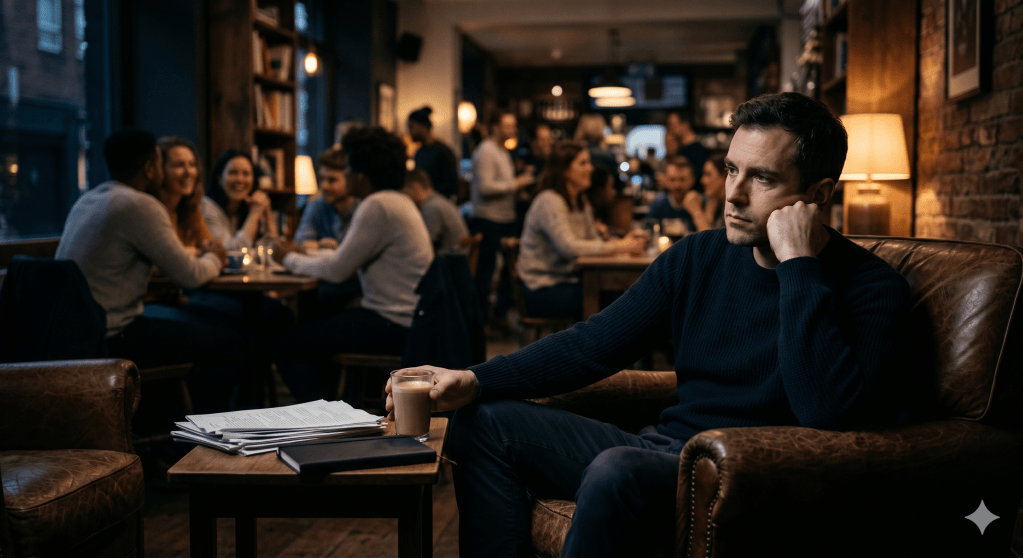
The silent rise of internal withdrawal examines how digital technology, economic stress, and cultural fragmentation drove a generation inward — and what psychology and neuroscience reveal about the cost.
There is a particular kind of quiet that has settled over modern life — not the quiet of peace, but the quiet of people who have stopped reaching outward. Over the past two decades, a measurable shift has taken place in how human beings relate to one another, to their communities, and to the world beyond their immediate experience. Social participation has declined. Trust in institutions has eroded. The average person’s circle of close friends has grown smaller. And yet, by most surface measures, people appear more connected than ever — scrolling, messaging, liking, reacting, broadcasting fragments of their lives into the void.
This contradiction sits at the center of what might be called the silent rise of internal withdrawal: a broad, quiet retreat from shared public life and genuine interpersonal engagement, accompanied by an equally broad expansion of private, screen-mediated experience. It is not a dramatic rupture. No one announced it. It accumulated gradually, reinforced by technology, economic stress, cultural fragmentation, and shifts in how the brain itself learned to process reward and connection. Understanding it requires looking at history, psychology, neuroscience, and the social conditions that made withdrawal feel, for millions of people, like the rational choice.
How We Got Here: The Social Fabric Before the Fracture
To understand where things changed, it helps to understand what preceded the change. For most of the twentieth century, American social life — and to varying degrees, social life in other developed nations — was organized around shared physical spaces and institutions. People went to church together, joined civic organizations, attended union halls, populated bowling leagues, and gathered at neighborhood bars. These weren’t just pleasant diversions. They were the infrastructure of social trust.
The sociologist Robert Putnam documented this world and its unraveling in his landmark 2000 book Bowling Alone. He tracked participation across hundreds of civic and social organizations from the 1950s through the 1990s and found consistent, widespread decline. Americans were voting less, joining less, attending religious services less, and socializing with neighbors less. Putnam called this the collapse of social capital — the networks of relationships and norms of reciprocity that make communities function. His diagnosis was prescient. What he described in 2000 would continue accelerating through the following two decades.
The causes Putnam identified were multiple: suburban sprawl, the rise of television as a passive entertainment medium, generational change, and the pressures of two-income households. But the forces that came after his book — particularly the smartphone and social media — would prove to be of an entirely different magnitude.
The Architecture of Avoidance
By the early 2010s, the smartphone had become the defining object of daily life for hundreds of millions of people. It was easy to frame this as connection — after all, you could reach anyone, see anything, stay informed, maintain friendships across distances. And in real ways, the technology delivered on that promise. But something else was also happening, something less visible.
The smartphone made it possible — and then normal — to be physically present somewhere while mentally elsewhere. The habit of reaching for a phone during any moment of social awkwardness, boredom, or discomfort gradually restructured people’s relationship to those feelings. Discomfort, which had previously served as the signal to engage — to start a conversation with a stranger, to sit with silence, to confront a difficult situation — became instead a cue to disengage. The phone offered an instant exit from the present moment, and the brain, reliably, began to prefer the exit.
This is not a moral judgment. It is a description of how reinforcement learning works in the human nervous system. Neuroscientists describe a process called operant conditioning, in which behaviors that produce rewarding outcomes become more frequent. The rewards embedded in smartphone use — the dopamine pulse of a notification, the social validation of a like, the endless novelty of a scroll — are carefully calibrated, often deliberately so. Sean Parker, one of Facebook’s founding presidents, described the design philosophy explicitly in a 2017 interview: the goal was to consume as much of users’ time and attention as possible by exploiting “a vulnerability in human psychology.” The feedback loop of social validation, he said, was built intentionally.
When avoidance of real-world discomfort becomes repeatedly rewarded with the frictionless comfort of digital engagement, the neural pathways supporting that avoidance grow stronger. The clinical term for this is negative reinforcement — not punishment, but the removal of something unpleasant (social anxiety, boredom, uncertainty) as a reward for a behavior (reaching for the phone). Over time, the threshold for tolerating ordinary social friction rises. Activities that require patience, ambiguity, or vulnerability — the raw material of genuine human connection — begin to feel increasingly costly.
The first generation to experience adolescence entirely through smartphones would later show some of the clearest signs of these changes. That story comes into sharper focus when you look at the data — but the mechanism began here, in the ordinary daily habit of reaching for the exit.
Loneliness and the Paradox of Hyperconnection
Researchers began documenting the loneliness paradox well before it became a mainstream concern. A 2006 study by sociologists McPherson, Smith-Lovin, and Brashears found that the average American had only two close confidants, down from three in 1985, and that the proportion of people who reported having no one to discuss important matters with had nearly tripled. That data predates the smartphone era entirely.
By the 2010s, the paradox had deepened. Despite — or perhaps because of — the explosion of social media platforms, reported loneliness continued to climb. Former U.S. Surgeon General Vivek Murthy declared loneliness a public health epidemic in his 2023 advisory report, citing research connecting social isolation to outcomes as serious as smoking fifteen cigarettes a day in terms of mortality risk — a comparison drawn from work by researcher Julianne Holt-Lunstad, who analyzed data from more than 70 prospective studies. The neuroscientist John Cacioppo, who spent decades studying loneliness, found that chronic social isolation triggers a distinct physiological stress response: elevated cortisol, disrupted sleep, impaired immune function, and a heightened state of threat vigilance that makes people paradoxically more defensive and less capable of the openness genuine connection requires.
The mechanisms Cacioppo identified help explain a feature of the loneliness epidemic that puzzled many observers. People experiencing chronic loneliness don’t simply become more eager for connection — they often become more guarded against it. The brain, operating in a prolonged threat state, begins treating social situations as potentially dangerous rather than rewarding. This creates a self-perpetuating cycle: isolation produces hypervigilance, which produces more isolation.
Social media, in this context, offers what researcher Sherry Turkle called “the illusion of companionship without the demands of friendship.” In her 2011 book Alone Together, Turkle documented how people used digital communication to maintain the feeling of connection while avoiding its most challenging aspects — the unpredictability of real-time conversation, the obligation of sustained attention, the vulnerability of being truly known by another person. The carefully curated self presented on social platforms is not the self that sits in silence with another person and says something honest.
The Economy of Exhaustion
Internal withdrawal did not emerge from digital technology alone. The social and economic conditions of the late 2000s and 2010s provided powerful independent momentum. The 2008 financial crisis was not merely an economic event. For millions of people, it was a rupture in the basic narrative of stable progress — work hard, play by the rules, expect incremental improvement. The recovery that followed was slow, uneven, and accompanied by rising costs of housing, education, and healthcare that put sustained pressure on the middle and working classes.
Precarity is psychologically costly in ways that compound over time. When basic stability feels uncertain, the bandwidth available for civic engagement, community investment, and social generosity narrows. Psychologists studying the cognitive effects of scarcity have found that financial stress consumes working memory and executive function — not because people become less capable in some fixed sense, but because the ongoing management of uncertainty is itself a demanding cognitive task that crowds out other concerns. The phenomenon is sometimes described as “the bandwidth tax” of poverty and economic insecurity.
This exhaustion fed into withdrawal in straightforward ways. After a long day managing financial stress, navigating a demanding job, and maintaining the logistics of a complex household, the appeal of collapsing onto a couch and streaming something is not weakness — it is a sensible response to depletion. The problem is that rest through passive digital consumption does not produce the kind of restoration that genuine social engagement and time in nature do. Research by psychologist Matthias Mehl and colleagues found that people reported greater well-being on days they had more substantive conversations and less trivial small talk. The brain restores differently through connection than through consumption.
Cultural Fragmentation and the Retreat Inward
Beyond individual psychology, the broader cultural atmosphere of the 2010s generated conditions that made internal withdrawal seem not just comfortable but reasonable. The collapse of shared media — the era in which most people in a given country watched the same television programs, read similar newspapers, and inhabited a common informational reality — had been underway since the rise of cable and the internet. But the algorithmic media environment of the mid-2010s accelerated this fragmentation into something qualitatively different.
Recommendation algorithms, designed to maximize engagement, reliably surfaced content that was emotionally provocative, identity-confirming, and outrage-generating. This was not a conspiracy — it was a predictable consequence of optimizing for clicks and time-on-platform. Outrage holds attention more reliably than nuance. Identity-affirming content produces stronger engagement signals than content that challenges assumptions. Over time, the information environments people inhabited grew increasingly personalized and increasingly divergent from those of their neighbors.
The social consequence was a kind of epistemological fracture. When shared facts are contested and the people around you seem to inhabit a different informational reality, the cost of political and social conversation rises sharply. People who might once have disagreed comfortably about policy while sharing basic facts increasingly found themselves unable to establish common ground. The rational response, for many, was to avoid such conversations entirely — to withdraw from political engagement not out of apathy but out of exhausted frustration with its apparent futility.
This retreat was documented in polling data throughout the decade. Trust in government, in media, in corporations, and in fellow citizens declined across demographic groups. The Edelman Trust Barometer, an annual global survey of institutional trust, showed consistent erosion across most Western democracies from the late 2000s onward. Trust in neighbors and communities showed similar patterns. The sociological term for this is anomie — a condition described by Émile Durkheim in the nineteenth century in which the norms and social bonds that give individual life meaning break down, leaving people unmoored.
Running parallel to these shifts was the quiet disappearance of what sociologist Ray Oldenburg called “third places” — the informal gathering spots that exist outside the home and the workplace, where people mix without agenda or obligation. Oldenburg identified these spaces — the neighborhood bar, the coffee shop, the barbershop, the community center, the local bookstore — as essential to civic health precisely because they are not organized around productivity or family. They are places where a person simply appears and belongs, where conversation happens without being scheduled, where social trust accumulates through repeated low-stakes contact with familiar strangers. By the 2010s, these spaces were in broad retreat. Big-box retail had hollowed out Main Streets. Rising commercial rents displaced independent gathering places. Suburban design prioritized cars over pedestrians. As third places disappeared from the physical landscape, so too did many of the settings where spontaneous community once formed. Digital platforms offered substitutes — online communities, group chats, comment sections — but they lacked the one thing Oldenburg’s third places reliably provided: the experience of sharing a room with people you hadn’t chosen in advance.
The Body Keeps the Score of Isolation
Internal withdrawal is not only a social and psychological phenomenon — it registers in the body. Research on social baseline theory, developed by psychologist James Coan, proposes that the human nervous system evolved to treat social connection as a fundamental resource, not merely a pleasant optional feature. In this framework, the brain continuously calibrates its energy expenditure based on perceived social support. When reliable connection is available, the nervous system can operate more efficiently, sharing the cognitive load of navigating the world with trusted others. When it is withdrawn, the system operates in a higher-cost, higher-vigilance mode.
Coan’s research used neuroimaging to show that people holding the hand of a trusted partner showed measurably reduced neural activity in regions associated with threat processing when faced with the prospect of mild pain. The presence of connection literally changes how the brain processes threat. Its absence does the opposite. Over time, a life organized around internal withdrawal — digital engagement substituted for embodied social presence, managed distance preferred over vulnerable closeness — may produce a subtle but persistent background activation of the threat response. People are not always aware of this consciously. It presents as a vague fatigue, a low-level irritability, a sense that effort is greater than it should be.
The physical health implications are not trivial. Beyond Cacioppo’s findings on loneliness and mortality, research has linked social isolation to increased inflammation markers, elevated blood pressure, and accelerated cognitive decline in older adults. The body, in other words, treats isolation as a stressor in ways that compound over years and decades.
Generation Z and the Cohort Most Affected
No demographic experienced the rise of internal withdrawal more acutely than the cohort born in the mid-1990s through the early 2010s — broadly labeled Generation Z — who came of age entirely within the smartphone era. Psychologist Jean Twenge, analyzing decades of survey data in her 2017 book iGen, identified a striking inflection point around 2012, the year smartphone ownership crossed fifty percent among Americans broadly. After that year, rates of adolescent depression, anxiety, loneliness, and self-reported unhappiness increased sharply and consistently, particularly among girls.
The causal question — does social media cause these outcomes, or do unhappy adolescents simply use social media more — remains genuinely contested among researchers. The honest answer is that causality likely runs in both directions, with social media both attracting already-struggling young people and exacerbating their struggles through mechanisms like social comparison, sleep disruption, and displacement of more restorative activities. What the data shows clearly is a correlation between the rise of smartphone-centered social life and declining adolescent mental health that is difficult to explain away.
What is less contested is the nature of the substitution. Time-use studies show that smartphone adoption was accompanied by declines in time spent on activities associated with well-being: in-person socializing, outdoor play, reading, and sleep. The hours went somewhere, and they went primarily into screens. For a developmental period during which the social brain is constructing its foundational architecture — learning to read cues, regulate emotion, tolerate discomfort, and build trust — the substitution of screen-mediated pseudo-connection for the messy, demanding work of real relationship may have consequences that extend well beyond adolescence.
Signs of Awareness and Paths Forward
By the late 2010s, awareness of these dynamics had begun to surface in mainstream culture, though it remained unevenly distributed and rarely translated into structural response. The former insiders who spoke publicly about the deliberate psychological design of social platforms — figures like Tristan Harris, whose work led to the documentary The Social Dilemma — found large audiences because they named something many people had sensed but not quite articulated. A loose tech ethics movement emerged, arguing that the default architectures of digital life were not neutral and that their costs were being externalized onto users, families, and communities.
Some researchers and practitioners began articulating what a healthier relationship to digital engagement might look like — not abstinence, which was neither realistic nor clearly desirable, but intentional use characterized by awareness of the habits being formed and the costs being incurred. The concept of digital minimalism, explored by computer scientist Cal Newport, proposed that the question was not whether to use digital tools but which tools, in what ways, in service of which values. Jonathan Haidt and Greg Lukianoff’s work on campus culture pointed toward the broader question of how entire generations could be helped to develop the psychological resilience that genuine engagement with difficulty requires.
None of this constitutes a solution. Internal withdrawal is not a personal failing that better habits can fully address — it is also a structural condition, shaped by economic pressures, platform design incentives, cultural fragmentation, and the erosion of the shared physical spaces in which social trust was historically built. Individual choices matter, but they occur within an environment that was not designed with collective well-being as its primary objective.
What the Silence Means
The silent rise of internal withdrawal is significant not because withdrawal is inherently wrong — privacy, solitude, and introversion are legitimate and valuable — but because of what distinguishes withdrawal that is chosen and restorative from withdrawal that is habitual and depleting. The former is a movement toward something: quiet, reflection, renewal. The latter is a movement away from something: the friction, unpredictability, and vulnerability of genuine engagement with other people and the world.
The distinction matters because democracy, community, and culture all require something more than passive consumption and managed distance. They require people who are willing to show up — to tolerate the awkwardness of disagreement, the discomfort of difference, the slow work of building trust with people who are not mirror images of themselves. These capacities are not innate. They are practiced. And they have been, for a generation, systematically underpracticed.
The years following 2019 — the pandemic, its aftermath, the sustained disruptions to ordinary social life — accelerated many of the dynamics described here rather than reversing them. Remote work, which had once been a perk available to a narrow slice of knowledge workers, became nearly universal overnight and then, for many, permanent. The office, whatever its frustrations, had been one of the last remaining daily structures that put people in repeated physical proximity with others they hadn’t selected. Its disappearance from the rhythms of daily life quietly removed one of the few remaining institutional anchors of spontaneous social contact.
Meanwhile, third places that had already been weakening took another blow. Pandemic closures finished off coffee shops, gyms, and community spaces that had been operating on thin margins for years. The social habits built around them — the morning regulars, the weekly trivia nights, the after-work conversations that went nowhere in particular — didn’t automatically reconstitute when restrictions lifted. For many people, the pandemic years normalized an inward-facing life in ways that proved stickier than expected. Online substitution deepened: grocery delivery, streaming, telehealth, remote socialization. Convenience justified each individual substitution. The cumulative effect was a daily life with fewer and fewer reasons to leave the house and encounter the unmanaged world.
By 2026, the question of how to rebuild genuine social connection, trust, and civic engagement had moved from the margins of cultural conversation to something close to its center. The answers, wherever they emerge, will need to engage honestly with how the withdrawal happened in the first place: not as a moral failure, but as a predictable human response to an environment that made disengagement easy, rewarding, and, for a long time, invisible.









