
Originally published in November 2019 and comprehensively updated/edited in June 2026.
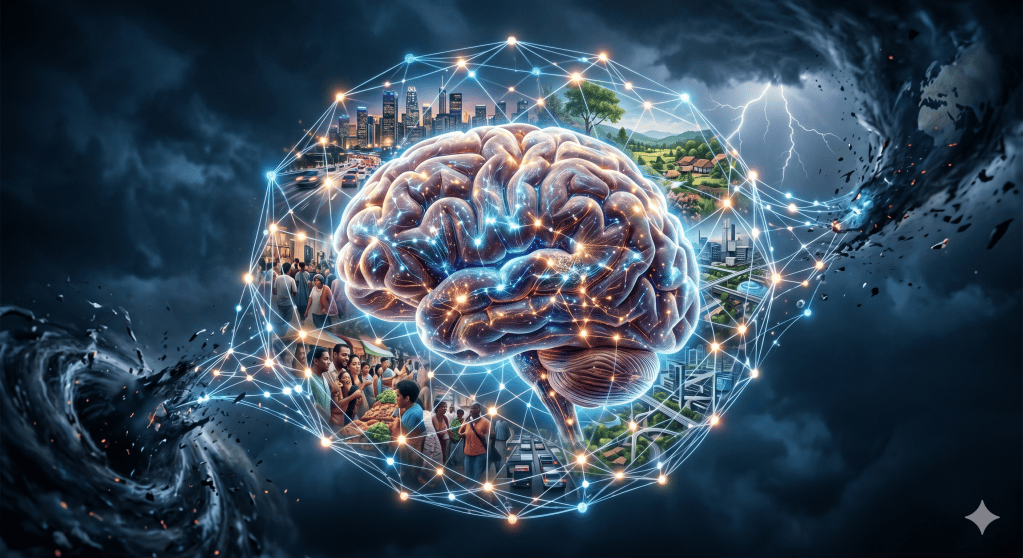
An in-depth look at the psychology and neuroscience of the pre-pandemic period — how technology, stress, loneliness, and polarization were already reshaping the human brain before 2020.
There is something strange about looking back at 2019. It feels simultaneously distant and close — a world that was recognizably modern, already saturated with smartphones and social media and algorithmic content, yet still operating under a set of assumptions that would be shattered within months. People were anxious, but in a particular way. The anxiety was personal, social, economic. It hadn’t yet metastasized into the collective, existential dread that would follow. The brain before global disruption was a brain already under significant stress — already being reshaped by technology, already navigating a fractured information environment — but not yet fully aware of how much more was coming.
Understanding the psychological and neurological state of people in that period isn’t just an exercise in historical curiosity. It offers something genuinely useful: a baseline. A picture of how human cognition was adapting, struggling, and changing before a sequence of events — a global pandemic, accelerating political instability — fundamentally altered the conditions of everyday life. To understand where we are now, it helps to understand where we were then, and what was already happening inside people’s heads.
A World Already Running Hot
By late 2019, it had become almost a cliché to say that modern life was overwhelming. But the research behind that cliché was real. The American Psychological Association’s annual “Stress in America” surveys found that nearly 75 percent of adults reported at least one significant stress symptom in the past month — trouble sleeping, irritability, fatigue, or feeling overwhelmed. This wasn’t a fringe experience. It was widespread enough to be called, by some researchers, a mental health crisis hiding in plain sight.
What made this period distinctive was the combination of stressors acting simultaneously. Economic inequality had been widening for decades, and the sense that hard work no longer reliably translated into security had taken hold across much of the middle class. Social trust — in institutions, in media, in neighbors — was measurably declining. Political polarization in the United States and across much of Europe had reached levels researchers described as historically unusual. And threading through all of it was technology: specifically, the smartphone and the social media platforms that lived on it.
These weren’t just cultural changes. They were changes with measurable cognitive and neurological consequences.
How the Smartphone Reshaped Attention
The human brain is not static. It is constantly reorganizing itself in response to experience — a property neuroscientists call neuroplasticity. This is largely a feature: it allows learning, adaptation, and recovery. But it also means the brain is vulnerable to being shaped by its environment in ways that aren’t always beneficial.
By 2019, the average American was spending three to four hours a day on their smartphone. For teenagers and young adults, the numbers were higher. Neurologically, this meant a significant portion of waking life was spent in a particular cognitive mode — one defined by frequent task-switching, constant scanning for new information, and intermittent reinforcement through notifications and social feedback.
Intermittent reinforcement is worth pausing on. It is the same mechanism that makes slot machines compelling. When rewards arrive unpredictably rather than on a fixed schedule, the brain’s dopamine system — which governs motivation and reward-seeking — responds with heightened engagement. Every notification, every like, every new post in a feed operates on this principle. The brain learns to expect stimulation and to feel discomfort in its absence. Researchers found that many users checked their phones not because they expected a specific notification but out of reflexive habit — a response to the low-grade restlessness that had become the default state of the digitally connected mind.
The Attention Economy and Its Costs
Platform design had evolved to reinforce this dynamic. The term “attention economy” describes the competitive landscape in which platforms vie for user time, with advertising revenue flowing to whoever captures the most attention for the longest duration. The business model required keeping people scrolling, and the most effective tools for doing so were novelty, outrage, and social comparison — each of which activates reward and threat systems in the brain.
The costs were becoming clearer to researchers by the late 2010s. Studies found associations between heavy social media use and increased rates of depression and anxiety, particularly among adolescents and young adults. The mechanisms were debated — correlation isn’t causation, and unhappy people may seek out social media rather than social media causing unhappiness — but the research consistently pointed toward at least some causal role. Social comparison appeared to be a significant driver: the brain’s social processing circuits, which evolved to track status and belonging in small groups, were being fed a continuous stream of curated highlights from hundreds or thousands of people at once — a task those circuits were not designed to handle.
There was also the matter of attention span, though this was more contested. Popular accounts claimed smartphones had reduced attention spans to less than that of a goldfish — a statistic that turned out to be invented. What seemed to be happening was not a general reduction in the capacity for sustained focus, but a shift in habits. People were spending less time in the deep, uninterrupted engagement that reading requires, and more time in the rapid, fragmented mode that scrolling demands. Whether this was a permanent cognitive change or a reversible behavioral adaptation remains an open question.
The Seeking System and Scroll Culture
The neuroscientist Jaak Panksepp described what he called the “seeking system” — a primary emotional circuit in the brain associated with exploration, curiosity, and the pursuit of reward. It is activated by novelty and the anticipation of reward rather than reward itself. It is, in other words, a system built for searching rather than finding.
The infinite scroll — designed specifically to eliminate natural stopping points in a social media feed — maps almost perfectly onto this logic. There is always something more to find. The content stream never ends. The seeking system keeps firing because the conditions that would satisfy it — a defined endpoint, a sense of completion — are deliberately absent. This is why people describe mindless scrolling as something that happens to them, almost against their will. It doesn’t feel like a choice. It feels like being swept along by a current.
This helps explain something many people found confusing about their own behavior: why they continued engaging with content that made them feel worse. The seeking system’s activation feels like purposeful engagement even when what’s being consumed is anxiety-provoking or distressing. The feeling of looking is, neurochemically, distinct from the feeling of finding — and the looking can become compulsive in its own right.
The Collapse of Downtime
One thing that distinguished 2019 from earlier eras was the near disappearance of boredom — not the clinical kind, but the ordinary, unremarkable variety that used to fill the gaps of daily life. People no longer waited in line, sat quietly on trains, or stood in elevators without reaching for stimulation. The smartphone had colonized every idle moment. If you had sixty seconds to spare, there was always something to check.
This might seem trivial — who misses boredom? — but the neuroscience suggests it matters more than it appears.
When the brain is not focused on an external task, it doesn’t go quiet. It shifts into what researchers call the default mode network: a pattern of activity associated with mind-wandering, daydreaming, autobiographical memory, and imagining future scenarios. This network was long dismissed as neural noise — the brain idling between tasks. More recent research has reframed it as something closer to the opposite. Activity in the default mode network appears central to creativity, to integrating new experiences with existing knowledge, and to the reflective self-awareness that allows people to process emotions and consolidate memory.
The moments we experience as doing nothing are moments when the brain is doing quite a lot. When those moments vanish — replaced by the low-level engagement of a social media feed — the brain loses time it would otherwise use for consolidation and reflection.
There is a simpler effect worth noting too: boredom has historically served as a motivational signal. It pushes people toward novel activity, toward creating something new when existing stimulation runs dry. By 2019, the phone had become an escape hatch from that discomfort — always available, always sufficient. The result was a kind of creative short-circuit: the stimulus arrived before the motivation to seek something more demanding could develop.
The Neuroscience of Chronic Stress
Stress, in small doses, is adaptive. The brain’s stress response — centered on cortisol and adrenaline, triggered by the amygdala — evolved to prepare the body for immediate physical danger. Heart rate increases. Blood flow shifts toward muscles. Non-essential functions are suppressed. It is a brilliant short-term solution.
The problem is that modern stressors are rarely the kind that physical readiness resolves. Financial anxiety doesn’t dissipate because you can run fast. Social comparison doesn’t ease because your blood pressure has spiked. When the stress response is activated chronically — not occasionally but persistently — it begins to cause damage.
Chronic cortisol exposure has been linked to structural changes in the hippocampus (involved in memory and learning) and the prefrontal cortex (responsible for planning, impulse control, and rational decision-making). Sustained stress, in other words, impairs the brain systems most responsible for clear thinking and emotional regulation — the very systems people most needed as anxiety and social conflict rose around them.
When the Threat Never Fully Arrives
There is a particular quality to the psychological climate of the pre-pandemic years worth naming: it was characterized less by acute crisis than by chronic low-level threat. The brain handles clear, immediate danger well. It handles sustained ambiguity — the feeling that something bad might be coming, without knowing what or when — considerably less well.
Research has described this state under various labels: anticipatory anxiety, uncertainty intolerance, hypervigilance. People experiencing it remain in a kind of perpetual low-level alert, spending cognitive resources scanning for threat signals even when no immediate threat exists. This is metabolically expensive and psychologically exhausting. By 2019, the information environment — with its relentless stream of alarming news, political volatility, and social conflict — had become remarkably effective at sustaining it.
Loneliness as a Public Health Problem
In 2018, the United Kingdom appointed the world’s first Minister for Loneliness — a move that struck observers as either touchingly progressive or absurdly bureaucratic. It reflected something real. Loneliness had been rising steadily across industrialized nations, and its health consequences were severe enough that researchers were beginning to treat it as a public health problem comparable to smoking or obesity.
The neuroscience is striking. Prolonged social isolation activates the same neural pathways as physical pain. The brain, in a very literal sense, experiences loneliness as hurt. From an evolutionary standpoint, this makes sense: for most of human history, exclusion from the group was genuinely life-threatening. But in a modern context — where loneliness is often structural, rooted in long working hours, geographic mobility, and the collapse of community institutions — the signal keeps firing without a clear resolution.
Research found that social media didn’t reliably help. The distinction that mattered was between passive consumption — scrolling through others’ posts without genuine interaction — and active, reciprocal communication. The former appeared to worsen loneliness; the latter could alleviate it. By 2019, most use had shifted heavily toward passive consumption.
The Paradox of Connection
The most technologically connected generation in human history was also among the loneliest. Young adults who had grown up with smartphones were reporting fewer close friendships, less frequent in-person socializing, and lower rates of activities — driving, dating, part-time work — that had previously served as both developmental experiences and social connectors. Researchers Jean Twenge and Jonathan Haidt were drawing attention to these trends; their work was controversial, but the underlying data showing declining well-being among adolescents, particularly girls, was difficult to dismiss.
Political Polarization and the Tribal Brain
One of the brain’s most powerful organizing principles is the distinction between “us” and “them.” The confirmation bias — the tendency to favor information that supports existing beliefs — is not a flaw unique to uninformed or irrational people. It is a feature of how the brain manages the cognitive burden of an information-rich world. We are all susceptible to it.
By 2019, the information environment had been optimized, largely by accident and partly by design, to exploit this tendency. Social media algorithms rewarded content that generated strong emotional reactions — and outrage was particularly effective at driving engagement. Partisan media on both ends of the political spectrum had learned that fear and anger kept audiences attentive in ways nuanced analysis did not. Geographic and social sorting reinforced this: people increasingly lived, worked, and socialized among those who shared their political views, reducing the corrective friction that comes from regular exposure to different perspectives.
The neuroscience is revealing. Studies using fMRI found that moralized anger — directed at perceived wrongdoing by outgroup members — activated reward circuitry. Righteous indignation is motivating and, to the brain, somewhat pleasant. This created a structural incentive, embedded in human neurobiology and amplified by platform design, for the escalating cycles of mutual outrage that came to define political discourse in the late 2010s.
Polling from this period found that a growing share of partisans on both sides of the American political spectrum viewed the opposing party not merely as mistaken but as genuinely threatening to the nation. This kind of polarization — rooted in emotion and identity rather than policy disagreement — is, according to political scientists, considerably harder to resolve than ordinary ideological difference.
Sleep, Technology, and the Exhausted Brain
Any serious account of the pre-pandemic brain has to include sleep. Even modest reductions — the difference between seven hours and six — measurably impair cognitive performance, emotional regulation, and immune function. The brain consolidates memory during sleep, clears metabolic waste, and processes emotional experience in ways that cannot be replicated during waking hours.
By 2019, surveys suggested a significant proportion of American adults were chronically underslept. Long working hours and economic pressure played a role, as did a cultural tendency to regard sleep as an indulgence rather than a biological necessity. Technology contributed too. Blue light from screens suppresses melatonin — the hormone that signals the brain to prepare for sleep — and the habit of checking phones in bed was disrupting circadian rhythms in ways that compound across weeks and months.
The neurological consequences were direct. The prefrontal cortex — the brain’s regulator of impulse control and rational thinking — is particularly sensitive to sleep deprivation. Sleep-deprived people show exaggerated amygdala responses to negative stimuli: the threat detection system becomes more active while the regulating system becomes less effective. In a period already characterized by elevated anxiety and polarization, chronic sleep deprivation was quietly amplifying both.
What Was Already Changing
By the end of 2019, these dynamics were beginning to generate their own counter-pressures — tentative, disputed, but real. Concerns about smartphone addiction and screen time had entered mainstream conversation. Several high-profile technology figures had publicly acknowledged the psychological risks of the platforms they had built. There was growing interest in mindfulness, digital detox, and the deliberate management of attention as a scarce resource. Researchers like Cal Newport were arguing that deep, focused attention was both cognitively valuable and increasingly rare — and that its rarity might make it a competitive advantage.
Whether these counter-pressures would have been sufficient, given time, is impossible to know. What happened instead was that conditions of life changed so rapidly and profoundly — beginning in early 2020 — that the pre-pandemic baseline was replaced almost overnight with something altogether different. Chronic low-level stress became acute crisis. Social isolation that had been creeping up gradually became abrupt and mandated. The information environment grew more intense, more saturated with threat signals, and the algorithmic amplification of fear and division accelerated sharply.
Looking Back to Understand What Followed
The events that followed the pre-pandemic years did not arrive into an empty psychological landscape. They arrived into a population already primed for anxiety, already experiencing degraded attention and elevated social conflict, already struggling with loneliness and sleep deprivation.
The disruptions of the 2020s did not create these vulnerabilities from scratch. They exposed and amplified what was already there. Many of the responses that followed — the rapid adoption of remote work, the explosive growth of streaming and gaming, the sometimes desperate search for community in online spaces, the intense political engagement that tipped easily into extremism — made sense as adaptations by brains already operating under significant strain, suddenly confronted with acute uncertainty and loss.
The emergence of generative AI in the early 2020s introduced an additional cognitive challenge: navigating a world where information became easier to generate than to verify. That development arrived on top of preexisting attention fragmentation and declining institutional trust, increasing the burden on human judgment at precisely the moment when human judgment was already taxed.
The crises of the 2020s did not begin the story. They entered a story that was already underway — one in which the modern brain, shaped by decades of accelerating technological and social change, was carrying more weight than it was designed to bear.









