
Originally published in October 2019 and comprehensively updated/edited in June 2026.
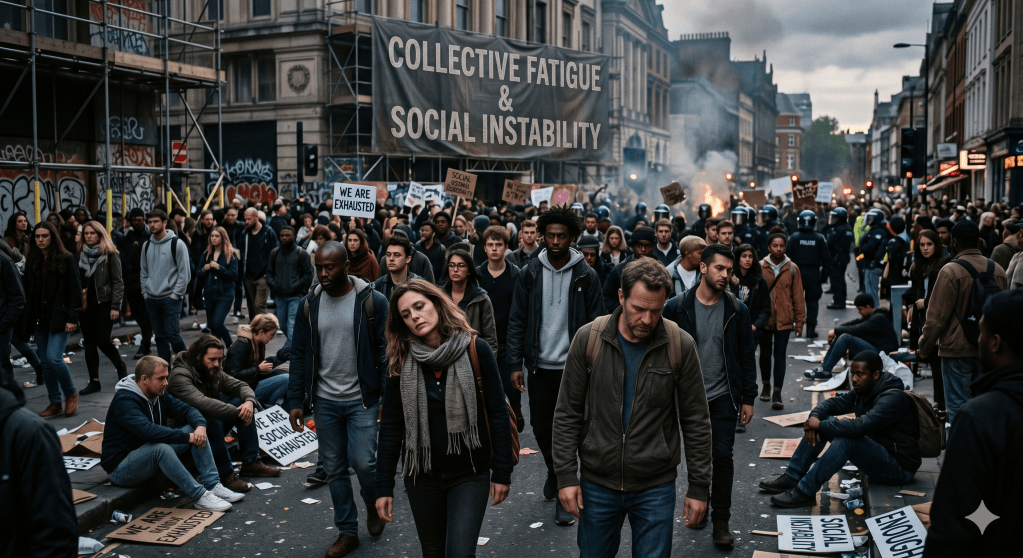
Collective fatigue and social instability are deeply connected. This essay examines how chronic stress, institutional distrust, and polarization shape societies — drawing on psychology, neuroscience, and sociology.
By late 2019, public trust in governments, media, and other major institutions was near historic lows across much of the Western world. Rates of loneliness were rising. Political polarization had intensified to the point where researchers were measuring it not just as a difference of opinion but as a form of social identity — something people felt in their bones rather than simply held as a view. Social media had become the primary lens through which tens of millions of people experienced public life, and it was a lens designed to surface conflict. Individually, each of these trends was concerning. Together, they created something harder to name: a climate of chronic social strain.
There are periods in history when the general atmosphere of public life feels heavier than usual — not because of any single catastrophe, but because of an accumulation of pressures that quietly erodes the social fabric. The late 2010s were one such period. Journalists wrote about “anxiety” and “burnout.” Researchers documented rising rates of depression and political distrust. But the threads connecting these phenomena — the shared psychological and sociological roots — were not always easy to see in real time.
This essay is an attempt to examine that period with more clarity. It draws on research from psychology, neuroscience, and sociology to explain how collective fatigue develops, how it feeds social instability, and why understanding both is important not just as historical analysis, but as a lens for recognizing similar patterns when they emerge again.
What Collective Fatigue Actually Means
The term “collective fatigue” does not appear in most psychology textbooks. It is not a clinical diagnosis. But that does not make it any less real or measurable. It refers to a widespread state in which large portions of a population are simultaneously experiencing elevated stress, reduced emotional resilience, and a diminished capacity to engage productively with disagreement, uncertainty, or bad news.
Individual fatigue is well understood. When a person is sleep-deprived, overworked, or chronically stressed, their cognitive and emotional functioning degrades in predictable ways. The prefrontal cortex — the part of the brain responsible for deliberate reasoning, impulse control, and perspective-taking — becomes less effective. The amygdala, which processes threats and emotional reactions, becomes more reactive. People become quicker to anger, slower to reconsider, and more likely to interpret ambiguous situations as hostile.
The psychologist Roy Baumeister described a related concept he called “ego depletion” — the idea that self-control and careful reasoning draw on a limited cognitive resource that gets used up over time. When that resource is depleted, people default to easier, more automatic patterns of thinking. They rely more on familiar narratives, in-group instincts, and emotional reactions rather than deliberate analysis. Subsequent research has refined and complicated the original ego depletion framework, but the broader point — that mental and emotional resources are finite and can be exhausted — remains well-supported in the cognitive and social psychology literature.
What happens when this kind of depletion occurs not just in individuals but across a society simultaneously? When millions of people are tired, stressed, and running low on emotional reserves at the same time? The social consequences are significant, and they are not simply the sum of individual exhaustions. There is something qualitatively different about collective fatigue — it changes the shared environment in which everyone must function.
The Institutional Trust Deficit
One of the most reliable indicators of social strain is declining trust in institutions. In the years leading up to 2019, polling organizations around the world were documenting a sustained erosion of public confidence in governments, media, scientific institutions, religious organizations, and corporations.
Gallup’s long-running surveys in the United States showed confidence in most major institutions at or near historic lows by the late 2010s. The Edelman Trust Barometer, which tracks institutional trust across dozens of countries annually, was reporting similar findings globally. This was not a new trend — it had been building gradually for decades in many Western democracies — but by 2019 it had become acute enough that researchers were treating it as a distinct social phenomenon.
Trust matters in ways that go beyond the political. Social scientists use the term “social capital” to describe the networks, norms of reciprocity, and generalized trust that allow communities to function smoothly. When social capital is high, people cooperate more easily, communities are more resilient to shocks, and individuals feel more connected to something larger than themselves. When it erodes, the friction in daily social life increases. People become more defensive, more suspicious, and more likely to interpret others’ actions uncharitably.
Robert Putnam, the political scientist who did foundational work on social capital, documented in his landmark book Bowling Alone how civic participation and community ties in America had been declining since at least the 1960s. The causes were multiple — television, suburbanization, generational change, working hours. By the 2010s, the internet had added a new and complicated variable to this picture.
The erosion of institutional trust and the weakening of social capital are mutually reinforcing. When people do not trust institutions, they rely more heavily on informal networks and in-group relationships. When those informal networks become polarized, they tend to confirm existing beliefs rather than challenge them. The result is a population that is simultaneously more isolated from broad civic engagement and more intensely attached to narrower tribal identities.
The Attention Economy and the Architecture of Outrage
Any serious account of collective fatigue in the late 2010s has to grapple with the role of digital media — not as a simple villain, but as an environmental factor that changed the psychological conditions in which people were living.
Social media platforms were designed, from their earliest iterations, to maximize engagement. Engagement, measured by time on platform, likes, shares, and comments, was the commodity that advertisers paid for. The problem is that the emotional states most reliably associated with high engagement are not the ones most conducive to reflective thought or civil disagreement. They are anger, fear, and moral outrage.
Research published by William Brady and colleagues at New York University found that on Twitter, the use of moral-emotional language — words expressing outrage, disgust, or moral condemnation — significantly increased the spread of posts within political networks. Each moral-emotional word added to a tweet increased the likelihood of retweet by roughly 20 percent. The platform’s algorithm was, in effect, rewarding outrage with distribution.
This is not a subtle effect. The volume problem alone was significant even before accounting for the content. The average person in 2019 was exposed to more news, commentary, opinion, controversy, and social comparison in a single week than many people in previous generations encountered in months. Even when that information was not overtly negative, continuously processing it required attention and cognitive resources. The sheer act of staying current — of knowing what was happening and what people were saying about it — had become a part-time cognitive job that previous generations were never asked to perform. The emotional tenor of the content made the burden considerably heavier.
When the information environment consistently surfaces content designed to provoke strong emotional reactions, it gradually recalibrates people’s baseline sense of the world. Psychologists refer to the “availability heuristic” — the cognitive tendency to judge the frequency or likelihood of something based on how easily examples come to mind. When a person’s daily media diet is saturated with outrage, conflict, and threat, their brain begins to treat those conditions as normal and expected. They become more vigilant, more reactive, and over time, more exhausted.
The concept of “doomscrolling” — compulsively consuming negative news despite the distress it causes — emerged as a cultural term around this period for good reason. It captured something real about the psychological experience of inhabiting these platforms. And chronic exposure to distressing information does have measurable physiological effects. Research on media consumption and stress responses has found that heavy news consumption is associated with elevated cortisol levels, disrupted sleep, and increased symptoms of anxiety and depression.
None of this means that social media was solely responsible for the social tensions of the late 2010s. The underlying political and economic grievances were real. But the architecture of digital media amplified those grievances, accelerated their spread, and made it significantly harder for people to encounter information that complicated or challenged their existing views.
Economic Anxiety and Its Psychological Shadow
The period between roughly 2008 and 2019 was defined, economically, by the aftermath of the global financial crisis. In many countries, that aftermath was longer and more uneven than official recovery statistics suggested. GDP growth eventually returned, but wages for many workers stagnated, wealth inequality widened, and the sense of economic security that had defined life for postwar middle classes in developed nations became significantly less reliable for younger generations.
Economists documented what researchers call “deaths of despair” — rising mortality among working-class Americans, particularly from drug overdoses, suicide, and alcohol-related illness. Anne Case and Angus Deaton, who named and analyzed this phenomenon, argued that the crisis was not simply about poverty but about the collapse of a particular way of life: the expectation that steady work, community ties, and incremental progress were available to people without a college degree. When that expectation was broken, the psychological consequences were severe.
Economic anxiety has well-documented psychological effects. Scarcity — both material and perceived — shifts cognitive functioning in ways that make long-term thinking harder and short-term thinking more dominant. The behavioral economists Sendhil Mullainathan and Eldar Shafir, in their research on the psychology of scarcity, found that financial stress consumed significant “cognitive bandwidth,” reducing people’s capacity for planning, self-control, and complex decision-making. The effect was not limited to people in genuine poverty; it extended to anyone experiencing the psychological stress of financial uncertainty.
At a societal level, widespread economic anxiety creates conditions favorable to social instability. People experiencing scarcity are more susceptible to zero-sum thinking — the belief that gains for one group necessarily come at the expense of another. They are more drawn to simple, decisive explanations for their circumstances and more receptive to political narratives that identify clear enemies and promise rapid transformation. These are not moral failings. They are understandable psychological responses to genuine insecurity.
How Fatigue Becomes Polarization
Here is where the threads begin to connect more clearly. Collective fatigue — the result of chronic stress, institutional distrust, information overload, and economic uncertainty — does not simply make people tired. It changes how they process the social world, and those changes make polarization more likely.
When people are cognitively and emotionally depleted, they rely more heavily on heuristics — mental shortcuts that allow quick judgments without extensive analysis. One of the most powerful of these is in-group favoritism. Decades of social psychology research, stemming originally from Henri Tajfel’s work in the 1970s, has demonstrated that humans are remarkably quick to identify with groups and to view out-groups less charitably. Under normal conditions, people can and do override these tendencies through deliberate thought. Under conditions of fatigue and stress, that deliberate override becomes much harder to maintain.
Psychologist Jonathan Haidt, in his work on moral psychology, described humans as “groupish” — deeply wired for tribal affiliation in ways that feel natural and even virtuous from the inside. His research suggested that much political disagreement is not primarily driven by differences in factual understanding but by differences in underlying moral frameworks, and that these frameworks are often defended with motivated reasoning rather than open inquiry. When people are tired, stressed, and surrounded by information that confirms their worst fears about the other side, motivated reasoning operates almost unchecked.
The political scientist Lilliana Mason documented in her research how “social sorting” — the increasing alignment of partisan identity with other social identities including race, religion, and education level — has made political polarization feel more personal and threatening than it did in earlier decades. When your political identity and your social identity overlap extensively, a political defeat feels like a personal attack on who you are, not just a policy disagreement. That raises the emotional stakes of politics considerably.
What this means, practically, is that collective fatigue and polarization exist in a feedback loop. Fatigue makes polarization more likely. Polarization — with its climate of constant conflict, outrage, and social threat — contributes to fatigue. Breaking that loop is genuinely difficult, partly because it requires the kind of sustained, deliberate effort that depleted people are least equipped to provide.
The Neuroscience of Social Threat
Understanding why collective fatigue has such powerful social consequences requires a brief look at how the brain processes social threat — which turns out to operate through many of the same neural systems as physical threat. Research by Naomi Eisenberger and colleagues at UCLA found that social exclusion activates regions of the brain associated with physical pain. The social brain does not experience threats to belonging or group membership as abstract. It registers them as genuine danger, triggering the same alarm systems that respond to bodily harm.
Matthew Lieberman, also at UCLA, has argued that social connection is not a luxury add-on to cognition but one of its most primary functions. When that connection is threatened or unreliable — as it is in a climate of constant cultural conflict, identity-based social media, and eroding institutional trust — basic regulatory functions suffer. Sleep degrades. Emotional regulation becomes harder. Immune function is affected. These are not metaphors. In an environment that reliably signals social threat, chronic low-level activation of those systems is physiologically exhausting in ways that compound everything else described in this essay.
Social Instability as an Emergent Condition
Social instability is sometimes treated as if it has a single cause — an economic shock, a charismatic demagogue, a foreign adversary. In reality, it is almost always an emergent condition: the result of multiple interacting factors that reinforce one another in ways that are difficult to anticipate or reverse.
The political scientist Peter Turchin, who developed a quantitative approach to analyzing historical patterns in social stability, identified several recurring conditions that tend to precede periods of heightened tension: too many people competing for too few elite positions, declining wages relative to GDP, eroding institutional trust, and rising political polarization. By his analysis, most of these indicators were trending in concerning directions in Western democracies by the late 2010s — not as deterministic predictions, but as measurable structural pressures.
What structural analysis alone cannot capture is the psychological dimension: how fatigued the population is, how much reserve capacity for compromise remains, whether institutions retain enough legitimacy to manage conflict. These factors matter enormously for whether structural pressures escalate or are absorbed — and they are precisely what this essay is about.
The Years That Followed
Writing in June 2026, it is possible to say with some confidence that the social tensions of the late 2010s did not simply resolve themselves. The COVID-19 pandemic, which began in early 2020, arrived into a social landscape that was already strained. It amplified many of the dynamics described in this essay — isolation, institutional distrust, polarization, information overload — while adding its own distinct forms of collective grief, economic disruption, and psychological exhaustion.
The pandemic also demonstrated, with unusual clarity, the relationship between collective fatigue and public health. Researchers studying the psychological effects of the pandemic documented widespread “pandemic fatigue” — a measurable decline in compliance with protective behaviors as the crisis extended over months and years. This was not primarily a failure of information or motivation. It was a documented consequence of sustained stress and cognitive depletion on behavioral self-regulation.
The social and political turbulence of the early 2020s — including significant political instability across multiple democracies, continued erosion of institutional trust, and increasingly complex information ecosystems shaped by artificial intelligence — suggests that the conditions examined in this essay have not disappeared. They have evolved and, in some respects, intensified.
Understanding What Remains Relevant
The value of examining collective fatigue and social instability as interconnected phenomena is not primarily historical. It is practical. Understanding the mechanisms — how chronic stress affects cognition, how information environments shape baseline emotional states, how economic insecurity narrows political imagination, how polarization and fatigue feed one another — provides a more accurate map of why societies sometimes behave as they do.
That map does not license despair. Societies have demonstrated remarkable resilience in difficult periods. Institutions can be rebuilt. Trust can be restored. Information environments can be reformed, though doing so requires deliberate effort at both the policy and individual level. Psychological research suggests that even simple interventions — getting more sleep, reducing social media consumption, investing in face-to-face relationships, finding shared projects with people who hold different views — can meaningfully improve individual resilience and reduce susceptibility to polarization.
But those interventions work better when people understand what they are working against. Collective fatigue is not a character deficiency or a sign of moral weakness. It is a predictable consequence of specific social, economic, and technological conditions. Individual habits matter, but resilience is also produced by institutions, communities, and social norms. Healthy societies make healthy psychological functioning easier rather than requiring individuals to constantly compensate for systemic pressures. Recognizing collective fatigue for what it is — a systemic condition with measurable psychological and sociological dimensions — is the first step toward addressing it with anything more than slogans.
The exhaustion many people felt at the close of the 2010s was real, and its causes were structural. So were its consequences. Understanding both remains as relevant in 2026 as it was when this essay was first drafted









