
Originally published in January 2020 and comprehensively updated/edited in June 2026.
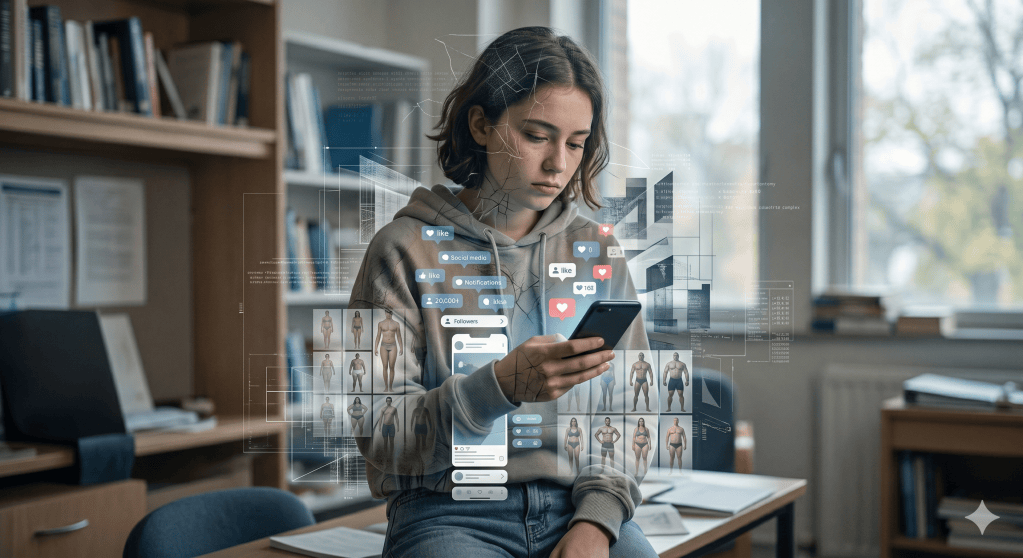
Explore how social media, psychology, and culture converged in the 2010s to intensify body image struggles—and what science reveals about why the body became the battlefield.
There is something quietly devastating about looking back at the years just before the pandemic and recognizing how thoroughly modern life had already turned the human body into a contested space. Not in some abstract philosophical sense, but in the concrete, daily experience of millions of people navigating a world that had become saturated with images, data, social comparison, and an almost oppressive awareness of physical appearance. By the late 2010s, a strange convergence had taken place. Smartphones were in nearly every pocket. Social media had matured from novelty to infrastructure. And the ancient, deeply human anxieties about how we look, how we measure up, and whether we are enough had found a new and extraordinarily powerful set of amplifiers.
This is an essay about what happened to the relationship between people and their own bodies during that period—and why it matters. It is not a story with a clean villain. Technology did not cause body image problems. Social comparison is as old as human society. Disordered eating, anxiety about appearance, and the relentless pursuit of an idealized physical self long predate Instagram or the iPhone. But something did shift in meaningful ways during this period, and understanding what shifted—and why—requires looking carefully at the intersection of psychological science, cultural change, and the mechanics of digital platforms designed, often deliberately, to keep human attention locked in.
The themes running through this story are intertwined: social comparison, reward and anxiety, cultural body ideals, adolescent vulnerability, and the ways digital environments transformed all of these from background noise into a constant signal. What follows is an attempt to map that terrain.
The Ancient Machinery of Comparison
To understand what went wrong—or at least, what changed—it helps to start with what has always been true about human beings and appearance. We are a profoundly social species, and our nervous systems are wired for social comparison in ways that are both functional and, under certain conditions, harmful.
Why We Compare Ourselves to Others
Leon Festinger introduced social comparison theory in 1954, and its core insight remains durable: people evaluate their own opinions and abilities by comparing themselves to others, particularly when objective standards are unavailable. In practice, this extends far beyond opinions and abilities. We compare our bodies, our attractiveness, our clothing, our apparent vitality and health—all in the service of calibrating our social standing and self-worth.
This is not a character flaw. It is cognitive architecture. From an evolutionary perspective, monitoring where you stood relative to others in your group had real survival implications. Status, alliance, and mate selection all depended on accurate self-assessment, and comparison to visible peers was the primary tool for achieving that. The problem, as researchers have documented extensively, is that this system was calibrated for small-group, face-to-face social environments. It was never designed for a world in which a person could, in a single afternoon, expose themselves to thousands of carefully curated images of other people’s bodies.
Upward Comparison and Its Costs
Psychologists distinguish between upward and downward comparison—comparing yourself to people you perceive as better off versus worse off. Upward social comparison, particularly around appearance, has been consistently linked to lower body satisfaction, diminished self-esteem, and increased risk of disordered eating behaviors. This is not especially surprising. What is more interesting is the degree to which the effect scales with exposure.
Research published in the journal Body Image and elsewhere has demonstrated a dose-response relationship: more time spent viewing idealized body images correlates with greater body dissatisfaction, and this relationship holds even when people are aware that the images they are viewing are edited or otherwise unrealistic. Knowing something is manipulated does not fully inoculate against its psychological impact. The comparison machinery runs faster than conscious reasoning.
The Architecture of the Image Economy
Against this psychological backdrop, this era built something genuinely new: a global, always-accessible infrastructure for the display and consumption of human bodies. Understanding what made this qualitatively different from earlier media environments matters a great deal.
From Passive Consumption to Participatory Performance
Earlier generations encountered idealized bodies primarily through passive media: magazines, television, film. These were curated environments, clearly demarcated as separate from ordinary life. The arrival of social media—and particularly the visual platforms that rose to dominance from roughly 2010 onward—changed the structure of the experience in a fundamental way. People were no longer just consuming images of idealized others; they were also producing and publishing images of themselves for public judgment.
This shift from audience to performer has significant psychological consequences. Research on self-objectification, developed by psychologists Barbara Fredrickson and Tomi-Ann Roberts in the late 1990s, describes how individuals come to internalize an observer’s perspective on their own bodies—habitually monitoring their appearance from the outside, treating themselves as objects to be evaluated. Digital self-presentation accelerated this process for a generation of users at a formative stage of identity development.
When you are regularly posting photographs of yourself, monitoring the response, and adjusting your behavior in anticipation of that response, you are not simply sharing your life. You are, to some degree, learning to experience your own body primarily as something to be managed and displayed. The psychological literature on this is consistent: higher levels of self-objectification are associated with greater body shame, appearance anxiety, and disordered eating cognitions.
The Algorithm as Mirror
The platforms themselves were not neutral pipes through which content happened to flow. They were—and remain—optimization engines, designed to maximize engagement by surfacing content that generates strong emotional responses. Content related to appearance, aspiration, and physical transformation tends to be highly engaging, which means algorithmic systems learned to promote it. Users did not necessarily seek out a steady diet of idealized body content; in many cases, the platforms learned to deliver it because doing so kept people scrolling.
This is not a conspiracy. It is an emergent property of engagement-maximizing systems operating on human psychological tendencies that include a hard-to-suppress interest in the appearance of others. But the practical effect—an environment in which body-focused content was systematically amplified—had real consequences for how people experienced their digital lives.
The Particular Vulnerability of Adolescence
Any honest account of what happened during this period has to grapple seriously with the question of age. Body image problems affect people across the lifespan, but adolescence has always been a period of heightened vulnerability, and the expansion of social media coincided with a pivotal developmental window for the generation now known as Gen Z.
Brain Development and Social Sensitivity
Neuroscience has clarified in recent decades why adolescence is such a high-stakes period for social experiences. The prefrontal cortex—the brain region most associated with long-term thinking, impulse regulation, and the ability to contextualize experience—is still actively developing well into the mid-twenties. Meanwhile, the limbic system, which processes emotion and social reward, is running at full intensity. This creates a period when social feedback is particularly powerful and particularly difficult to regulate.
Research using neuroimaging has shown that adolescents have a stronger neural response to social exclusion than adults do, and that social acceptance activates reward circuitry more intensely in teenage brains than in mature ones. Put simply: social feedback hits harder during adolescence, for neurobiological reasons. When that social feedback is mediated through a platform that provides constant, quantified signals of approval and rejection—likes, follower counts, comment tone—the potential for psychological disruption is not trivial.
The Evidence on Adolescent Girls
The research evidence is more compelling in some populations than others, and adolescent girls have been the most studied and arguably the most affected demographic. A series of studies, including large-scale longitudinal work by Jean Twenge and colleagues, documented significant increases in depression, anxiety, and body dissatisfaction among teenage girls beginning around 2012—a date that corresponds closely with the mass adoption of smartphones and image-based social media.
Jonathan Haidt’s and Jean Twenge’s later synthesis of this research, while contested in some methodological details, identified a consistent pattern: girls who spent more time on social media reported higher rates of negative mental health outcomes, with appearance-related anxiety and depression showing some of the strongest correlations. The effect sizes were not uniform, and social media was not the only relevant variable during that period. But the convergence of evidence across multiple studies and methodologies was difficult to dismiss.
It is also worth noting what the evidence does not say. It does not say that social media use is uniformly harmful for all adolescents. Research suggests that passive consumption—scrolling through others’ content—tends to be more harmful than active, communicative use. Context, intensity, and the type of content consumed all matter. But for a subset of adolescents, particularly those already prone to anxiety or low self-esteem, the environment created by visual social media during this period represented a meaningful increase in psychological risk.
The Rise and Commercialization of the Ideal Body
Body ideals have always been culturally constructed and historically contingent. What counts as an attractive or healthy body has shifted dramatically across centuries and across cultures, driven by everything from agricultural productivity and disease prevalence to elite fashion and colonial aesthetics. This era was not unique in promoting a body ideal—but the mechanisms through which that ideal was promoted, and the scale at which it operated, were new.
The Fitness and Wellness Industrial Complex
The mid-2010s saw the emergence and rapid commercialization of what might be called aspirational fitness culture. Instagram in particular became a major distribution channel for a visual aesthetic built around lean, muscular, or otherwise highly sculpted bodies, often presented under the banner of “health” and “wellness.” This framing was significant. Earlier eras of body image pressure had tended to be more explicitly about thinness or conventional attractiveness. The new aesthetic wrapped the pursuit of a particular body type in the language of discipline, self-care, and empowerment.
This was savvy, in a way. It made the content harder to critique directly—who could argue against health?—while still transmitting the same fundamental message: your body, as it currently exists, is not sufficient. The wellness industry, valued at over four trillion dollars globally by the late 2010s, according to the Global Wellness Institute, had discovered that aspirational body content was an extraordinarily effective marketing vehicle. Influencers, supplements, meal plans, fitness programs, and a sprawling ecosystem of related products all flowed through the same channels that delivered the aspirational images.
Muscularity, Men, and a Shifting Pressure Landscape
Discussions of body image in this period sometimes focused narrowly on thinness and female experience, but the picture was broader. Research on male body image documented significant increases in what psychologists call “muscle dysmorphia”—a preoccupation with being insufficiently muscular that has some structural similarities to other body image disorders. The idealized male body promoted through social media and entertainment during these years had become dramatically more muscular than in earlier decades, and surveys of men and boys showed growing rates of appearance-related anxiety, supplement use, and disordered eating behaviors.
The psychological mechanisms were similar to those operating in female populations: exposure to idealized images, upward social comparison, and the internalization of appearance standards that most people could not achieve without extreme effort, if at all. The manifestations differed somewhat—dietary restriction and purging were less common in men, while excessive exercise and steroid use were more common—but the underlying dynamic was recognizable.
The Science of Body Image Disorders
Running parallel to these cultural developments was a growing scientific understanding of the conditions that emerge when body image disturbance becomes clinically significant. The etiology of these disorders is genuinely multifactorial. Genetic vulnerability plays a meaningful role—twin studies have consistently found substantial heritability for anorexia nervosa and bulimia nervosa. Neurobiological factors, including differences in reward processing and anxiety regulation, contribute as well. The current research consensus is not that media exposure or social comparison causes eating disorders in otherwise invulnerable individuals, but rather that sociocultural pressures can accelerate onset, increase severity, or lower the threshold at which vulnerable people develop clinical problems. The environment matters, but it does not operate in isolation.
Perhaps the most striking scientific finding in this area has been the discovery of how profoundly distorted body perception can be—and that this distortion has a neurobiological basis. Brain imaging studies have shown that individuals with anorexia nervosa process visual information about bodies differently at the neural level, with abnormal activation in regions involved in visual processing and emotional response. This helped shift clinical understanding away from simplistic frameworks—that people with eating disorders are being vain or willfully refusing to see reality—and toward recognition that what is happening is, in part, a genuine perceptual phenomenon. The brain, under conditions of chronic stress and malnutrition, can construct a body image that diverges substantially from physical reality.
Digital Platforms, Regulation, and the Search for Accountability
By the early 2020s, the accumulating evidence had produced genuine political and regulatory pressure. Internal research from major platforms—some of which became public through investigative journalism—appeared to confirm that company researchers had identified harmful effects on some user populations, particularly adolescent girls, and that this knowledge had not necessarily translated into meaningful changes in platform design. Regulatory responses varied by region, with some governments moving toward formal requirements for platforms to assess and mitigate risks to minors, while the American process remained fractured, producing more congressional hearings than concrete legislation as of mid-2026.
The platforms themselves adopted various measures—content warnings on heavily edited images in some jurisdictions, algorithmic adjustments for young users, expanded mental health resources—with outcomes that were difficult to evaluate independently. The fundamental tension remained: platforms whose business models depend on engagement have structural incentives that may not align neatly with user wellbeing, particularly for the most psychologically vulnerable users.
Recovery, Resilience, and the Limits of Individual Solutions
Any serious engagement with this topic has to grapple with what can actually be done—both at the individual level and at the level of policy and platform design. The evidence here is mixed, and intellectual honesty requires acknowledging the limits of what we know.
Media Literacy and Its Modest Effects
A significant amount of effort went into media literacy interventions during this period—programs designed to help young people understand how images are manipulated, how ideals are constructed, and how to engage more critically with the content they consume. The evidence on the effectiveness of these interventions is modestly encouraging. Studies suggest that media literacy education can reduce the internalization of unrealistic body ideals and improve some body image outcomes, but effect sizes tend to be small and effects often fade over time without reinforcement.
This is not a reason to abandon media literacy work. It is a reason to be realistic about what it can accomplish on its own. Individual psychological resources can provide meaningful protection, but they cannot fully neutralize an environment that is designed to exploit psychological vulnerabilities at scale. The burden of adaptation should not fall entirely on users, particularly young ones.
What Clinical Research Says About Treatment
For individuals who develop clinically significant body image disorders, the treatment landscape improved meaningfully during this period, even as access remained a persistent problem. Cognitive behavioral therapy adapted for body dysmorphic disorder and eating disorders showed solid efficacy in clinical trials. Enhanced cognitive behavioral therapy for eating disorders demonstrated effectiveness across diagnostic categories. Acceptance and commitment therapy approaches offered promising results for some populations. Family-based treatment for adolescents with anorexia had a growing evidence base.
The gap between what worked in clinical settings and what was available to most people who needed it remained enormous. Eating disorders had among the highest mortality rates of any psychiatric condition, access to specialized treatment was geographically and economically restricted, and the cultural stigma surrounding these conditions continued to delay help-seeking. The science was ahead of the system.
What This Period Revealed
The roughly decade-long arc from the early 2010s through the pandemic and into the mid-2020s clarified several things that were only dimly visible while they were happening.
First, it demonstrates that technological change can interact with existing psychological vulnerabilities to produce measurable shifts in population-level mental health outcomes. This is not a moral judgment about technology—it is a statement about the importance of studying second-order effects carefully, especially when innovations are adopted at enormous scale before their implications are understood.
Second, it reveals something about the resilience and the fragility of body image across the lifespan. For most people, most of the time, exposure to idealized images produces discomfort but not disorder. The human capacity for adaptation is real. But for a meaningful minority—and the research suggests that minority is larger than it once appeared—the environment created by visual social media during this period represented a genuine and sustained harm.
Third, and perhaps most importantly, this period clarified that body image is not merely a personal psychological matter. It is a social phenomenon, shaped by cultural forces, economic incentives, and technological infrastructure. Individual resilience matters, but it cannot substitute for environments that are designed with human wellbeing in mind.
The body became the battlefield in these years not because anything about human psychology fundamentally changed, but because the terrain shifted. The ancient machinery of comparison, the developmental vulnerabilities of adolescence, the neurobiological underpinnings of body perception, and the economic logic of attention capitalism all converged in ways that made the struggle over self-image more intense, more continuous, and more difficult to escape than it had been for any previous generation raised in the modern world.
That convergence did not end when the pandemic arrived in 2020, or when various regulatory responses began to take shape afterward. If anything, it deepened. Understanding how it happened—what made certain people more vulnerable, what made certain environments more harmful, and what interventions actually helped—remains one of the more urgent projects at the intersection of psychology, public health, and technology policy.









