
Originally published in August 2020 and comprehensively updated/edited in June 2026.
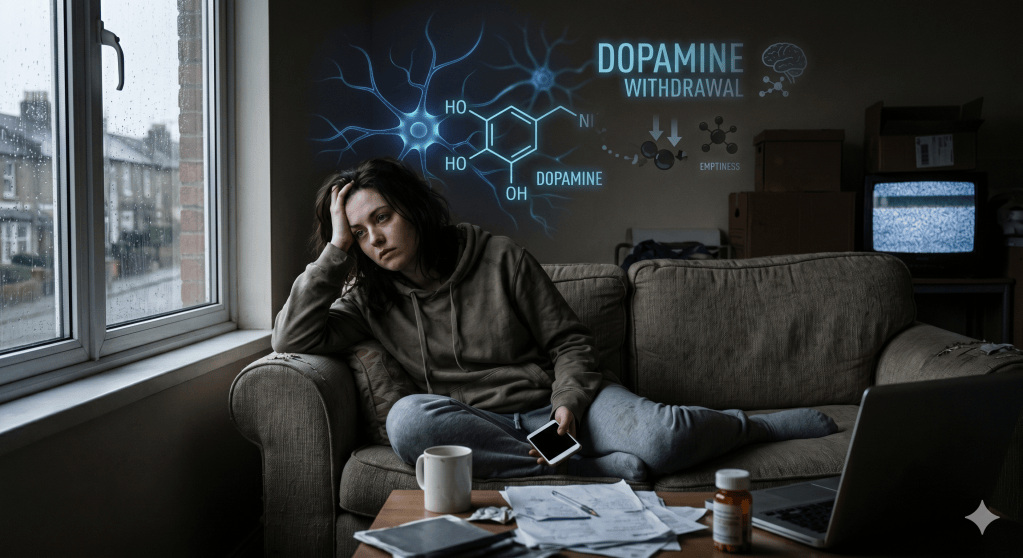
What pandemic lockdowns revealed about the brain’s reward system, the environmental roots of motivation, and why digital life couldn’t fill the gap.
In the spring of 2020, the world stopped. Not gradually, and not in the way anyone had expected or planned for. Within the span of a few weeks, the familiar architecture of daily life — offices, gyms, restaurants, schools, casual errands, spontaneous plans — was dismantled almost overnight. For billions of people, the outside world shrank to the dimensions of a home, a balcony, or a postage-stamp yard. The pandemic lockdowns that began that spring were, in historical terms, one of the most dramatic disruptions to normal human social behavior ever recorded in peacetime.
At the time, much of the public conversation focused on the epidemiology, the economics, and the politics. But quieter, and in some ways more lasting, was the psychological disruption that unfolded in parallel. People began reporting something harder to name than grief or fear. They described a kind of flat, hollow restlessness — a numbing of motivation, an inability to enjoy things that had previously brought pleasure, a strange sensation of being both bored and overwhelmed simultaneously. Some slept too much; others couldn’t sleep at all. Many found themselves caught in compulsive loops of social media scrolling, eating, or streaming — reaching, it seemed, for something they couldn’t quite locate.
What they were experiencing, in large part, was a disruption of the brain’s reward system. And understanding that disruption — through the lens of dopamine, behavioral neuroscience, and what we now know about digital life — tells us something important not just about the pandemic, but about the neurological conditions of modern existence.
What Dopamine Actually Does
Before getting into the specifics of lockdown psychology, it’s worth clearing up one of the most persistent misconceptions in popular science. Dopamine is almost universally described as the “pleasure chemical” — the neurological substance your brain releases when you experience something enjoyable. That’s not exactly wrong, but it’s not quite right either.
The more precise picture, developed through decades of research and made accessible by neuroscientists like Robert Sapolsky and Wolfram Schultz, is that dopamine is primarily a signal of anticipation and motivation rather than pleasure itself. The dopamine spike doesn’t arrive when you get what you want — it arrives when you expect you might get what you want. It is, in the words of many researchers, less about the reward itself and more about the prediction of a reward.
This distinction matters a great deal. Studies on rats and primates have shown that dopamine neurons fire intensely in response to cues that predict a reward, not just the reward itself. When the expected reward fails to arrive, dopamine drops below baseline — a signal that functions almost like a neurological disappointment. And when rewards arrive unexpectedly, with no predictive cue, the dopamine spike is especially large. This is the neurological logic behind why unpredictable rewards, like slot machines and social media notifications, are so compelling. The uncertainty is the whole point.
Dopamine also plays a central role in what researchers call the motivational salience system — essentially, the brain’s mechanism for deciding what to pay attention to and pursue. Without adequate dopamine signaling, the world tends to feel inert. Things that used to be interesting lose their pull. Getting started on a task becomes unexpectedly difficult. The clinical version of this is called anhedonia — the inability to experience pleasure or motivation — and it’s a core feature of depression.
What lockdown did was dramatically alter the reward landscape of everyday life.
The Architecture of Normal Reward
To appreciate what was lost during pandemic lockdowns, it helps to think about how thoroughly the structure of ordinary pre-pandemic life was organized around small, frequent, socially embedded rewards.
Getting dressed and commuting to an office isn’t, on its face, pleasurable. But it involves dozens of tiny anticipated events: the coffee you’ll pick up, the colleagues you’ll see, the satisfaction of completing a task, the ritual of lunch. Even the commute, often maligned, provides sensory variety, a sense of movement through the world, and a psychological transition between the domestic and professional selves.
Social interaction is itself one of the most potent sources of dopamine signaling available to human beings. Laughter, recognition, physical touch, eye contact, the warmth of belonging to a group — all of these activate reward pathways in the brain. Humans are, by evolutionary design, intensely social animals. The neurological cost of social isolation is not metaphorical; it registers in the brain in ways that look, on imaging studies, remarkably similar to physical pain.
Beyond direct social contact, ordinary daily life before the pandemic was rich with what might be called mild novelty — the low-grade stimulation of moving through different environments, encountering unexpected events, making spontaneous small decisions. Behavioral research has consistently shown that novelty is itself a powerful trigger for dopamine release. The brain is, in a fundamental sense, a prediction machine that is energized by new information.
Lockdown removed most of this. Not all at once, and not equally — essential workers faced a very different experience from people working from home, and those with financial precarity faced stresses of a wholly different order. But for enormous numbers of people, the daily texture of life became suddenly narrow, repetitive, and socially starved. The reward landscape flattened.
What the pandemic also revealed, unexpectedly, was how much of what people thought of as personal motivation was actually environmental. Before 2020, most people assumed that their drive to exercise, to work productively, to socialize, to create, was something they generated from within — an expression of personality or willpower. Lockdown quietly dismantled that assumption. People who had exercised reliably for years found themselves unable to maintain the habit without a gym. Productivity collapsed for workers who had previously seemed disciplined; it turned out the office, the commute, and the proximity of colleagues were doing motivational work that no one had consciously credited them with. Writers couldn’t write. Social people stopped reaching out, not because they didn’t want connection but because the ambient social encounters that normally primed the desire for deeper contact — the hallway conversation, the accidental run-in — had been removed.
The lesson wasn’t that people lacked self-discipline. It was that motivation is rarely generated in a vacuum. It is, to a significant degree, a product of context — triggered by environments, social cues, and physical circumstances that we move through largely without noticing. Lockdown made the invisible scaffolding visible by taking it away.
Withdrawal Without a Substance
The term “dopamine withdrawal” isn’t a clinical diagnosis. Strictly speaking, withdrawal is typically used to describe the physiological effects of removing a substance — alcohol, opioids, stimulant drugs — on a brain that has adapted to its presence. But the metaphor is more useful than it might initially appear.
When the brain’s reward system is chronically deprived of its usual inputs, it adapts. Studies on prolonged social isolation in both animals and humans show changes in dopamine receptor density and sensitivity, alterations in baseline motivation, and shifts in mood regulation. The brain is not a passive organ; it adjusts to its environment. And when the usual sources of stimulation are removed, the adjustment process isn’t painless.
Some researchers, including psychiatrist Anna Lembke (Dopamine Nation, 2021), have argued that contemporary life had already produced a kind of baseline dopamine imbalance — that the density of modern pleasures had raised the threshold for satisfaction, making quieter experiences feel flat by comparison. The evidence is suggestive rather than conclusive, but the framework helps explain what lockdown then imposed: a sudden contraction of the most stimulating inputs at precisely the moment when many people’s reward systems were least equipped to cope with their absence.
This helps explain a pattern many people described during lockdown: an inability to enjoy “simple pleasures” that seemed like they should be accessible. Reading, cooking, gardening, home projects — things people had always claimed to wish they had more time for — often proved unexpectedly difficult to engage with. The problem wasn’t lack of time. The problem was that the motivational system was dysregulated, either dulled by deprivation or destabilized by the competing pull of higher-stimulation digital substitutes.
The Digital Compensation Problem
If lockdown starved people of real-world reward sources, it simultaneously offered an abundance of digital ones. Screen time surged dramatically in 2020. Streaming platforms reported record subscriber growth. Social media usage climbed. Video calls became the primary mode of human connection for millions. Gaming participation spiked across every demographic.
On the surface, these technologies served a genuine and important function. They kept people connected, entertained, informed, and — in many cases — employed. There is no serious argument that digital technology was anything other than a lifeline during the acute phase of the pandemic.
But from a neurological standpoint, digital media and real-world social experience are not equivalent, and the substitution was not without cost.
Social media platforms are engineered, with considerable sophistication, around the same principles of variable-ratio reinforcement that make slot machines so powerful. The notification, the like, the comment — each represents an unpredictable delivery of social validation, triggering small bursts of dopamine activation. The infinite scroll format, deliberately designed to remove stopping cues, exploits the same anticipatory mechanisms that keep the dopamine system in a state of low-grade activation. You keep scrolling because something interesting might come next.
But there’s a subtler problem that goes beyond the mechanics of variable rewards. Digital media creates a peculiar mismatch between cognitive stimulation and physical experience. During a few hours of social media use, a person might encounter hundreds of conversations, dozens of emotional reactions, and an enormous volume of images and information — while remaining completely motionless in the same chair, in the same room, looking at the same four walls. The brain receives a continuous stream of social and sensory signals. The body goes nowhere. The environment doesn’t change at all.
This matters because the reward system evolved in a world where stimulation and environmental change were tightly coupled. You found food by moving through a landscape. You encountered other people by leaving familiar territory. The brain learned to associate cognitive and social engagement with physical movement and novel environments. Digital media breaks that coupling entirely — delivering the stimulation without the context that the nervous system expects to accompany it. The result is a kind of neurological mismatch: a brain that has been busy all day while the body experienced almost nothing.
The problem is that this kind of reward activation is high-frequency but rarely deep. It produces engagement without satisfaction. Research on social media use, including work by psychologists Jean Twenge and Jonathan Haidt, has documented consistent associations between heavy platform use and declines in reported wellbeing, particularly among adolescents, though the effects appear across age groups. The proposed mechanism is partly this dopamine trap: constant stimulation that raises the threshold for satisfaction without providing the deeper reward that comes from genuine social connection, creative accomplishment, or meaningful experience.
During lockdown, many people found themselves in a cycle that felt impossible to break. Real-world stimulation was severely limited. Digital stimulation was unlimited and ever-present. The brain, seeking to maintain its reward equilibrium, increasingly oriented toward the screen — which then further habituated the reward system and made real-world activities feel even less engaging by comparison.
The Unusual Case of Boredom
There’s something worth examining specifically about the experience of boredom during lockdown, because it behaved strangely. People reported being intensely bored while simultaneously being unable to engage with the activities they’d theoretically had time for. This isn’t a contradiction — it reflects something specific about how the reward system works under conditions of both deprivation and digital saturation.
Research on boredom, led in part by psychologist John Eastwood at York University, has characterized it not as an absence of things to do but as a failure of engagement — specifically, a failure to find meaning or connection in available activities. This is a motivational and attentional problem before it’s a scheduling one. And it maps quite precisely onto what disrupted dopamine signaling produces: activities that would normally feel engaging begin to lose their motivational pull.
There’s a further wrinkle. Studies have found that boredom is often experienced as aversive — sometimes acutely so. A now-famous 2014 study by Timothy Wilson and colleagues found that a significant portion of participants chose to administer mild electric shocks to themselves rather than sit quietly alone with their thoughts for fifteen minutes. The finding was widely interpreted as evidence of how poorly humans tolerate unstructured mental time. In the context of lockdown, this shed light on why so many people found themselves compulsively reaching for their phones even when they knew it wasn’t making them feel better. Boredom, in neurological terms, activates discomfort signals. Digital stimulation suppresses them — temporarily.
Children, Adolescents, and Developmental Disruption
Pandemic lockdown didn’t affect all age groups equally. For developing brains, social experience isn’t optional enrichment — it is the primary material of cognitive and emotional development.
The teenage brain is undergoing a reconfiguration of its reward circuitry that specifically increases sensitivity to social signals, particularly peer approval and belonging. The peer environment during adolescence isn’t just a preference; it’s a neurological input the developing brain is actively using. Removing it carries real developmental risk.
Lockdown did exactly that at precisely the wrong moment for millions of young people. School closures didn’t just interrupt education; they dismantled the entire social infrastructure of adolescent life. Studies across multiple countries documented significant increases in anxiety, depression, and eating disorders among teenagers during the pandemic period, and emergency psychiatric presentations by adolescents climbed in several healthcare systems.
The turn to social media as a substitute was understandable but imperfect. The same variable-reward mechanics that unsettle adult wellbeing operate on brains running at heightened sensitivity to social comparison — making the mismatch between digital stimulation and genuine peer contact especially acute for younger users.
What the Research Said — and What It Couldn’t Resolve
One of the honest complications of writing about lockdown psychology is that the science moved very fast, and not always in a straight line. During 2020 and 2021, research on pandemic mental health effects proliferated rapidly — but a good deal of it was preliminary, conducted under difficult conditions, and subject to revision.
What the evidence fairly consistently showed was an increase in psychological distress during the acute phase of lockdowns — elevated symptoms of anxiety, depression, loneliness, and disordered sleep across multiple populations and countries. Meta-analyses published through 2021 and 2022 confirmed that these effects were real and widespread. Particular vulnerability was found among women, young adults, those with pre-existing mental health conditions, and people in lower-income households.
What was harder to disentangle was the specific contribution of reward system disruption, as distinct from other sources of psychological stress. Fear of illness, economic anxiety, grief, and uncertainty were all operating simultaneously. The dopamine framework helps explain some features of pandemic distress — particularly the flat affect, the motivational slump, and the compulsive turn to low-quality stimulation — but it doesn’t explain everything, and careful researchers were appropriately cautious about overstatement.
It’s also worth noting that the pandemic experience wasn’t uniform. Some people, particularly introverts and those with demanding pre-pandemic social schedules, found aspects of lockdown genuinely restorative. The enforced deceleration allowed some individuals to reconnect with quieter pleasures, slow down a driven lifestyle, or simply sleep more than they had in years. These experiences were real and reported by a non-trivial proportion of people. Any account that treats lockdown as uniformly negative is painting an incomplete picture.
The Longer Shadow
By the time restrictions lifted in most places, the acute phase of dopamine withdrawal had, for many people, resolved. The return of social life, physical movement, and environmental novelty brought with it a recovery of sorts — sometimes reported as an almost overwhelming surge of pleasure in ordinary activities that had previously been taken for granted.
But the neurological and behavioral adaptations that accumulated over months didn’t simply evaporate. Habits formed under lockdown — particularly around screen time, sleep timing, work patterns, and social engagement — proved surprisingly durable. Research on habit formation suggests that behaviors maintained consistently for several months become deeply encoded in the brain’s procedural memory. Breaking them requires deliberate effort and sustained alternative behavior.
The broader societal changes that lockdown accelerated — remote work, expanded streaming and gaming culture, delivery-dependent consumption, reduced casual social contact — didn’t reverse when restrictions lifted. Many of these trends had been developing for years before the pandemic; lockdown functioned as an accelerant. The question of how a permanently more digital, more sedentary, more home-centered lifestyle interacts with human reward systems is one that researchers are still working to answer, and the pandemic served as an unplanned experiment of enormous scale.
There is also the matter of what might be called collective attentional change. Anecdotal reports of shortened attention spans, reduced capacity for sustained reading, and difficulty engaging with slower-paced creative work were widespread after lockdown. Whether these changes are durable, how much they relate to dopamine system recalibration versus other factors, and whether they vary meaningfully by age group are all questions that the research community has been examining with some urgency since 2021.
What This Teaches Us
The reward system disruption of pandemic lockdown was, in a sense, a forced revelation about how deeply the architecture of ordinary human life is woven into our neuroscience. The social rituals, the physical movement, the mild novelty of moving through a varied world, the unpredictable small pleasures of human contact — these aren’t luxuries or preferences. They are, in important ways, the environmental inputs that keep the motivational and hedonic systems running.
The pandemic also clarified something about the relationship between digital life and genuine wellbeing that had been building as a concern for years before 2020. Digital stimulation can substitute for real-world experience in some respects — it can maintain social connection across distance, provide entertainment, deliver information. But it appears unable to fully replace the deeper, slower, more embodied rewards that come from physical presence, genuine creative engagement, and unmediated social contact. And crucially, it provides stimulation while leaving the environment unchanged — which, as lockdown demonstrated so clearly, is not the same thing as the kind of reward the nervous system actually needs.
Perhaps the most durable insight from the period is how much human motivation depends on context rather than character. The behaviors people lost during lockdown — exercise habits, social rhythms, creative practices, work discipline — were often not products of individual willpower but of the environments that quietly sustained them. When the environments disappeared, the behaviors often went with them. That’s a humbling finding, but also a clarifying one: it shifts attention away from self-improvement as an internal project and toward the design of conditions that make desired behavior natural rather than effortful.
None of this leads to a simple prescriptive conclusion. Human beings are not uniformly wired, circumstances vary enormously, and the relationship between technology and wellbeing is not zero-sum. What the pandemic experience added to the conversation was something invaluable in behavioral science: scale, urgency, and a real-world context in which the consequences of reward system disruption became visible to almost everyone, not just researchers.
The restlessness and hollowness that millions of people felt during lockdown wasn’t weakness or irrationality. It was a nervous system, precisely calibrated over millennia for a social and physical world, signaling that something essential was missing — not just connection, not just stimulation, but the environment itself. Understanding that signal may be one of the most valuable lessons we can draw from those strange and suspended months.









