
Originally published in July 2020 and comprehensively updated/edited in June 2026.
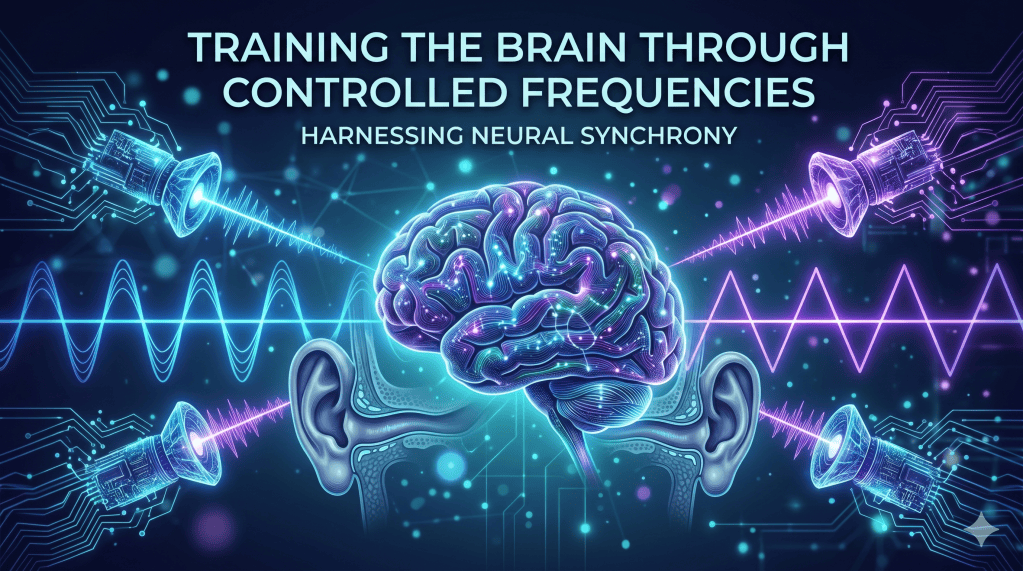
Explore the science of brainwave entrainment and how controlled frequencies like binaural beats influence brain states — from ancient ritual to modern neuroscience.
The summer of 2020 felt like a rupture. Months into a global pandemic, millions of people found themselves isolated, anxious, and reaching for anything that might restore some sense of calm or control. Sleep was elusive. Concentration had dissolved into a fog of doom-scrolling and ambient dread. And into that psychological vacuum came a wave of products, apps, and YouTube videos promising to fix everything with sound.
Binaural beats playlists racked up hundreds of millions of streams. Meditation apps exploded in downloads. “Focus music” and “deep sleep frequencies” became legitimate search categories. The claim behind most of these products was deceptively simple: expose the brain to certain sound frequencies, and it will synchronize with them — calming the stressed, sharpening the scattered, and nudging the sleepless toward rest.
It sounded almost too convenient. But the underlying science, while frequently overstated by marketers, points to something genuinely interesting about how the brain processes rhythmic stimulation — and why human beings have been exploiting that tendency for far longer than any app store has existed.
This article explores the science of brainwave entrainment, the history of its use, and what the research actually says about training the brain through controlled frequencies. The story turns out to be more complicated, and more fascinating, than any promotional copy suggests.
What the Brain Is Actually Doing
To understand how sound frequencies might influence mental states, it helps to first understand what brain activity looks like in electrical terms.
The neurons in your brain are constantly firing — sending electrochemical signals to one another in patterns that shift depending on what you’re doing. When researchers measure this activity with an electroencephalogram (EEG), they detect rhythmic oscillations: waves of synchronized electrical activity that cycle at different speeds depending on the mental state of the person being measured.
These oscillations are divided into frequency bands and given Greek letter names. Delta waves (roughly 0.5 to 4 Hz) dominate during deep, dreamless sleep. Theta waves (4 to 8 Hz) appear during light sleep, deep meditation, and the drowsy moments just before falling asleep. Alpha waves (8 to 13 Hz) are associated with relaxed wakefulness — the calm, unfocused state you might experience while staring out a window. Beta waves (13 to 30 Hz) characterize active, engaged thinking. And gamma waves (above 30 Hz) show up during moments of intense concentration and cognitive binding — when the brain is pulling disparate pieces of information into a unified perception.
None of these bands is inherently good or bad. A brain producing mostly beta waves isn’t better than one producing mostly alpha waves; it’s just doing a different job. The question that brainwave entrainment researchers ask is whether external rhythmic stimulation — sound, light, or even touch — can reliably nudge the brain toward a targeted frequency state.
The Phenomenon of Entrainment
The word “entrainment” comes from physics. It describes what happens when two oscillating systems interact and fall into synchrony. The classic example is pendulum clocks: Christiaan Huygens, the Dutch physicist who invented the pendulum clock, noticed in 1666 that two clocks hung on the same wall would eventually synchronize their swings, driven by subtle vibrations passing through the wood between them.
The same principle appears throughout nature. Fireflies in certain parts of Southeast Asia will synchronize their flashing when gathered in large groups. Cardiac pacemaker cells in the heart beat together.
The brain, as an oscillating system, shows a similar tendency. When exposed to rhythmic sensory input at a specific frequency, neural activity can begin to entrain to that rhythm — a phenomenon researchers call “frequency following response” or “auditory driving.” The brain, in other words, has a measurable tendency to follow a beat.
This is not simply about hearing music and enjoying it. The mechanism is more specific than that, and researchers have been investigating it formally since at least the 1930s, when psychologist and electrical engineer William Gray Walter conducted EEG studies showing that flickering light at certain frequencies could trigger corresponding changes in brain wave patterns. His work laid the groundwork for decades of subsequent research into both auditory and photic entrainment.
How Binaural Beats Work
The most commercially popular form of auditory brainwave entrainment is binaural beats — a technology with a surprisingly long scientific pedigree that predates its current app-store ubiquity by more than a century.
The discovery is attributed to Heinrich Wilhelm Dove, a Prussian physicist who first described the phenomenon in 1839. When two slightly different tones are presented separately to each ear through headphones — say, 200 Hz in the left ear and 210 Hz in the right — the brain perceives a third, phantom tone pulsing at the difference between the two frequencies. In this example, that would be a 10 Hz beat, landing squarely in the alpha range.
The brain doesn’t hear this tone through the ears; it manufactures it through a process called binaural processing, which takes place in the auditory cortex and brainstem. The pulsing beat exists only in neural processing, not in physical sound waves. And the hypothesis behind binaural beats therapy is that this manufactured frequency can drive the brain toward corresponding wave states.
The idea attracted serious scientific attention in the 1970s and 1980s, most notably through the work of Gerald Oster, a biophysicist whose 1973 paper in Scientific American helped reframe binaural beats from a perceptual curiosity into a potential research tool. Oster was particularly interested in what differential perception of binaural beats might reveal about neurological conditions, but his work also sparked popular interest in using the phenomenon deliberately to alter cognitive states.
Since then, the research literature has grown substantially — and so has the complexity of the picture.
What the Research Actually Shows
Here is where honesty requires some careful navigation. The popular marketing of binaural beats and brainwave entrainment tends to outrun the science by a significant distance. Claims about instant focus, cured insomnia, elevated mood, or enhanced creativity deserve skepticism when they come from product pages rather than peer-reviewed journals.
That said, the research is not as empty as critics sometimes suggest.
A 2019 meta-analysis published in Psychological Research by Garcia-Argibay and colleagues examined 22 studies on binaural beats and found a medium overall effect size across cognition, anxiety, and pain perception — with anxiety reduction producing some of the stronger results. Separate research on working memory and attention has produced more mixed findings; some studies report modest improvements, particularly with theta and gamma frequencies, while others find no reliable effect, and the picture remains genuinely unresolved.
Sleep research has produced similarly mixed but cautiously interesting results. Several small studies have found that delta-range binaural beats can reduce latency to slow-wave sleep or increase slow-wave sleep duration compared to sham conditions — genuine physiological findings rather than self-reports. But sample sizes in this literature are typically small, and results have not yet been consistently replicated at scale.
The picture that emerges from the literature is cautiously positive, not conclusive. Many studies in this field suffer from small sample sizes, heterogeneous methodologies, and the kind of publication bias that makes positive findings more likely to appear in print than null results. Replication remains an ongoing challenge. What the better-designed studies suggest is that entrainment effects are real under certain experimental conditions — but translating laboratory findings into reliable real-world outcomes is a different matter, and one the field has not yet fully resolved.
The most defensible assessment is that binaural beats appear to work for some people, for some purposes, some of the time — which is actually a more interesting scientific statement than either the marketing hype or the blanket dismissal.
Individual Differences and the Limits of One-Size-Fits-All
One of the most consistent findings in the entrainment research literature is that individuals respond very differently to the same stimulus. What produces noticeable relaxation in one person may have little effect on another, and what improves focus for a morning person at 8 AM may be irrelevant to a night owl at midnight.
Several factors appear to influence entrainment response. Baseline EEG state matters: someone who already produces a lot of alpha activity at rest will show less dramatic change from alpha entrainment than someone with a more beta-dominant baseline. Age plays a role, as the dominant frequency of alpha oscillations tends to decline with age, which may affect both the target frequency and the expected response. Attention to the stimulus appears to matter as well — passive exposure while distracted produces weaker effects than active, engaged listening.
There is also considerable debate about the role of expectancy. Placebo effects are substantial in subjective measures like mood and relaxation, which creates genuine methodological challenges for studies relying on self-report. The more rigorous studies attempt to control for this with sham conditions — exposing participants to a stimulus they believe is active but which has no theorized effect — though blind conditions are difficult to maintain when one group perceives a pulsing tone and the other doesn’t.
This complexity is not a reason to dismiss the research; it’s a reason to read it carefully. The signal in the literature points toward real effects, but context, individual variation, and proper conditions shape whether those effects manifest in any given person on any given day.
The Role of Isochronic Tones and Light Entrainment
Binaural beats are not the only route to brainwave entrainment. Isochronic tones — evenly spaced pulses of a single tone that turn on and off at a specific frequency — are another commonly used method, with one important practical difference: unlike binaural beats, they don’t require headphones to work. The rhythmic pulsing itself provides the entraining stimulus.
Some researchers argue that isochronic tones produce stronger entrainment effects than binaural beats because the auditory cortex responds more powerfully to sharp, distinct pulses than to the subtle phase difference between two continuous tones. A comparative EEG study published in Neuroscience found that isochronic-style stimulation in the gamma range produced larger increases in gamma-band EEG power than binaural beat stimulation under the same conditions. The trade-off is that many people find the repetitive pulsing of isochronic tones less pleasant to listen to for extended periods.
Photic entrainment — using flickering light rather than sound — has a deeper research history and some of the strongest experimental evidence for genuine EEG effects. Stroboscopic light at specific frequencies has been used in clinical and research settings for decades. Its applications range from the investigation of photosensitive epilepsy (where certain flicker frequencies can trigger seizures in susceptible individuals, which reveals just how powerfully light can drive neural oscillations) to therapeutic uses in treating seasonal affective disorder and cognitive decline.
A line of research that gained significant momentum in the years just before this article was originally written involves 40 Hz gamma stimulation through combined light and sound. Work from the Tsai Lab at MIT, published in Nature in 2016 and expanded in subsequent papers, showed that exposing mice with Alzheimer’s-like pathology to 40 Hz flickering light reduced amyloid plaque buildup and improved cognitive performance. When follow-up human studies began exploring the same approach, the results were cautiously encouraging — not a cure, but a potentially meaningful intervention. While the animal findings remain intriguing, researchers have not yet demonstrated comparable disease-modifying effects in humans. As of 2026, clinical trials are ongoing, and the field has attracted considerable attention from both research institutions and medical device developers.
Ancient Rhythm, Modern Technology
What makes the current scientific interest in brainwave entrainment culturally interesting is the implicit acknowledgment that something humans have done intuitively for thousands of years may have a measurable neural basis.
Repetitive drumming, chanting, and rhythmic movement are central to spiritual and healing practices across virtually every human culture. The repetitive drumming of shamanic traditions from Siberia to the Amazon, the dhikr chanting of Sufi practice, the drumming patterns of West African ceremonial music, the complex rhythmic structures of Gregorian plainchant — these traditions didn’t have EEG machines to explain what was happening, but they had millennia of experiential evidence that specific rhythms produced specific mental states.
Researchers studying shamanic drumming have found that the repetitive rhythms used in these practices, typically in the range of 4 to 7 Hz, fall precisely in the theta range associated with hypnagogic states, vivid imagery, and reduced critical thinking. A drumbeat at a Lakota ceremony and the theta binaural beat in a Spotify playlist may engage some of the same underlying neural mechanisms — though the contexts, intentions, and meanings attached to each are entirely different.
What’s new is not the human impulse to use rhythm to alter mental states. It’s the ability to measure, isolate, and deliberately engineer the stimulus, and to study its effects under controlled conditions.
The 2020 Context and What It Revealed
Returning to where this article began: the pandemic moment of 2020 was a kind of natural experiment in what happens when large populations experience sustained psychological stress and turn en masse to self-administered interventions.
Downloads of meditation apps like Headspace and Calm surged by the tens of millions. Binaural beats and focus music channels on YouTube grew their subscriber counts by hundreds of thousands. Sleep aid products of every description flew off digital shelves. This wasn’t just a wellness trend. It reflected something genuine: a recognition, however inchoate, that the brain is trainable, that its state is not simply a fixed given but something that can be influenced through deliberate intervention.
The commercial exploitation of that recognition was uneven at best. Many products made claims that wildly exceeded the evidence. But the underlying intuition — that rhythmic sensory stimulation can meaningfully influence neural states — turned out to be better supported by science than the skeptics assumed and less miraculous than the marketers suggested.
What the pandemic moment also revealed was a widespread hunger for tools that give individuals some agency over their own mental states. In a situation defined by helplessness, the ability to put on headphones and do something — even something whose effects are modest — provided a sense of control that had its own psychological value, independent of any brainwave effect.
Where the Science Is Heading
In the years since 2020, the field of brainwave entrainment has matured in ways that suggest its most important applications may still be ahead. Closed-loop neurofeedback — systems that monitor brain activity in real time and adjust the entrainment stimulus dynamically — represents a significant step beyond passive listening. Previously confined to research labs, these systems are beginning to reach consumer-grade devices, treating entrainment not as a broadcast but as a conversation between the stimulus and the brain’s current state.
The consumer market has also consolidated, with the more credible products moving away from extravagant claims and toward more modest, evidence-grounded language — reflecting both regulatory pressure and a public that has grown more sophisticated about distinguishing plausibility from proof.
Conclusion
The idea of training the brain through controlled frequencies sits at an unusual intersection: ancient practice, modern neuroscience, commercial enthusiasm, and genuine clinical uncertainty all converge on the same basic phenomenon.
What the research suggests — carefully, with the caveats the field deserves — is that the brain’s tendency to follow rhythmic stimulation is real, that this tendency can be measured, and that under the right conditions it correlates with meaningful shifts in cognitive and emotional states. The effects are neither as large nor as reliable as the marketing claims. But they are not imaginary, either, and that distinction matters.
The more interesting story, though, may be the one the pandemic inadvertently told. Millions of people, confronting a situation they couldn’t control, discovered that their mental states were not entirely fixed — that putting on headphones and choosing a specific frequency was a form of agency, however small. The brain, they intuited, is something you can work with rather than simply endure. Science offers some support for that intuition. The reality is less dramatic than advertised, and more interesting than dismissal. That gap — between what people hoped the technology would do and what evidence suggests it actually does — turns out to be the most revealing thing about it.
Further Reading
Foundational research
- Oster, G. (1973). Auditory beats in the brain. Scientific American, 229(4), 94–102. https://doi.org/10.1038/scientificamerican1073-94
- Walter, W. Grey. (1953). The Living Brain. W. W. Norton & Company. [Early EEG and photic entrainment research — no DOI; widely available in academic libraries]
Key meta-analyses and systematic reviews
- Garcia-Argibay, M., Santed, M. A., & Reales, J. M. (2019). Efficacy of binaural auditory beats in cognition, anxiety, and pain perception: A meta-analysis. Psychological Research, 83(2), 357–372. https://doi.org/10.1007/s00426-018-1066-8
- Ingendoh, R. M., Posny, E. S., & Heine, A. (2023). Binaural beats to entrain the brain? A systematic review of the effects of binaural beat stimulation on brain oscillatory activity, and the implications for psychological research and intervention. PLOS ONE, 18(5), e0286023. https://doi.org/10.1371/journal.pone.0286023
- Basu, S., & Banerjee, B. (2023). Potential of binaural beats intervention for improving memory and attention: Insights from meta-analysis and systematic review. Psychological Research, 87, 951–963. https://doi.org/10.1007/s00426-022-01706-7
Gamma entrainment and Alzheimer’s research
- Iaccarino, H. F., Singer, A. C., Martorell, A. J., Rudenko, A., et al. (2016). Gamma frequency entrainment attenuates amyloid load and modifies microglia. Nature, 540(7632), 230–235. https://doi.org/10.1038/nature20587 [The foundational MIT Tsai Lab paper]
Brainwave entrainment methods compared
- Chaieb, L., Wilpert, E. C., Reber, T. P., & Fell, J. (2015). Auditory beat stimulation and its effects on cognition and mood states. Frontiers in Psychiatry, 6, 70. https://doi.org/10.3389/fpsyt.2015.00070









