
Originally published in February 2021 and comprehensively updated/edited in June 2026.
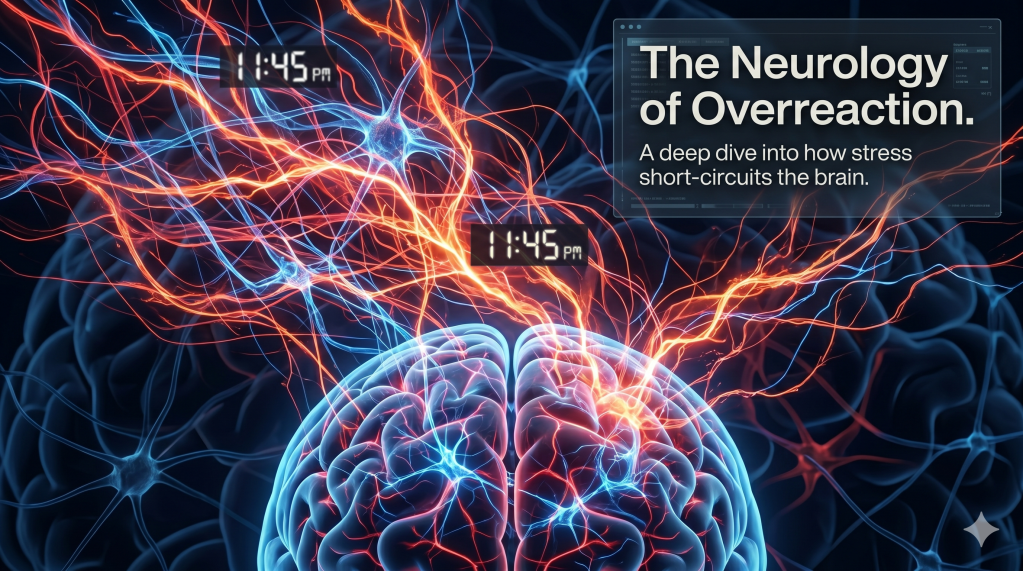
Why do people overreact? Explore the neuroscience behind threat responses, cortisol, social media algorithms, and collective dysregulation — and what it reveals about human behavior.
There is a particular kind of exhaustion that set in for many people during the early years of the 2020s. It wasn’t just the fatigue of a pandemic, or of political upheaval, or of economic uncertainty — though all of those were real and accumulating. It was something harder to name: the sense that everything, always, was an emergency. That every news story demanded an immediate emotional response. That conversations that once would have been unremarkable had become minefields. That people — ordinary, reasonable people — were losing their minds over things that, by any historical measure, were not that serious.
At the same time, other things that were genuinely serious seemed to disappear into the noise, swallowed by the churn. The volume was turned up so high that nothing could be heard clearly.
This wasn’t a moral failure or a generational weakness. It was, in large part, a neurological one — or more precisely, it was what happens when the architecture of the human brain, shaped over hundreds of thousands of years of evolutionary pressure, collides with a modern information environment it was never designed to handle. Understanding the neurology of overreaction doesn’t excuse it, but it does explain it. And understanding it might be the first step toward doing something about it.
What the Brain Is Actually Built to Do
The human brain is not built for accuracy. It is built for survival. These are related goals, but they are not the same thing, and the distinction matters enormously when you’re trying to understand why people behave the way they do.
The amygdala — a small, almond-shaped cluster of neurons deep in the temporal lobe — functions as the brain’s threat-detection center. It operates fast, below the level of conscious thought, scanning incoming information for anything that resembles danger. When it detects a potential threat, it triggers what most people know as the fight-or-flight response: a cascade of hormones, including adrenaline and cortisol, that prepare the body to deal with an immediate physical crisis. Heart rate increases. Muscles tense. Attention narrows. The body is ready to run or fight.
This system was exquisitely well-suited to the environment it evolved in. When a predator was nearby, you needed to react before you had time to think. The cost of a false alarm — getting startled by a rustling leaf — was much lower than the cost of missing a real threat. So the brain evolved to be trigger-happy. It was, and is, designed to err on the side of overreaction.
The prefrontal cortex, by contrast, is the part of the brain responsible for what researchers call executive function: deliberate reasoning, long-term planning, perspective-taking, the ability to evaluate whether a perceived threat is actually dangerous. It’s slower than the amygdala, more effortful, and critically, it can be overridden. Under conditions of significant stress or arousal, the amygdala can effectively hijack the prefrontal cortex — a process that neuroscientist Daniel Goleman famously described as an “amygdala hijack.” The rational mind goes offline, or at least gets turned down, and the reactive, emotional response takes over.
The problem is that the amygdala cannot reliably distinguish between a physical threat and a social one. It responds to a threatening email with something close to the same intensity as it responds to a threatening person. It processes an upsetting news story and a genuinely dangerous situation through overlapping neural circuitry. The mechanisms are similar even when the actual risks are categorically different.
The Role of Cortisol and Chronic Stress
A single amygdala hijack is recoverable. The stress hormones metabolize, the prefrontal cortex comes back online, and the person returns to something like a baseline state. The problem, both for individuals and for societies, comes with chronic activation — when the stress response is triggered repeatedly, or stays elevated over time.
Cortisol, the primary stress hormone involved in sustained threat responses, serves useful short-term functions — it mobilizes energy and focuses attention. But chronic elevation is a different matter. Research has shown that prolonged cortisol exposure can damage neurons in the hippocampus, the brain region most involved in memory and contextual learning, while simultaneously increasing the amygdala’s sensitivity to perceived threats. The result is a feedback loop: chronic stress makes you worse at accurately evaluating threats, remembering relevant context, and thinking clearly — precisely when those capacities matter most.
For much of the early 2020s, large portions of the population were living under sustained stress. The pandemic introduced genuine, life-and-death uncertainty. Economic instability created financial anxiety that, for millions of people, was entirely rational. Political polarization reached levels — measured by researchers tracking partisan animosity — that had not been seen in generations. And layered on top of all of this was an information environment that had evolved, quite deliberately, to keep people in a state of heightened arousal.
How Platforms Learned to Exploit the Threat Response
The relationship between social media and emotional dysregulation is not an accident. It is, in a significant sense, a product.
Platforms like Twitter (now X), Facebook, and YouTube are built on engagement-optimization algorithms — systems designed to surface content that keeps users on the platform as long as possible. In the early years of these platforms, engagement was broadly defined. Over time, as the data accumulated, a consistent pattern emerged: content that triggered strong negative emotions — outrage, fear, disgust, moral indignation — generated significantly more engagement than content that was informative, neutral, or even positive. Users didn’t just view outrage-inducing content; they responded to it, shared it, and returned to it.
From a business standpoint, this was useful information. The algorithms were tuned accordingly.
Research published in the journal Science in 2018 by Soroush Vosoughi, Deb Roy, and Sinan Aral found that false news traveled faster, farther, and more broadly on Twitter than true news, and that this disparity was driven primarily by human behavior rather than bots. The researchers found that false stories were 70 percent more likely to be retweeted than accurate ones. The emotional profile of false stories — they tended to inspire more fear, disgust, and surprise — appeared to be a significant driver of this difference.
This is not simply because people are gullible. It’s because their brains were responding in a predictable way to stimuli that activated threat-detection circuitry. Emotionally charged, novel, and threatening information draws attention and prompts sharing for the same reasons that an unusual sound in the dark draws your focus: the brain is prioritizing it as potentially survival-relevant. The algorithm didn’t create this tendency. It learned to exploit it at scale.
The cumulative effect was an environment that delivered a near-constant stream of threat signals — political threats, social threats, health threats, moral threats — into millions of brains that were physiologically primed to respond to threat signals as if they were immediate and physical. At the level of rapid threat detection, the brain is not naturally equipped to calibrate for the difference between a distant informational threat and an immediate physical one. Both can register as things that need to be dealt with right now.
The Social Dimension: Tribalism, Belonging, and Identity Threat
The neuroscience of overreaction doesn’t end with individual stress responses. Humans are deeply social animals, and the brain’s threat-detection system is closely intertwined with the social circuitry that governs belonging, status, and group identity.
Naomi Eisenberger, a social neuroscientist at UCLA, has spent years studying the neural overlap between physical pain and social pain. Her research, along with a growing body of supporting work, has shown that social exclusion activates many of the same brain regions as physical pain — including the dorsal anterior cingulate cortex and the anterior insula. Being rejected, ostracized, or publicly criticized is not merely metaphorically painful. In neurological terms, it shares machinery with the kind of pain that tells you your body is being damaged.
This helps explain why people respond to perceived social threats — criticism, public shaming, challenges to group identity — with an intensity that can seem disproportionate to an outside observer. From the brain’s perspective, there’s a real threat being registered. And in the context of highly polarized group dynamics, where social identity has become increasingly bound up with political and ideological affiliation, the stakes of any given interaction can feel existential in a way that is neurologically genuine even when it is practically exaggerated.
Decades of research in social psychology have established that people derive a significant portion of their self-concept from the groups they belong to, and that they are strongly motivated to see those groups in a favorable light. This isn’t vanity — it’s a deeply wired social instinct. And it extends into moral reasoning: much of what looks like principled argument turns out, under scrutiny, to be post-hoc rationalization of gut-level, group-protective reactions. People reach the conclusion first and construct the reasoning second.
When the information environment began saturating people with threats to group identity — “they are coming for your values, your people, your way of life” — it was activating a threat response that was both neurologically real and socially amplifying. People didn’t just feel threatened individually; they recruited others into the threat perception, which validated and intensified the response.
Outrage as Information and Signal
It would be a mistake to treat all emotional reactivity as irrational noise. Outrage, in particular, has a legitimate social function. Moral outrage — the feeling that something wrong has been done and that it demands a response — has historically been a driver of genuine social progress. The abolition movement, the labor movement, and the civil rights movement were all powered, in part, by moral outrage that was proportionate to real injustices.
The problem is not outrage per se. The problem is the decoupling of outrage from proportionality — a decoupling that the modern information environment has accelerated and that chronic stress makes harder to resist.
Psychologist Paul Rozin and his colleagues have studied what they call “the prevalence-induced concept change” — the finding that when the prevalence of a problematic phenomenon decreases, people’s threshold for what counts as an instance of that phenomenon also decreases, such that the subjective experience of its frequency doesn’t change. Applied to outrage: as genuinely serious injustices become less common, the category of “outrage-worthy behavior” may simply expand to maintain a constant level of perceived wrongdoing. People aren’t necessarily becoming more irrational; their perceptual systems may be recalibrating in ways that generate the same subjective experience of threat regardless of whether the objective threats have changed.
Combined with algorithms that continuously surface the most outrage-inducing content available — which is not necessarily the most representative content — the result is a perceptual environment that makes the world appear far more threatening and unjust than it may actually be. The brain responds to this perceived environment, not to a measured statistical account of reality. Chronic stress narrows attention further, reducing the cognitive resources available for perspective-taking and calibration.
The Pandemic Effect and Collective Dysregulation
The COVID-19 pandemic introduced a particularly potent form of stress into this already-strained system. It combined genuine, objective danger with massive uncertainty — two conditions that are especially potent triggers for sustained threat activation. Uncertainty, in particular, is neurologically distinct from known danger. Research suggests that not knowing whether something bad will happen is more stressful than knowing that it will. The brain cannot resolve uncertainty; it can only maintain vigilance, which means keeping the stress response elevated.
The pandemic also collapsed the usual boundaries between public and private life, between work and home, and between individual and collective risk in ways that made stress ubiquitous rather than compartmentalized. It disrupted sleep — one of the primary mechanisms by which the brain processes emotional experiences and recalibrates threat sensitivity — for vast numbers of people. And it generated enormous amounts of conflicting information from sources that were often themselves uncertain, creating conditions in which distrust and anxiety were, to a significant degree, reasonable responses that nonetheless fed back into the dysregulation loop.
Social isolation compounded everything. Human social connection is a powerful regulator of the stress response. Physical proximity to trusted others triggers the release of oxytocin, which modulates cortisol and reduces amygdala reactivity. When people were physically separated from their social networks, they lost one of the most effective neurological buffers against stress dysregulation. Many of them turned, understandably, to social media to fill the gap — which fed more threat-laden information into nervous systems that were already overwhelmed.
The result, across much of the world, was a period of what might be called collective dysregulation: a broad, shared state of heightened reactivity in which the neurological threshold for overreaction was significantly lowered at a population level. Individual brains were not simply behaving badly; they were behaving predictably under conditions specifically calibrated to produce that behavior.
What Recovery Requires
The neurology of overreaction points toward its own remedies, though none of them are simple or fast-acting.
The most fundamental is the reduction of chronic stress — not through the elimination of stressors, which is not possible, but through the restoration of the physiological conditions under which the prefrontal cortex can do its job. Sleep is among the most important. Research by Matthew Walker and others has shown that sleep deprivation significantly increases amygdala reactivity while impairing prefrontal cortex regulation. Seven to nine hours of sleep per night is not a luxury; it is a neurological requirement for emotional regulation.
Physical exercise has robust, replicated evidence for its effect on stress hormones and amygdala function. Social connection — real, in-person, embodied connection — remains one of the most powerful stress regulators available. Deliberate, effortful engagement with perspectives different from one’s own has been shown to activate prefrontal cortex processes and reduce the automatic, reactive quality of amygdala-driven responses.
What makes these interventions effective is not that they are morally virtuous. It’s that they restore the biological conditions under which the brain can accurately assess threat — conditions under which the prefrontal cortex can do its job, rather than being overridden by a system designed for a different world. The personal and the structural are not separable here: individual habits matter, but so does the environment those habits are performed inside.
At the structural level, the incentives that drove algorithmic amplification of outrage-inducing content have proven difficult to reform, though the conversation has shifted considerably since the early 2020s. Research on the psychological effects of social media consumption has accumulated, regulations in several jurisdictions have introduced friction into some of the more directly harmful design patterns, and public awareness of the engagement-optimization dynamic has grown. Whether any of this has materially altered the information environment in ways that reduce collective dysregulation remains an open and contested empirical question.
The Longer View
The story of the early 2020s — of overreaction and collective dysregulation — is not primarily a story about bad people or broken values. It is a story about what happens when the neurological architecture of human beings, shaped by millions of years of evolutionary pressure toward threat-sensitivity and group protection, is placed inside an environment designed to exploit precisely those features for commercial purposes, under conditions of genuine and widespread stress.
This framing is important not because it removes responsibility, but because it locates the problem more accurately. Moral criticism of individuals for overreacting tends to generate defensive responses that increase polarization without improving behavior. Understanding the neurological substrate of the behavior creates the possibility of addressing it at the right level — through changes in environment, in habits, in structural incentives, and in the institutional choices that shape the information ecosystems people live inside.
Human beings have, historically, managed to adapt their environments when those environments became clearly incompatible with their wellbeing. The invention of institutions, norms, laws, and social practices can be understood in part as the slow process of building guardrails around the worst tendencies of the social primate brain. The neurology of overreaction is not destiny. It is a description of a problem, and problems, unlike fate, have solutions.
What the period of the early 2020s demonstrated, perhaps most clearly, is that the gap between the pace of technological change and the pace of human adaptation is not a trivial engineering problem. It is a civilizational one — and the first step toward closing that gap is understanding, with some precision, what it is that we are actually dealing with.









