
Originally published in January 2021 and comprehensively updated/edited in June 2026.
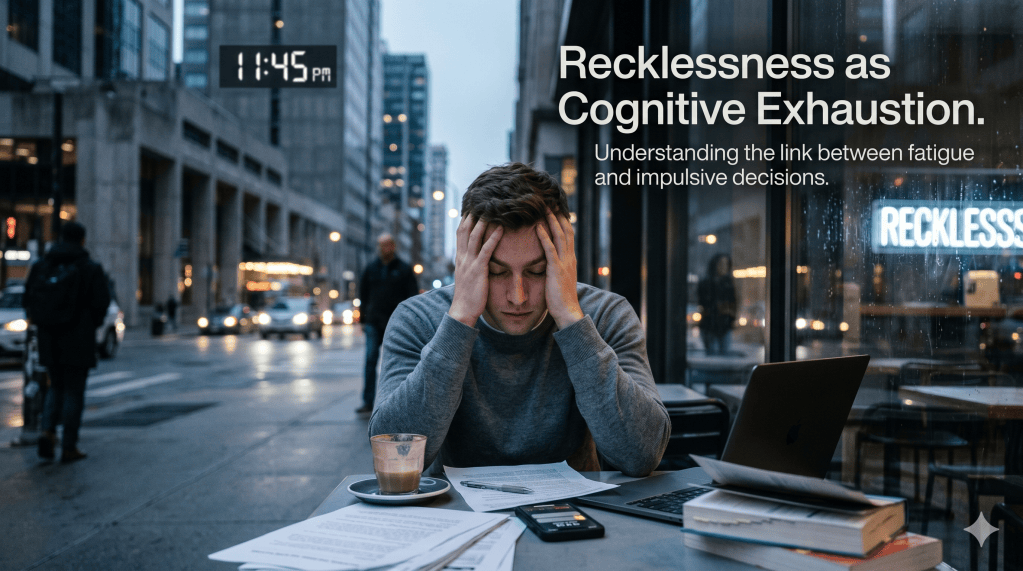
How cognitive exhaustion drives reckless behavior — exploring the neuroscience and psychology of decision fatigue, pandemic behavior, and why mental overload looks like poor choices.
There was a moment somewhere in the middle of 2020 when a lot of people stopped caring about things they had previously cared about deeply. Not out of nihilism, exactly. Not out of some philosophical shift in values. They stopped caring because they were tired — bone-deep, mentally wrung-out tired — in a way that didn’t respond to sleep.
This was the year the pandemic reshaped daily life, but the exhaustion it produced wasn’t purely physical. It was cognitive. The endless stream of decisions, risks, contradictions, and uncertainties that defined pandemic living didn’t just wear people down emotionally. It degraded the mental machinery people use to make good choices. And once that machinery starts to fail, behavior starts to look a lot like recklessness.
What happened during those months offers a lens into something that psychologists and behavioral scientists had been studying long before anyone had heard of COVID-19: the relationship between mental fatigue and poor decision-making. The pandemic didn’t create this dynamic. It amplified it, spread it across entire populations simultaneously, and made its effects visible in ways that are still worth examining years later. Understanding recklessness as a form of cognitive exhaustion — rather than a character flaw or moral failure — changes how we think about human behavior under stress, and it has implications that extend well beyond any single crisis.
The Mental Load Nobody Talked About
In ordinary times, most people navigate life on a kind of cognitive autopilot. Routine decisions — what to eat, which route to take, how to respond to a colleague — happen almost automatically, requiring minimal mental effort. This matters more than it sounds.
The human brain has a finite capacity for deliberate, careful thinking. Psychologists call this kind of effortful mental processing “System 2” thinking, drawing on a framework popularized by Nobel laureate Daniel Kahneman in his 2011 book Thinking, Fast and Slow. System 2 is the slow, analytical mode of thinking — the kind you use when calculating a tip, weighing a major financial decision, or considering whether a symptom warrants a doctor’s visit. It’s resource-intensive. It fatigues. And when it’s depleted, the brain tends to default to faster, less deliberate modes of processing that are far more prone to error.
The pandemic eliminated autopilot for millions of people at once. Suddenly, tasks that had required no conscious thought at all — going to the grocery store, visiting a friend, attending a child’s school event — required active deliberation. Is this safe? What’s the current guidance? How do I weigh my risk against someone else’s? These weren’t rhetorical questions. They had to be answered, repeatedly, every day.
This layering of decisions on top of decisions is sometimes called “decision fatigue.” A widely cited 2011 study by Jonathan Levav and Shai Danziger found that Israeli parole judges granted favorable rulings far more often at the start of sessions than at the end — not because the cases were weaker, but because the judges were depleted. The study has faced methodological scrutiny since, and the effect may be less tidy than the original headlines suggested, but the neuroscience it pointed toward has held up. Decision-making draws on metabolic resources in the prefrontal cortex — the brain region responsible for planning, impulse control, and weighing consequences. Deplete those resources through sustained effort, and the prefrontal cortex’s regulatory capacity weakens. What emerges in its place are responses driven more by habit, emotion, and the desire to reduce discomfort as quickly as possible.
When Risk Calculations Break Down
One of the most consistent findings in cognitive psychology is that mental fatigue doesn’t just make people slower or more distracted. It specifically impairs risk assessment — the very mental function people most need when navigating genuinely dangerous situations.
A 2019 study published in Current Biology by researchers at the University of Oxford used neuroimaging to track how prolonged cognitive effort affects brain activity during decision-making tasks involving risk. As participants became more mentally fatigued, activity in the lateral prefrontal cortex declined, and activity in the striatum — a region associated with reward processing and habitual behavior — increased. The practical effect was a measurable shift toward riskier choices, even when participants were offered the same objective options they would have considered more carefully when rested.
Put differently: fatigue doesn’t just make you less careful. It makes recklessness feel more appealing. The cognitive systems that normally pump the brakes on impulsive behavior are the same systems that exhaust first.
This goes some distance toward explaining behavioral patterns that emerged throughout the pandemic. By late summer 2020, health researchers and journalists were documenting a phenomenon sometimes described as “pandemic fatigue” — a widespread decline in the careful, deliberate precautionary behavior that had characterized the early months of lockdowns. People who had been meticulous about hygiene, isolation, and mask-wearing began to slip. Social gatherings resumed. Risk tolerance climbed.
It was easy — and common — to interpret this as moral weakness, or political defiance, or simple selfishness. Those explanations fit neatly into existing cultural arguments about individual responsibility. But they missed something important. A significant portion of this behavioral shift wasn’t driven by a change in values or beliefs. People still understood, on an intellectual level, that the risks were real. Their cognitive exhaustion had simply degraded their ability to consistently act on that understanding.
The World Health Organization acknowledged pandemic fatigue as a genuine public health challenge in a 2020 policy brief, describing it as a natural and expected response to a sustained public health emergency. The language of that document was careful to distinguish fatigue-driven non-compliance from deliberate, values-based rejection of protective measures. That distinction mattered enormously for how interventions were designed, but it rarely made it into mainstream media coverage, which continued to frame behavioral decline primarily through moral and political lenses.
Social Contagion and the Exhaustion of Collective Uncertainty
Individual cognitive depletion is only part of the story. The pandemic also demonstrated how quickly behavioral norms can shift at a collective level when the informational environment becomes overwhelming.
Human beings are deeply social animals, and a substantial portion of our everyday risk assessment is outsourced to our social environment. We infer what’s safe and what isn’t partly by observing what the people around us do. Social psychologists call this “descriptive norms” — the behavior that’s actually common in a group, as distinct from the behavior the group endorses in theory. When descriptive norms shift, individual behavior tends to follow, often without people consciously recognizing that their calculus has changed.
Throughout 2020, the informational environment that shapes descriptive norms became extraordinarily chaotic. Official guidance changed frequently, sometimes within days. Scientists communicated genuine uncertainty in ways that were honest but difficult for non-experts to process. Social media platforms accelerated the spread of contradictory claims. And crucially, the people whose behavior set descriptive norms — friends, family members, visible community figures — began taking more risks as the year wore on, which created a feedback loop. When people see others acting recklessly and surviving without obvious consequence, the perceived risk of the behavior decreases, even if the objective risk hasn’t changed at all.
This is sometimes framed as “risk compensation” — the tendency for people to take more risks when they feel that a threat has become more manageable or familiar. But in the pandemic context, it was less a rational recalibration than an exhaustion-driven surrender to social cues. Processing conflicting information is itself cognitively expensive. The brain, given a choice between the hard work of independent risk assessment and the easier task of simply mirroring surrounding behavior, tends toward the latter — especially when depleted.
The Architecture of Modern Attention
The pandemic did not create cognitive overload from scratch. It arrived in a society that had already spent more than a decade adapting to increasingly fragmented attention environments.
The widespread adoption of smartphones, social media, and notification-driven communication platforms had produced what researchers at institutions including Stanford and UC San Francisco described as structural changes in how people process information. Attention spans, it turned out, weren’t simply a matter of individual willpower. They were shaped by the architecture of the technological environment people inhabit.
A 2019 study led by Gloria Mark at UC Irvine found that it takes an average of more than 23 minutes to return to a task after an interruption — and that modern knowledge workers are interrupted, on average, every few minutes. Over the course of a workday, this constant interruption depletes exactly the cognitive resources that sustained, careful thinking requires. The information environment of the smartphone era wasn’t designed with cognitive sustainability in mind. It was designed for engagement, which is a different thing.
This matters for understanding what happened during the pandemic because it means that COVID-19 arrived at a moment when many people’s baseline cognitive capacity for deliberate decision-making had already been eroded. The pandemic added an enormous additional load onto a foundation that had already been weakened. The cognitive resources people needed most were precisely the resources that had been quietly draining for years.
There’s also a dimension here that involves emotional regulation. Emotional regulation — the ability to manage anxiety, frustration, and fear in ways that don’t drive impulsive behavior — draws on the same prefrontal resources as deliberate decision-making. Sustained stress depletes both. Research published in Psychological Science has shown that chronic stress impairs working memory and cognitive flexibility, making it harder to shift attention, update plans, and resist immediate impulses. A population managing sustained, unresolved stress is a population with genuinely diminished capacity for careful risk assessment, not merely a population that has chosen to exercise that capacity less.
Recklessness Reconsidered
Taken together, this body of research points toward a picture of recklessness that looks quite different from the conventional understanding. In everyday language, recklessness implies a choice — someone who knows better but does it anyway. It carries moral weight. It implies agency and responsibility.
But the neuroscience and psychology suggest that many behaviors that look like recklessness are better understood as the predictable outputs of a system under load. The prefrontal cortex, sufficiently depleted, produces behavior that resembles a decision but lacks the full deliberative machinery that careful risk assessment requires. The person may be exercising far less conscious deliberation than observers assume. The cognitive machinery that normally supports careful choice has been substantially impaired.
Consider something as small as grocery sanitizing. In spring 2020, many people carefully wiped down every package that came into the house. By autumn, most had stopped. That change is easy to read as complacency or indifference. But a more accurate reading is that months of sustained vigilance — of treating every ordinary errand as a risk-management exercise — had simply exhausted the mental resources the behavior required. The person who abandoned the practice wasn’t necessarily rejecting the threat. They may have reached the limits of what sustained vigilance actually costs.
This doesn’t mean individual behavior during the pandemic was blameless in every case, or that the concept of personal responsibility becomes meaningless under conditions of stress. It means that applying moral frameworks to behavior that’s substantially driven by cognitive exhaustion produces explanations that are satisfying but incomplete. And incomplete explanations tend to lead to ineffective responses.
Public health interventions designed on the assumption that non-compliant behavior reflects bad values or deliberate defiance tend to use tools that are poorly matched to the actual problem: shaming, moral appeals, punitive enforcement. These tools are poorly suited to addressing cognitive exhaustion, and can actually worsen the psychological load driving the problem. Approaches that reduce decision burden — clear, simple, consistent guidance; environmental design that makes protective behavior the path of least resistance; genuine acknowledgment of the difficulty of sustained vigilance — are better matched to the actual mechanism.
The Longer Arc
By January 2021, when the first version of this essay was written, the behavioral patterns described here were visible across populations in every country that had been managing the pandemic for nearly a year.
Five years later, those patterns can be seen in a longer context. The pandemic accelerated several trends in human cognitive behavior that were already underway, and some of those trends have persisted. Some researchers have suggested that the widespread experience of collective cognitive exhaustion may have contributed to a lasting wariness toward sustained uncertainty — an increased preference for simple, clear narratives over complex, qualified ones. This had effects on media consumption, political behavior, and social trust that are still being studied.
It also prompted a renewal of interest in what researchers sometimes call “cognitive ergonomics” — the design of environments, institutions, and information systems in ways that reduce unnecessary mental load. There is growing recognition, particularly in public health, workplace design, and education, that human cognitive capacity is a genuine resource that can be preserved or depleted depending on how environments are structured. The pandemic made this abstract idea viscerally concrete for millions of people who had never thought about it before.
The Conditions That Make Good Choices Possible
Every crisis exposes something about ordinary life that was previously invisible. The pandemic, among other things, exposed just how much of what we call responsible behavior depends on conditions that aren’t always present: adequate rest, manageable stress levels, a stable and comprehensible informational environment, a community of people modeling careful behavior. Strip away those conditions and the behavior changes, not primarily because people become different people, but because the cognitive infrastructure that supports careful behavior becomes unavailable.
This is not a counsel of despair. It is, if anything, an argument for taking the conditions that support good decision-making seriously — as a matter of public and institutional design, not just individual effort. The brain is not infinitely elastic. It performs the way it performs partly as a function of what it’s been asked to do and in what environment it operates.
Recklessness as cognitive exhaustion isn’t an excuse. It’s a mechanism. Understanding the mechanism doesn’t dissolve individual agency, but it does suggest that the most important levers for improving behavior under stress may not be the ones we’ve traditionally reached for. Moral exhortation has its limits. So does blame. What tends to work better is reducing the load — simplifying choices, stabilizing environments, and acknowledging honestly that sustained vigilance is harder than it looks, and that asking people to maintain it indefinitely, without support, is asking more than the human brain was designed to deliver.
That insight, earned through one of the more difficult collective experiences of recent memory, seems worth holding onto.









