
Originally published in April 2021 and comprehensively updated/edited in June 2026.
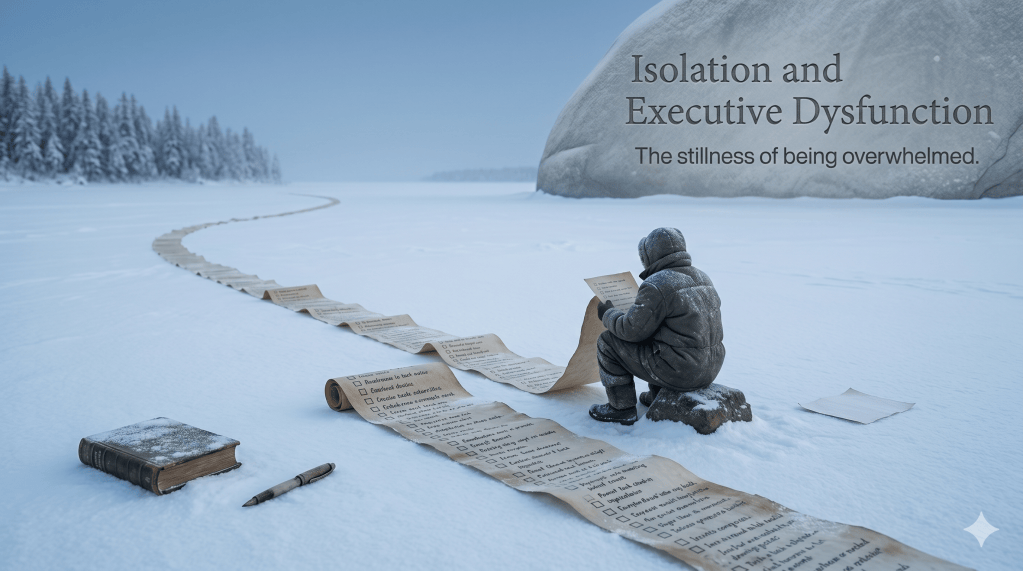
How prolonged social isolation disrupts executive function — and what neuroscience reveals about the brain’s dependence on social context for motivation, structure, and self-regulation.
There is a particular kind of stillness that settles over a person who has stopped leaving the house. It isn’t peace. It’s the quiet of a clock that has wound down — everything suspended, nothing quite moving the way it should. During the long stretches of social isolation that defined life for much of the world beginning in early 2020, millions of people encountered a version of this stillness they had never felt before. And many of them discovered something unsettling about themselves in the process: they couldn’t get things done.
Not the big things, necessarily. Not the dramatic failures people might expect from a global crisis. What crept up on people — quietly, almost imperceptibly — was an inability to manage the small things. The email that sat unanswered for three weeks. The prescription that needed to be refilled but somehow never was. The shower that got put off until putting it off felt like its own accomplishment to reverse. People who had always thought of themselves as capable, organized, and functional found themselves frozen in ways they couldn’t quite explain.
What they were experiencing had a name, though most of them didn’t know it at the time: executive dysfunction. Understanding why isolation produces this effect requires looking at how the brain manages motivation, attention, and self-regulation — and why those systems are far more dependent on social context than most people realize.
What Executive Function Actually Means
The term “executive function” sounds clinical and abstract, like something that belongs in a corporate org chart rather than a discussion of human psychology. But the concept is straightforward. Executive function refers to a set of mental processes that allow people to plan, focus, adapt to new information, and regulate their own behavior. It’s the part of your mind that decides you should start a task before the last minute, that reminds you what your priorities are, and that keeps distractions from hijacking the whole afternoon.
Researchers typically describe it as resting on three pillars: the working memory that holds a task in mind while you execute it, the cognitive flexibility that lets you adapt when plans change, and the inhibitory control that keeps impulses and distractions from taking over. These systems operate together, and they depend heavily on the prefrontal cortex — the region of the brain just behind the forehead, one of the last areas to fully mature and one of the first to suffer under stress. Social isolation, it turns out, disrupts all three — just not in the ways people typically expect.
The Social Brain and Why It Needs Other People
Humans evolved as intensely social animals. This is not simply a philosophical observation about community or connection; it’s a statement about neurobiology. The human brain developed under conditions in which other people were constantly present — not just emotionally, but as cognitive scaffolding. Other people provide cues about what time it is, what’s worth paying attention to, what counts as done, and when it’s appropriate to start or stop an activity.
Psychologists call this “social scaffolding,” and it operates in ways most people never consciously notice. When a coworker passes your desk and glances at their watch, you feel a subtle pull to return to work. When a friend texts asking if you’ve finished something you mentioned, the question acts as a gentle external accountability mechanism. When you’re sitting in a café surrounded by other people working, their presence exerts a quiet pressure — documented in research on co-working environments — that increases sustained effort even among strangers. None of this requires conversation. The mere presence of others structures behavior in ways the isolated individual loses access to entirely.
Leon Festinger’s social comparison theory, developed in the 1950s, offered one of the first formal accounts of this phenomenon. Festinger argued that humans evaluate their own opinions, abilities, and behaviors largely through comparison with others. Remove those comparison points, and the internal calibration system starts to drift. When you don’t know whether your current pace is normal, fast, or embarrassingly slow, it becomes harder to maintain a sense of urgency about anything at all.
For millions of people, beginning in the spring of 2020, this drift became lived experience. They woke up in bedrooms that had also become offices, attended meetings from the same chair where they would later eat lunch alone, and ended the workday in a space indistinguishable from the one where they’d begun it. The physical and temporal boundaries that had once divided work from rest, effort from recovery, and the social from the private collapsed into a single undifferentiated environment. The external world stopped sending the signals the brain had always relied on to organize the day. And without those signals, the day — and the self within it — began to lose its shape.
More recently, researchers studying loneliness and social isolation have documented the neurological consequences of this drift. John Cacioppo’s groundbreaking work at the University of Chicago showed that chronic loneliness — the subjective sense of social disconnection — produces measurable changes in how the brain processes threat, regulates sleep, and manages stress hormones. Lonely individuals showed elevated cortisol levels, disrupted circadian rhythms, and hypervigilance to social threat. Each of these factors independently degrades executive function. Together, they create conditions in which getting started on almost any task begins to feel genuinely effortful in a way it never did before.
Dopamine, Motivation, and the Empty Calendar
One of the least intuitive aspects of executive dysfunction is that it doesn’t feel like a neurological phenomenon. It feels like laziness. It feels like moral failure. When a person cannot make themselves sit down and answer emails, the emotional experience is often shame rather than curiosity about what might be happening in their brain.
What’s actually happening involves dopamine — a neurotransmitter widely misunderstood as the brain’s “pleasure chemical.” Dopamine is more accurately understood as a signal for anticipation and motivation. It fires not just when rewards arrive, but when the brain predicts that a rewarding outcome is coming. It is, in many respects, the neurochemical engine of “I’m going to do this and something good will happen.”
Social interaction is one of the most reliable triggers for dopamine release — but it isn’t the only one. Novelty, physical movement, learning something new, and the satisfaction of completing a challenge all stimulate dopaminergic activity in overlapping ways. What isolation does is quietly eliminate several of these triggers at once. Conversation, humor, shared experiences, physical contact — all of these activate the reward circuits in ways that reinforce behavior. When they disappear together, and the days begin to look identical, the brain’s dopamine economy goes quiet in a way that no single missing element would produce on its own. And when dopamine signaling is depressed, the experience of motivation itself changes. Tasks that once felt neutral or mildly engaging start to feel pointless. The mind generates reasons not to start. The gap between intending to do something and actually beginning it widens into something that can feel uncrossable.
This is not unique to clinical depression, though depression and executive dysfunction overlap significantly. Research published in journals like Neuropsychologia and Behavioural Brain Research has consistently shown that disruptions to dopaminergic function — including those caused by stress and social deprivation — impair performance on tasks requiring planning, sustained attention, and working memory. The isolated person staring at their to-do list isn’t being difficult. Their brain’s motivational signaling has been quietly degraded by the absence of the social context that helped sustain it.
Routine, Structure, and the External Clock
One of the less appreciated functions of social life is that it imposes time structure. The workday begins because colleagues arrive. Meals happen at predictable hours because they’re shared. Weekends feel different from weekdays because the social world treats them differently.
Chronobiologists — researchers who study biological time — have documented a phenomenon called “social zeitgebers,” from the German for “time givers.” Social cues act as synchronizers for circadian rhythms, helping the body’s internal clock stay calibrated to the external world. Regular exposure to social zeitgebers — mealtimes with others, consistent commute schedules, shared routines — keeps the circadian system running smoothly. Remove them, and the system starts to drift.
Under isolation, sleep schedules shift. The distinction between morning and afternoon blurs. Without external anchors, the subjective experience of time becomes strangely elastic — hours can feel interminable or vanish without explanation. This circadian disruption is not just uncomfortable. It directly impairs the prefrontal cortex. Research has long established that sleep deprivation and circadian misalignment reduce working memory capacity, increase impulsivity, and make sustained effort measurably harder. People experiencing isolation weren’t just lonely; they were, in many cases, operating with cognitive equipment that had been quietly degraded by the loss of temporal structure.
When Isolation Meets Pre-Existing Vulnerability
For some people, the executive dysfunction of isolation was an entirely new experience — a temporary disruption to systems that had always functioned reliably. For others, the conditions of 2020 and 2021 took an existing vulnerability and amplified it dramatically.
ADHD (Attention-Deficit/Hyperactivity Disorder) is fundamentally a disorder of executive function. People with ADHD have structural and functional differences in the prefrontal cortex and its connections to dopaminergic circuits that make planning, working memory, and inhibitory control chronically difficult. Many of them spend years developing workarounds — transition rituals, environmental constraints, accountability relationships — that compensate for what the brain doesn’t automatically supply.
Isolation stripped many of those compensatory structures away overnight. The commute that had served as a transition ritual between “home brain” and “work brain” disappeared. The physical office, with its implicit social pressure and absence of household distractions, was replaced by a couch in a studio apartment. Accountability to colleagues, which had functioned as a de facto external regulation system, weakened as remote communication became more asynchronous. For people with ADHD, this wasn’t just inconvenient. It was, in many cases, functionally disabling.
Similar dynamics played out for people with anxiety disorders, depression, and autism spectrum conditions — each of which involves distinct but overlapping challenges with executive regulation. The general population was getting a taste of something these communities had always known: that human cognition does not function in a social vacuum, and that the capacity to self-regulate is far more fragile than it typically appears.
The Paradox of Unstructured Time
There is a persistent cultural belief that free time is restorative — that if people were simply given enough of it, they would flourish. The pandemic offered something approaching a natural experiment in this assumption, and the results were complicated.
Some people did flourish. Released from commutes, rigid schedules, and social obligations they had experienced as draining, certain individuals found that unstructured time allowed them to reconnect with creativity, rest, and pursuits that had been crowded out by the machinery of ordinary working life. This was real, and it deserves acknowledgment.
But for a significant proportion of the population, unstructured time was not liberating. It was paralyzing. The absence of external demands did not translate into internal motivation. It translated into an absence of clear behavioral cues, which the brain experienced as ambiguity, which anxiety interpreted as low-grade threat. The question “what should I do now?” — seemingly simple — became, without social context to answer it, genuinely difficult to resolve.
Psychologist Mihaly Csikszentmihalyi spent decades studying “flow” — the state of deep, effortless engagement that people experience when a task is challenging enough to hold attention but achievable enough not to produce anxiety. One of his central findings was that people are generally better at experiencing flow during structured activities than during free time, even when they report preferring the idea of leisure. The brain, it turns out, doesn’t respond particularly well to the open-ended. It engages most reliably when conditions provide a clear starting point, a defined goal, and feedback about progress. Isolation, at its most extreme, removes all three.
Recovery, Reentry, and the Persistence of Disruption
As restrictions lifted and social life resumed in phases across 2021 and into 2022, many people expected that their cognitive functioning would simply snap back to normal. For some it did — relatively quickly, once social rhythms were restored. But for a large number of people, the dysregulation that had developed over months of isolation proved more persistent than expected.
This is consistent with what neuroscience would predict. The brain is plastic, meaning it changes in response to experience. Extended isolation doesn’t just reduce current function; it reshapes patterns of neural activity and connectivity in ways that can outlast the isolation itself. Research on sensory deprivation and social isolation in animal models has documented structural changes in prefrontal circuits that persist long after normal conditions are restored. While direct translation from animal studies to human experience requires caution, the general principle — that prolonged abnormal conditions leave lasting traces — is well supported.
The experience of social reentry was also, for many people, unexpectedly difficult. After months of low-stimulation, high-control domestic environments, the sensory complexity of crowded spaces, the cognitive demands of in-person conversation, and the subtle calibrations required by face-to-face interaction felt overwhelming in ways they never had before. A 2022 meta-analysis examining pandemic-related mental health outcomes found significant increases in social anxiety symptoms across multiple countries, with particularly pronounced effects in people who had spent the longest periods in strict isolation — a pattern consistent with the idea that social skills and tolerance for social complexity can diminish through prolonged disuse. Some people described this as anxiety they hadn’t experienced before the pandemic. Others described it more vaguely as fatigue — a sense that ordinary social demands now cost more than they once did.
Where isolation had produced paralysis through the absence of structure, reentry produced overwhelm through its sudden abundance. The executive function system, which had been running on a reduced load for months, was being asked to ramp back up faster than the brain could comfortably manage.
What This Reveals About Human Cognition
One of the most important insights to emerge from this period is that the capacity for self-directed, effortful behavior is not purely an individual attribute. It is partly a social achievement. People are not self-regulating in isolation; they are self-regulating within a social ecosystem that provides structure, motivation, and feedback in ways so pervasive and automatic that their absence becomes noticeable only when they suddenly disappear.
This has implications that extend well beyond the specific circumstances that made isolation so widespread. The design of work environments, school structures, and community institutions carries cognitive consequences that aren’t fully captured by thinking about individual productivity in a social vacuum. Environment shapes capacity in ways that matter practically, not just philosophically.
It also offers a more compassionate framework for understanding executive dysfunction in its clinical forms. ADHD, depression, anxiety, and other conditions that impair executive function are often still culturally framed as individual failures of willpower or character. The pandemic provided a kind of mass demonstration that the neural systems underlying willpower are environmentally sensitive — that even typically functioning brains become dysregulated under conditions of social deprivation. This doesn’t explain every aspect of every clinical condition, but it does illustrate the degree to which self-regulation is a joint project between the individual brain and its social surround.
Looking Forward
By 2026, the acute phase of pandemic isolation has long receded, but its intellectual and psychological legacy continues to shape how researchers, clinicians, and individuals think about cognition and social life. The widespread adoption of remote work has created ongoing natural experiments in how human brains perform in reduced-social-contact environments. Some of the earliest findings from this period are being refined by longitudinal research that can now track people over multiple years rather than months.
There is growing interest in what might be called “social prosthetics” — intentionally designed structures that replicate some of what organic social life once delivered automatically. Accountability apps, body-doubling services (in which people work silently alongside each other via video call), and structured coworking communities all represent attempts to engineer socially mediated regulation back into lives that have become structurally less social. The evidence on their effectiveness is still accumulating, but the underlying logic is well-grounded in what the research on isolation revealed.
The broader shift may be in how the culture thinks about executive function itself. The pandemic provided a mass demonstration that self-regulation is a joint project between the individual brain and its social surround — and that understanding isolation and executive dysfunction together, as intertwined phenomena, may be one of the more durable insights to emerge from a period that generated no shortage of painful ones.
The clock doesn’t have to stay wound down. But understanding why it stopped in the first place is probably the necessary first step toward setting it moving again.









