
Originally published in May 2021 and comprehensively updated/edited in June 2026.
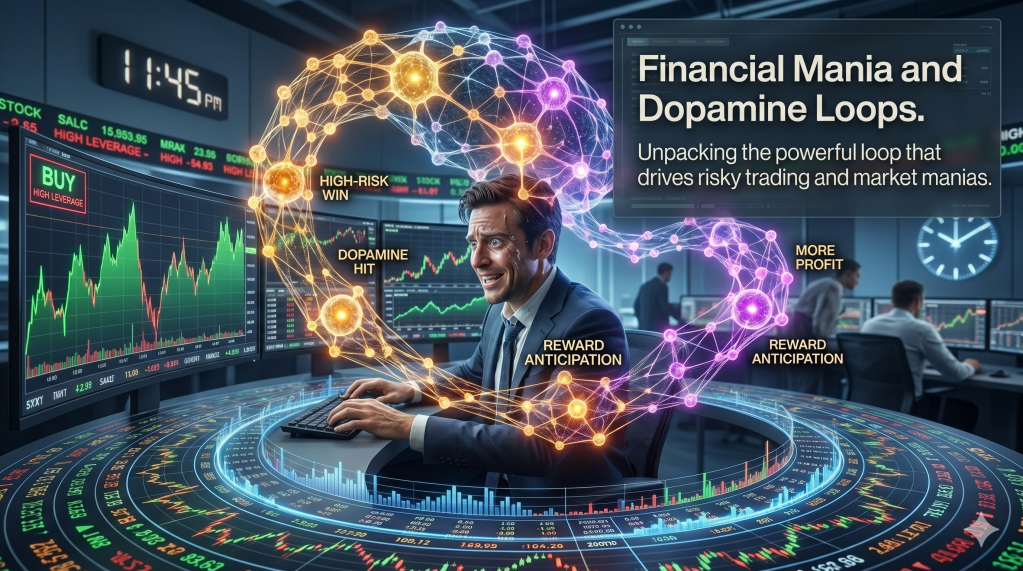
How dopamine, social contagion, and gamified technology drove the 2020–2021 retail trading frenzy — and what behavioral science reveals about financial mania.
There are moments in history when large numbers of people seem to temporarily lose their grip on reality — not through ignorance or stupidity, but through something far more interesting. Something biological. In the early months of 2021, millions of ordinary people became day traders, cryptocurrency speculators, and amateur market analysts almost overnight. They weren’t simply chasing money. They were chasing a feeling. And understanding that feeling — where it comes from, how it spreads, and why it’s so difficult to resist — reveals something important about the intersection of human psychology, social behavior, and the technologies that now mediate both.
The period stretching from roughly late 2020 through 2021 produced one of the most unusual financial environments in living memory. Retail investors flooded into the stock market in numbers not seen in decades. Cryptocurrency prices surged and collapsed with breathtaking speed. Meme stocks — shares in struggling companies like GameStop and AMC — became vehicles for something that looked as much like a social movement as a financial strategy. NFTs sold for millions of dollars. Online communities devoted to trading grew from thousands of members to millions in a matter of weeks. A new vocabulary emerged: “to the moon,” “diamond hands,” “YOLO trades.”
To dismiss all of this as simple greed or irrationality misses the deeper story. Financial manias are as old as markets themselves, but the 2020–2021 episode had features that distinguished it from its predecessors. It was shaped by a global pandemic that had upended daily life, a flood of government stimulus money, near-zero interest rates, and — crucially — a new generation of social and financial technologies designed, whether intentionally or not, to make speculation feel like a game. To understand what happened, you have to understand how the brain processes reward, risk, and novelty. And you have to understand how those ancient biological circuits can be triggered, amplified, and exploited by the modern world.
The Brain Was Not Built for Wall Street
How Dopamine Actually Works
Most people have heard that dopamine is the brain’s “pleasure chemical.” That description is technically misleading, but it contains a useful grain of truth. Dopamine is a neurotransmitter — a chemical messenger — that plays a central role in motivation, anticipation, and the encoding of reward. When something good happens, dopamine gets released. But research by neuroscientist Wolfram Schultz and others has shown that the more important trigger isn’t the reward itself — it’s the prediction of reward, especially when that prediction is uncertain.
In a landmark series of experiments conducted in the 1990s and built upon extensively since, Schultz demonstrated that dopamine neurons fire most strongly not when a reward is delivered, but when an unexpected reward arrives — or when a signal appears that might predict a reward. When rewards become fully predictable, dopamine activity actually diminishes. The brain, it turns out, is most energized by the possibility of something good, not the certainty of it. This is sometimes called “reward prediction error,” and it’s one of the most influential findings in modern neuroscience.
What this means in practical terms is that uncertainty is not just tolerable to the human brain — it’s stimulating. Variable outcomes, where you sometimes win and sometimes lose in an unpredictable pattern, produce more dopamine activity than consistent, predictable rewards. This is precisely the mechanism that makes slot machines so compelling. It also happens to describe financial markets with almost uncomfortable accuracy. Stock prices move in patterns that feel meaningful but are riddled with randomness. A trade might succeed for reasons entirely unconnected to the trader’s analysis. Prices spike without warning. This unpredictability, far from discouraging participation, can actively drive it.
Behavioral psychologists have long known that rewards delivered on unpredictable schedules create the most persistent behaviors. Known as intermittent reinforcement, this pattern produces actions that are remarkably resistant to extinction — far more so than behaviors rewarded every time or never at all. The same principle that keeps gamblers pulling slot-machine levers can keep traders refreshing market charts and checking portfolio balances throughout the day. It also helps explain why people continue speculating through losses: the next trade might be the one that pays off, and the brain, primed by past wins, keeps generating the motivation to find out.
The Anticipation Machine
There’s another layer to this that matters for understanding financial mania. Dopamine doesn’t just respond to rewards — it governs what we pay attention to, what we seek out, and how motivated we feel to pursue a goal. Neurologist Kent Berridge has spent decades distinguishing between what he calls “wanting” and “liking” — two systems in the brain that are related but separate. Dopamine is primarily a “wanting” chemical. It drives pursuit, craving, and anticipatory excitement. The actual pleasure of receiving a reward — the “liking” — is mediated by different circuits.
This distinction explains a phenomenon that many people recognize from experience but find hard to articulate: the feverish excitement of chasing something can feel more intense than actually getting it. For a trader watching a stock position move in real time, the experience of monitoring — of not yet knowing whether the bet has paid off — can be more neurologically activating than the moment of cashing out. The dopamine system keeps wanting, keeps pushing, keeps saying “not yet, keep going.” This is the neurological engine of compulsive behavior, and it doesn’t require conscious awareness to run.
The Social Architecture of Speculation
Online Communities as Amplifiers
Individual psychology doesn’t exist in isolation. The 2020–2021 trading frenzy was not a million separate people independently discovering the same opportunities. It was a social phenomenon, shaped by the platforms and communities through which information and emotion traveled.
Reddit’s r/WallStreetBets community, which grew from roughly 1.5 million members in early 2020 to over 10 million by early 2021, became the most visible example of how online communities could transform financial behavior. The forum had a distinctive culture: irreverent, profane, self-mocking, and built around the sharing of both spectacular wins and catastrophic losses. Members posted screenshots of their portfolios the way athletes might show off trophies — and crucially, outsized losses were displayed with almost the same bravado as gains. This cultural norm — celebrating the audacity of risk-taking rather than prudent outcomes — shaped participation in ways that subtly shifted what members were actually optimizing for.
Psychologists have long documented the phenomenon of social comparison, the way that people assess their own situation by looking at those around them. In environments where extreme risk-taking is celebrated and social status is tied to the size of one’s position rather than the wisdom of one’s strategy, the rational baseline shifts. What looks reckless from the outside can feel, within the community, like the expected behavior of a serious participant. Social psychologists call this “descriptive norms” — the power of perceived common behavior to reshape individual behavior. When everyone around you seems to be making leveraged bets on volatile assets, doing so stops feeling exceptional and starts feeling normal.
The Fear of Missing Out, Quantified
Social media didn’t invent FOMO — the fear of missing out — but it industrialized it. The visible, real-time nature of social platforms meant that stories of people turning small investments into life-changing sums circulated constantly, algorithmically amplified because they generated engagement. A post about a $50,000 gain on GameStop options attracted hundreds of thousands of views. The investors posting those screenshots were visible precisely because they had succeeded. The much larger population of unsuccessful traders rarely became viral examples — their losses were quieter, less shareable, and structurally absent from most people’s feeds. This created a systematic distortion in the information environment: people were exposed to a skewed sample of outcomes, which naturally skewed their estimates of likely outcomes.
Research in behavioral economics, including foundational work by Daniel Kahneman and Amos Tversky on what they called the “availability heuristic,” shows that people tend to estimate the probability of an event based on how easily examples come to mind. When dramatic gains are constantly surfacing in feeds and group chats, the brain assigns them a higher probability than the underlying statistics would justify. This isn’t a failure of intelligence. It’s a predictable consequence of how human cognition processes social information, interacting with platforms specifically designed to surface emotionally resonant content.
Pandemic Conditions as Accelerant
Disruption, Boredom, and Gamification
The COVID-19 pandemic did not cause the financial mania of 2020–2021, but it created conditions that made it possible in ways that would not otherwise have existed. Lockdowns eliminated many of the activities and social structures that normally absorb attention and energy. Millions of people, particularly younger adults, found themselves with more unstructured time than they had ever experienced. Government stimulus programs deposited cash directly into people’s accounts. Commission-free trading apps — particularly Robinhood, which had launched in 2013 but saw explosive growth during the pandemic — made it possible to begin investing with minimal friction and minimal capital. Interest rates had been driven to near zero by central banks responding to the economic crisis, which made savings accounts and bonds unattractive. The conditions were, in retrospect, almost precisely engineered to funnel bored, cash-holding people toward financial markets.
One of the most significant and debated features of this period was the role of trading application design. Robinhood was built around a user experience borrowed heavily from mobile gaming: confetti animations when trades were completed, simple bright graphics, and a design philosophy centered on making complex financial actions feel effortless and fun. Critics, including researchers who testified before Congress in the aftermath of the GameStop episode, argued that the design choices were not neutral. Academic work on gamification shows that features like visual rewards, streaks, and progress indicators can significantly increase engagement and risk-taking. A 2021 study published in the Journal of Financial Economics found evidence that Robinhood users were more likely to concentrate on highly volatile, high-attention stocks than users of comparable platforms with less gamified interfaces. The interface wasn’t making people irrational, but it was creating conditions where the excitement of trading could be more salient than its financial logic.
Historical Echoes
Manias Are Not New
It would be a mistake to treat the events of 2021 as entirely unprecedented. Financial manias have recurred throughout history with enough regularity that economists have developed frameworks for understanding their common features. The Dutch tulip bubble of the 1630s, the South Sea Bubble of 1720, the railway mania of the 1840s, the dot-com boom of the late 1990s, and the U.S. housing bubble of the mid-2000s all share structural similarities that transcend their specific assets and eras.
Economist Hyman Minsky described a pattern in which extended periods of stability and rising prices breed complacency and encourage increasing risk-taking, eventually producing instability. His framework — often summarized as “stability is destabilizing” — anticipates the way that a long bull market can generate behavior that ultimately undermines it. Charles Kindleberger’s influential study Manias, Panics, and Crashes identified recurring phases in financial bubbles: a displacement that creates new opportunities, a credit expansion that funds speculation, euphoria as prices rise and outsiders are drawn in, distress as insiders begin to exit, and then revulsion as prices collapse.
What was different in 2021 was not the psychological architecture of the mania — the dopamine-driven anticipation, the social contagion, the availability bias amplified by vivid stories of overnight wealth — but the technologies through which these ancient dynamics were expressed. The speed was faster. The reach was broader. The barriers to participation were lower. A speculative impulse that might once have been confined to professional traders or wealthy investors could now find expression in seconds, on a phone, by someone with $50 and a Robinhood account.
The Cryptocurrency Dimension
A New Asset Class, or a New Casino?
The 2020–2021 period was also a pivotal moment for cryptocurrency, which occupied a distinct but related space in the broader financial mania. Bitcoin rose from roughly $10,000 at the start of 2020 to nearly $65,000 by April 2021. Hundreds of smaller alternative coins rose and fell with a volatility that dwarfed anything in traditional equity markets. What made cryptocurrency particularly potent from a psychological standpoint was not just the scale of the gains — it was the structure of the market. Crypto traded 24 hours a day, seven days a week, eliminating the circuit-breaker function that trading hours provide elsewhere. The culture surrounding it was saturated with ideological commitment — the belief that cryptocurrency represented a fundamental transformation of the financial system, not merely an investment. This added a layer of motivated reasoning that could override normal risk assessment: to sell was not just to realize a loss, it was to lose faith.
The emergence of NFTs — non-fungible tokens, digital assets verified on a blockchain — extended the same psychological logic into a new arena. What made NFTs neurologically compelling had less to do with the assets themselves than with what they activated: novelty, the powerful pull of a poorly understood opportunity that might be enormous; social proof, as celebrities and major brands signaled participation; and the classic intermittent reinforcement of a market where some tokens appreciated dramatically and others became worthless overnight. NFTs were also, crucially, a status technology — owning a recognizable one signaled membership in a community of early adopters. The financial and social rewards were tangled together in ways that made purely rational evaluation nearly impossible. By 2022, the market had collapsed, and by the mid-2020s the vast majority of NFTs had lost most of their market value. But the psychological template they embodied — novelty plus scarcity plus social validation — has proven durable in other forms.
What Science Tells Us About Risk Perception
The Feeling of Certainty in Uncertain Situations
One of the most consistent findings in behavioral finance is that people in speculative environments tend to dramatically underestimate the risk they are taking. This isn’t simply because they haven’t thought about the possibility of loss. It’s because the psychological state produced by speculative excitement actively distorts risk perception.
Neuroscientist Antonio Damasio’s somatic marker hypothesis suggests that emotional signals — physical feelings associated with previous experiences — play a central role in decision-making, particularly in situations involving uncertainty. Under normal conditions, this system helps people make reasonably adaptive choices. But in environments saturated with excitement and social validation, the emotional signals being generated are strongly positive, which can suppress the anxiety that would otherwise flag risk. Put more plainly: when you are excited, and everyone around you is excited, and the asset you own just went up 40% in a week, it is genuinely neurologically difficult to feel afraid.
There is also a phenomenon called “hot cognition” — a state in which emotional arousal interferes with cool, analytical reasoning. Research shows that people in states of high arousal, whether from excitement, anger, or fear, are less effective at tasks requiring deliberate, careful thinking and more prone to heuristic, intuitive judgment. Financial markets, particularly during periods of unusual volatility and social excitement, are precisely the environments in which hot cognition is most likely to be operating and most likely to be costly.
The Particular Vulnerability of Inexperienced Investors
Research in financial psychology suggests that inexperienced investors face a specific set of risks beyond the general challenges of speculative markets. Experienced investors often develop calibrated expectations — they have seen rallies end and bubbles burst, and their emotional responses, while not immune to excitement, are modulated by memory. First-time investors in a bull market, by contrast, are calibrating their expectations based on a potentially unrepresentative sample. If your first six months of investing coincide with a rapid market appreciation, it is cognitively natural — even if statistically unsound — to assume that this is how markets work.
This is a well-documented problem in investment research. Studies of retail investor behavior consistently show that people tend to enter markets after extended rises — buying high — and exit after extended falls — selling low — despite this being precisely the opposite of profitable strategy. The emotional logic is straightforward: rising markets feel safe and exciting, falling markets feel dangerous and depressing. The neurological machinery is responding to the environment as it is, not as it will be.
The Longer Arc
What Changed After 2021
The most dramatic episodes of the 2020–2021 trading frenzy eventually resolved as most such episodes do. The GameStop short squeeze — in which retail traders coordinating on Reddit drove a dramatic price spike by buying shares in a company that large hedge funds had bet against — produced extraordinary gains for some and serious losses for many. The broader meme stock phenomenon faded as prices corrected. Cryptocurrency markets entered a severe multi-year downturn beginning in late 2021, with Bitcoin falling from its peak of nearly $69,000 in November 2021 to below $16,000 by late 2022. The NFT market collapsed even more dramatically, with the vast majority of NFTs losing most or all of their value within two years of their peak.
What did not resolve so quickly were the structural conditions that had produced the episode in the first place. Commission-free trading remained the standard. Social media platforms continued to amplify financial content, and a new generation of creators built audiences specifically around investment and trading advice. Cryptocurrency, despite severe downturns, did not disappear — it rebuilt, evolved, and eventually experienced another significant price appreciation cycle in 2024 and into 2025 as institutional adoption accelerated and regulatory clarity began to emerge in several major markets. The psychological and social dynamics that had driven the 2021 frenzy did not dissipate; they became more familiar features of the landscape.
Technology, Regulation, and the Limits of Rules
The GameStop episode prompted congressional hearings and regulatory attention on both the trading apps facilitating retail speculation and the short-selling practices that had created the conditions for the short squeeze. Some regulatory changes followed — enhanced reporting requirements, discussions of payment for order flow practices, greater scrutiny of social media’s role in market movements. But regulating the underlying psychological dynamics has always proven more difficult than regulating specific practices, because the human brain’s appetite for reward, novelty, and social validation is not a policy failure. It is a feature of the species.
This is not a counsel of despair. Financial education, more honest disclosure of risk, and better-designed platforms that don’t exploit psychological vulnerabilities can all make a difference at the margins. Research on “choice architecture” — the design of environments that help people make decisions more aligned with their actual long-term interests — suggests that relatively modest changes in how options are presented can shift behavior meaningfully. But anyone who has watched a financial mania unfold, or who has felt the pull of a surging market in their own gut, knows that these forces are not simply ignorance to be corrected. They are biology to be understood.
A Pattern That Persists
The period of financial mania that swept through retail markets in 2020 and 2021 was not an anomaly produced by a unique set of circumstances, never to recur. It was a particularly vivid expression of dynamics that have always characterized speculative markets: the dopamine-driven pull of uncertain reward, the social contagion of excitement and story, the distortion of risk perception in environments saturated with gains, and the way that new technologies lower barriers and accelerate cycles without changing their fundamental character.
What made this episode worth examining closely — and what continues to make it instructive — is that the technologies involved made the psychological mechanisms unusually legible. The algorithms that amplified exciting financial content were the same ones amplifying everything else. The gamified interfaces were built on the same behavioral psychology as mobile games. The online communities that coordinated market movements operated on the same dynamics as any other passionate online subculture. The mania was not separate from the broader architecture of digital life — it was an expression of it, running on the same infrastructure, activating the same circuits, producing the same feedback loops that drive engagement across every corner of the internet.
Understanding financial mania and dopamine loops is, in this sense, not just about understanding markets. It is about understanding what it means to live in environments specifically engineered to engage and reward the most ancient parts of our psychology — and about the gap that can open between what we are being driven to do and what, with time and clarity, we would choose.









