
Originally published in January 2022 and comprehensively updated and edited in June 2026.
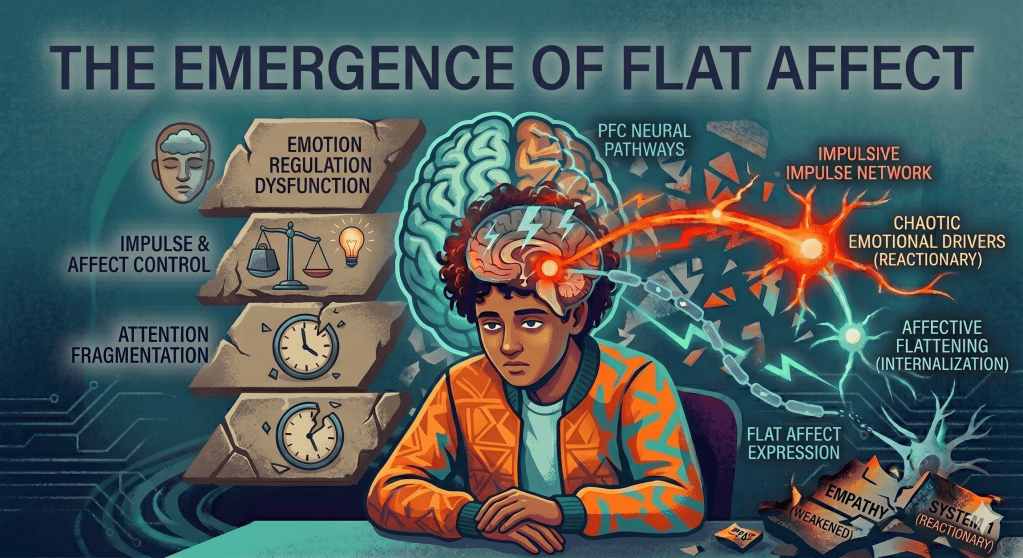
How pandemic-era stress, screen fatigue, and information overload gave rise to a cultural sense of emotional flatness, explained through psychology and neuroscience.
A Particular Kind of Quiet
Weddings returned. Restaurants reopened. Restrictions lifted. And yet, by late 2021 and into 2022, many people noticed something strange happening to themselves. They were receiving good news and bad news with roughly the same expression. A friend’s engagement, a positive case count finally trending down, a long-delayed reunion at the airport, all of it registered, but distantly, like watching weather happen to someone else’s town. Conversations that once carried genuine excitement now felt like they were happening through a pane of glass. People reported scrolling past headlines that, a year earlier, would have stopped them cold. Therapists began hearing a recurring complaint from clients who weren’t depressed in any clinical sense but who also weren’t quite present. Something had gone quiet in the emotional register of daily life, and people reached for a clinical-sounding term to describe it: flat affect.
That borrowing of language matters, and it’s worth pausing on before going any further. In psychiatry, flat affect is a specific and fairly rare clinical sign, most often associated with schizophrenia, severe depression, certain neurological conditions, or as a side effect of some medications. It refers to a near-total absence of outward emotional expression, regardless of what’s actually happening internally. What millions of people experienced during the pandemic years, and what many continue to describe in the years since, is a different and much more common phenomenon. It’s closer to emotional numbing, habituation, or what researchers sometimes call blunted affect, a milder and far more widespread dimming of emotional reactivity. The clinical term escaped the clinic and became a piece of everyday shorthand for a cultural mood, and that shift in language tells us something real about the period it emerged from.
This essay traces how that mood developed. It looks at the social and technological conditions of the early 2020s that primed so many people to feel emotionally dulled, the psychological and neuroscientific research that helps explain why prolonged stress and screen-mediated life can blunt emotional response, and the cultural conversation that has carried the idea of flat affect well past its origins in clinical psychiatry. The goal isn’t to diagnose a generation or to declare a crisis. It’s to understand, carefully and without exaggeration, why so many people reached for the same word to describe the same strange feeling, and what that says about the relationship between social conditions and inner life.
The Atmosphere of 2020 to 2022
To understand why the language of flat affect took hold, it helps to remember what those years actually felt like for a lot of people. The pandemic didn’t arrive as a single dramatic event and then resolve. It arrived as a prolonged, low-grade emergency that reshaped daily routines for months and then years. Offices emptied out. School moved onto screens. Holidays were canceled or shrunk down to immediate household members. Grief became background noise, with daily case counts and death tolls scrolling across news broadcasts the way sports scores once had.
Psychologists who study stress have long distinguished between acute stress, a short sharp jolt that resolves once the danger passes, and chronic stress, a sustained low hum of threat that never fully switches off. The pandemic period was, for most people, an extended experience of the second kind. There was no single moment of resolution to return to baseline. Instead there was an ongoing series of smaller adjustments: another wave, another variant, another set of restrictions, another recalibration of what felt safe. The body’s stress systems are built to handle sprints, not marathons, and a few years of unresolved low-grade alarm leaves a mark.
There’s a useful concept here called allostatic load, which describes the cumulative wear on the body and brain from sustained stress exposure. It’s not a single hormone or a single switch. It’s the accumulated cost of a nervous system that keeps bracing for impact long after the original threat has changed shape. Researchers who study allostatic load generally agree that chronic, low-level stress can dull emotional reactivity over time, partly as a kind of conservation strategy. If every day brings fresh bad news, the nervous system starts treating bad news as background rather than emergency, simply because reacting fully to every alarm would be exhausting and unsustainable. This isn’t indifference in any moral sense. It’s closer to a survival adaptation that, paradoxically, can leave people feeling disconnected from things that should matter to them.
Compassion Fatigue and the Numbers Problem
One of the more well-documented psychological phenomena from this period is compassion fatigue, sometimes called empathy fatigue. It was first studied in detail among healthcare workers, social workers, and first responders, the people whose jobs require sustained emotional engagement with other people’s suffering. What researchers found is that empathy isn’t an infinite resource. It behaves more like a muscle that tires with overuse, and when the demand for emotional engagement vastly exceeds what a person can sustainably provide, something in the nervous system starts to throttle the response.
During the pandemic, this dynamic expanded well beyond healthcare workers and into the general population, mediated largely through media consumption. There’s a well-established finding in behavioral psychology, sometimes called psychic numbing or the collapse of compassion, which shows that people’s emotional response to suffering doesn’t scale up with the number of people affected. A single identifiable person in distress tends to generate a strong emotional reaction. A statistic representing thousands of people in distress generates a much weaker one, even though the scale of suffering is obviously greater. This isn’t a flaw unique to any one person; it appears to be a structural feature of how human emotional processing handles scale. The pandemic put millions of people in daily contact with exactly this kind of large-number suffering, delivered in the form of case counts and death tolls, day after day, for years. The emotional system, faced with statistics it had no evolutionary template for processing, did something it does fairly reliably under those conditions: it quieted down.
This is one of the more grounded explanations for the cultural sense of flatness that emerged. It wasn’t that people stopped caring. It was that the volume and abstraction of the suffering being reported outpaced the brain’s capacity to respond to it as the brain typically responds to identifiable, individual harm. Over time, the dulled response generalized. People who had spent months not fully reacting to mounting death tolls found that the same dulling crept into smaller, more personal moments too.
The Role of the Screen
Technology amplified this dynamic in ways that deserve their own explanation, and the most useful one predates the pandemic by decades. Communication researchers have long studied what’s known as social presence theory, the idea that different communication mediums vary in how strongly they convey the sense that another person is actually, psychologically there with you. A phone call carries more social presence than a text message. A face-to-face conversation carries more than a phone call. A related framework, media richness theory, developed in the 1980s to study workplace communication, ranks mediums by how much information they can carry beyond the literal content of a message, things like tone, timing, facial expression, and the subtle feedback loop of a shared physical space. Richer mediums convey more of this surrounding information; leaner mediums convey less, and ambiguity tends to fill the gap.
Put together, these two frameworks describe something more precise and more interesting than “screens are tiring,” which is the idea of emotional bandwidth. Every medium of communication has a ceiling on how much emotional and relational information it can carry at once, and that ceiling matters far more than people tend to assume. A shared room carries an almost unlimited bandwidth of cues: posture, breath, the micro-timing of a pause, the warmth of physical proximity. A video call narrows that bandwidth considerably, compressing a person into a flat rectangle, stripping out peripheral vision and shared space, and introducing lag that disrupts the natural rhythm of turn-taking. A text message narrows it further still, down to words alone. For much of the pandemic, an enormous share of human connection, work, school, friendship, even grief, was rerouted through mediums sitting near the bottom of this bandwidth scale, for months and then years at a stretch.
This is the more useful lens for understanding why so much pandemic-era communication felt simultaneously exhausting and unsatisfying. Video calls replaced in-person meetings on a scale that had never happened before, and researchers quickly began documenting the resulting strain under the informal name “Zoom fatigue.” Several explanations for it have held up well under further study. Video calls demand more sustained, direct eye contact than in-person conversation typically does, since every participant’s face is framed and centered on screen at once, which is cognitively taxing in a way casual conversation usually isn’t. They also strip out much of the nonverbal information people normally rely on, while introducing technical friction, lag, frozen frames, a half-second of audio delay, that the brain has to work to compensate for. None of this is really about video calls being unpleasant on their own terms. It’s about a low-bandwidth medium being asked to carry a high-bandwidth task, sustained emotional and social connection, for which it was never well suited.
Over years of relying on these narrower channels for an outsized share of human connection, it’s plausible that people’s own expressive habits adapted to the lower-bandwidth medium, learning to convey less because less could be received, and that this adaptation didn’t fully reverse once in-person contact became possible again. This is a more speculative claim than the well-established research on social presence and media richness, and it should be treated that way. But it lines up with what a lot of people reported anecdotally: a sense that their own expressiveness, not just their perception of others, had narrowed, as though years spent communicating through a narrow channel had quietly recalibrated what felt like a normal amount of feeling to show.
What the Brain Research Actually Shows
It’s worth being careful here, because some of the language used to describe flat affect borrows heavily from neuroscience, and not all of that borrowing is equally well supported. The clinical literature on flat affect, as a psychiatric sign, has linked it to underactivity in brain regions involved in emotional processing, including the amygdala, which plays a central role in detecting and responding to emotionally significant stimuli. This research is specific to clinical populations, primarily people with schizophrenia or severe depression, and it shouldn’t be casually extended to describe ordinary people going through a stressful few years.
What neuroscience does support more broadly is that chronic stress changes how the brain’s emotional circuitry operates, even outside of any diagnosable condition. Sustained activation of the body’s stress response system, involving the hypothalamus, pituitary gland, and adrenal glands working together, has measurable effects on regions of the brain involved in emotion regulation and reward processing over time. Under prolonged stress, the brain’s reward circuitry, including the release and uptake of dopamine in response to pleasurable or novel experiences, can become less responsive, a pattern sometimes described as anhedonia when it becomes pronounced. This is a real and well-studied effect of chronic stress, and it offers a more scientifically grounded explanation for the colloquial sense of flatness than any direct claim about amygdala underactivity in the general population.
The honest summary is this: there is solid evidence that chronic stress and overwhelming, repetitive exposure to distressing information can dull emotional reactivity through well-understood mechanisms involving stress hormones and reward circuitry. There is much weaker and more speculative evidence for claims that millions of ordinary people developed anything resembling the clinical sign of flat affect in a diagnostic sense. The cultural use of the term borrowed its emotional weight from psychiatry without necessarily borrowing its precision, and that distinction matters for anyone trying to understand the phenomenon accurately rather than dramatically.
Normalization and the Shifting Baseline
There’s a sociological dimension to this story that’s just as important as the psychological one. Human beings are remarkably good at adjusting their sense of normal to match whatever conditions persist long enough. Sociologists studying disaster and crisis response have observed that communities living through prolonged emergencies tend to undergo a process of normalization, where conditions that would have been shocking at the outset become the unremarkable backdrop of daily life. This isn’t unique to the pandemic; it shows up in studies of communities living through war, prolonged economic hardship, and other sustained disruptions.
What made the pandemic period distinctive was the speed and uniformity with which this normalization happened across an enormous, interconnected population, largely because so much of daily experience was now mediated through the same handful of digital platforms. Practices that would have seemed extraordinary in February 2020, like daily case-count tickers, mask mandates, remote schooling, and canceled milestones, became routine within months. Once something becomes routine, the emotional system stops flagging it as significant, which is an efficient and generally adaptive feature of cognition. But it also means that genuinely significant losses, postponed weddings, missed funerals, disrupted educations, got folded into the same flattened emotional category as more mundane disruptions, simply because they were all happening against the backdrop of an unending stream of similar news.
This shifting baseline helps explain why so many people described feeling flat even during moments that should have registered as good news, like reunions or the lifting of restrictions. The emotional baseline itself had moved, and it took time, in some cases years, for it to recalibrate back toward a fuller range of response.
Flat Affect as a Cultural Idiom
By the time the acute phase of the pandemic had passed, “flat affect” had taken on a life of its own as a piece of cultural vocabulary, showing up in essays, social media posts, and casual conversation as a catchall term for a particular flavor of modern disconnection. This is a familiar pattern in the history of psychological language. Terms like “burnout,” “trauma,” and “trigger” all began as fairly specific clinical or technical concepts before migrating into everyday speech, where they took on broader, looser meanings shaped by lived experience rather than diagnostic criteria.
This migration isn’t necessarily a problem. Language adapts to describe what people are actually experiencing, and the popular use of flat affect captured something real that didn’t have a better existing name: a widely shared sense of emotional dampening that wasn’t quite depression, wasn’t quite numbness, and wasn’t quite exhaustion, but had elements of all three. The risk lies in treating the borrowed clinical term as though it carries the same diagnostic weight in casual use that it carries in a psychiatric evaluation. Someone who feels flat after two years of pandemic stress and screen-mediated isolation is describing something psychologically real and worth taking seriously, but they are not describing the same clinical picture as someone with schizophrenia-related flat affect, and conflating the two risks both trivializing a serious clinical symptom and over-pathologizing an ordinary, if uncomfortable, human response to extraordinary circumstances.
The Slow Return of Range
For many people, the years following the most acute phase of the pandemic brought a gradual return of emotional range, though not in a clean or linear way. Some of this likely reflects the resolution of the acute and chronic stress that had been driving allostatic load in the first place. As routines stabilized, as in-person contact resumed, and as the daily drumbeat of pandemic-specific bad news faded from the center of public attention, the conditions that had been dulling emotional reactivity gradually eased as well.
But the recovery wasn’t universal or complete for everyone, and that unevenness is itself worth noting rather than glossing over. Some people described a lasting change in how they related to bad news, having grown accustomed to a kind of protective distance that didn’t fully dissolve once the original threat receded. Others described the opposite, a kind of emotional whiplash where feelings that had been suppressed for years arrived all at once, sometimes inconveniently, once the pressure that had been holding them down let up. Both patterns are consistent with what’s known more broadly about how people recover from sustained stress: recovery tends to be gradual, individually variable, and shaped heavily by what other resources, social support, financial stability, physical health, a person had available to draw on during the stressful period itself.
What recovery actually looked like, for the people who experienced it, tended to follow a fairly consistent shape, even if the timeline varied widely. The earliest sign was usually a return of responsiveness to novelty, the small jolt of interest or pleasure that a new experience produces, which is closely tied to the same dopamine-mediated reward circuitry that chronic stress had been dampening. A first trip somewhere unfamiliar, a new restaurant, an unplanned outing, things that would have barely registered during the most stressful stretch of the pandemic began producing a noticeably sharper response. This tracks with what’s understood about reward sensitivity more broadly: it isn’t simply restored by the passage of time, but by renewed exposure to the kind of varied, unpredictable, in-person experience that chronic stress and prolonged routine had crowded out.
Social reconnection followed a similar pattern, though it tended to lag slightly behind the return of novelty-seeking. Rebuilding the muscle of in-person interaction, after years of leaning on lower-bandwidth substitutes, took practice in a fairly literal sense. People who had grown accustomed to communicating through screens often described early in-person gatherings as oddly effortful, even when they were glad to be there, before the ease of shared physical space reasserted itself. Researchers who study social reconnection after prolonged isolation have noted that this initial friction is normal and tends to fade with repeated exposure, much like any other skill that atrophies without use and rebuilds with practice. The friction itself isn’t evidence that something had been permanently lost; it’s better understood as evidence of how much the nervous system had adapted to a different mode of connection, and how much deliberate re-engagement it took to adapt back.
What emerges from this picture is less a single dramatic turning point than an accumulation of small re-engagements: a sharper reaction to good news here, an easier conversation there, a gradually widening tolerance for letting things matter again. For some people that accumulation happened over a matter of months. For others, particularly those who had fewer resources to draw on during the hardest stretch of the pandemic, it took considerably longer, and some described still feeling its residue years later. None of this points toward a single recovery timeline that applies to everyone, only toward a consistent underlying mechanism: emotional range returns largely through renewed exposure to the conditions, novelty, in-person connection, lower sustained stress, that had been suppressing it in the first place.
Why This Period Matters Beyond Itself
It would be easy to treat the emergence of flat affect as a strange footnote belonging entirely to a specific few years and then move on, but the underlying dynamics it revealed have outlasted the pandemic that triggered them. The basic mechanism, that large-scale, abstract, unrelenting exposure to distressing information can blunt emotional responsiveness over time, doesn’t require a global pandemic to operate. It applies just as readily to the ongoing, low-grade churn of conflict coverage, climate news, and economic anxiety that has remained a fixture of daily media consumption in the years since. The pandemic offered an unusually concentrated and universally shared example of a dynamic that has, in milder and more diffuse forms, been quietly shaping emotional life in the digital age for considerably longer.
A Preview of a Larger Shift
The pandemic also offered an early preview of a tension that has only grown since: as screen-mediated communication carries more of human connection, the emotional bandwidth available within it becomes a real structural constraint, not just a stylistic difference from being in the same room as someone. That tension didn’t disappear once offices reopened. It moved into new forms.
One notable example is the rise of conversational AI as a source of emotional support. In the years since, growing numbers of people have turned to AI chatbots not just for practical tasks but for something closer to companionship, a place to think out loud or have a responsive presence available at any hour. Viewed through social presence and media richness, this is striking: a text- or voice-based exchange with an AI sits near the leaner end of the bandwidth scale, well short of face-to-face cues, and yet many people report it as genuinely soothing.
Two explanations seem plausible, without overreaching. AI conversation may succeed less by being emotionally rich and more by being reliably present and non-judgmental, qualities that matter when someone is processing distress and don’t require a high-bandwidth medium. Or years of pandemic-era adaptation to leaner communication may have narrowed people’s baseline expectations for what connection should feel like, making a lean medium feel more sufficient than it once would have. The research here is still early, but the underlying question, how much bandwidth a medium needs before it stops feeling hollow, is the same one the pandemic forced through Zoom calls and texts, now transposed onto newer technology.
A Closing Thought
The emergence of flat affect as both a felt experience and a piece of popular vocabulary captures something true about how social conditions shape inner life. People didn’t imagine the dulling they described during those years. The mechanisms behind it, chronic stress, compassion fatigue in the face of overwhelming statistics, the narrowed bandwidth of screen-mediated relationships, and the quiet recalibration of what counts as normal, are well-documented and reasonably well understood, even if the popular language used to describe them borrowed more drama from clinical psychiatry than the underlying science strictly supports.
What the period demonstrated, more than anything, is how responsive human emotional life is to the texture of daily existence, the pace of information, the medium of connection, the sheer volume of demand placed on empathy. None of that is a flaw in human psychology. It’s closer to evidence of how adaptable, and how vulnerable, the emotional system actually is to the conditions it’s asked to operate within. Understanding that adaptability, rather than treating it as a mystery or a failing, is probably the more useful lesson to carry forward as those conditions keep evolving.









