
Originally published in November 2021 and comprehensively updated and edited in June 2026.
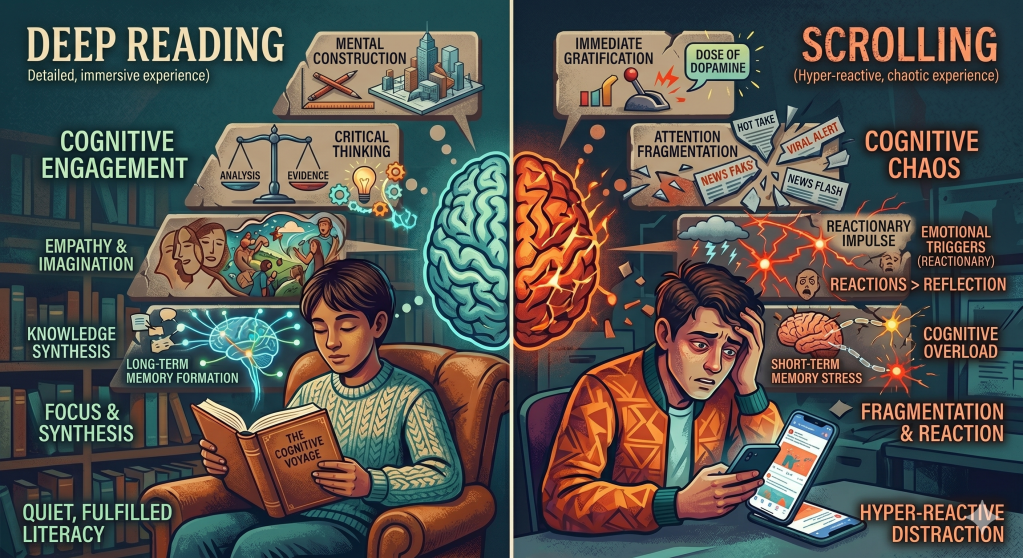
How social media, smartphones, and AI reshaped human attention since 2021, and what psychology and neuroscience reveal about the decline of deliberate thinking.
In the early 2020s, something quietly shifted in the texture of everyday thought. People still read, still argued, still made decisions about their jobs and relationships and futures. But the pace at which they did these things had changed, and so had the depth. Conversations that once unfolded over an afternoon now happened in fragments between notifications. Opinions that once took days to form arrived within minutes of a headline, often before anyone had read past it. Attention itself had become a contested resource, fought over by apps, platforms, and algorithms that were, by design, very good at winning.
This was not a sudden event. It was the visible result of a slower, decade-long erosion of what psychologists call deliberate thinking: the slow, effortful, conscious reasoning that allows people to weigh evidence, consider alternatives, and resist their first impulse. In its place, a faster and more reactive mode of thought began to dominate daily life. By the time the COVID-19 pandemic pushed entire populations into isolation, screens, and a nonstop churn of conflicting information, the conditions for this shift were already firmly in place. The pandemic did not create the problem. It accelerated it, and made it visible.
This piece looks at why deliberate thinking declined, what the science actually says about attention and cognition in a digital environment, and how the years since 2021 — particularly the rise of conversational AI — have continued to reshape the way people process information. The goal is not to issue a verdict on whether technology is “good” or “bad.” It is to understand, as clearly as the evidence allows, what has changed in human thinking and why it matters.
Two Systems, One Overloaded Brain
To understand what has been lost, it helps to start with a basic distinction from cognitive psychology, most famously described by Nobel laureate Daniel Kahneman in his book Thinking, Fast and Slow. Kahneman described two modes of mental processing. The first, often called System 1, is fast, automatic, and intuitive. It is the mode that lets a person swerve to avoid a pothole or recognize a friend’s face in a crowd without conscious effort. The second, System 2, is slow, deliberate, and effortful. It is the mode used to solve a math problem, evaluate a complex argument, or decide whether a claim in the news is actually supported by evidence.
Both systems are essential. The problem is not that fast thinking exists — it has always existed, and it serves a real evolutionary purpose. The problem is what happens when an environment is engineered, intentionally or not, to keep people locked in fast-thinking mode almost permanently. System 2 thinking requires something that modern digital environments are specifically designed to interrupt: sustained, uninterrupted attention. Every notification, every auto-playing video, every infinite scroll feed is a small tax on that attention, and over the course of a day, those small taxes add up to something significant.
Researchers who study attention have noted that deliberate thought is not just slower, it is also more costly in terms of mental energy. The brain, when given the choice, tends to default to the easier path. This is not laziness in any moral sense; it is an efficient use of limited cognitive resources. But when the environment constantly offers quick, low-effort alternatives to deep thinking — a notification instead of a paragraph, a headline instead of an article, a short video instead of a documentary — the brain has less practice exercising the slower system, and less incentive to do so.
The Limits of Working Memory: Cognitive Load
Before turning to distraction and algorithms, it helps to understand a more basic constraint on deliberate thinking: the brain simply cannot hold unlimited information in mind at once. Human cognition evolved under conditions where information arrived relatively slowly, in small enough quantities that the mind could process one problem, conversation, or task at a time before moving to the next. Modern environments present something very different: a continuous stream of stimuli requiring evaluation, filtering, and prioritization, often arriving faster than any single mind can sort through it.
This is the territory of what psychologists call cognitive load theory, developed initially by educational psychologist John Sweller in the 1980s to explain why certain ways of presenting information make learning harder rather than easier. The central idea is that working memory, the mental workspace used to actively hold and manipulate information, has a limited capacity. When the demands placed on that workspace exceed its capacity, performance on reasoning tasks declines, not because a person has stopped paying attention, but because there is no longer enough mental room left to do the work of careful thought.
This matters for the broader argument here because it shows that excessive informational demand can impair reasoning even before distraction enters the picture. A person does not need to be actively interrupted by a notification to think less clearly. Simply existing inside an environment that constantly presents new information to evaluate, whether it is a crowded news feed, a barrage of work messages, or a dozen open browser tabs, places a steady tax on working memory. Deliberate thought, which depends on that same limited workspace to weigh evidence and consider alternatives, has less room to operate. Attention and cognitive load are related but distinct constraints, and both have to be addressed to understand why slow thinking has become harder to sustain.
The Attention Economy and the Architecture of Distraction
The Attention Economy
By the early 2020s, the phrase “attention economy” had moved from academic circles into common usage, and for good reason. Social media platforms, streaming services, and news outlets compete directly for a finite resource: the hours and minutes of human attention. Their revenue models, built largely on advertising, depend on maximizing the amount of time users spend engaged with their products. This created a powerful incentive to design systems that are not just informative or entertaining, but genuinely difficult to disengage from.
This is not a conspiracy theory or a fringe claim. Former technology executives and engineers have spoken publicly about the deliberate use of psychological principles — many borrowed from slot machine design — to keep users scrolling. The mechanism at the center of this design is something behavioral scientists call a variable ratio reinforcement schedule.
Variable Reward and the Pull of the Feed
Variable ratio reinforcement is a concept from behavioral psychology, first studied extensively by B.F. Skinner in the mid-twentieth century. The basic finding is that rewards delivered on an unpredictable schedule are more effective at sustaining behavior than rewards delivered on a predictable one. A slot machine does not pay out every time, and that unpredictability is precisely what makes it so compelling. A social media feed works the same way. Most posts a person scrolls past are unremarkable. But occasionally, one is funny, validating, infuriating, or surprising enough to trigger a small dopamine response. Because the user cannot predict which scroll will deliver that response, the behavior of scrolling itself becomes self-reinforcing.
It is worth being precise about what dopamine actually does here, since the concept is often oversimplified in popular writing. Dopamine is not simply a “pleasure chemical.” Neuroscience research suggests it plays a larger role in anticipation and wanting than in the experience of reward itself. This distinction matters because it helps explain why endless scrolling often does not feel satisfying even as it remains hard to stop. The brain is not chasing a payoff it already received; it is chasing the next uncertain one. This pattern is well documented in research on behavioral addiction, though it is important to note that the comparison between social media use and clinical addiction remains a subject of ongoing scientific debate, not a settled diagnosis.
The Pandemic as Accelerant
The introduction mentioned the COVID-19 pandemic only briefly, but its role deserves more direct attention. For much of 2020 and 2021, hundreds of millions of people shifted abruptly into a life lived largely through screens. Remote work collapsed the boundary between professional and personal time, often replacing brief in-person exchanges with a steady stream of messages and calls arriving at all hours. Social contact, cut off in person, moved online almost entirely, and so did the search for news during a period when conditions were changing rapidly and the stakes of staying informed felt unusually high.
This produced a pattern that came to be known, somewhat informally, as doomscrolling: the compulsive, often anxious habit of continuously checking news and social feeds, even when doing so brought little new information and considerable emotional strain. Surveys from this period found marked increases in daily screen time across most age groups, along with self-reported increases in anxiety linked to news consumption. None of this created the underlying mechanics described elsewhere in this essay, the variable reward loops, the attention economy, the limits of working memory; those were already in place well before 2020. What the pandemic did was remove most of the offline alternatives to screen-based engagement at the exact moment those mechanics were operating at full strength, compressing years of gradual behavioral drift into a much shorter and more visible window.
What the Research Actually Shows
It is easy to make sweeping claims about technology rotting people’s brains. The actual research is more measured, and more interesting, than that kind of language suggests.
The “Brain Drain” Effect
One of the more widely cited studies in this area was conducted by researchers Adrian Ward, Kristen Duke, Ayelet Gneezy, and Maarten Bos, published in 2017 in the Journal of the Association for Consumer Research. The study found that the mere presence of a smartphone — even when turned off and face down — measurably reduced participants’ performance on tasks requiring sustained attention and working memory, compared to when the phone was left in another room. The effect was strongest among participants who reported the highest dependence on their phones.
This finding is significant because it does not require someone to be actively using their phone to be affected by it. The researchers proposed that part of the mind is unconsciously devoted to resisting the urge to check the device, which leaves fewer cognitive resources available for the task at hand. This is sometimes referred to as the “brain drain” effect, and it offers a partial scientific explanation for something many people already sensed intuitively: that simply having a phone nearby changes how well they can concentrate, even without looking at it.
Skimming Versus Deep Reading
A separate but related body of research concerns reading itself. Cognitive scientist Maryanne Wolf, who has spent decades studying the neuroscience of reading, has written extensively about what she describes as a shift from “deep reading” toward “skimming” as a default cognitive mode. Deep reading, in Wolf’s framework, involves the slower cognitive processes associated with inference, critical analysis, and empathy — the kind of reading required to follow a complex argument or sit with an unfamiliar perspective. Skimming, by contrast, prioritizes speed and surface-level pattern recognition.
Wolf’s concern, expressed across several books and academic papers, is not that skimming is inherently bad — it is a useful skill for navigating large volumes of information. Her concern is that when skimming becomes the dominant mode of reading, even when people sit down with material that calls for deep reading, the brain may default to surface-level processing out of habit. This is a theoretical and observational claim more than a definitively proven causal one, and Wolf herself has been careful to frame it as an area requiring continued study rather than a settled fact. Still, it lines up with a broader pattern researchers have observed: as screen-based reading has displaced print reading for many people, average attention spans devoted to single texts appear to have shortened, even as total reading volume, in terms of words consumed per day, may have stayed the same or increased.
Offloading Memory and Thought
A third relevant area of research concerns what is sometimes called the “Google effect,” first described in a 2011 study by Betsy Sparrow, Jenny Liu, and Daniel Wegner published in Science. The study found that when people expect information to remain accessible later (for example, by searching for it online), they are less likely to remember the information itself, but more likely to remember where to find it. This is consistent with a long-standing psychological concept called transactive memory, in which people and groups naturally distribute the work of remembering across external sources, including other people, notebooks, and now search engines.
This is not necessarily a sign of cognitive decline. Offloading memory to external tools is something humans have done for millennia, from written language to filing cabinets. What has changed is the speed and ubiquity of the offloading. When nearly every fact is one search away, the incentive to deeply encode information — to actually understand and retain it — weakens. The concern raised by some researchers is not that people are becoming less intelligent, but that the cognitive habit of working through a problem, rather than immediately outsourcing it, is being used less often, and like any underused skill, it may atrophy with disuse.
From Feeds to Conversations: 2021 to 2026
When this essay was first drafted in late 2021, the dominant concern in this space was the algorithmic feed: the endless, personalized scroll of content on platforms designed to maximize engagement. That concern has not gone away. But the years since have introduced a new and significant variable into the picture: the widespread adoption of conversational AI tools.
The Acceleration of Algorithmic Content
Between 2021 and 2026, short-form video, popularized first by TikTok and quickly adopted across nearly every major platform, became one of the dominant formats for information consumption. Surveys conducted across this period consistently showed declining average engagement time per piece of content alongside rising total time spent on these platforms: people consumed more content, in shorter pieces, with less total reflective time per piece. Researchers have raised reasonable concerns about what this format shift means for sustained attention, though correlation between platform design and attention metrics does not, by itself, prove a direct causal mechanism, and isolating technology’s effect from other social factors remains methodologically difficult.
AI Chatbots and the New Cognitive Offload
The more recent development is the rapid normalization of AI chatbots as a default tool for everyday thinking tasks: drafting emails, summarizing articles, answering questions, and even working through emotional or interpersonal decisions. This represents a meaningfully different kind of offloading than memory alone. Search engines outsourced the storage of information. AI chatbots, by contrast, can outsource a portion of the reasoning itself.
This is not inherently negative. Used well, these tools can support deliberate thinking by organizing information, surfacing counterarguments, or handling rote tasks so a person has more bandwidth for the genuinely difficult parts of a problem. Early research, still limited and evolving, suggests the effect on human reasoning may depend heavily on how the tools are used: as a thinking partner that prompts further reflection, versus a shortcut that ends reflection prematurely. Some preliminary studies from 2024 and 2025 raised questions about whether habitual reliance on AI for writing and decision-making correlates with reduced confidence in unassisted reasoning, though this remains an active and unsettled area of research rather than an established finding. What can be said with more confidence is that the pattern identified in earlier research on smartphones and search engines — offloading effortful cognition onto an available external tool — now has a new outlet, one that is, in some ways, more capable than anything that came before it.
The Social Consequences of Faster Thinking
Reactive Thinking and Polarization
When System 1 thinking becomes the default mode for processing political and social information, the consequences extend beyond individual attention spans. Fast thinking relies on existing beliefs, emotional associations, and pattern recognition rather than careful evaluation of new evidence. Studies in political psychology have found that emotionally charged content, particularly content that triggers anger or moral outrage, spreads further and faster on social platforms than neutral content. Work by William Brady and colleagues on “moral contagion” in social networks found that moral or emotional language in online posts is associated with significantly higher rates of sharing.
This creates a feedback loop: content that triggers fast, emotional responses gets amplified by platform algorithms because it generates more engagement, and that amplified content then shapes the information environment most people encounter, reinforcing reactive processing as the norm. None of this requires assuming bad intent on the part of any individual user. It is largely an emergent property of systems optimized for engagement interacting with well-documented features of human psychology.
Patience for Complexity
A related and harder-to-measure consequence is a possible decline in tolerance for complexity itself. Long-form journalism and arguments that require holding multiple competing considerations in mind do not translate well into formats optimized for speed and brevity. Editors and writers across industries have noted, anecdotally and through engagement metrics, a growing preference for content that delivers clear conclusions quickly, even when the subject matter does not support clean, simple answers. This trend is difficult to quantify rigorously, but it aligns with what cognitive science would predict from an environment that consistently rewards fast processing over deliberate engagement.
The Disappearance of Friction
Running underneath nearly every development described so far is a single, unifying shift: the steady removal of friction from the act of thinking itself. Friction, in this sense, is not a flaw to be engineered away. It is the natural resistance that once forced a pause between an impulse and an action, and that pause was often where deliberate thinking happened.
Historically, that friction was built into the basic mechanics of communication and learning. Finding information required effort: a trip to a library, a search through reference books, a conversation with someone more knowledgeable. Writing required drafting, which meant a sentence could be reconsidered before anyone else saw it. Communication across distance required waiting, sometimes days, for a reply, which gave both sides time to reflect before responding further. Research required searching, sorting, and evaluating sources by hand, a slow process that doubled as a kind of forced deliberation.
Nearly all of that friction has been engineered out of modern life. Answers arrive instantly through search and, increasingly, through direct AI assistance. Reactions are instant, expressed in real time through likes, comments, and replies composed in seconds rather than drafted over hours. Publishing is instant, with no editor, delay, or production process standing between a thought and its public audience. Validation, in the form of views, likes, and shares, is also nearly instant, arriving within minutes of posting rather than developing slowly through reputation over time.
None of this is inherently undesirable. Friction can be an obstacle as easily as it can be a safeguard, and plenty of older, slower systems were inefficient for reasons that had nothing to do with protecting deep thought. But friction and deliberate thinking are closely linked, because the pause that friction creates is often the only space in which System 2 has a chance to engage before System 1 has already acted. As that pause has shrunk across nearly every domain of communication and information-seeking, the conditions that once made deliberate thinking the default response to a new piece of information have shrunk along with it.
Is the Trend Reversible?
It would be inaccurate to frame this as an unstoppable, one-directional decline. Human cognition is remarkably adaptable, and there is good evidence that deliberate thinking skills, like most cognitive skills, respond to practice. Researchers studying attention and reading have found that structured practices, such as sustained periods of distraction-free reading or deliberate “digital sabbaths,” can produce measurable improvements in sustained attention over time, though effects vary by individual and study design.
There is also a growing, if still early, body of work on designing technology differently: interfaces that reduce variable-reward mechanics, default settings that limit notifications, and educational approaches that explicitly teach media literacy and slow, deliberate reasoning as skills. Whether these countermeasures can meaningfully offset the scale of engagement-optimized design across the broader technology industry remains an open question, and likely one that will not be answered for years.
What seems most accurate, based on the current evidence, is that humans are not powerless against these dynamics, but the environment people now inhabit requires more conscious effort to maintain deliberate thinking than environments of the past did. Deep reading, careful reasoning, and resistance to immediate emotional reaction are not gone. They have simply become skills that require active cultivation rather than something that develops passively through ordinary daily life.
Conclusion: A Mind Built for a Different Pace
The shift described in this essay did not happen because people became less capable thinkers. It happened because the environment surrounding human cognition changed faster than human cognition itself could adapt. The brain’s two systems of thought — one fast and intuitive, one slow and effortful — evolved long before notifications, infinite scroll, or AI assistants existed. Fast thinking was never the problem. The problem is an information environment that, often by design, makes fast thinking the path of least resistance for nearly every kind of decision, from what to believe about a news story to how to phrase an email.
Looking back from 2026, the period beginning around 2021 looks less like a sudden break and more like an inflection point, the moment when the underlying mechanics of attention, reward, and cognitive offloading became impossible to ignore. The years since have not reversed this trend, but they have added new layers to it, particularly through the rise of AI tools capable of handling not just information storage but parts of reasoning itself. Whether that development ultimately strengthens human thinking, by freeing up mental space for harder problems, or further erodes the practice of deliberate reasoning, by removing the need to engage in it at all, is likely to be one of the more consequential open questions of the coming decade.
What the science supports today is more modest than either a utopian or dystopian conclusion: human attention and reasoning are shaped by the environments people build, and the environments built over the past several years have generally favored speed over depth. Deliberate thinking is not a trait people either possess or lack; it is a cognitive habit that depends on the environments in which it is exercised. Human beings did not evolve for an environment where every spare moment could be filled with information, opinion, stimulation, or assistance. Yet that is increasingly the environment we inhabit. The future of deliberate thinking may depend less on whether technology becomes smarter and more on whether people remain willing to protect the conditions under which deep thought can occur at all.
Selected References
- Daniel Kahneman — Thinking, Fast and Slow
- Adrian Ward, Kristen Duke, Ayelet Gneezy, and Maarten Bos (2017) — “Brain Drain: The Mere Presence of One’s Own Smartphone Reduces Available Cognitive Capacity”
- Maryanne Wolf — Reader, Come Home: The Reading Brain in a Digital World
- Betsy Sparrow, Jenny Liu, and Daniel Wegner (2011) — “Google Effects on Memory,” Science
- John Sweller — Cognitive Load Theory
- William Brady et al. — Research on moral contagion in social networks









