
Originally messaged in May 2022 and comprehensively updated and edited in June 2026.
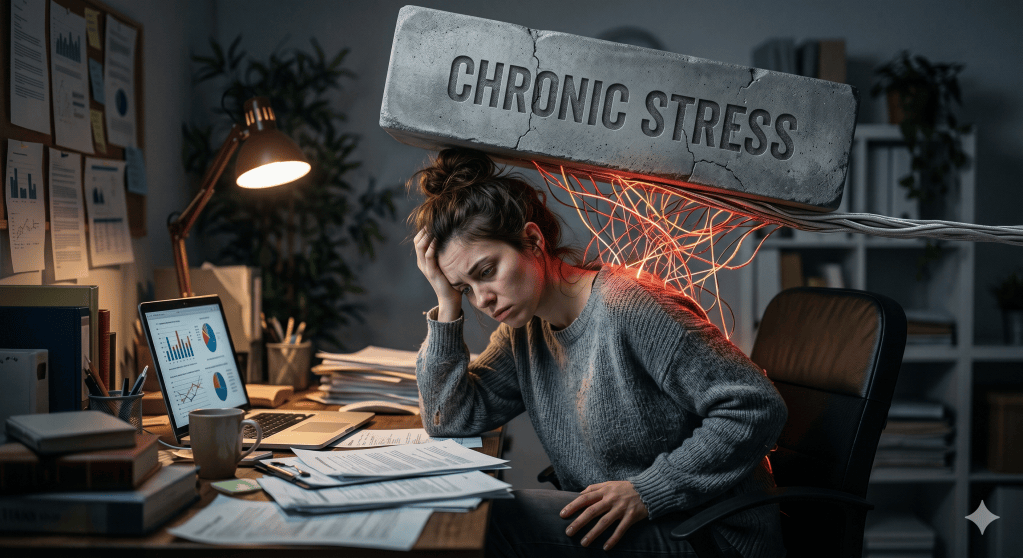
How prolonged pandemic-era stress dulled emotional life — and what neuroscience reveals about chronic stress, allostatic load, and nervous system recovery.
By the time the worst of the pandemic emergency had passed, a strange thing had happened to a lot of people. They weren’t in crisis anymore, not exactly. The acute fear of the early lockdowns had faded, the news cycle had moved on to other catastrophes, and daily life had mostly resumed its old shape. But something underneath had changed. People described feeling muted, like they were watching their own lives through glass. Joy didn’t quite land the way it used to. Neither did sadness, really. Friends who had once been easy to excite or easy to anger seemed to have settled into a kind of low, gray hum. Ask someone how they were doing in 2022 and you’d often hear some version of “fine, just tired” — not the tiredness of a bad night’s sleep, but something more structural.
This essay is about that phenomenon, which researchers and clinicians have come to associate with chronic stress and what is sometimes called nervous system flattening — a blunting of emotional range and physiological responsiveness that can follow prolonged, unresolved stress. It is not a formal diagnosis. You won’t find it in the Diagnostic and Statistical Manual of Mental Disorders. But it describes something real that shows up across psychology, neuroscience, and the lived experience of millions of people who went through several years of sustained uncertainty: a pandemic, economic instability, social isolation, political volatility, and an always-on digital environment that rarely let anyone’s stress response fully stand down.
The years since have offered distance and considerably more research. This piece traces what that research reveals: the climate that produced nervous system flattening, the biology that explains it, and what it suggests about how human beings adapt — for better and worse — to a world that rarely lets them rest.
The Atmosphere That Produced It
A Sustained, Ambiguous Threat
Most of what humans know about stress comes from research on acute threats: a car nearly hitting you, a public speech, a sudden loss. These events activate the body’s stress response quickly and, ideally, release it just as quickly once the danger passes. The pandemic era was different in a way that mattered enormously for the nervous system. It wasn’t one threat. It was a long, ambiguous, slow-moving one, with no clear endpoint and frequently changing information. Should you wipe down groceries? Was it safe to see your parents? Would your job still exist in six months? The threat was real, but it was also diffuse, which made it almost impossible for the body to fully resolve.
This mattered because the human stress response evolved to handle short bursts of danger followed by recovery, not years of low-grade, unresolved alarm. Think of someone who narrowly avoids a car accident: the heart pounds, the hands shake, and then — within minutes — the body begins to settle. The threat is over; the system discharges and returns toward baseline. Humans living through 2020 to 2022, and the uneven recovery years that followed, rarely got that discharge. The threat kept renewing itself in new forms: a new variant, a layoff announcement, a contentious election, inflation eating into savings. There was rarely a clean “all clear.”
Isolation as a Compounding Factor
Social isolation compounded the biological strain. Human beings are an intensely social species, and a great deal of stress regulation actually happens between people rather than within a single nervous system. A reassuring conversation, a hug, simply being in the physical presence of someone trustworthy — these all help calm the body’s threat-detection systems. During extended lockdowns and the social withdrawal that followed even after restrictions eased, that co-regulation became harder to access. People were managing dread largely alone, often through screens, which is a poor substitute for in-person contact when it comes to calming a nervous system.
The Role of Digital Saturation
The digital environment didn’t just reflect the stress of this period — it shaped how that stress was delivered. Smartphones and social media had already been reshaping attention and mood for over a decade, but the pandemic accelerated dependence on screens for work, socializing, and information simultaneously. This mattered in a specific way: emotionally salient threats encountered through screens can activate many of the same stress-response systems as threats encountered offline. A headline about rising case counts, an argument unfolding in a comment thread, a friend’s anxious post at midnight — each could trigger a low-grade stress response, and because the phone was always present, those micro-activations accumulated across the day in a way that had no real precedent in human experience.
This created a feedback loop: people were anxious, so they checked the news; the news was often distressing, so anxiety increased; increased anxiety prompted more checking. Researchers and journalists began using the term “doomscrolling” to describe this pattern. The term is informal, but what it points to is real: a behavior that kept the nervous system in a state of low-level vigilance for hours at a time, well past the point of gathering useful information. Attention researchers have noted that the algorithmic design of most major platforms optimizes for engagement, and that threat-related content — conflict, outrage, danger — is particularly effective at capturing and holding attention. This meant the digital environment was not a neutral pipe through which stress happened to flow; it was a system with structural incentives to keep delivering stress-inducing content to people whose nervous systems were already overloaded.
There is also a subtler effect worth naming. Heavy screen use during this period often substituted for the kinds of in-person social contact that help regulate the nervous system — not because people preferred it, but because it was what was available. The result was a double bind: people turned to digital connection for relief from stress, while the platforms providing that connection were simultaneously amplifying it.
Taken together, these conditions — an ambiguous and prolonged threat, reduced access to in-person co-regulation, and a digital environment structurally incentivized to keep delivering alarming content — created a kind of chronic stress that was historically unusual not in its intensity but in its duration and diffuseness.
What Chronic Stress Does to the Body
The Stress Response, Briefly
To understand flattening, it helps to understand what the stress response is actually doing. When the brain perceives a threat, a chain of signals runs from the amygdala (a region involved in detecting danger) to the hypothalamus, which signals the pituitary gland, which signals the adrenal glands to release cortisol and adrenaline. This is often called the HPA axis — short for hypothalamic-pituitary-adrenal axis — and it is the body’s primary system for mobilizing energy and attention in response to a threat. In short bursts, this system is adaptive. It sharpens focus, increases heart rate, and prepares the body to act.
The problem is what happens when this system doesn’t get to switch off. Neuroendocrinologist Bruce McEwen, whose work shaped much of the modern understanding of stress, described the cumulative wear this produces as “allostatic load” — the physiological cost of repeatedly activating stress systems, or of activating them and never fully deactivating them. Allostatic load isn’t a single hormone or a single symptom; it’s a cumulative strain across multiple systems, including the cardiovascular system, the immune system, and the brain itself. Over time, this strain has been associated with changes in brain regions involved in memory, decision-making, and emotional regulation, including the hippocampus and prefrontal cortex.
Why the Body Eventually Dials Itself Down
Here is where the science connects most directly to the lived experience of flattening. A nervous system asked to stay on high alert for months or years cannot sustain that intensity indefinitely. One of the body’s responses to unrelenting stress is to downregulate — reducing its own sensitivity and reactivity as a protective measure. This happens at the level of hormone regulation, receptor sensitivity, and neural circuitry, not as a conscious decision but as an automatic adjustment to an unsustainable load.
This is consistent with research on chronic stress and reward processing. Studies in both animal models and humans have linked prolonged stress exposure to changes in the brain’s dopamine systems, which play a central role in motivation and the anticipation of pleasure. When these systems are chronically taxed, people can experience anhedonia — a reduced capacity to feel pleasure or interest in previously enjoyable activities. This is a well-documented feature of depression, but researchers have also observed milder, subclinical versions of it in people under sustained stress who do not meet criteria for a depressive disorder. They aren’t depressed in the clinical sense. They’re just… less responsive. Less moved. Their emotional bandwidth has narrowed.
It’s worth being precise here about what is established and what is more speculative. The link between chronic stress, allostatic load, and changes in mood and reward circuitry is well supported by decades of research. The idea of “nervous system flattening” as a specific, named phenomenon is more of a useful descriptive concept than a settled clinical category — it’s a way of naming a cluster of related findings (blunted emotional reactivity, reduced motivation, a narrowed window of felt experience) rather than a single, separately validated condition. Readers should hold it as an organizing idea, not a diagnosis.
The Window of Tolerance
A related and widely used concept in trauma-informed psychology is the “window of tolerance,” a term introduced by psychiatrist Daniel Siegel to describe the zone of arousal in which a person can think clearly, feel their emotions, and respond flexibly to what’s happening around them. Outside that window, a person tends to move into either hyperarousal (anxiety, panic, irritability) or hypoarousal (numbness, fatigue, disconnection). Under chronic stress, that window can narrow. Things that once felt manageable start to tip a person into one extreme or the other, and the comfortable middle ground — where most of life’s actual texture and feeling reside — shrinks.
This maps well onto what many people described during and after the pandemic years: not constant panic, and not complete shutdown, but a narrowed range in which everything felt slightly more effortful, slightly less vivid, and harder to feel deeply about.
How This Showed Up in Daily Life
The “Fine, Just Tired” Phenomenon
One of the more telling cultural artifacts of this period was the sheer frequency with which people described themselves as fine but tired — not sick, not in crisis, just worn down in a way they struggled to name. Mental health professionals reported a noticeable rise in clients who didn’t fit neatly into existing diagnostic categories. They weren’t presenting with classic depression or anxiety disorders in every case; many were describing something closer to emotional flatness, difficulty concentrating, and a sense that their motivation had quietly drained away without a dramatic trigger.
This is consistent with the broader concept of burnout, which the World Health Organization has classified as an occupational phenomenon characterized by exhaustion, cynicism or detachment, and reduced professional efficacy. Burnout research, much of it building on the work of psychologist Christina Maslach, has long emphasized that prolonged, unresolved stress — particularly stress without a sense of control or meaningful recovery — produces exactly this kind of blunted, depleted state. What changed during and after the pandemic era was the scale: burnout-like symptoms appeared not just among overworked professionals in high-stress fields, but across much of the general population, including people whose daily routines hadn’t obviously intensified.
Changes in Social and Emotional Expression
Sociologists and communication researchers also noted shifts in how people related to one another. Casual social contact — the kind that happens in hallways, waiting rooms, and shared physical spaces — declined and, for many, never fully returned to its previous frequency. This mattered because casual social contact, even brief and seemingly unimportant, plays a meaningful role in emotional regulation and a sense of belonging. Its reduction left many people more reliant on a small number of close relationships to do work that had previously been distributed across a wider social network, adding strain to those relationships while also narrowing the emotional input people received from the world.
Research on social participation from this period points to a related pattern: membership and active involvement in community organizations — religious groups, civic associations, recreational leagues, volunteer networks — declined during the pandemic and recovered unevenly. Sociologists had been tracking a long-term erosion of these “weak tie” networks for years before 2020, but the disruption accelerated it. Weak ties matter for emotional well-being in ways that are easy to underestimate: they provide low-stakes social contact, a sense of belonging to something larger than one’s immediate circle, and a kind of ambient social density that stronger relationships can’t fully replicate. Their further erosion during this period meant that many people’s social worlds contracted not just in frequency of contact but in structural diversity — leaving them with deeper but narrower relational lives than before.
Recovery, Adaptation, and What the Years Since Have Shown
The Nervous System Is Not Fixed
If there is a hopeful thread running through this research, it is that the nervous system’s downregulation under chronic stress is not a permanent rewiring. The same plasticity that allows the brain to adapt to prolonged stress by dampening its responses also allows it to recalibrate when conditions change. This is consistent with research on stress recovery showing that restored social connection, predictable routines, physical activity, and adequate sleep are among the most reliable contributors to nervous system regulation returning toward baseline. None of these are quick fixes, and none of them work instantly, but they form a fairly consistent picture across the research literature of what actually helps.
Clinically, there has also been a shift in how mental health professionals approach this kind of flattened, depleted presentation. Rather than treating it solely as a symptom to medicate away, many practitioners — drawing on frameworks like the window of tolerance and somatic (body-based) approaches to therapy — have focused on gradually widening a client’s capacity to tolerate and feel a fuller range of emotion, rather than aiming directly at mood elevation. This reflects a broader, ongoing evolution in trauma-informed care that predates the pandemic but gained considerable traction as clinicians encountered more clients with this particular profile.
A Longer Lens
Looking back from several years’ distance, it’s also become clearer that what happened during the pandemic era was an unusually visible, population-scale example of a dynamic that has always existed in smaller pockets: prolonged, unresolved stress producing emotional blunting in caregivers, soldiers, refugees, and people in chronically high-stress occupations. What made 2020 through roughly 2023 distinctive wasn’t a new phenomenon so much as its scale and simultaneity — a huge number of people experiencing a milder version of a pattern that had previously been studied mostly in smaller, more extreme populations.
This has had a useful, if unintended, effect on the broader field. It pushed researchers and clinicians to take “ambient” or “diffuse” chronic stress — as opposed to single, identifiable traumatic events — more seriously as a subject of study in its own right, rather than as a secondary contributor to more clearly defined conditions like PTSD or major depressive disorder. Several research groups have since turned attention toward better characterizing this in-between territory: stress that is real, cumulative, and impairing, but that doesn’t fit neatly into existing diagnostic boxes.
Conclusion
The flattened, muted quality that so many people noticed in themselves and others during and after the pandemic years was not imagined, and it was not simply a matter of individual resilience or willpower. It reflected a real, well-documented biological response to a historically unusual kind of stress: prolonged, ambiguous, socially isolating, and amplified by a digital environment that rarely allowed the body’s alarm systems to fully stand down. The science of allostatic load, the window of tolerance, and stress-related changes in reward processing all point toward the same underlying story — that nervous systems asked to stay vigilant for too long will eventually protect themselves by dialing down, and that this dialing down is felt, subjectively, as a kind of emotional dimming.
The broader significance of this period extends beyond the pandemic itself. It offered an unusually large, unusually visible natural experiment in what happens to human emotional life under sustained ambient stress, and it has reshaped how researchers and clinicians think about stress that doesn’t arrive as a single dramatic event. As of 2026, that shift continues to influence how mental health care approaches depletion and numbness — less as a problem to be immediately fixed, and more as a signal of a nervous system that adapted reasonably well to genuinely difficult conditions, and that can, with the right conditions, adapt back.









