
Originally published in June 2022 and comprehensively updated and edited in June 2026.
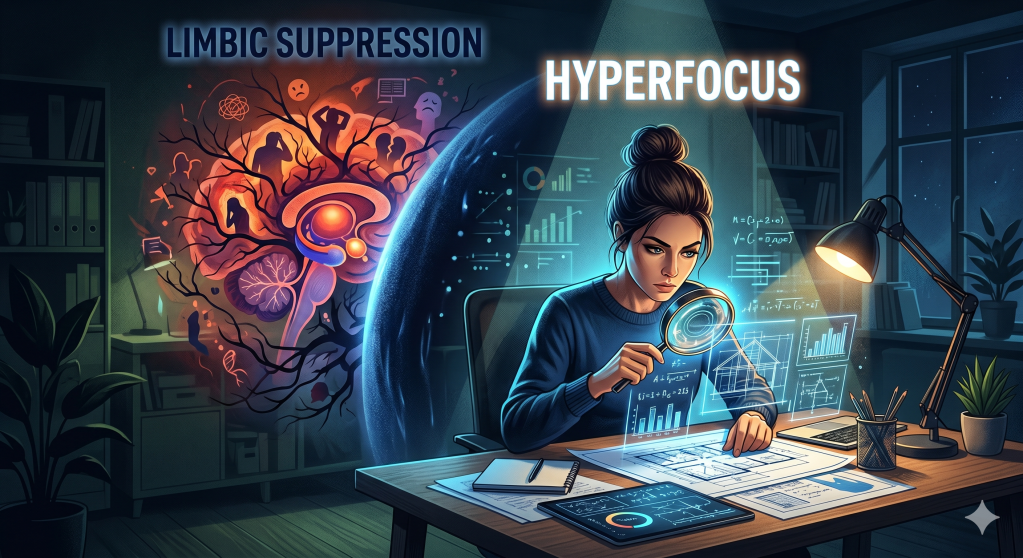
What is hyperfocus and why does it happen? How dopamine, salience, and the ADHD brain’s reward system drive intense concentration — and what neuroscience actually knows.
There is a particular kind of concentration that most people have experienced at least once — a stretch of time when hours vanished, when the room around you dissolved, when the task in front of you felt less like work and more like a current pulling you forward. Programmers who look up from a problem to find it’s 2 a.m. Musicians who play the same passage forty times without registering fatigue. Gamers who lose entire afternoons to a single session. Writers who finish a draft and realize they haven’t eaten since morning.
This is hyperfocus. And for a long time, science didn’t quite know what to make of it.
The term sounds self-explanatory — very intense focus — but that casual definition misses something important. Hyperfocus isn’t simply “paying close attention.” It represents a qualitatively different cognitive state, one in which peripheral awareness narrows dramatically, time perception warps, and the normal mechanisms that interrupt attention and redirect it elsewhere appear to go partially offline. Understanding why that happens requires going into the architecture of the brain itself — specifically, how the brain decides what is worth paying attention to in the first place.
What makes this topic genuinely interesting isn’t just the neuroscience, though that’s compelling on its own. It’s what hyperfocus reveals about attention, motivation, and the complicated relationship between the brain’s emotional machinery and its capacity to focus. It also says something broader about how society has come to understand certain cognitive styles — particularly ADHD — in ways that challenge the older, deficit-centered frameworks that dominated clinical thinking for decades.
What Hyperfocus Actually Is (And Isn’t)
Before getting into the brain mechanisms, it helps to establish what hyperfocus actually describes, because the concept has been used loosely in both clinical and popular discourse.
In a 2021 paper published in Psychological Research, researchers Brandon Ashinoff and Ahmad Abu-Akel offered one of the more rigorous attempts to define the term. They described hyperfocus as a phenomenon reflecting complete absorption in a task, to a point where a person appears to entirely ignore or “tune out” everything else. Crucially, they noted that hyperfocus, though ostensibly self-explanatory, is poorly defined within the literature, and in many cases goes undefined — relying on the assumption that the reader inherently knows what it entails. Their paper argued that the phenomenon deserved far more scientific investigation than it had received.
That gap is telling. For most of the 20th century, research on attention focused heavily on its failures — distractibility, mind-wandering, inattention. The idea that the same brains most susceptible to those failures might also be capable of extraordinary concentration wasn’t a popular research question. The attention disorders literature was built around deficits, not paradoxes. Hyperfocus was the paradox that researchers kept setting aside.
It also shouldn’t be confused with “flow,” the state of effortless engagement popularized by psychologist Mihaly Csikszentmihalyi in the 1990s. Hyperfocus and flow are both experiences of intense concentration associated with reduced perception of irrelevant stimuli and improved task performance, but they differ in meaningful ways. Flow tends to occur when a task is optimally challenging — neither too easy nor too hard — and carries a sense of mastery and forward momentum. Hyperfocus is less selective. It can attach to tasks regardless of their productive value, including ones that are repetitive, trivial, or even harmful. A person in flow is typically performing well; a person in hyperfocus might be hyperfocused on something they’ve been avoiding for weeks. The brain’s reward system, not the quality of the activity, tends to be the deciding factor.
The Limbic System and the Brain’s Priority Engine
To understand why hyperfocus happens, you need a basic map of the relevant brain territory.
The limbic system is a collection of interconnected structures that sit roughly in the middle of the brain, wrapped around the upper brainstem. The components most relevant here include the amygdala, which processes emotional salience; the hippocampus, involved in memory and context; the nucleus accumbens, which sits at the heart of the brain’s reward circuitry; and the ventral tegmental area (VTA), which produces and distributes dopamine throughout the system. These regions don’t operate in isolation — they communicate constantly with the prefrontal cortex, the large region at the front of the brain responsible for planning, impulse control, and what neuroscientists call executive function.
The key concept is salience. The limbic system is, among other things, a priority engine. It is constantly tagging incoming information — this matters, this doesn’t; move toward this, avoid that; pay attention here, ignore that — and dopamine is the chemical messenger it uses to signal importance. When the limbic system fires a strong dopamine signal toward the prefrontal cortex, it is essentially saying: whatever you’re currently doing, keep doing it. This is worth your attention.
Dopamine mediates what researchers call “wanting” — the incentive salience that motivates approach behavior — through mesocorticolimbic dopamine systems, and deficits in this system contribute to problems with motivation seen in depression and related conditions. In a healthy attention cycle, these dopamine signals help guide focus without overwhelming it. The prefrontal cortex can still override limbic signals when necessary — it’s what allows you to do your taxes even though they’re boring, or stop playing a video game when you’ve already been at it for three hours.
In hyperfocus, something in that balance shifts. To understand how, it helps to look more closely at dopamine — the neurotransmitter doing most of the signaling.
Dopamine, Salience, and the Architecture of Engagement
Dopamine’s role in attention is sometimes described in popular writing as simply “the pleasure chemical,” which misrepresents it. Dopamine is better understood as the neurotransmitter of incentive salience — not pleasure itself, but the anticipation of reward and the motivation to pursue it. It’s what makes you want to keep reading when a book is gripping. It’s what makes a chess problem feel urgent. It’s the chemical version of “this matters, keep going.”
This distinction matters for understanding hyperfocus. The limbic system doesn’t generate hyperfocus by making something feel pleasurable — it generates it by flagging something as worthy of sustained attention. When the salience signal is strong enough, the whole attentional system reorganizes around it.
During a hyperfocus episode, the reward circuitry appears to remain unusually engaged throughout, in contrast to ordinary focused attention, where motivational signals tend to ebb and flow. The task continues to register as salient, engagement keeps reinforcing itself, and the competing signals that would normally interrupt — fatigue, boredom, awareness of time — don’t break through. It’s worth noting that the precise dopamine dynamics during naturally occurring hyperfocus in humans haven’t been directly measured; what researchers are working from is inference from related findings about reward circuitry, ADHD neuropharmacology, and attention regulation. The model is plausible and well-supported by adjacent evidence, but it remains a model.
This unusually stable motivational state has real consequences for how people experience hyperfocus. Many people who hyperfocus describe it not merely as concentration but as something closer to compulsion. The task doesn’t feel like a choice — it feels like where the brain needs to be. Exiting the state, particularly when it’s externally interrupted by someone else, can produce a jarring, even distressing transition: disorientation, irritability, a kind of cognitive whiplash from being pulled out of a state of deep neural commitment.
When the Background Chatter Goes Quiet
Here is where another piece of the puzzle comes in.
Your brain has a network sometimes called the default mode network (DMN) — a set of regions that activates when you’re at rest, daydreaming, mind-wandering, or thinking about yourself and others. Think of it as the brain’s background chatter. When you’re engaged in a demanding task, the DMN is normally suppressed. The attentional system takes over, quiets the internal noise, and allows focused processing to occur. Task-on, DMN-off. This is a normal, healthy switching process.
In ADHD, there is often a failure to adequately suppress activity in the default mode network during task-focused activities, and this lack of suppression may contribute to inattentiveness and difficulties in sustaining attention. This is one reason people with ADHD experience mind-wandering so frequently — the background chatter doesn’t quiet down properly when they try to concentrate.
Researchers suspect that hyperfocus may involve the opposite problem: unusually deep suppression of that same background activity, driven by the intensity of the salience signal. When the dopaminergic reward system is sufficiently engaged, the theory goes, the DMN doesn’t just quiet down — it gets pushed out of the picture almost entirely, which is why external cues like hunger, the passage of time, and other people’s voices barely register. Direct evidence for this in real-world hyperfocus episodes is limited, since it’s difficult to study the phenomenon under natural conditions in a brain scanner. What supports the idea, more broadly, is the well-established finding that motivational engagement and DMN suppression are tightly coupled — the stronger the first, the deeper the second tends to go.
In other words, the same brain that struggles to suppress its own default mode during ordinary tasks can, under the right conditions, suppress it so thoroughly that the outside world effectively recedes. The brain hasn’t lost its suppression capacity. It’s found a trigger powerful enough to deploy it.
That trigger is almost always motivational. High interest, urgency, novelty, competitive stimulation, creative engagement, or emotional stakes can all provide it. This is why hyperfocus attaches so reliably to things a person finds inherently compelling rather than things they’re simply supposed to do.
The ADHD Paradox
The hyperfocus phenomenon creates what looks, on the surface, like a contradiction. ADHD is defined substantially by attention difficulties — difficulty sustaining focus, following through on tasks, filtering distractions. Yet many people with ADHD report hyperfocus experiences that dwarf what most neurotypical people can achieve. Hours of unbroken concentration. Complete absorption. Extraordinary output, in the right conditions.
This isn’t a contradiction when you understand the underlying mechanism. ADHD doesn’t reflect a uniform deficit of attention capacity. It reflects a dysregulation of how attention is allocated — and in particular, a dependence on motivational salience to engage the focus system in the first place. In the ADHD brain, dopamine acts like a bouncer at the door of attention: genuinely interesting or urgent things get in, but boring-but-necessary things struggle to get through because the prefrontal cortex can’t easily override the limbic system’s indifference to them.
When something fires a strong enough salience signal — because it’s genuinely interesting, new, urgent, or emotionally charged — the same system that routinely fails on low-salience tasks can lock in with striking intensity. The attentional machinery isn’t broken; it’s been handed a reason to work.
Hyperfocus has also been described as disrupting attention control in ways that aren’t always productive — in some contexts, it allows individuals to focus so intensely on internet use that the behavior escalates into addictive patterns. This darker side of hyperfocus is worth acknowledging. The same mechanism that allows a programmer to solve a complex problem in a single long session can just as easily trap someone in a six-hour social media loop. The brain doesn’t distinguish between “productive” and “unproductive” when calibrating its salience signals — it responds to interest and reward, not value.
The Limbic-Prefrontal Tension
To understand hyperfocus more deeply, it helps to think about the relationship between the limbic system and the prefrontal cortex not as a hierarchy but as a negotiation.
The prefrontal cortex is often described as the brain’s executive — the seat of rational planning, long-term thinking, and top-down control over impulses and distractions. This framing is broadly accurate, but it can give the misleading impression that the prefrontal cortex is always in charge, with the limbic system playing the role of unruly subordinate. The actual relationship is more bidirectional than that. Limbic signals regularly override prefrontal intentions, particularly when emotional salience is high. Fear, desire, novelty, and social threat can all redirect attention even when the prefrontal cortex has other plans. This is not a design flaw — it’s what allows urgent situations to get prioritized over mundane ones.
What varies between individuals, and across different cognitive profiles, is how readily this balance tips in one direction or the other.
Research using resting-state fMRI has found that in adults with ADHD, regions that are negatively correlated with the default mode network in healthy controls show positive correlations instead — indicating that the default mode network is hyperconnected in ADHD rather than properly suppressed during task engagement. This provides one possible explanation for both the inattention and the hyperfocus. When the limbic system isn’t providing a strong enough salience signal, the DMN stays active and the mind wanders. When it provides an overwhelming signal — as in hyperfocus — the DMN is pushed aside, the prefrontal cortex lines up behind the limbic priority, and attention locks in completely.
This is why so many attempts to manage ADHD through willpower or discipline run into walls. Telling someone to “just focus” on a low-salience task is, neurologically speaking, asking the prefrontal cortex to hold back the tide without the motivational resources to do so. The brain isn’t being stubborn. It’s operating exactly as designed — it just requires a different kind of fuel.
This is also why hyperfocus episodes can result in neglect of basic needs. Hunger, thirst, and fatigue are signals that compete with the focused task for attentional resources. When the limbic salience of the task is high enough, those competing signals get deprioritized — sometimes severely. The brain, in effect, has decided what matters most right now, and biological housekeeping isn’t it.
Social and Clinical Implications
Understanding hyperfocus as a neurological phenomenon rather than a personality quirk or a matter of discipline has significant implications — for how ADHD is diagnosed and treated, for how educational environments are designed, and for how people understand their own minds.
For most of the 20th century, ADHD was framed almost entirely in terms of deficits. The condition was characterized by what the person couldn’t do: couldn’t sit still, couldn’t pay attention, couldn’t follow instructions, couldn’t complete tasks. This framing shaped treatment approaches, educational policies, and cultural attitudes. The child who couldn’t do worksheets but could spend three hours building a model airplane was seen as willfully inattentive — choosing to indulge rather than comply.
The neuroscience of hyperfocus reframes this picture considerably. It suggests that the same brain wiring that makes sustained engagement difficult on low-salience tasks enables extraordinary engagement on high-salience ones — not as a compensatory workaround, but as a product of the same underlying mechanism. The ADHD brain isn’t failing to pay attention broadly; it’s allocating attention according to motivational salience, placing greater weight on interest, urgency, novelty, and reward than on external expectations alone.
This doesn’t make ADHD easy to live with. The mismatch between how ADHD brains allocate attention and what institutional life — school, standardized work schedules, routine administrative tasks — tends to require is real and consequential. But it does complicate the purely deficit-based narrative, and it opens questions about how environments might be designed to work with rather than against the attentional profiles of the people in them.
There’s also a growing body of research connecting hyperfocus to technology use in ways that deserve attention. Hyperfocus is a common but often overlooked symptom in those with ADHD, and research has found associations between hyperfocus tendency and internet addiction — the suggestion being that hyperfocus allows individuals to focus intensely on internet use in ways that can escalate to excessive and compulsive behavior. The design of digital platforms — variable reward schedules, infinite scroll, social feedback loops — maps almost perfectly onto the neurological conditions that trigger and sustain hyperfocus. This is not a coincidence. The attention economy has, in some respects, been engineered to exploit the very mechanisms that generate hyperfocus, in everyone, not just in people with ADHD.
Between Asset and Liability
Hyperfocus sits at an unusual intersection in the map of human cognition. It can be an extraordinary asset — a capacity for sustained, intensive engagement that produces genuine creative and intellectual output. It can also be a liability — a mechanism that gets captured by the wrong targets, generates neglect of responsibilities, and proves nearly impossible to redirect through ordinary means once engaged.
What determines which it is, in any given instance, is largely a matter of what the brain has decided is salient. And that determination is made below the level of conscious intention, in the limbic circuitry that assigns motivational weight to the contents of experience.
The practical implication is counterintuitive. Managing hyperfocus — both harnessing its productive potential and protecting against its disruptive effects — isn’t primarily about willpower or discipline. It’s about understanding the conditions that trigger it and the conditions that redirect it. People who work effectively with their hyperfocus tend to have learned, through trial and error, how to construct environments that align high-salience tasks with priority goals. They use deadlines, accountability structures, interest-based engagement, and sometimes pharmacological support to give their limbic system the signal it needs to direct attention where they want it.
This also points toward why stimulant medications work in ADHD. Drugs like methylphenidate and amphetamines increase dopamine and norepinephrine availability in the prefrontal cortex. They don’t eliminate the motivational sensitivity of the ADHD brain — they raise the baseline availability of the neurotransmitters that allow the prefrontal cortex to sustain attention even on tasks that don’t naturally generate strong limbic salience. The medication helps the system hold focus without requiring an extraordinary motivational trigger to do so.
What This Tells Us About Attention More Broadly
It would be a mistake to treat hyperfocus as a phenomenon relevant only to clinical populations. While its most pronounced expressions occur in ADHD and autism, the underlying mechanics — limbic salience driving attentional allocation, default mode activity varying with engagement level, reward circuitry sustaining focus — are features of every human brain.
Most people have experienced something close to hyperfocus when deeply engrossed in a task they find genuinely compelling. The difference between typical deep engagement and clinical hyperfocus tends to be one of degree and of control — how easily the state is entered, how deeply peripheral awareness is suppressed, and how much agency the person retains in exiting the state.
This suggests that attention is more motivationally governed than the standard educational and professional frameworks tend to acknowledge. The assumption that attention is largely a matter of will — that people can focus when they choose to and should be held accountable when they don’t — misses the degree to which limbic salience shapes the entire landscape of what the mind is willing to engage. Interest isn’t a luxury. It’s a neurological input.
Looking Forward
The study of hyperfocus is still, by the standards of cognitive neuroscience, relatively young. The neuroimaging tools to examine real-time brain dynamics during hyperfocus episodes in natural settings are relatively new. Most of what’s known comes from studies of resting-state brain connectivity or from laboratory tasks that, by their design, can’t fully replicate the conditions under which hyperfocus actually occurs.
What has emerged is a clearer picture of the neural architecture involved — the limbic-prefrontal axis, the default mode network’s role as both obstacle and background noise, the dopaminergic reward system as the gate mechanism for attentional commitment. And with that clearer picture comes a more nuanced understanding of conditions like ADHD, one that holds both the genuine difficulties and the genuine capacities in view simultaneously.
Attention is not a uniform resource, evenly available and simply a matter of direction. It is an emergent property of how the brain has tagged the contents of experience with motivational meaning. Hyperfocus is what happens when that tagging process becomes absolute. And the limbic system — the part of the brain we once thought of primarily as the seat of emotion — turns out to be a central architect of what we pay attention to, and how completely.
That’s not a flaw in the design. It’s the design.









