
How overstimulation, chronic stress, social disconnection, and eroded agency changed the texture of emotional life
Originally published in August 2022 and comprehensively updated and edited in June 2026.
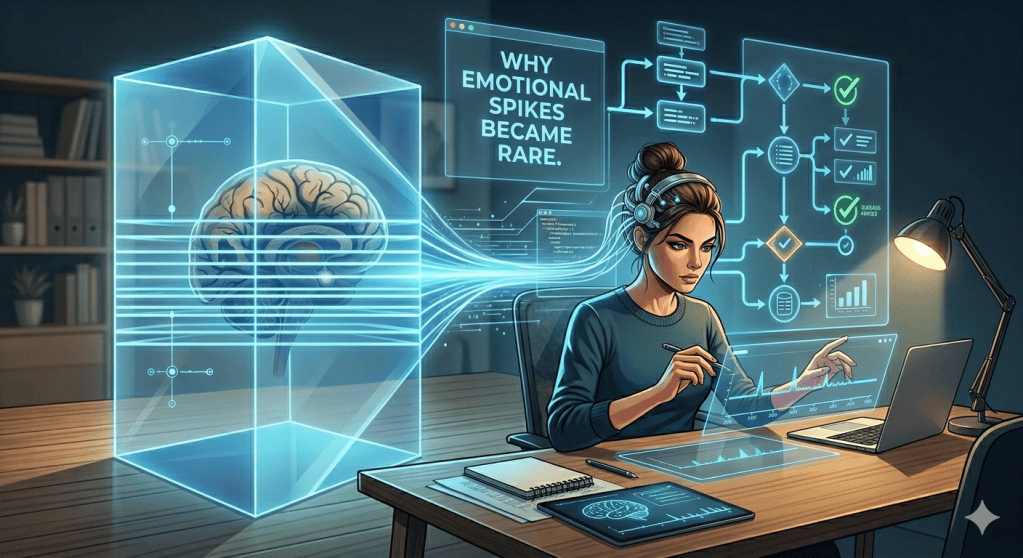
How overstimulation, chronic stress, social disconnection, and eroded agency reshaped emotional intensity — and why so many people report feeling less than they used to.
There was a time when major news arrived intermittently. A death, a political event, a natural disaster reached people through a newspaper, a radio broadcast, or a neighbor’s account — and then there was silence in which to absorb it. Now it arrives continuously, stacked and scrolling, each item competing for the same finite store of emotional attention. The stone still gets thrown. The water barely moves.
This is not a complaint. It is an observation worth stating carefully. It is impossible to know whether emotional intensity has literally declined across entire populations. What researchers can observe is that growing numbers of people describe their emotional lives in those terms: fewer surprises, fewer moments of awe, fewer emotional peaks and valleys. Psychologists and clinicians are documenting rising rates of reported numbness, emotional exhaustion, and blunted affect. Therapists describe this as among the most consistent presenting complaints of the past several years.
The goal of this essay is not to declare that humanity has gone emotionally flat. It is to examine why so many people feel that way — and to take that feeling seriously as a social and psychological phenomenon worth understanding.
Emotional flattening, wherever it appears, seems to emerge from at least four overlapping processes: overstimulation, chronic stress, social disconnection, and a gradual erosion of personal agency. None of these operates independently. They interact, amplify each other, and in combination produce something that no single mechanism could explain on its own. What follows is an attempt to trace those four threads — and to show how, woven together, they changed the texture of emotional life for a significant portion of the population.
The Overstimulation Hypothesis
Emotions are signals. Fear alerts you to danger. Joy reinforces behaviors worth repeating. Grief processes loss and strengthens social bonds. These are not decorative features of the human mind — they are functional systems that evolved to drive behavior in response to meaningful events.
The key word is meaningful. The brain tags incoming information according to its apparent importance, activating stress-response systems when something novel or threatening appears, and encoding those moments more deeply in memory. This is why you remember exactly where you were when you heard genuinely shocking news, but cannot recall what you read on your phone twelve minutes ago. The system was calibrated for a world in which emotionally significant events were relatively rare — a predator, a flood, a death in the tribe.
Contemporary information environments operate on the opposite principle. Social media platforms, news aggregators, and content algorithms have been engineered to generate exactly the kind of material that triggers an emotional response: outrage, fear, moral conflict, social comparison, unexpected reversals. The goal of these systems is engagement, and the most reliable path to engagement runs directly through the brain’s emotional circuitry.
Consider what a routine morning now looks like. A person can read about a wildfire, scroll past a war update, watch a celebrity scandal unfold, answer work messages, and see a friend’s vacation photos — all within five minutes. The nervous system receives each of these as a potentially significant signal, but has no time to fully process any of them before the next one arrives. The result is not deeper engagement but a kind of triage, in which the emotional system learns, gradually, to dial down its responses to a stream of input it cannot meaningfully absorb.
Neuroscientists call the underlying process habituation — the tendency of neural responses to diminish when a stimulus is repeated without meaningful consequence. It is one of the most fundamental mechanisms in nervous system biology. A smell that was overwhelming when you first entered a room becomes undetectable after a few minutes. The emotional spikes that used to mark genuinely extraordinary events tend to shrink when the nervous system is processing a continuous stream of material designed to produce them.
The Numbing Effect of Constant News
Research published in the years following the COVID-19 pandemic began formalizing what many people had already noticed about themselves. Surveys studying media consumption found that substantial numbers of respondents described feeling emotionally detached from news events that, by any historical standard, should have been deeply affecting. Climate disasters, political upheavals, violent conflicts — events that would have dominated conversation for weeks or months in earlier eras were being processed, reacted to briefly, and replaced by the next cycle within hours.
This was not simply a matter of people caring less. Qualitative research suggested many people cared a great deal, at least in the abstract. The issue was that sustained emotional engagement had become physiologically difficult to maintain at the pace the information environment demanded. Psychologists describe this state using terms like compassion fatigue and psychic numbing — both of which refer to the diminishing emotional return that occurs when the nervous system has been repeatedly asked to respond to loss or suffering at a scale it cannot meaningfully process.
Paul Slovic, a decision psychologist at the University of Oregon, has spent decades studying a related phenomenon: the collapse of empathic response as the scale of suffering increases. His research demonstrated that people respond more powerfully to the suffering of a single identified individual than to statistics involving thousands or millions. The brain does not scale its emotional responses linearly with numbers. What Slovic’s work suggested, and what subsequent researchers built on, was that human emotional systems appear optimized for the personal and proximate — and that exposure to suffering at an industrial scale tends to trigger protective desensitization rather than proportionate empathy.
The digital information environment effectively industrialized emotional exposure. The result, playing out across many individuals simultaneously, was something that looks like a collective recalibration of baseline emotional sensitivity — though whether it is uniform, durable, or reversible remains genuinely open.
Social Exhaustion and the Pandemic Reshaping
The COVID-19 pandemic warrants its own section in any serious analysis of this topic, because it did not simply accelerate preexisting trends — it introduced new ones. And unlike the technology story, the pandemic’s psychological effects are documented with unusual clarity.
In the early weeks and months of the pandemic, emotional intensity was high and widely shared. Fear, uncertainty, grief, and an unusual sense of collective attention created conditions that many people later described as, paradoxically, among the most emotionally alive periods of their lives. This is not as contradictory as it sounds. Extreme events, when they are clearly defined and externally imposed, have a focusing effect on emotional experience. The psychologist Viktor Frankl, writing about survival in the Nazi concentration camps, observed something similar: that even under conditions of extreme suffering, people reported a sharpened sense of what mattered. Crisis clarifies.
But the pandemic did not resolve cleanly. It stretched. The emergency that was supposed to last weeks lasted months and then years. The emotional intensity of the early period could not be sustained, and the human nervous system did what it always does in the face of sustained, unresolvable stress: it adapted downward. Psychologists call this process emotional blunting — a reduction in the range and intensity of emotional responses that functions as a kind of protective mechanism when prolonged stress threatens to overwhelm coping resources.
Studies conducted during the prolonged phases of the pandemic found measurable reductions in emotional reactivity across population samples. People reported experiencing fewer moments of acute joy, as well as fewer moments of acute distress. The range narrowed. This is consistent with what researchers know about the effects of chronic stress on emotional regulation — elevated stress hormones, maintained over long periods, alter the sensitivity of emotional circuits in ways that take months or years to fully reverse.
The Social Withdrawal Factor
The isolation that accompanied pandemic-era restrictions introduced a separate mechanism. Human emotional experience is deeply social. Much of what we feel in any given moment is not a private internal event but a response to the behavior of other people — their facial expressions, tone of voice, physical proximity, and emotional states. Researchers use the term social baseline theory to describe the finding that the human nervous system appears to have evolved with the assumption of social connection built into its baseline operating state. When social contact is disrupted, the system registers a form of resource depletion, even in the absence of any specific loss.
Extended social isolation, particularly the kind that replaced face-to-face interaction with screen-mediated communication, appears to reduce both the frequency and the intensity of emotional responses. Part of this is simply the absence of the social stimuli that ordinarily trigger strong feelings. Part of it is neurochemical: sustained isolation is associated with changes in the systems that regulate positive emotional experience.
By the time pandemic restrictions lifted, many people found that their emotional range had not simply bounced back. The recalibration that had occurred during isolation persisted. Social situations that should have felt joyful sometimes felt flat. Events that should have inspired awe or excitement produced only mild interest. The clinical literature began documenting what therapists were hearing from patients: a widespread sense that the emotional bandwidth had narrowed and was slow to recover.
The Technology of Constant Stimulation
Parallel to the pandemic — and operating on a longer timeframe — digital technology was reshaping the emotional architecture of daily life in ways that are now better understood than they were even a few years ago.
The smartphone, and specifically the social media ecosystem that runs on it, created something genuinely new in human history: a device that is present at nearly every waking moment and specifically optimized to produce frequent, low-level emotional activations. Notifications, reactions, social comparisons, outrage content, and fear-based headlines are not incidental features of these platforms. Research into the design practices of major social media companies — much of it surfaced through investigative journalism and internal document disclosures starting in the late 2010s — confirmed what behavioral scientists had long suspected: the platforms were deliberately engineered to maximize emotional engagement, with negative emotional content consistently shown to outperform positive content on engagement metrics.
The consequences for emotional regulation have been significant, though researchers continue to debate the precise mechanisms involved. A growing body of evidence suggests that heavy engagement with novelty-driven digital environments changes patterns of attention, reward anticipation, and emotional responsiveness over time. What that looks like in practice is an emotional style that activates quickly in response to novel stimuli but habituates just as quickly — producing a cycle of brief intensity and rapid disengagement that begins to feel, over time, like nothing quite lands.
Emotion researchers distinguish between bottom-up emotional processing, which is driven by external stimuli, and top-down regulation, which involves conscious control over emotional responses. What heavy social media use appears to do, over time, is train users toward a reactive, stimulus-driven mode of emotional processing while undermining the capacity for sustained, reflective emotional engagement. The result is not necessarily less emotion in a raw sense, but a different texture to emotional life: shallower peaks, faster cycling, and a reduced tolerance for the slower, quieter feelings that tend to carry the most meaning.
The Cultural Symptom
These individual-level changes show up in cultural artifacts too. The ironic detachment of online communication styles, the preference for meme-based processing of serious events, the rise of what cultural critics called “vibes” as a substitute for substantive emotional engagement — these are not random aesthetic choices. They are symptoms of populations managing emotional overload through cultural means. When the intensity of direct engagement becomes uncomfortable or exhausting, people find ways to maintain distance while still participating. Irony is, among other things, a form of emotional self-protection.
Learned Futility: The Agency Problem
This is the section of the analysis that feels most underexplored in popular writing about emotional blunting — and the one that may ultimately be the most important.
Psychologist Martin Seligman’s research on learned helplessness demonstrated that when organisms are repeatedly exposed to negative events they cannot control, they eventually stop trying to respond, even when control later becomes possible. The emotional flattening that accompanies learned helplessness is not genuine equanimity. It is not the calm of someone who has made peace with uncertainty. It is a kind of shutdown — a withdrawal of the self from a situation that has been registered, through accumulated experience, as beyond influence.
The information environment of the past decade and a half has exposed people to a continuous stream of large-scale negative events — political, environmental, social, epidemiological — while simultaneously demonstrating, through the logic of those events themselves, that individual action has limited purchase on any of them. Climate change, political polarization, pandemic spread, economic inequality: these are problems at a scale that dwarfs individual agency. They are also problems that appear, repeatedly, in the media environments most people inhabit for several hours each day.
Regular, sustained exposure to evidence of one’s own powerlessness is precisely the condition that Seligman’s research — and decades of subsequent work — identifies as producing emotional withdrawal. The mechanism is not apathy in the ordinary sense. It is closer to a rational-seeming disinvestment: if I cannot affect the outcome, and caring about the outcome produces pain, why continue to invest emotionally? The logic is not conscious, but it doesn’t need to be. Habituation and emotional withdrawal operate below the level of deliberate reasoning.
The Compounding Effect
What makes this dynamic particularly significant is the way it interacts with the other mechanisms described in this essay. Overstimulation raises the threshold for emotional response. Chronic stress narrows the emotional range. Social isolation removes the relational scaffolding that amplifies and sustains feeling. And then, on top of all of that, learned futility removes one of the core motivations for emotional investment in the first place: the sense that feeling something might actually lead somewhere.
These four forces are not merely additive. They compound. A person living through sustained social isolation who is also chronically overstimulated by digital media, who is also managing the residual effects of pandemic-era stress, who also feels structurally unable to influence the large forces shaping their life — that person is encountering all four mechanisms simultaneously. The emotional flattening that results is not one thing. It is a convergence.
This compounding dynamic also explains why recovery, when it occurs, tends to be slower than the original adaptation. Removing one factor — logging off social media, reducing news consumption — changes one variable in a system that was shaped by many. Meaningful recovery tends to require changes across multiple dimensions simultaneously, which is precisely what makes it difficult to sustain.
What “Flat” Actually Feels Like
It is worth pausing here to be clear about what emotional flattening, in this context, actually describes. It is not the absence of all feeling. People who report it still experience emotions — they get angry, they laugh, they feel sad. What tends to diminish is a specific quality of emotional experience: the surprise of it, the sharpness of it, the sense that a feeling arrived from somewhere outside the self and demanded a response. What flattens is the spike.
For many people, the experience is closest to what clinicians call anhedonia — not an inability to feel pleasure exactly, but a reduction in the intensity of pleasant experience, a graying-out of what used to have color. Others describe it in terms of latency: the feeling arrives, but late, and at reduced amplitude, like a signal that has traveled too far. Still others describe a kind of observer effect — watching themselves have an emotion rather than simply having it. Clinical psychology has formal categories for all of these experiences. What is less certain is whether what people are describing in casual conversation maps precisely onto those clinical categories, or whether it is something subtler: a shift in the phenomenology of everyday emotional life that does not quite rise to the level of disorder but is nonetheless real and widespread.
What the Data Actually Shows
Before drawing any conclusions, it is worth being honest about the limits of the evidence. Much of what this essay describes is documented in research that is still relatively recent, often based on self-report measures, and complicated by the difficulty of distinguishing between true changes in emotional experience and changes in how people describe or perform emotion in social contexts.
What the evidence clearly supports: increased rates of reported emotional exhaustion and numbness in populations studied after 2020; documented reductions in emotional reactivity in samples of heavy digital media users; and epidemiological data showing elevated rates of depression and anxiety — both of which are associated with emotional blunting — across many developed nations since the mid-2010s.
What is less certain: whether the flattening of emotional responses represents a durable change or a transient adaptation that will reverse as conditions improve; whether the effects are uniform across age groups, cultures, and socioeconomic contexts; and whether what people describe as emotional numbness actually corresponds to measurable changes in neural activity or reflects a shift in how emotional experience is interpreted and communicated.
These are not minor uncertainties. They are reasons to hold the analysis lightly while still taking the underlying patterns seriously. The claim this essay makes is not that emotional intensity has objectively declined. It is that something real is happening to a meaningful number of people, that the forces producing it are identifiable, and that understanding them is worthwhile.
The Forward View
By 2026, the conversation about emotional blunting has moved from a fringe observation to something approaching mainstream recognition in both clinical psychology and public discourse. Therapists report higher rates of patients presenting with anhedonia than at any point in their careers. Researchers studying adolescent development have raised concerns about the emotional range available to young people who grew up with social media as their primary socializing environment.
A small but growing body of work in psychology and contemplative neuroscience is examining whether practices like meditation, sustained attention, and intentional digital abstinence can meaningfully reverse the adaptations that chronic overstimulation and stress have produced. The evidence on this point is cautiously encouraging. The brain retains significant plasticity across the lifespan, and the mechanisms that drove emotional flattening — habituation, threshold adaptation, stress-related blunting — can, in principle, be reversed by changing the conditions that produced them. Studies examining the effects of reduced digital media consumption on emotional reactivity consistently find improvements in emotional range and depth over periods of weeks to months. The recovery is real but not instantaneous, and it is not guaranteed by any single intervention.
There is also a possibility that cultural attitudes toward emotional life are themselves shifting. The valorization of perpetual engagement — with news, with social media, with content of every kind — that characterized the early social media era has given way, in many quarters, to something more like deliberate restraint. Practices that prioritize depth over speed, and presence over responsiveness, have gained cultural currency in ways that would have seemed almost retrogressive a decade ago.
Whether this constitutes a meaningful counter-trend or a minority adaptation is not yet clear. What is clear is that the four forces described in this essay — overstimulation, chronic stress, social disconnection, and the erosion of agency — have not disappeared. They have, in most respects, intensified. The emotional changes they have produced in many people are real, even if their precise scope and duration remain uncertain.
The emotional spikes that used to mark the texture of a human life became rarer for reasons that are traceable, documented, and, to a meaningful extent, reversible. But understanding a problem and solving it are different things. And between them lies the much harder work of choosing — deliberately, against significant structural headwinds — to feel fully again.









