
Originally published in September 2022 and comprehensively updated/edited in June 2026.
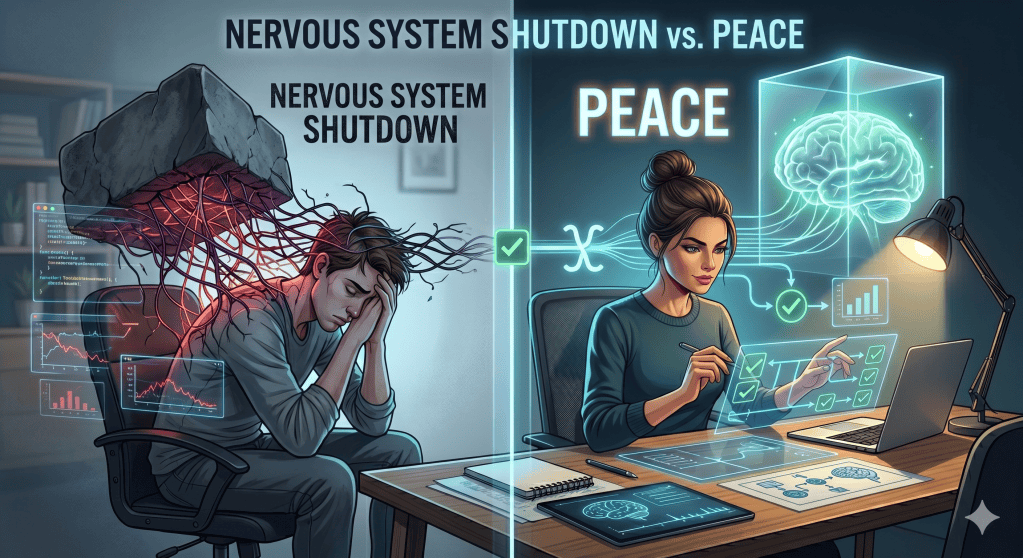
What’s the difference between nervous system shutdown and genuine peace? This article explores the neuroscience of chronic stress, dysregulation, and what psychological safety actually looks like.
There was a particular kind of exhaustion that settled over people in the early 2020s that was difficult to name. It wasn’t simply tiredness. It wasn’t depression in the clinical sense, though it shared some of its features. It was something closer to a sustained, low-grade alarm state — the feeling of being permanently braced for something without knowing exactly what. For many people, the pandemic years had not ended with a clean return to normalcy. They had ended with a kind of frayed, overstimulated nervous system that struggled to find its way back to rest.
This phenomenon — the collision between chronic stress and the human body’s most ancient survival machinery — sits at the center of a much larger question: what does it actually mean to feel at peace, and why has that feeling become so elusive for so many people? The answer reaches into neuroscience, into evolutionary biology, into the sociology of modern life, and into the psychology of how human beings process threat, loss, and uncertainty.
This article explores what happens when the nervous system gets stuck in a survival state, how that differs from genuine psychological peace, and why the distinction matters — not just for individuals, but for how we understand collective mental health in an age of relentless stimulation.
The Alarm System That Doesn’t Turn Off
To understand nervous system shutdown, it helps to understand what the nervous system is actually doing when it sounds the alarm in the first place.
The autonomic nervous system — the part of your nervous system that operates largely outside your conscious control — has two primary branches. The sympathetic nervous system activates the stress response: heart rate climbs, muscles tense, digestion slows, attention narrows. The parasympathetic nervous system does the opposite: it slows the heart, relaxes the muscles, and restores the body to a state of equilibrium. These two systems are meant to cycle naturally. Stress happens, the body mobilizes, the threat passes, and the parasympathetic system brings everything back down.
The problem arises when threats don’t feel like they pass. When stressors are chronic — when there is no single lion to run from, but instead a continuous background hum of financial pressure, health anxiety, social fragmentation, and ambient bad news — the sympathetic system can remain perpetually activated. Cortisol, the body’s primary stress hormone, stays elevated. The parasympathetic system struggles to assert itself. And over time, something strange can happen: instead of remaining in a state of high arousal, the nervous system flips into what researchers have described as a kind of defensive shutdown.
The Polyvagal Framework and Its Limits
Psychiatrist Stephen Porges introduced what he called Polyvagal Theory in the 1990s, and while aspects of it remain debated in the scientific community, its core observations have proven clinically useful. Porges proposed that the vagus nerve — the longest cranial nerve in the body, connecting the brain to the heart, lungs, gut, and face — operates in a hierarchical way. When safety is perceived, the more recently evolved branch of the vagus nerve promotes social engagement: calm, connection, the capacity for conversation and eye contact. When danger is perceived, the sympathetic system takes over. But when threat is perceived as inescapable — when there is no way to fight or flee — an older, more primitive neural circuit can take control, producing what Porges called the dorsal vagal response: a kind of shutting down, a collapse, an emotional and physiological withdrawal.
It is worth being careful about overapplying this framework. Polyvagal Theory has attracted significant criticism from neuroscientists who argue that its anatomy is not entirely accurate and that its clinical claims go beyond what the evidence supports. But the phenomenological description — the idea that humans can enter a state that looks less like fight-or-flight and more like a dimming of the lights — does resonate with what many clinicians observe and what many people report experiencing.
What that shutdown state feels like, in practice, is a kind of emotional flatness. Not peace. Not contentment. A numbness that lacks the warmth of genuine rest. People in this state often describe feeling disconnected from themselves and others, unable to feel pleasure, hard to motivate. They may sleep too much or too little. They may find it difficult to be present in conversations. They may reach for substances, screens, or other forms of stimulation in an attempt to break through the flatness — often without success.
How the Pandemic Altered the Baseline
The COVID-19 pandemic created conditions that were almost purpose-built to dysregulate the nervous system at a population level. The threat was invisible and ubiquitous. The rules changed constantly. The social structures that normally buffer stress — workplaces, schools, religious communities, extended family gatherings — were disrupted or eliminated. Loneliness increased dramatically. Grief accumulated without the rituals that normally help people process loss.
Research published during and after the pandemic documented sharp increases in anxiety, depression, and what psychologists call “somatic” symptoms — physical complaints like headaches, fatigue, and digestive problems that have a psychological component. A 2021 report from the World Health Organization estimated that the first year of the pandemic triggered a 25 percent increase in anxiety and depression globally. These numbers were striking, but they also somewhat understated the more diffuse, harder-to-categorize suffering: the pervasive sense of not being okay without quite being able to say why.
Psychologist Adam Grant named one dimension of this in a widely read 2021 essay in The New York Times, introducing the concept of “languishing” into popular discourse. Drawing on the work of sociologist Corey Keyes, Grant described languishing as a state of being neither mentally ill nor mentally well — a kind of joyless, aimless muddling through. It wasn’t clinical depression. It was something more like the absence of flourishing. The term resonated immediately with an enormous number of people, which itself told a story about how widely the condition was being felt.
The Role of Threat Ambiguity
One of the most psychologically taxing features of the pandemic — and of the years that followed, which brought their own cascading crises — was what researchers call threat ambiguity. Human beings are actually reasonably good at coping with concrete, defined dangers. The brain can orient toward a specific problem, mobilize resources, act, and then evaluate whether the action worked. What it handles far less well is uncertainty: threats that are unclear, that can’t be acted upon directly, that may or may not materialize.
Under conditions of ambiguous threat, the brain tends to stay alert. It keeps scanning. It keeps the stress response at a low simmer because it cannot confidently signal that the coast is clear. When that ambiguity is sustained over months and years — as it was through the pandemic and its economic, political, and social aftermath — the result is a nervous system that has essentially lost its sense of where the baseline is. The return to calm that should follow a stressful period doesn’t arrive, because the period never clearly ends.
This is not weakness or fragility. It is the nervous system behaving exactly as it was designed to behave under conditions it was not designed to endure for so long.
The Difference Between Shutdown and Peace
This is perhaps the most important distinction in this entire discussion, because the two states can feel superficially similar while being neurologically and psychologically opposite.
When the nervous system shuts down, it produces stillness, but it is not the stillness of rest. It is the stillness of withdrawal. The body is conserving resources, reducing exposure, pulling inward. There may be a lack of anxiety in the immediate moment — anxiety, after all, requires some degree of engagement — but there is also a lack of joy, curiosity, connection, and vitality. The shutdown state is not a destination; it is a defense.
Peace — in the psychological sense that researchers actually study — looks different. Psychologist Barbara Fredrickson’s work on positive emotions established what she called the “broaden-and-build” theory: that positive emotional states, including feelings of serenity and contentment, don’t just feel good. They expand cognitive and behavioral repertoires. They make people more creative, more socially connected, more open to new information. They build psychological resources over time. A person who is genuinely at peace is not closed off from the world. They are, in a particular way, more available to it.
The neuroscience of this distinction is not perfectly settled, but researchers studying the parasympathetic nervous system’s role in positive affect have found that states of genuine calm and safety are associated with increased activity in the ventral vagal complex — the social engagement system — rather than with the dorsal vagal withdrawal that characterizes shutdown. Genuine peace, in other words, is not the absence of sympathetic activation. It is the presence of something else: a felt sense of safety that allows the social nervous system to come online.
Why This Matters Culturally
The cultural implications of this distinction are significant. When people mistake shutdown for wellness — when numbness is interpreted as equanimity, when withdrawal is mistaken for boundaries, when disconnection is read as calm — it becomes harder to address what is actually happening. The interventions that help genuine rest don’t necessarily help a nervous system stuck in defensive collapse. In fact, some popular wellness practices — aggressive detachment, radical solitude, relentless digital fasting — may inadvertently deepen the shutdown state by reducing the social and relational contact that is one of the most reliable inputs for the ventral vagal system.
This was a genuine irony of the wellness culture that expanded dramatically in the 2020s. Much of it was reaching for something real: a desire to regulate an overwhelmed nervous system, to find genuine peace in a turbulent world. But some of it, in practice, was reinforcing withdrawal rather than rest, isolation rather than stillness, avoidance rather than recovery.
Collective Stress and the Social Nervous System
There is another layer to all of this that individual-level analysis tends to miss: human beings regulate their nervous systems socially. This is not metaphor. It is neurophysiology.
Humans are, by evolutionary history, deeply social animals. The nervous systems of people in close proximity actually co-regulate each other — a process sometimes called “co-regulation” in developmental psychology. Infants learn to regulate their own stress responses partly through repeated contact with regulated caregivers. Adults do something similar in their relationships. A calm, present, safe other person — someone who is not themselves dysregulated — can actually help another person’s nervous system settle. This is one reason why social connection is consistently one of the strongest predictors of resilience in the psychological literature, and one reason why isolation is so corrosive to mental health.
The pandemic didn’t just create individual stress. It disrupted the social co-regulation that would normally help people recover from that stress. People were isolated precisely at the moment they most needed co-regulating contact. And when social contact resumed, it often resumed under conditions of heightened polarization, mutual suspicion, and conflict — conditions that made the social environment itself feel threatening rather than regulating.
Technology as a Partial Substitute
Into this vacuum, technology offered a partial substitute. Video calls, social media, group chats, and streaming services all became more central to social life than they had been before. These technologies provided some things — information, distraction, a kind of simulated presence — but research consistently suggests they do not provide the same nervous system regulation that in-person contact does.
A 2021 study published in the journal PNAS found that face-to-face interactions were significantly associated with lower levels of self-reported loneliness than digital interactions, even when controlling for the amount of contact. This does not mean digital contact is worthless — it clearly provides real value, especially for people who are geographically separated. But it does suggest that for the purposes of nervous system regulation, there is something specific about physical presence that screens cannot fully replicate.
This matters for understanding the chronic dysregulation that many people emerged from the pandemic years carrying. They had often maintained some form of social contact — they were not literally isolated in many cases — but the quality of that contact, for purposes of co-regulation, had been substantially degraded.
What Research Says About Recovery
Recovery from chronic stress dysregulation is possible, but it is not a simple or linear process, and it looks different depending on whether someone is primarily stuck in a hyperaroused state — the elevated, anxious, on-edge quality — or in the shutdown, withdrawn state.
For hyperarousal, interventions that activate the parasympathetic system have the most direct evidence base. Slow, diaphragmatic breathing — particularly breathing with a longer exhale than inhale — has been shown in multiple studies to increase vagal tone and reduce physiological markers of stress. Regular aerobic exercise reduces baseline cortisol and improves the nervous system’s ability to return to equilibrium after stressors. Sleep, when it can be achieved, is when the brain does a significant amount of its stress-hormone clearance and memory consolidation.
For the shutdown, withdrawn state, the path is somewhat different and counterintuitive. Simply resting more doesn’t necessarily help; it can sometimes deepen the withdrawal. What tends to help more is graduated, gentle re-engagement — with people, with activities, with sensory experience. Not forced socializing, not aggressive optimism, but small, manageable doses of positive engagement that begin to reactivate the ventral vagal system. Movement helps here too, particularly movement that is social or rhythmic — walking with a friend, dancing, group exercise — because it combines physical vagal stimulation with social co-regulation.
Meaning and purpose also play a documented role. Research by psychologist Victor Frankl, and decades of subsequent work in the psychology of meaning, consistently finds that a sense of purpose buffers against the depressive effects of chronic stress. People who have a clear sense of why they are doing what they are doing — who feel that their lives matter and are connected to something larger than immediate comfort — show greater resilience and faster recovery from adversity.
What connects all of these approaches is something that the standard wellness conversation tends to gloss over: recovery does not begin when stress disappears. It begins when the nervous system accumulates enough repeated evidence that stress is survivable — that activation is not catastrophe, that discomfort does not equal danger, that the body can move into alarm and come back out again without being destroyed by the journey. This is a fundamentally different goal than trying to eliminate stress altogether. A nervous system that never activates is not healthy. It is either chemically suppressed or stuck in the very shutdown state this article has been describing. The goal is flexibility — the capacity to move between states — not the permanent abolition of arousal.
The Importance of Safety Signals
One concept that appears consistently in trauma-informed approaches to nervous system regulation is what researchers call “safety signals” — environmental and relational cues that communicate to the nervous system that the current moment is not dangerous. These can be surprisingly physical: a warm room, familiar smells, soft lighting, the sound of a calm voice, the presence of a trusted person. They can also be cognitive: reminders that this moment is different from the threatening moments that caused the dysregulation, that the danger has actually passed.
This is partly why rituals and routines have such documented psychological value. They are safety signals. A consistent morning routine, a familiar evening practice, predictable mealtimes — these are not merely habits. They are neurological anchors that communicate to the nervous system that the environment is predictable and therefore probably safe. When chronic stress strips away routines — as the pandemic certainly did — one of its less-discussed costs is the loss of these ambient safety signals.
The Longer Arc: What Comes After
By 2026, several years after the most acute phase of the pandemic, the research picture that has emerged is complex. Mental health outcomes have improved for many people. Rates of acute anxiety and depression, while still elevated compared to pre-pandemic baselines in many populations, have declined from their peaks. Many people report having developed, through the experience of the pandemic years, a somewhat clearer sense of what actually matters to them — a reordering of priorities that, for some, has translated into genuine life changes.
But the effects on the nervous system are proving stubborn. Rates of chronic fatigue, sleep disorders, and what clinicians sometimes call “stress allostatic load” — the accumulated wear on the body from sustained stress — remain elevated. The concept of “long stress,” somewhat parallel to long COVID, has begun to appear in clinical and research conversations: the idea that chronic psychological stress, like certain viral infections, can produce physiological changes that persist well beyond the original stressor.
What seems clear is that recovery at the individual level depends significantly on factors that are partly social and structural, not just personal. Access to safe and stable housing, economic security, meaningful social connection, exposure to nature, and the ability to exercise genuine agency over one’s life all emerge consistently in the research as buffers against chronic dysregulation. The nervous system does not exist in a vacuum. It exists in bodies, relationships, communities, and social structures.
The Distinction That Matters Most
Return, finally, to the central tension that this article opened with: the difference between nervous system shutdown and genuine peace.
Shutdown is the nervous system’s attempt to protect itself from overwhelming input. It is intelligent, in its way — a self-preservation move under conditions that feel unmanageable. But it extracts a significant cost. It reduces the capacity for joy, for connection, for creativity, for full engagement with life. It mistakes the absence of feeling for the presence of safety.
Peace, in the deeper sense, is something that the nervous system reaches when it actually trusts that the moment is safe — not because danger has been eliminated, but because the system has enough internal and relational resources to meet whatever arises without being overwhelmed. That trust is built slowly, through consistent experience of safety, through reliable relationships, through bodies that are cared for, through lives that have enough meaning and enough rest.
The early 2020s, in their particular severity, taught many people what a dysregulated nervous system feels like from the inside. That knowledge, uncomfortable as it is, may turn out to be one of the period’s more valuable unintended gifts: a literacy about internal states that most of us spent years failing to develop, because we had never been forced to pay that kind of attention.
The question that follows is what to do with that knowledge — not to pathologize the shutdown that helped us survive, but to understand it clearly enough to find our way from there to somewhere warmer, more alive, more genuinely at rest.









