
Originally published in January 2023 and comprehensively updated/edited in June 2026.
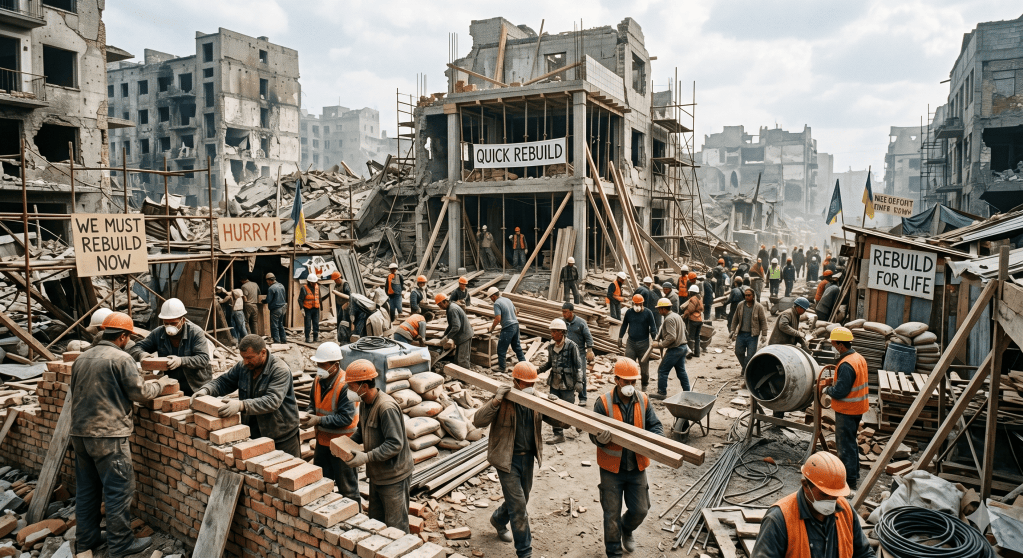
After the pandemic, cultural pressure to bounce back clashed with the real neuroscience of trauma recovery. This essay examines why everyone rebuilt too fast — and what it cost.
There’s a specific kind of exhaustion that doesn’t show up on any medical chart. It’s the feeling of having survived something enormous and then being told — by your culture, your employer, your own ambitions — that it’s time to get moving. That the hard part is over. That you should be grateful, resilient, and ready.
In the months and years that followed the acute phase of the COVID-19 pandemic, that pressure became almost atmospheric. Everywhere you looked, someone was “pivoting,” “rebuilding,” or declaring that they had “used lockdown to level up.” The economy was supposed to roar back. Relationships were supposed to deepen. People were supposed to emerge from the crucible of collective trauma having figured out what really mattered.
For a lot of people, that’s not what happened. Instead, what followed was a quieter, more confusing period — one where the rush to return to normal, or to build something better than normal, collided with a population that was still, in very measurable psychological and neurological ways, not done recovering. Understanding why requires looking honestly at what trauma does to the human mind and body, and what recovery actually demands.
The Psychology of Collective Trauma
The word “trauma” gets used casually enough that its clinical weight sometimes gets lost. In psychological terms, trauma refers to an experience that overwhelms a person’s capacity to cope — one where the nervous system’s normal processing mechanisms get overtaxed, leaving the event partially unintegrated in memory and behavior. Collective trauma applies that same principle at scale: when an entire society shares a threatening, destabilizing experience, the psychological consequences don’t stay individual. They spread through communities, institutions, and cultures.
By any reasonable psychological definition, the pandemic qualified. At its peak, it combined health threat, economic disruption, social isolation, grief, uncertainty about the future, and a collapse of basic routines — all at once, all sustained over time. Research from the early 2020s documented rising rates of depression, anxiety, PTSD symptoms, sleep disorders, and what psychologists began calling “pandemic fatigue” — a deep depletion of the mental and emotional resources people use to navigate daily life.
What was less discussed, at least in mainstream conversation, is that these responses are not signs of weakness. They are biologically appropriate responses to sustained stress. The human nervous system is remarkably well designed to respond to threat, but that design assumes threats are temporary. A predator, a storm, a confrontation. What it does not handle as gracefully is a threat that lasts for months or years with no clear endpoint — what researchers call “chronic unpredictable stress.” Under those conditions, the stress response systems that exist to protect us can begin to cause their own damage.
What Chronic Stress Actually Does to the Brain
The neuroscience here is worth spending a moment on, because it explains a great deal about why the post-pandemic period felt so disorienting for so many people.
The amygdala, the brain’s primary threat-detection center, becomes hyperactivated under sustained stress. It starts flagging situations as dangerous that might ordinarily feel routine. Meanwhile, the prefrontal cortex — the region responsible for planning, decision-making, impulse control, and the capacity to think about the future — becomes functionally less available. This isn’t metaphorical. Neuroimaging studies have shown that chronic stress literally reduces gray matter volume in the prefrontal cortex and impairs its connectivity with other regions.
What this means in practical terms is that people who have been through prolonged periods of stress are often less capable, neurologically, of the kinds of forward-thinking, risk-tolerant, optimistic planning that “rebuilding” requires. They’re more reactive and less reflective. More sensitive to setbacks and less able to sustain the motivation needed for long-term projects. Not because they’ve become lesser people, but because their brains are still responding to an environment that no longer technically exists.
Recovery from chronic stress is possible — the brain shows remarkable plasticity — but it takes time, stability, and usually some deliberate effort. Simply removing the stressor does not instantly restore function. Research on stress recovery consistently shows that the process is slower, more nonlinear, and more sensitive to disruption than people generally expect.
The Culture Said: Bounce Back
Into that neurological reality walked a culture that was extremely eager to move on.
This is not entirely surprising. The desire for normalcy after prolonged disruption is deeply human. And there were genuine, legitimate economic and social pressures driving the rush. Businesses needed revenue. Supply chains needed to be rebuilt. Children who had lost years of in-person schooling needed support. Healthcare backlogs needed to be addressed. The urgency was real.
But alongside those practical pressures, something more psychological was also happening. After years of collective suffering, there was a massive cultural appetite for a redemption narrative. The idea that the pandemic, as terrible as it was, had also stripped away the unnecessary and left people clearer about what mattered. That the forced pause had created an opportunity for reinvention. That resilience — that much-invoked word — would carry the day.
This narrative was everywhere. In the business press, in self-help content, in political speeches, in the language of corporate return-to-work memos. The pandemic became framed, in much of the public conversation, as a kind of chrysalis: painful, but transformative. And transformation, the story went, should produce something better. Something worth the suffering.
The problem with this framing is that it placed an implicit demand on people to be transformed — and to demonstrate that transformation promptly. Those who were struggling to function, who found themselves more anxious or less ambitious or simply unable to care about the things they had cared about before, faced a cultural message that they were doing recovery wrong.
The Productivity Trap
This pressure crystallized most visibly in the discourse around productivity. Social media in 2021 and 2022 was thick with content about how people had “used the pandemic” to learn languages, start businesses, finish novels, get fit, improve their relationships, or otherwise optimize themselves during a period of mass death and collective anxiety. The cultural expectation that suffering should produce output is not new — but it intensified considerably in the post-pandemic moment.
Psychologists and organizational researchers have documented what happens when people in a depleted state are pushed to perform at high levels. Burnout — a syndrome characterized by emotional exhaustion, depersonalization, and reduced sense of personal accomplishment — spiked dramatically in the early 2020s and remained elevated for years. The people most affected were not those who had coasted through the pandemic. They were often the most motivated, the most committed, the ones who had tried hardest to keep going and to meet the cultural expectation of resilience.
This is one of the more counterintuitive findings in stress research: the people at highest risk of burnout are often the ones most dedicated to pushing through. The very traits that look like strength in the short term — persistence, conscientiousness, the refusal to slow down — can become liabilities when the underlying stress load is not adequately addressed.
Why Rebuilding Requires More Than Willpower
There’s a concept in trauma psychology called “window of tolerance,” developed by psychiatrist Daniel Siegel and expanded by researcher Pat Ogden. It refers to the zone of arousal in which a person can function effectively — calm enough to think clearly, activated enough to act. Trauma narrows that window. People are more likely to swing between states of hyperarousal (anxiety, irritability, hypervigilance) and hypoarousal (numbness, disconnection, exhaustion), with a smaller zone in the middle where sustained, complex work feels manageable.
Rebuilding — whether a business, a relationship, a daily routine, or a sense of purpose — is complex work. It requires inhabiting that middle zone for extended periods. It requires tolerating uncertainty, making decisions with incomplete information, sustaining effort without immediate reward. For a population whose collective window of tolerance had been narrowed by years of chronic stress, these demands were genuinely harder than they would have been before.
This is not a comfortable thing to say in a culture that prizes self-determination and the idea that mindset is everything. But the evidence is fairly clear: psychological recovery is not primarily a matter of attitude. It is also a matter of biology, social support, time, and safety. When any of those ingredients are missing or insufficient, recovery stalls — regardless of how much willpower a person applies.
The Role of Social Connection
One of the most consistently replicated findings in stress and trauma research is that social connection is one of the most powerful buffers against the psychological effects of adversity. Feeling seen, supported, and not alone appears to have actual neurological effects — activating systems associated with safety and reducing the activation of threat-detection networks.
The pandemic disrupted social connection at precisely the moment it was most needed. Extended periods of isolation, the shift to remote work, the loss of the ambient social contact that most people take for granted — all of these had measurable effects on wellbeing. And importantly, the effects were not evenly distributed. People who already had thinner social networks, who lived alone, who worked in industries that collapsed, who faced economic precarity — they bore a disproportionate share of the psychological costs.
When the acute phase ended and the pressure to rebuild began, those disparities did not simply disappear. People with robust social support networks, financial cushions, and stable living situations were in meaningfully better positions to respond to the cultural pressure to bounce back. Those without those resources faced the same cultural expectation from a much more difficult starting position. The gap between “rebuilding” as it looked in aspirational media and as it felt on the ground was, for many people, vast.
The Grief That Got Left Out
Another dimension that complicated the post-pandemic rush to rebuild was grief — specifically, collective grief that the culture was not quite prepared to hold.
The pandemic produced staggering losses. Millions of deaths worldwide. The loss of ordinary moments that people had counted on: weddings, funerals, graduations, the last years with an elderly parent, the early years of a child’s life. The loss of businesses that people had spent decades building. The loss, for many, of a sense of safety in the world that had previously felt stable.
Grief, in the clinical and psychological literature, is not something that moves in a straight line or on a fixed schedule. It requires time, space, and a community willing to witness it. Historically, societies have had rituals and structures for collective mourning — spaces that allowed grief to be acknowledged and held communally before the pressure to return to functioning life was fully applied.
The pandemic made those rituals largely impossible in real time. Funerals were restricted or virtual. The scale of loss was too large and too distributed for any conventional mourning framework to contain. And the social pressure to look forward — to rebuild, to be resilient, to not dwell — arrived before many people had finished grieving what they had lost.
Unprocessed grief does not resolve on its own. Research by psychologist George Bonanno and others on resilience and bereavement has shown that while many people do recover from loss without prolonged difficulty, a significant portion experience what’s now called “prolonged grief disorder” — a persistent, impairing state in which normal grief does not resolve and continues to interfere with functioning. The conditions of the pandemic — scale, isolation, disruption of mourning rituals, economic pressure to keep going — were precisely the conditions most likely to complicate normal grief processing.
What “Too Fast” Looked Like in Practice
By 2022 and into 2023, the consequences of the rebuild-too-fast dynamic were becoming visible across a range of domains.
In the labor market, the wave of departures that became known as the “Great Resignation” had multiple causes — wage competition, remote work opportunities, demographic shifts. But burnout was a consistent thread. Many workers who left were not chasing something better so much as running out of the capacity to stay where they were.
In healthcare, providers who had been treating pandemic patients for years were burning out at alarming rates. Therapists and mental health workers, facing soaring demand for their services, were overwhelmed and often struggling themselves. The mental health infrastructure, which had been underfunded for decades before the pandemic, was dramatically insufficient for the scale of need it was now being asked to meet.
In education, students — particularly those who had been in formative years during the pandemic — were showing academic and social-emotional gaps that simple “catching up” strategies could not readily address. The urgency to close those gaps was real. But the pressure to accelerate academic progress did not always account for the fact that many of the children in question were still carrying unprocessed stress and grief from the years they had just lived through.
In personal relationships, the couples and families who had been compressed together during lockdowns — and those separated by distance or circumstance — were navigating complex emotional terrain. Divorce rates fluctuated in patterns that researchers are still analyzing. Friendships that had gone dormant during the pandemic often failed to spontaneously revive when restrictions lifted. The social infrastructure of people’s lives, it turned out, did not automatically rebuild itself just because the official impediments had been removed.
What Recovery Actually Requires
The problem wasn’t the rebuilding — it was the timeline, the expectations, and the failure to account for where people actually were.
None of this is to argue that ambition or forward motion were misplaced. The desire to create something meaningful after a period of loss is a fundamentally healthy impulse. But research on post-traumatic recovery suggests that meaningful change after adversity tends to emerge through a process of making sense of what happened, integrating it into a larger narrative, and gradually rebuilding a sense of agency and possibility. That process requires safety, time, adequate support, and the freedom to acknowledge difficulty without shame — not a cultural mandate to perform transformation on a fixed schedule.
Studies of recovery after large-scale social disruptions — natural disasters, economic collapses, wars — have found that the communities and individuals who rebuild most sustainably tend to be those who allow time for what might be called “grief work” before pivoting fully to reconstruction. The metaphor that comes up repeatedly is that you cannot build on a foundation that is still settling. Structures erected too quickly, on ground that has not stabilized, are fragile.
What We Might Learn
Looking back from 2026, the post-pandemic period reads as a kind of large-scale natural experiment in what happens when a society pushes too hard, too fast, against the genuine timeline of collective recovery.
The mental health consequences have been significant and lasting. Rates of anxiety and depression that spiked during the pandemic have remained elevated well beyond what most early projections anticipated. Burnout has become a defining feature of multiple professional sectors. Youth mental health, in particular, has been a consistent area of concern across multiple countries and demographic groups.
At the same time, there has been — slowly, unevenly — a genuine cultural shift in how many people talk about mental health, limits, and the relationship between productivity and wellbeing. The pandemic forced conversations that had been avoided. It made visible the inadequacy of mental health support systems that had been underfunded for a generation. It produced, in some communities and organizations, a more honest reckoning with what sustainable work and life actually look like.
Whether those shifts are durable is still an open question. Cultural change of this kind tends to be contested and reversible. The pressures that drove the rush to rebuild — economic, competitive, political — have not disappeared, and in many contexts have intensified. But the evidence from the post-pandemic years adds to a body of research that makes one thing fairly clear: the human capacity for resilience is real, but it is not unlimited, and it is not a substitute for the actual conditions recovery requires.
Everyone wanted to rebuild too fast. Understanding why — and what it cost — is not an argument against ambition or hope. It’s an argument for giving recovery the seriousness it deserves, and for building on ground that’s actually ready to hold weight.









