
Originally published in April of 2023 and comprehensively updated/edited in June 2026.
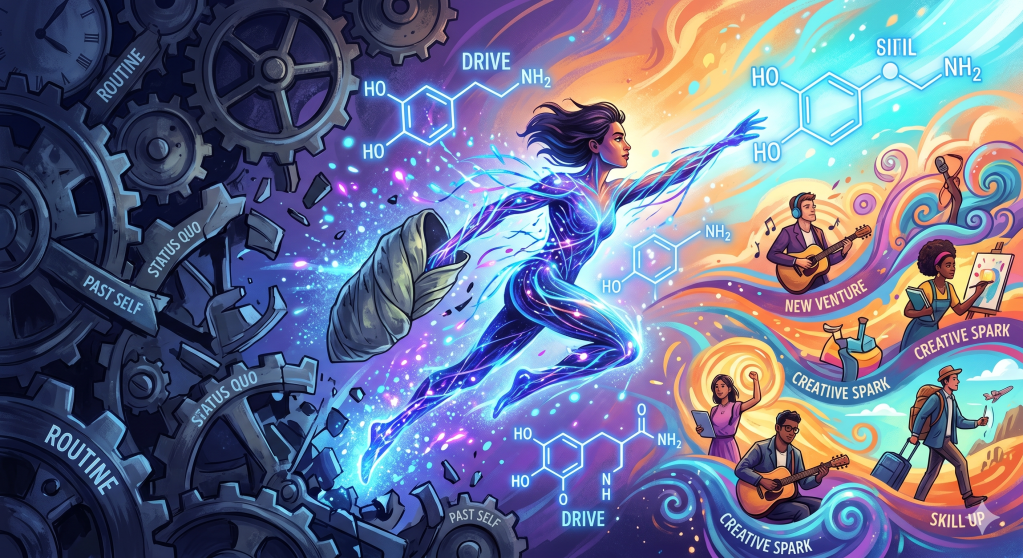
How the pandemic, neuroscience, and digital culture collided to drive a mass wave of personal reinvention — and what it tells us about identity, dopamine, and lasting change.
In the summer of 2021, a 34-year-old accountant in Chicago started spending her lunch breaks watching videos on her phone — not to relax, but with something closer to hunger. They were videos of people who had quit their jobs, moved to other countries, retrained as designers, started farms, learned to weld. People who had, as the phrase kept appearing in captions, completely changed their lives. She wasn’t sure what she was looking for exactly. But six months later she had enrolled in a UX design bootcamp. A year after that she was working remotely from another state, doing work she had never imagined doing. She is not a real person in the sense that her name exists in a public record, but she is real in the sense that some version of her story happened to hundreds of thousands of people during this period — close enough in its specifics that millions more recognized it immediately.
Stories like hers became the defining social phenomenon of the early 2020s. Across countries, age groups, and income brackets, a remarkable number of people found themselves asking a question that most people reserve for midlife — who am I, really, and is this the life I actually want? They were asking it at 24. At 38. At 51. During lockdowns, during resignation waves, during the slow and disorienting return to a world that somehow felt both the same and completely different.
What made this wave of self-examination so striking wasn’t just its scale, but its texture. It wasn’t a collective depression. It was something more restless — a hunger, almost. People weren’t just questioning their lives; they were redesigning them. Changing careers, moving cities, ending long relationships, starting businesses, picking up instruments they’d never played, rebuilding daily habits from scratch. The term that kept appearing in headlines, therapy sessions, and social media posts was reinvention.
But reinvention doesn’t happen in a vacuum. It happens in a brain — a brain that, as it turns out, was being rewired in real time by a converging set of forces: a global crisis that shattered routine, a digital ecosystem engineered to exploit novelty-seeking, and a cultural moment that suddenly made the idea of transformation both accessible and aspirational. Understanding why so many people felt compelled to reinvent themselves during this period means understanding what was happening not just in society, but inside the human nervous system.
That’s the story this essay is trying to tell.
The Disruption That Reset the Clock
Routine is deeply underrated as a psychological anchor. Most people don’t experience their daily schedule as something that holds them together — it’s just the background hum of life, the sequence of habits that gets them from morning to night. But when routine disappears, its absence is staggering. The brain, which runs on prediction and pattern, suddenly has no script to follow.
That’s what happened in 2020. Overnight, the architecture of daily life collapsed for hundreds of millions of people. Commutes vanished. Offices emptied. School pickup routes became irrelevant. The small rituals that punctuate a day — the coffee shop stop, the gym visit, the after-work drink — were gone. What remained was a strange and unsettling amount of psychological space.
For many people, especially in the early months, that openness felt like grief. The psychological concept of ambiguous loss, developed by family therapist Pauline Boss, describes the distress caused by losses that lack clarity or closure. The pandemic was a masterclass in ambiguous loss — people weren’t just mourning the dead, but mourning jobs, relationships, plans, and versions of the future they’d been quietly counting on. The brain doesn’t grieve abstractions easily, and the result for many was a diffuse, hard-to-name anguish.
But alongside the grief, something else was happening. The stripping away of routine also stripped away what psychologists sometimes call identity foreclosure — the tendency to define ourselves so completely by our roles and routines that we stop questioning whether those roles actually fit. When the job that defined you suddenly becomes remote work in a spare bedroom, or disappears entirely, the psychological protection that job provided goes with it. You’re left with yourself, and the uncomfortable question of whether the version of yourself that existed before was one you consciously chose.
Research in identity theory, particularly work building on sociologist Erving Goffman’s concept of role performance, suggests that people maintain their sense of self partly through the social scripts they perform day after day. When those scripts are disrupted, identity becomes unstable in ways that are simultaneously unsettling and generative. The disruption is painful — but it’s also an opening.
Dopamine and the Pull Toward New
Here’s where neuroscience becomes relevant to what looks, on the surface, like a sociological phenomenon.
The neurotransmitter dopamine is widely misunderstood. Popular culture tends to frame it as the brain’s “pleasure chemical” — the reward you get when something good happens. But that’s not quite right, and the correction matters enormously for understanding human behavior during this period.
Dopamine is primarily a signal of anticipation. It’s released not when you receive a reward, but when you expect one. More specifically, it fires in response to novelty — to anything new, unexpected, or potentially meaningful. Neuroscientist Wolfram Schultz’s foundational research on dopamine neurons in the 1990s demonstrated that these cells respond most powerfully to prediction errors: moments when something happens that your brain didn’t see coming. The bigger the surprise, the bigger the dopamine spike.
This is why the pursuit of new things — new experiences, new goals, new identities — feels so intrinsically motivating. The dopaminergic system isn’t just rewarding you for getting what you want. It’s rewarding you for searching. The hunt itself generates neurochemical pleasure.
When the pandemic upended routine and threw so much of life into uncertainty, it created, paradoxically, a landscape saturated with novelty. New threats, new information, new rules, new ways of working — the brain’s prediction systems were firing constantly, recalibrating continuously. And while much of this was experienced as anxiety (which is, in part, the brain’s response to unresolved prediction errors), it also primed people for novelty-seeking. The nervous system was already in high-alert, search-mode engagement. Reinvention — the active pursuit of something new — offered a way to channel that state toward something that felt purposeful rather than just frightening.
To be precise about what this means: dopamine did not cause people to change their lives. It made the search for alternatives feel unusually compelling — which is a meaningful distinction, and one worth keeping in mind as this story unfolds.
The Digital Amplifier
If the pandemic created the psychological conditions for reinvention, digital platforms provided the scaffolding — and the fuel.
Social media platforms, particularly those built around short-form video, are architecturally designed to exploit the dopamine-novelty connection. TikTok’s algorithm, for example, is extraordinarily efficient at detecting what keeps any individual user engaged, and it feeds that content in an unpredictable, variable-ratio schedule — the same reinforcement pattern that makes slot machines so compelling. You never quite know what the next scroll will bring, which means the brain stays in perpetual anticipation mode, dopamine trickling continuously.
During the pandemic, when people had more time, more anxiety, and fewer offline stimuli, screen time increased dramatically. A survey published in the journal PLOS ONE in 2021 found that social media use rose substantially across age groups during lockdowns, with particularly sharp increases among adults who lived alone. The platforms became primary environments — not supplementary ones — for social connection, entertainment, information, and increasingly, identity exploration.
This matters because what people encountered on those platforms wasn’t neutral content. They were seeing, in enormous quantities, the spectacle of other people reinventing themselves. The “I quit my corporate job to become a ceramicist” video. The “I moved to Portugal and here’s why I’m never going back” account. The fitness transformation. The new business launch. The divorce glow-up. These stories tapped directly into the brain’s reward circuits — they were novel, emotionally resonant, and laced with the promise that transformation was not just possible, but imminent. One decision away.
Psychologists who study social comparison theory — first articulated by Leon Festinger in 1954 — have documented that people have a fundamental tendency to evaluate their own lives against those of others. In digital environments where the most dramatic transformations are algorithmically amplified, the baseline for comparison shifts. Your relatively stable life, measured against a feed full of reinvention stories, starts to feel like stagnation. The gap between who you are and who you might become becomes vivid, and viscerally motivating.
What those feeds systematically obscured, of course, was the full picture. Social media disproportionately showcased successful transformations while hiding the many attempts that stalled, reversed, or quietly proved unsustainable — a survivorship bias baked into the platform’s architecture, where failure doesn’t generate content worth sharing.
The Reinvention Economy
Something else was happening at the same time — a cultural and economic reframing of what transformation meant and who it was for.
For most of the twentieth century, radical self-reinvention was a narrative reserved for a particular kind of American mythology: the immigrant who builds a new life from nothing, the fallen executive who rises again, the artist who sacrifices everything for their vision. It was dramatic, exceptional, and implicitly available only to those willing to pay an extraordinary price.
By the early 2020s, that narrative had been democratized — and commercialized. The wellness industry, the life coaching industry, the personal development publishing world, and the creator economy had collectively built an infrastructure around the idea that reinvention was not only possible for ordinary people but was, in fact, a responsibility. Self-optimization had become a consumer category. There were apps for habit building, online courses for career transitions, Instagram accounts dedicated to “becoming your best self,” and an entire genre of books promising frameworks for transformation.
This commercial ecosystem is worth noting not to dismiss it, but to understand its function. It lowered the perceived cost of change. When reinvention has an instruction manual, when there’s a 12-week course that promises to walk you through the process, the commitment device that previously required enormous courage — quitting, leaving, starting over — could now be initiated with a purchase, a sign-up, a subscription. The dream wasn’t just being sold. The process was being sold alongside it, which made the dream feel genuinely within reach.
Behavioral economists use the term choice architecture to describe the way environments are designed to make certain decisions easier or harder to reach. A well-placed default option, a streamlined sign-up flow, a community of people who have already done the thing you’re considering — these are all elements of choice architecture, and the reinvention economy had quietly assembled all of them. It didn’t merely encourage change. It restructured the environment around change, making major life transitions feel less extraordinary and more procedural. That shift in friction — not in desire, but in the perceived effort required to act on desire — mattered enormously.
What the Resignation Wave Was Actually About
No discussion of mass reinvention during this period can ignore the Great Resignation — the wave of voluntary job departures that began in 2021 and continued well into 2022. In the United States alone, the Bureau of Labor Statistics recorded over 47 million voluntary separations in 2021, a figure unprecedented in modern labor history. Similar patterns emerged across the UK, Canada, Australia, and parts of Western Europe.
Early commentary on the Great Resignation tended to frame it primarily as an economic phenomenon — workers demanding better pay, pushing back against unsafe conditions, leveraging a tight labor market. All of that was true. But the psychological dimension ran deeper.
Surveys conducted during this period, including a notable 2021 study from McKinsey Global Institute, found that workers leaving their jobs consistently cited reasons that weren’t primarily about compensation. They wanted meaning. They wanted flexibility. They wanted to feel that their work connected to something they cared about. The pandemic, by forcing millions of people into an extended period of reflection, had effectively conducted a large-scale audit of what people actually valued — and many discovered that what they’d been trading their time for didn’t make the cut.
This connects to a concept in psychology called self-determination theory, developed by researchers Edward Deci and Richard Ryan over several decades. The theory holds that people have three fundamental psychological needs: autonomy (the sense that your actions are chosen, not coerced), competence (the sense that you’re capable and effective), and relatedness (meaningful connection with others). Work that satisfies these needs tends to generate what the researchers call intrinsic motivation — the kind that sustains effort over time. Work that thwarts these needs generates compliance at best, and burnout, disengagement, and exit behavior at worst.
The Great Resignation was, in many respects, a mass expression of unmet intrinsic needs. People weren’t just leaving bad jobs — they were leaving the version of themselves that had agreed to stay.
Identity in Flux
What happens inside a person when they decide to reinvent themselves? The process is less heroic and more neurologically interesting than most reinvention narratives suggest.
Psychological research on identity change — sometimes called identity shift — suggests that the process involves a fundamental reorganization of the self-concept, the mental model each person maintains of who they are. This reorganization is cognitively expensive and emotionally destabilizing, even when the change is sought and welcomed. Psychologist Herminia Ibarra, whose research at London Business School focused on career transitions, documented extensively how people in the midst of major professional reinventions experience what she called identity paralysis — a phase where they know they don’t want what they had but haven’t yet solidified a convincing new identity to inhabit.
This paralysis is real, but it’s also functional. The brain is essentially running a slow update in the background, testing new self-narratives against available evidence, filtering which new roles and identities feel authentic and which feel like costumes. The people who move through reinvention most successfully, Ibarra’s research suggested, are those who adopt what she called an experimental approach — trying new things in small doses before committing fully, allowing a new identity to emerge from action rather than waiting for certainty before acting.
This experimental approach maps neatly onto what neuroscience tells us about how the brain actually learns new behaviors. The basal ganglia, a set of structures deep in the brain involved in habit formation, are far more responsive to doing than to planning. Repeated action builds the neural pathways — the grooves, in the metaphor that’s become popular — that eventually make a new behavior feel automatic and, by extension, like “who you are.” Planning to become someone new, without the behavioral experimentation to back it up, leaves those pathways unbuilt.
The reinvention wave of the early 2020s produced both successful and unsuccessful outcomes along these lines. Those who made sustainable changes tended to combine genuine motivation with incremental action — the person who started freelancing on weekends before leaving their full-time job, or who practiced a new creative skill for a year before calling themselves an artist. Those whose reinventions stalled often got caught in the planning-and-inspiration loop that digital platforms are so good at generating: a steady diet of reinvention content that produced the neurochemical sensation of progress without the behavioral change to make it real.
The Social Texture of Change
Reinvention rarely happens in isolation, even when it feels deeply personal. Social support — or its absence — is one of the most significant predictors of whether major life changes succeed or collapse.
Sociologist Mark Granovetter’s influential research on social networks, published in the 1970s and revisited extensively since, identified a crucial distinction between strong ties (close relationships with family and close friends) and weak ties (looser connections with acquaintances and peripheral contacts). Counterintuitively, weak ties often proved more valuable than strong ones during periods of transition — they expose people to different information, different perspectives, and different opportunities than the tight social circle that shares the same worldview.
This insight gained new relevance during the pandemic, when weak ties were disproportionately disrupted. The casual colleague you ran into at the coffee machine, the gym acquaintance, the neighbor you chatted with occasionally — these connections, it turned out, were load-bearing in ways people hadn’t recognized. Their loss contributed to what became widely documented as pandemic loneliness. But it also had a specific effect on reinvention: it narrowed the social information people had access to, making it harder to discover new possibilities and to test new identities in low-stakes social environments.
The explosion of online community — Discord servers, subreddits, Twitter/X threads, niche newsletters — partially filled this gap. People found weak ties in unexpected places: the community of people learning to code, the online forum for career changers, the Discord of people interested in the same obscure creative practice. These digital communities served the function that Granovetter’s weak ties served — they exposed people to a wider range of possibilities, made unusual transitions seem more plausible by showing examples, and provided social permission to pursue paths that felt eccentric within the person’s existing circle.
Reinvention and the Longer Arc
It would be a mistake to evaluate the reinvention wave of the early 2020s only through the lens of what it produced in the short term. Some reinventions failed. Some people changed careers only to discover that the problem was never the career. Some relationships ended not because they were genuinely incompatible but because the disruption of 2020 made everything feel unbearable simultaneously. Transformation, when driven primarily by the brain’s novelty-seeking circuits rather than by genuine reflection, can mistake escape for progress.
But the longer arc is more interesting and, in many ways, more hopeful.
The period produced a generation of workers who have a fundamentally different relationship to their employment than their predecessors. They have demonstrated — to themselves — that they can leave, can change, can survive the uncertainty of transition. That demonstrated resilience is a psychological asset that doesn’t go away when the reinvention itself resolves. Research on self-efficacy — a concept central to psychologist Albert Bandura’s social cognitive theory — consistently shows that the single most powerful source of confidence in your ability to do something is having done something like it before. The people who navigated reinvention during this period built a kind of change-competence that shows up in how they approach uncertainty going forward.
The period also accelerated a broader cultural renegotiation of what a stable life is supposed to look like. The linear model — education, stable career, retirement — was already under pressure from economic precarity, automation, and the decline of long-term employment relationships. The reinvention wave pushed the alternative into sharper relief. A life of multiple chapters, multiple identities, multiple attempts isn’t a failed life. It may be the default life for the coming decades. The psychological infrastructure needed to navigate that — tolerance for ambiguity, comfort with identity flux, ability to find meaning in process rather than only in arrival — is something this period, however painfully, did something to build.
By 2026, many of the most dramatic reinventions from this period have settled into their next phase — not transformation, but integration. The person who became a ceramicist still does ceramics, but also does something else. The person who left the corporate job has built something new, or has returned to something adjacent with different terms. The Great Resignation has been followed by something less dramatic but perhaps more significant: a quieter, ongoing renegotiation of what people are willing to trade their time for, and what they’re not.
Dopamine drove the initial surge — the novelty, the search, the hunger for something different. But what sustains change beyond the neurochemical rush of beginning is something else: meaning, competence, and the slow satisfaction of becoming someone you actually recognize.
That’s the reinvention that lasts.









