
Originally published in March of 2023 and comprehensively updated/edited in June 2026.
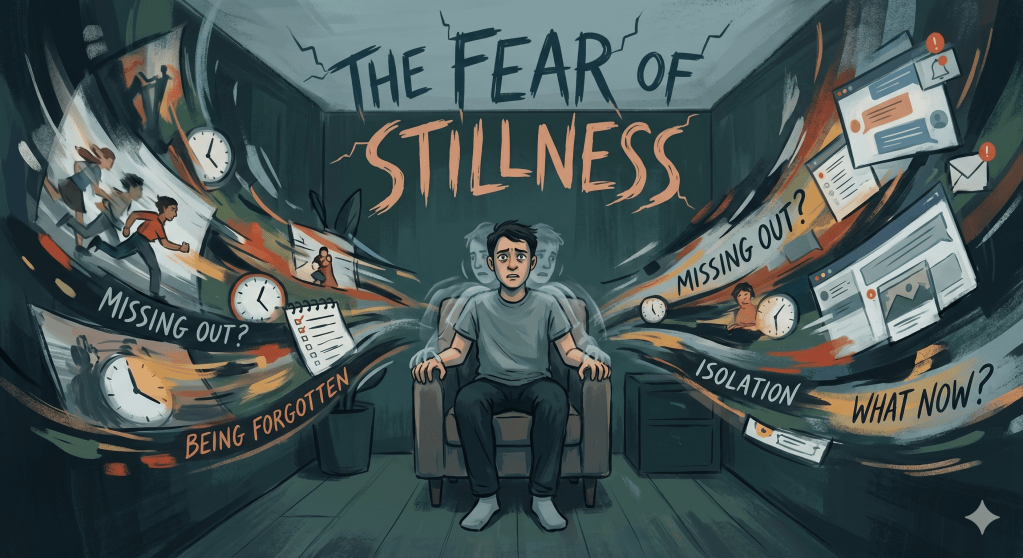
The fear of stillness explores why modern life has made silence uncomfortable, what neuroscience reveals about the resting mind, and what the avoidance of quiet actually costs us.
There is a particular discomfort that most people recognize but rarely name. It arrives in the quiet moments — waiting for a friend at a restaurant, lying awake before sleep, sitting in a car while the gas pumps. It’s the sensation of having nothing to do and no screen to look at. For many people, that sensation has become almost intolerable.
This isn’t simply distraction or laziness. Something deeper is happening. Over the past two decades, the relationship between human beings and unoccupied time has changed dramatically, and the consequences of that change have filtered into mental health, productivity, creativity, relationships, and the way people understand themselves. The fear of stillness — of being alone with one’s own thoughts without stimulation or task — has become one of the defining psychological pressures of contemporary life.
Understanding how this happened, what it does to us, and what it might mean going forward requires looking at the social conditions that made it possible, the science of what happens inside a mind left to itself, and the very human anxiety that technology has learned to exploit with remarkable precision.
A World Engineered Against Pause
To understand the fear of stillness, it helps to understand how thoroughly modern life has been arranged to prevent it.
The smartphone didn’t create the desire to avoid boredom — that impulse is ancient. But the smartphone made it possible to act on that impulse every single moment of every single day, with virtually zero effort. Before the device became ubiquitous somewhere around 2010 to 2012, there were still long stretches of ordinary life that simply had to be endured without stimulation. Waiting rooms. Commutes without a podcast. Dinner conversations that trailed off into silence. These weren’t dramatic experiences. They were just the texture of a less connected existence.
The phone changed that texture completely. Not by force, but by convenience. The friction required to access entertainment, social connection, news, or distraction dropped to almost nothing. You didn’t have to plan to avoid boredom — avoidance became the default. And once something becomes the default, the alternative stops feeling normal. It starts feeling strange.
The Attention Economy’s Core Design
This transformation was not accidental. The major platforms that came to dominate digital life — social media feeds, short-form video, notification-driven apps — were deliberately designed to compete for and hold human attention. This is not a conspiracy theory; it’s basic business. Advertising-supported platforms earn revenue proportional to the time users spend on them. Engineers at these companies developed sophisticated tools — variable reward schedules, social validation loops, infinite scroll, autoplay — that are highly effective at keeping people engaged.
The variable reward mechanism deserves particular attention because it explains something that a lot of people find puzzling about their own behavior: why they keep checking a phone even when they expect nothing interesting to be there. Variable reward schedules, first studied extensively by the behavioral psychologist B.F. Skinner in the mid-twentieth century, are more compelling than predictable ones. A slot machine is more addictive than a vending machine precisely because the reward is unpredictable. Social media feeds function the same way. The scroll might turn up something fascinating, or it might turn up nothing, and that uncertainty is what makes it hard to stop.
Over time, constant engagement with these systems reshapes expectations. The brain adjusts to a particular pace and density of stimulation. Silence and unstructured time — once ordinary — begin to feel thin by comparison. They don’t feel restful. They feel like something is missing.
What Actually Happens When the Mind Goes Quiet
The science of what occurs inside a resting brain has become one of the more surprising areas of neuroscience research in recent decades. For a long time, neuroscientists thought that brain activity during rest was essentially noise — the brain idling between tasks. That view changed substantially with the discovery and study of what researchers call the default mode network.
The Default Mode Network
The default mode network, or DMN, is a collection of brain regions that become more active when a person is not focused on an external task. It was identified in detail in the early 2000s through brain imaging studies that noticed consistent patterns of activity during rest. Far from idling, this network is doing something quite specific. It supports mental time travel — the ability to think about the past, imagine the future, consider other people’s perspectives, and engage in what researchers sometimes call spontaneous thought, or mind-wandering.
These aren’t trivial functions. They appear to be central to how human beings plan, empathize, learn from experience, and develop a coherent sense of self. Research by psychologists including Mary Helen Immordino-Yang at the University of Southern California has suggested that default mode activity may be important for moral reasoning and the development of meaning — the kind of reflective thinking that helps people connect their experiences into a larger personal narrative.
When someone is constantly externally stimulated — always reading, watching, scrolling, or listening — periods of constant external stimulation may reduce the amount of time spent in the reflective states typically associated with default mode activity. The brain is always in task mode, always responding to input from outside. The question researchers have begun asking is what the long-term effects of that pattern might be, especially in people who have grown up with smartphones from early adolescence.
Mind-Wandering: The Uncomfortable and the Useful
There’s an important complication here. Mind-wandering doesn’t always feel good. A widely cited 2010 study by Matthew Killingsworth and Daniel Gilbert at Harvard used a smartphone app to sample people’s thoughts and feelings throughout the day. Their findings were striking: people’s minds were wandering roughly 47 percent of the time, and they reported being less happy during mind-wandering than when focused on a task — even a task they didn’t enjoy. The researchers concluded that a wandering mind is an unhappy mind.
This finding has been influential, but it’s worth being careful about what it does and doesn’t show. The study measured happiness at the moment of sampling, not over longer periods. It didn’t distinguish between different types of mind-wandering — ruminating about past failures versus imagining a future trip versus idly noticing what the sky looks like. And more recent research has refined the picture considerably.
Studies by Jonathan Smallwood and colleagues have found that certain types of mind-wandering — particularly what might be called future-oriented, constructive thought — are associated with creativity and problem-solving. The incubation period, well-known among artists, writers, and scientists as the phase when you stop actively working on a problem and the solution seems to appear, appears to involve default mode activity. Many people report their best ideas arriving in the shower, on a walk, or just before sleep — precisely when the mind is allowed to roam.
The fear of stillness, in this light, carries a real cost. It doesn’t just feel uncomfortable in the moment; it may actually cut off a cognitive process that serves important functions.
The Social Dimension: Boredom Becomes Suspect
Psychological shifts don’t happen in a vacuum. The discomfort around stillness is also shaped by cultural attitudes — specifically, the way contemporary culture frames productivity, busyness, and constant engagement.
Busy as a Status Symbol
Sociologist Jonathan Gershuny and others have documented a curious reversal over the past half-century. In the mid-twentieth century, leisure was associated with status. Having time was a sign of wealth and success. Over subsequent decades, that association began to flip. Busyness became prestigious. Being constantly occupied — always working, always scheduling, always producing — became the mark of an important, valuable person. Saying “I’ve been so busy” is now almost universally used as a compliment to oneself, a signal of relevance and demand.
This shift has made stillness socially suspicious in a way it wasn’t before. Not doing anything feels not just uncomfortable but vaguely illegitimate. There is a low-level anxiety attached to rest that wasn’t there when rest was expected and admired. The person who sits quietly without a task risks appearing unproductive, which in a culture that has conflated productivity with worth, risks appearing worthless.
The Pandemic as a Brief Test Case
The COVID-19 pandemic offered an involuntary illustration of this dynamic. When normal social routines collapsed, many people found themselves face-to-face with thoughts they had been outrunning for years — and therapists noted a corresponding uptick in people confronting long-deferred emotional material. For some, the forced stillness was destabilizing. For others, it was unexpectedly clarifying. What it revealed, most plainly, is that chosen stillness and imposed stillness feel entirely different even when they’re functionally similar — and that beneath the discomfort, some people found something they hadn’t known they were missing.
Anxiety, Avoidance, and the Self-Perpetuating Loop
For a meaningful portion of the population, the discomfort with stillness isn’t just cultural — it’s clinical. Anxiety disorders, which affect roughly one in five adults in the United States according to data from the National Institute of Mental Health, are characterized in part by the experience of unwanted intrusive thoughts. For people who struggle with anxiety, the quiet mind isn’t neutral — it’s a space where worries, fears, and self-criticism tend to fill the vacuum.
This creates a particular logic for avoidance. Staying busy, staying distracted, staying stimulated prevents the anxious thoughts from surfacing. The phone becomes a coping tool, a way of managing internal experience by keeping attention fixed outward. This works in the short term. It provides relief. And that relief reinforces the behavior, making avoidance more automatic and more necessary over time.
Psychologists use the term “experiential avoidance” to describe the pattern of escaping uncomfortable internal experiences — thoughts, feelings, sensations — rather than tolerating or engaging with them. Research associated with Acceptance and Commitment Therapy (ACT) and related approaches has consistently found that experiential avoidance, while immediately effective at reducing distress, tends to maintain and worsen anxiety over the long term. The feared internal experience doesn’t get processed or diminished; it waits.
What We Run From in the Quiet
What exactly are people running from when they reach for the phone at the first sign of boredom? Research suggests several candidates.
Self-criticism is a major one. Studies in self-compassion research, particularly work by Kristin Neff at the University of Texas at Austin, indicate that many people have a deeply critical inner voice that becomes most audible when external noise subsides. The busyness of modern life provides an almost continuous excuse to avoid hearing it.
Mortality awareness is another. Terror Management Theory, developed by Jeff Greenberg, Sheldon Solomon, and Tom Pyszczynski and based on the work of cultural anthropologist Ernest Becker, proposes that a significant portion of human behavior is motivated by the need to manage the awareness of death. Becker argued in his 1973 book The Denial of Death that culture, productivity, achievement, and constant activity are in part systems for managing existential anxiety. Stillness removes those buffers and can bring the underlying awareness uncomfortably close.
Unresolved grief, relational conflict, and unnamed dissatisfaction with one’s life choices are also things that quiet tends to surface. The fear of stillness is often, underneath it, the fear of specific thoughts that stillness makes available. Keeping busy isn’t really about avoiding boredom. It’s about avoiding contact with something more particular.
Technology and the Developing Brain
The conversation around stillness takes on additional weight when it involves adolescents. Psychologist Jean Twenge’s research, published in works including iGen and later updated analyses, identified correlations between smartphone adoption rates among teenagers and increases in reported loneliness, depression, and anxiety, particularly in girls. These correlations are real but complex, and researchers continue to debate their magnitude and causation.
What seems less contested is that adolescents today have fewer opportunities for the kind of unstructured, understimulated time that previous generations experienced as a matter of course. Developmental psychologists have long observed that boredom is actually important for children — it promotes imagination, self-directed play, and the gradual development of an inner life. The child who announces “I’m bored” and is not immediately rescued from that state learns, over time, to generate their own engagement from internal resources. The adolescent who never has to do that may reach adulthood without having built a strong relationship with their own interior world — not as a moral failing, but as a gap in experience that can have quiet downstream effects.
Reclaiming the Quiet: What the Evidence Suggests
It would be easy to moralize here — to conclude that people should put down their phones, sit in silence, and reconnect with themselves. That kind of prescription is easy to make and hard to implement, particularly without understanding why the behavior it opposes feels so necessary. More usefully, the research offers some insight into what actually helps.
One clarification matters before going further: solitude and loneliness are not the same thing, though people often experience them as interchangeable. Loneliness is a painful state of perceived social disconnection — the feeling that one lacks meaningful contact with others. Solitude is simply time spent alone, and when it’s chosen rather than imposed, it tends to be psychologically nourishing rather than harmful. The late social psychologist and social neuroscientist John Cacioppo, whose decades of research on loneliness remains foundational, was careful to draw this distinction. Loneliness, he found, has measurable negative effects on physical and mental health. But solitude — voluntary, comfortable aloneness — is a different experience entirely. Sherry Turkle, the MIT sociologist and author of Alone Together, has argued similarly that the capacity to be alone with oneself is not a deficiency but a skill, and one that has atrophied as constant connectivity has made aloneness feel like something to be remedied rather than inhabited. The fear of stillness, in this reading, is partly a confusion of the two: people reaching for their phones not because they are genuinely lonely, but because they have lost the habit of solitude and can no longer tell the difference.
The Restorative Function of Nature and Low-Stimulation Environments
Attention Restoration Theory, developed by Rachel and Stephen Kaplan in the 1980s and 1990s, proposes that certain environments — particularly natural ones — restore depleted attentional capacity by engaging “involuntary attention,” a gentle, effortless form of engagement that allows directed attention to recover. Research testing this framework has found that time in nature, even relatively brief exposure, reduces mental fatigue and improves subsequent performance on attention-demanding tasks.
This research has gained traction in clinical settings. Time in natural environments has been associated with reductions in rumination, lower physiological stress markers like cortisol, and improvements in mood. What makes the effect particularly relevant to the fear of stillness is that natural environments tend to be relatively low in the kind of rapid, demanding stimulation that characterizes digital media. They are not empty — they’re full of subtle sensory information — but they don’t compete for attention the way a screen does.
Boredom Tolerance as a Skill
Some researchers have begun examining boredom tolerance as a learnable capacity rather than a fixed trait. Sandi Mann, a psychologist at the University of Central Lancashire, has conducted studies suggesting that allowing oneself to be bored — and sitting with that feeling rather than immediately resolving it — can actually increase creative output. The discomfort of boredom appears to motivate the mind to generate its own stimulation, which in some contexts produces novel thinking.
This framing suggests that the fear of stillness, like other anxiety-adjacent experiences, responds to graduated exposure. People who practice spending time without stimulation — progressively longer periods, in progressively quiet environments — often report that the initial discomfort diminishes, and something else, harder to name, begins to emerge in its place.
Mindfulness-based interventions have accumulated a substantial research base over the past three decades suggesting that the capacity to observe one’s own thoughts without being carried away by them is both teachable and beneficial. Mindfulness is not the same as stillness, but it develops a similar tolerance for unoccupied mental space. Studies reviewed in meta-analyses have found consistent associations between mindfulness practice and reductions in anxiety, rumination, and psychological distress.
The Question That Stillness Asks
There’s a dimension to the fear of stillness that can’t be fully addressed by neuroscience or behavioral research. It’s the existential dimension: the question that quiet tends to ask, which is simply, how am I actually doing?
Constant stimulation is not just a distraction from boredom. It’s a deferral of the question. The person who is always busy, always connected, always consuming something, never quite has to answer it. And since the answer might be uncomfortable — might involve acknowledging an unhappy relationship, an unfulfilling career, a grief that hasn’t been named — the deferral is understandable. It’s even rational, in a narrow sense. The discomfort of confronting those things is real and immediate. The benefit of confronting them is uncertain and delayed.
What makes this particular dynamic so persistent is that the technology facilitating avoidance is genuinely pleasurable, genuinely useful, and genuinely connecting in many ways. It’s not all hollow. The phone in your pocket contains relationships, information, art, and entertainment of real value. The choice is not between good and bad things. It’s between different modes of engagement with one’s own life — one that runs outward almost entirely, and one that occasionally turns inward long enough to take stock.
The fear of stillness, viewed from this angle, isn’t a pathology. It’s a very human response to the availability of relief. What makes it worth examining is the cumulative cost of that relief — the creative work not done, the self-knowledge not developed, the emotional material not processed, the capacity for solitude that quietly atrophies.
The Broader Trajectory
By the mid-2020s, the conversation about attention, stillness, and digital life had moved well past individual concern. That shift in itself is significant — it suggests that the fear of stillness is being recognized as a structural issue rather than purely a personal one. The individual trying to sit quietly with their thoughts is competing against systems designed by teams of engineers with access to behavioral data at an almost incomprehensible scale. That asymmetry doesn’t disappear through willpower alone.
What the research collectively suggests is not that technology is simply harmful or that stillness is simply good. It’s that human beings need a certain ratio of outward engagement to inward reflection, and that contemporary digital life has pushed that ratio sharply toward the outward. The corrective doesn’t require rejecting technology. It requires recognizing the value of what gets crowded out when stimulation is always available and almost always chosen.
The fear of stillness tells us something. It tells us how much we’ve come to depend on external stimulation for our sense of being occupied, engaged, and alive. It also suggests, by implication, what stillness might hold — a quieter but perhaps more fully inhabited version of experience, available to anyone willing to stay in the discomfort long enough to find out.









