
Originally published in May 2023 and comprehensively updated/edited in June 2026.
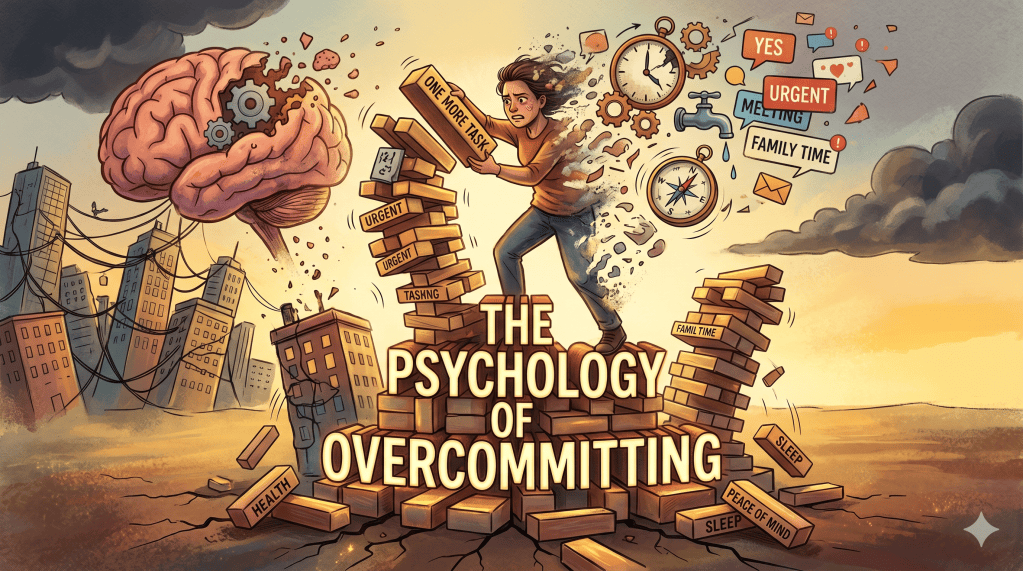
Explore the psychology of overcommitting — why we say yes when we mean no, how cognitive biases, social pressure, and identity shape our decisions, and what research says about changing the pattern.
You said yes again. To the committee, the side project, the favor, the dinner you didn’t really want to attend. Maybe you meant to say no, started to say no, and then heard yourself agreeing anyway. Or maybe in the moment it genuinely seemed manageable — until the calendar filled up and the dread set in.
Overcommitting is one of the most universal experiences in modern life, and one of the least examined. It’s easy to chalk it up to poor planning or weak willpower, but the reality is considerably more interesting. The psychology of overcommitting runs through some of the deepest features of how human beings think, feel, relate to one another, and imagine the future. Understanding why we do it doesn’t just satisfy curiosity — it sheds light on the gap between the lives we intend to live and the ones we actually end up living.
This article explores that gap: what causes it, what sustains it, and why it’s so stubbornly difficult to close.
Consider someone like Maya, a project manager in her mid-thirties who would have been easy to find in almost any organization in 2023. Over the course of a single month, she agrees to mentor a new hire who reminds her of herself at twenty-five. She joins a cross-departmental hiring committee because the VP asks and she doesn’t want to seem unengaged. She volunteers for a conference panel because it feels like visibility she’s been told she needs. She agrees to help coordinate her best friend’s wedding because she’s known her since college and of course she will. Each commitment arrives separately. Each one seems, in the moment, like the obvious thing to do — the kind and professional and loyal response to a specific person asking a specific thing. It is only six weeks later, when the calendar has solidified into something unrecognizable, that the full picture becomes clear: she is not sleeping well, she is late on her actual deliverables, and she has started dreading her phone.
Nothing about Maya’s situation is unusual. What’s unusual is pausing long enough to ask why it happened — why someone intelligent and organized and self-aware ended up here again. The answer, it turns out, has less to do with scheduling than with some of the deepest features of how human beings think, make decisions, relate to other people, and imagine the future.
Why We Can’t Say No: The Social Architecture of Overcommitment
Before getting into the cognitive mechanics, it’s worth acknowledging the social dimension. Saying yes has never just been a scheduling decision. It’s a social act — one that carries meaning about who you are, how much you care, and whether you can be counted on.
In most cultures, availability signals virtue. The person who is always busy, always contributing, always willing to take on more has traditionally been admired, not pitied. Busyness became a status symbol sometime in the late twentieth century, and that shift had real consequences for how people evaluate both themselves and others. Researchers like Silvia Bellezza at Columbia Business School have documented what they call the “busy person” stereotype — the tendency for people to perceive those with full schedules as higher in social status and competence. When being busy reads as being important, there’s an implicit social reward for overcommitting, even when it creates personal misery.
At the individual level, saying no carries a social cost that saying yes avoids. Declining a request risks disappointing someone, damaging a relationship, or being perceived as unhelpful, lazy, or not a team player. These are not irrational fears. Social rejection and exclusion activate some of the same neural pathways as physical pain, a finding that has been replicated across multiple neuroscience studies. The anticipation of social discomfort is a powerful motivator, and agreeing — even when we shouldn’t — reliably makes that discomfort go away, at least temporarily.
This is worth sitting with. The relief of saying yes is immediate and concrete. The cost — the overloaded schedule, the stress, the exhaustion — arrives later and in a more diffuse form. From the brain’s perspective, the calculus isn’t as obvious as it might seem in hindsight.
The Planning Fallacy and the Optimistic Brain
One of the most replicated findings in behavioral psychology is what Daniel Kahneman and Amos Tversky identified in the 1970s as the planning fallacy: the tendency to underestimate how long tasks will take, how much they will cost, and how many obstacles will arise, even when we have direct experience suggesting otherwise.
The planning fallacy is not a sign of stupidity or inexperience. It affects everyone from individuals scheduling their week to engineers designing infrastructure projects to governments estimating the cost of public works. The pattern is remarkably consistent: people plan based on best-case scenarios, mentally picturing a smooth, uninterrupted path to completion while ignoring everything that might go wrong.
Why? Partly because imagining a task tends to activate a narrative of the task itself rather than a realistic accounting of all the things that compete with it. When you agree to write a report, you picture yourself writing the report — not the three meetings that will be scheduled, the urgent email that will arrive, the headache that will sideline you for an afternoon. The task exists cleanly in imagination; the future exists messily in reality.
There’s also an optimism bias at work. Most people — roughly 80 percent by some estimates — rate themselves as more likely than average to experience positive outcomes and less likely to experience negative ones. This isn’t simply arrogance. Optimism appears to serve important psychological functions: it motivates action, sustains effort under hardship, and supports mental health. But it also leads people to commit to futures they won’t be able to deliver on, again and again, with genuine conviction each time.
When you combine the planning fallacy with optimism bias, you get a kind of structural overcommitment: a systematic tendency to take on more than is realistic, not because of character flaws but because of how the mind naturally constructs the future.
Temporal Discounting: Why Future-You Gets the Worst Deals
There is a third cognitive force that deserves its own discussion, and it may be the most important of all: temporal discounting.
Temporal discounting refers to the tendency to value things less the further away they are in time. A reward available now is worth more, subjectively, than the same reward available next month. A cost that arrives next month feels lighter than one arriving today. This is a basic feature of human cognition — and of many other species’ cognition as well — and it has deep evolutionary roots. In an environment where the future was genuinely uncertain, prioritizing present resources over future ones was often the rational move. The brain learned to treat the future as a discount bin.
The problem is that this built-in preference for the present systematically distorts our decisions about commitments. When someone asks you to give a presentation six weeks from now, the event is far enough away that it feels abstract and manageable. The discomfort of saying no is immediate. The discomfort of preparing and delivering the presentation is hypothetical, weeks distant, and easy to underweight. So you say yes — and you mean it, in the way that you can only mean something that hasn’t happened yet.
This is the trap built into every long-range commitment. It isn’t that people lie to themselves exactly. It’s that the version of the task they’re agreeing to is a compressed, cleaned-up mental image that leaves out almost everything inconvenient. You imagine giving the presentation; you don’t imagine the Sunday night you’ll spend writing it, or the fact that three other things will also be due that week. The commitment feels light because the future feels light — indistinct and far away, like a city seen from the air.
Psychologists sometimes describe this as a conflict between your “present self” and your “future self.” Present-you makes the commitment. Future-you has to honor it, often under conditions — fatigue, competing demands, reduced motivation — that present-you didn’t account for. Research by Hal Hershfield at UCLA has shown that people who feel more psychologically connected to their future selves make better long-term decisions: they save more money, exercise more, and are more likely to consider the downstream consequences of their choices. Those who feel more disconnected from their future selves treat that future person almost like a stranger. Someone else’s problem, to be managed by someone who doesn’t quite exist yet.
What makes this particularly insidious is that the emotional stakes are real in the moment of the commitment. The discomfort of saying no is felt immediately and vividly. The discomfort of a packed October is a vague smear on a mental horizon. The brain is wired to resolve that asymmetry in favor of the present, every time.
Overcommitting, viewed through this lens, is often less about being unable to say no and more about failing to simulate — in any visceral, grounded way — what future-you will actually experience when the bill comes due. The question isn’t really “do I have time for this?” It’s “will future-me have time for this?” And that question, for most people, is much harder to answer honestly.
People-Pleasing and the Anxious Yes
For some people, overcommitting isn’t primarily about optimism or poor time estimation. It’s about anxiety — specifically, anxiety about disapproval.
The psychological literature on people-pleasing, sometimes discussed under the broader category of “fawning” behavior or excessive agreeableness, describes a pattern in which agreeing with others and meeting others’ expectations becomes a primary emotional regulation strategy. When someone with this pattern receives a request, the subjective experience isn’t primarily about the task itself. It’s about managing the relationship — specifically, managing the threat of the other person’s disappointment or frustration.
This can have roots in early experience. Children who grew up in environments where approval was conditional — where love or safety depended on being good, helpful, and undemanding — sometimes develop a deep association between saying no and being rejected or punished. As adults, they may find themselves agreeing to things that genuinely conflict with their needs and values, not because they’ve miscalculated their schedule, but because the felt experience of saying no is intolerable.
What’s interesting is that people-pleasing doesn’t actually function as well as it promises. Research consistently shows that it tends to undermine the very relationships it’s meant to protect. When you chronically agree to things you can’t or don’t want to do, you often end up resenting the people you’re trying to please, delivering subpar results because you’re stretched too thin, and experiencing a quiet erosion of trust in yourself. The short-term relief of saying yes is purchased at a long-term cost to authenticity and relationship quality.
It’s also worth noting that the fear of disappointing people is often more severe in imagination than in reality. When people do say no — calmly, kindly, and without excessive explanation — the social consequences they anticipated frequently don’t materialize. The other person adjusts, finds another solution, and the relationship continues. The gap between the imagined and actual consequences of saying no is itself a kind of cognitive distortion, one that maintains the overcommitting cycle.
Identity, Self-Concept, and the Stories We Tell About Ourselves
There’s another layer to overcommitting that rarely gets discussed: what it means for how we see ourselves.
For many people, being someone who shows up, takes on responsibility, and can be counted on is a core part of their identity. Saying no doesn’t just feel risky socially — it can feel like a betrayal of who they are. This is especially true in professional contexts, where reliability and work ethic are often central to self-concept, and in caregiving roles, where being available to others can feel like the most important thing a person does.
The distinction matters. Social pressure, optimism bias, and temporal discounting are all external or cognitive in nature — they operate on a person from the outside or from below conscious awareness. Identity is different. It operates from the inside, at the level of meaning. When you overcommit because you’re afraid of what other people will think, there’s at least a gap between the fear and who you believe yourself to be. When you overcommit because saying no feels like a violation of your own values, that gap disappears entirely. You’re not just agreeing under pressure — you’re agreeing because this is what people like you do.
The sociologist Arlie Hochschild wrote about this dynamic in the context of working mothers in the 1980s, describing what she called the “second shift” — the expectation that women would work full time and still manage the majority of domestic labor. What she observed wasn’t just external pressure but an internalized set of expectations about what good mothers, wives, and workers did. Many of the women she interviewed overcommitted not because they were forced to but because saying no conflicted with their understanding of who they were supposed to be. The identity had absorbed the obligation.
That dynamic hasn’t disappeared. If anything, it’s spread. In a culture that increasingly prizes productivity and achievement, the pressure to take on more applies across demographic lines, with particular intensity for high-achievers, first-generation professionals, caregivers, and anyone navigating institutional environments where visibility and availability are read as commitment. Many people have built their sense of self-worth around a kind of relentless availability — to their employers, their families, their communities — and the thought of scaling back doesn’t just feel impractical. It feels like loss.
This is why identity-driven overcommitment is so unusually difficult to address through practical means. You can restructure a calendar. You can set up systems to delay your responses to requests. But you can’t schedule your way out of a self-concept. Telling someone to “just say no” or “protect your time” doesn’t reach the problem when the problem is that declining feels like a statement about their worth, their loyalty, or their character. The practical intervention and the psychological root are operating at different levels entirely.
The Role of Technology and the Always-On Environment
These biases are ancient, but the environment in which they now operate is not.
The smartphone made availability the default. Before the mid-2000s, there were natural limits on how many requests could reach a person in a given day, and natural delays in responding to them. Email replaced mail; texting replaced phone calls; push notifications made the boundary between work and rest difficult to maintain. The friction involved in making a request dropped close to zero, which meant the volume of requests went up substantially.
What technology did, in psychological terms, was change the baseline against which commitments are evaluated. When a colleague can message you at 10 PM on a Sunday and receive a response, the norm shifts. What was once out-of-bounds becomes standard. And once a behavior is normalized, declining it starts to feel like an anomaly that requires justification.
There’s also something specific about asynchronous communication — email, messaging platforms, project management apps — that makes overcommitting easier. When you agree to something via email, you don’t have to see the person’s face or immediately contend with the logistics of delivering on it. The social act of committing is compressed into a single button click, which removes one of the natural friction points that previously acted as a check. Research on digital communication and well-being has consistently found that the perception of being “always on” — even when a person isn’t actively working — is associated with elevated stress and difficulty recovering. It isn’t just the actual work that’s costly; it’s the psychological state of constant low-level readiness, the sense that a request might arrive at any moment and should be addressed.
Decision Fatigue: An Amplifier, Not a Cause
All of the mechanisms above — social pressure, optimism bias, temporal discounting, identity — operate more or less independently of how tired you are. But there’s one additional factor worth naming, not as a root cause but as something that turns the volume up on everything else: decision fatigue.
The research on decision fatigue, developed through work by Roy Baumeister and colleagues on what they called “ego depletion,” suggests that the capacity for effortful, deliberate choices diminishes over the course of a day. This remains an active area of inquiry — some replication studies have complicated the original findings — but the core observation has support from multiple directions: saying no is harder when you’re depleted. It requires holding your position against social pressure, managing anticipated discomfort, and constructing an explanation. Under conditions of fatigue, the path of least resistance becomes more attractive not because the situation has changed but because resistance has.
This is why overcommitting tends to cluster at particular moments — the end of a long week, after an emotionally taxing conversation, in the midst of a period of sustained stress. It’s not that the social pressure or the optimism is any stronger in those moments. It’s that the psychological resources needed to push back against them are thinner. Each of the biases described above is, in a sense, more powerful when the person confronting it is running low. Decision fatigue doesn’t create the problem. It just makes it harder to see clearly enough to avoid it.
What Changes — And What Doesn’t
Understanding the psychology of overcommitting doesn’t automatically fix it. But it does shift the frame from a character problem to a structural one, and that matters.
If overcommitting were simply a question of discipline or self-awareness, it would presumably have been solved already by the millions of people who are aware of the problem and genuinely want to do better. The persistence of the pattern — across cultures, professions, income levels, and personality types — suggests something more fundamental is at work. The social pressures, cognitive biases, and emotional dynamics described in this article are not edge cases. They’re features of ordinary human psychology operating in ordinary social environments.
What does seem to help, at least according to the available evidence, is building what might be called structural support for better decisions — creating conditions in which good choices are easier to make rather than relying on willpower in the moment. This includes things like establishing explicit policies (“I don’t make commitments on the spot”), creating time gaps between request and response, and working to develop a clearer and more present sense of what future-you will actually experience. The research on future self-continuity, for example, suggests that exercises that make the future feel more real and connected — even simple ones, like writing a letter to your future self — can shift decision-making in meaningful ways.
There’s also something to be said for decoupling self-worth from productivity. This is easier said than done in a culture that conflates the two, but the psychological evidence strongly suggests that people who tie their sense of value primarily to what they produce and accomplish are more vulnerable to overcommitting, more prone to burnout, and less satisfied with their lives than those who maintain a sense of worth that exists independently of output.
The Bigger Picture
The psychology of overcommitting is, in a sense, a window into something larger: the difficulty of living intentionally in an environment that was not designed with intention in mind. Modern life presents more options, more requests, more opportunities, and more social connections than any previous era. It also presents more demands on time and attention than human beings have historically been equipped to manage.
The mismatch between the scale of modern life and the cognitive architecture we bring to it generates pressure — pressure to do more, be more, and commit to more than is sustainable. Recognizing this mismatch doesn’t dissolve it, but it does make it easier to be honest about what’s actually happening when you say yes one more time.
Understanding the planning fallacy doesn’t make time estimates perfect. Knowing about temporal discounting doesn’t eliminate the pull of the present. And awareness of people-pleasing tendencies doesn’t make the discomfort of saying no evaporate. But knowledge is a starting point. It makes it possible to ask better questions: not just “can I technically fit this in?” but “what will it actually cost me, and is that a trade-off I’m genuinely willing to make?”
The gap between those two questions is where most of the real work happens.









