
Originally published in June 2023, and comprehensively updated and edited in June 2026.
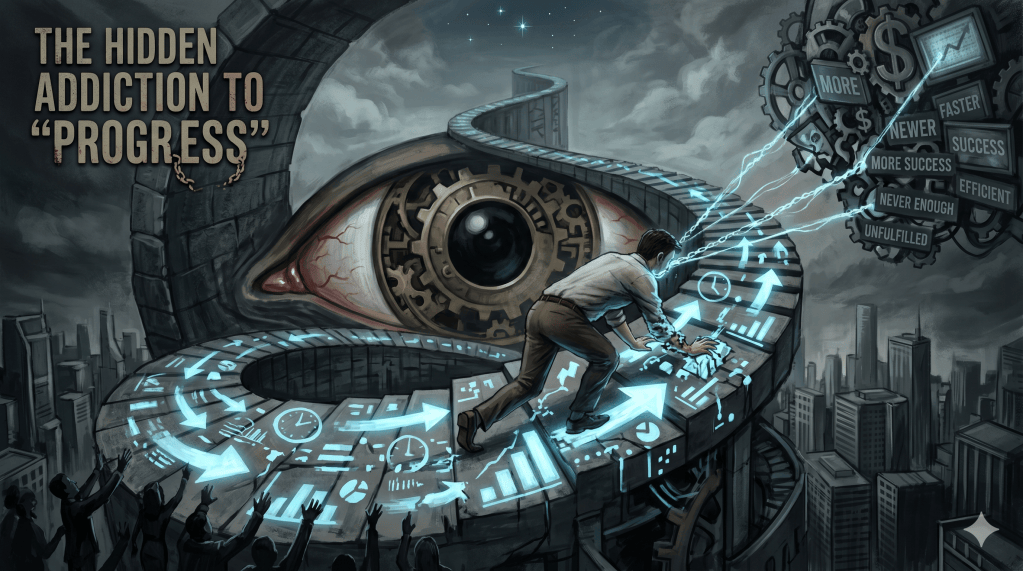
Why constant busyness feels compulsive: the psychology, neuroscience, and history behind our cultural addiction to productivity and “progress.”
Somewhere between the rise of the productivity app and the slow normalization of answering work email at midnight, a quiet shift took place in how many people relate to their own time. Progress stopped being something we pursued toward a specific end — a degree, a promotion, a finished project — and became a state we tried to occupy at all times. Rest started to require justification. A Sunday afternoon with nothing accomplished could trigger a low hum of guilt that no one quite remembered signing up for.
This essay is about that hum. It is about the way “being productive” came to function less like a tool and more like a craving — something pursued not because it reliably made people happier, but because not pursuing it had started to feel unbearable. The atmosphere that produced this shift was not invented by any one generation or platform. It built up over more than a century, through industrialization, through the self-help movements of the twentieth century, through the attention economy of the smartphone era, and through a pandemic that briefly made unstructured time both abundant and, for many people, intolerable.
What follows is an attempt to take that feeling seriously as a psychological and social phenomenon rather than a personal failing. The goal is not to moralize about hustle culture or to tell anyone to work less. It’s to look honestly at what’s happening in the brain and in the broader culture when “getting things done” starts to feel less like a choice and more like a need — and at what the research from psychology, neuroscience, and sociology actually says about why that happens. It’s worth saying up front that not all productivity belongs in the same category. Writing a novel for the love of it and checking email every few minutes both count, technically, as “being productive,” but they engage the mind in very different ways — one tends to produce absorption, the other tends to produce compulsion. That distinction runs underneath nearly everything that follows.
How “Progress” Became a Personality Trait
The Industrial Roots of Constant Output
The idea that hard work is morally good did not begin with the factory. It has deep roots in older traditions, including the Protestant work ethic described by sociologist Max Weber, Calvinist ideas about labor as a calling, and the civic virtue Benjamin Franklin preached in his almanacs a century before industrialization took hold. Industrialization did not invent the moral value of hard work, but it transformed it from a virtue into a measurable and continuously monitored practice. Before factories and standardized clocks, most people’s labor followed the rhythms of seasons, daylight, and task completion — you finished when the task was finished, and idleness, while sometimes frowned upon, wasn’t tracked. Industrial labor introduced something different: time itself became the unit being sold, and idle time became, by definition, wasted money. Historians of labor have documented how factory owners in the eighteen and nineteen hundreds actively trained workers out of older, more flexible relationships with time, instituting bells, shifts, and surveillance to enforce constant motion during paid hours.
This mattered less for what it did to the workday and more for what it did to the underlying cultural assumption: that a person’s time has a “should” attached to it, and that unstructured time is suspect. That assumption didn’t stay confined to factory floors. It migrated into how people came to evaluate themselves outside of work entirely.
The Self-Help Boom and the Moralization of Productivity
By the mid-twentieth century, this assumption had found a second home in the self-help industry. Books and seminars on personal effectiveness reframed productivity not just as an economic necessity but as a moral virtue — a sign of discipline, character, and even spiritual worth. Stephen Covey’s widely read work on personal effectiveness in the 1980s, for instance, treated the organization of one’s goals and time as inseparable from the project of becoming a good person.
Many people found real value in frameworks that helped them set goals and follow through on them. The reason productivity systems became culturally dominant is not that they failed — they often worked remarkably well. Millions of people became healthier, more organized, and more capable through structured goal pursuit, and there is little reason to doubt that the underlying tools, used deliberately, produce real benefits. The question this essay is interested in is not whether productivity is useful. It clearly is. The question is what happens when a useful tool becomes a primary source of identity — when the practice that was supposed to serve a person’s goals starts, instead, to define their worth. But it also planted something that would later prove difficult to dislodge: the idea that an unproductive day wasn’t just inefficient, it was a character problem. Once productivity becomes entangled with identity and self-worth, the felt cost of rest goes up. It’s no longer “I didn’t get much done today.” It becomes closer to “I wasted who I am today” — a much heavier sentence to carry.
The Smartphone Era and the Quantified Self
The arrival of smartphones and wearable trackers in the late 2000s and 2010s did not introduce the idea of measuring productivity — people have tracked output, in one form or another, for as long as ledgers and calendars have existed. What changed was the frequency, immediacy, and omnipresence of the feedback. Step counts, screen-time reports, sleep scores, and task-completion streaks turned productivity from something measured occasionally, at the end of a week or a project, into a number that updated continuously, often dozens of times a day. This is often described as the “quantified self” movement, and the shift it produced was less about measurement existing and more about measurement never stopping.
Measurement is not inherently harmful — for many people, tracking habits supports genuine behavior change. The deeper issue isn’t that smartphones made productivity visible; earlier eras also made it visible, through performance reviews, report cards, and ledgers. What smartphones did was compress the interval between effort and feedback down to seconds, and make that feedback available constantly rather than at predictable, occasional checkpoints. A closed ring on a fitness app or a green checkmark on a to-do list became small, frequent hits of feedback, available far more often than any earlier productivity culture could offer. That shift from occasional, milestone-based feedback (finishing a project, getting a promotion) to constant, granular feedback (closing rings, clearing inboxes) is one of the more significant and under-discussed developments of this period, and it sets up the neuroscience discussed below.
The Pandemic Interruption and What It Revealed
The COVID-19 pandemic, beginning in 2020, created an unusual natural experiment. For a period of months, large numbers of people lost access to the external structures — commutes, offices, in-person obligations — that had previously organized their sense of “useful” time. What followed, for many, was not relief but a scramble to manufacture new structure: sourdough starters, daily workout streaks, side projects, online courses. Surveys conducted during this period found that many people reported feeling guilty about unstructured time even when external demands on them had measurably decreased.
This is a useful data point precisely because it isolates the psychological piece from the economic piece. The usual explanation for hustle culture is that people are simply responding rationally to economic pressure — stagnant wages, job insecurity, the need to build a personal brand. That explanation is real and well-supported. But the pandemic showed that even when external pressure briefly eased, the internal compulsion toward visible output often didn’t. That gap between necessity and compulsion is the actual subject of this essay.
What the Brain Is Doing When “Getting Things Done” Feels Like a Need
Dopamine, Prediction, and the Pull of Small Wins
A common misunderstanding is that dopamine is the brain’s “pleasure chemical,” released as a reward once something good happens. Research from the 1990s onward, particularly the work of neuroscientist Wolfram Schultz on what’s called reward prediction error, complicates that picture. Dopamine neurons fire most strongly not simply when a reward arrives, but when a reward is better than expected — and they respond especially strongly to cues that predict an upcoming reward, sometimes more than to the reward itself.
This is why checking off a task, watching a progress bar fill, or seeing a notification badge can produce a small jolt of motivation independent of how meaningful the underlying task actually was. The brain is responding to the structure of the cue-and-reward sequence, not necessarily to the substance of the accomplishment. Psychiatrist and addiction researcher Anna Lembke has argued, in her work on the broader dopamine economy of modern life, that activities offering frequent, small, and easily repeatable rewards — checking email, completing micro-tasks, refreshing a productivity app — can engage the same reward circuitry implicated in more classic forms of compulsive behavior, even though the comparison to clinical addiction should be drawn carefully and is more often a useful analogy than a precise diagnosis.
It’s worth being precise here: this does not mean checking off to-do items is equivalent, clinically, to substance dependence. The neural circuitry involved overlaps, but the intensity, the physiological withdrawal, and the diagnostic criteria are different. What the research does support is a more modest and still meaningful claim: that environments offering frequent, small, low-effort completions can train attention and motivation toward those completions in ways that crowd out slower, less immediately rewarding work — including rest. It’s a partial explanation for something most people recognize without needing the neuroscience: why answering three quick emails can feel more urgent, in the moment, than starting the one piece of work that actually matters that day.
The Goal-Gradient Effect
A second, well-established finding from behavioral psychology is the goal-gradient effect, first documented experimentally by Clark Hull in the 1930s and confirmed many times since: organisms, including humans, increase their effort and speed as they perceive themselves getting closer to a goal. The brain doesn’t just want the goal; it specifically accelerates its pursuit as the goal nears, regardless of whether the goal itself was chosen deliberately or assigned by an app’s design team. This helps explain why clearing the last few items from a to-do list can feel disproportionately urgent compared to the actual importance of those tasks — and why digital products that use progress bars, percentage-complete indicators, or “almost there” messaging are so effective at sustaining engagement. The pull isn’t really coming from the task. It’s coming from proximity to the finish line.
Habit Loops and the Erosion of Deliberate Choice
B.F. Skinner’s mid-twentieth-century research on operant conditioning, particularly his work on variable reinforcement schedules, remains directly relevant here, even though it predates modern technology by decades. Skinner found that rewards delivered on an unpredictable schedule — sometimes after one action, sometimes after many — produce more persistent, harder-to-extinguish behavior than rewards delivered predictably. Many of the systems that structure modern work and self-tracking, intentionally or not, mirror this unpredictable reward structure: you don’t know which email will be important, which post will get traction, which day’s effort will produce a breakthrough. That uncertainty is part of what keeps people checking, working, and optimizing past the point where it’s serving a clear goal.
Over time, behavior that begins as deliberate goal pursuit can shift into habit — a process the psychologist Wendy Wood and colleagues have studied extensively, showing in a frequently cited 2002 study that 43 percent of daily behavior occurs through habitual, rather than consciously decided, processes. When productivity behaviors become habitual rather than chosen, the felt sense of compulsion described at the start of this essay starts to make more neurological sense. It isn’t always a decision to keep working. Often, it’s a habit loop running with minimal conscious oversight.
The Psychology of Self-Worth Tied to Output
Contingent Self-Esteem
Psychologists distinguish between self-esteem that is relatively stable and self-esteem that is contingent — meaning it rises and falls based on specific outcomes, such as appearance, approval from others, or, relevantly here, achievement and productivity. Research by Jennifer Crocker and her colleagues in the early 2000s found that people whose self-worth was strongly tied to academic or professional competence showed greater day-to-day mood instability and were more vulnerable to anxiety and depressive symptoms following setbacks, compared to people whose self-worth rested on more stable foundations like relationships or personal values.
This matters for understanding the addiction-like quality of productivity culture. If a person’s sense of being a good or worthwhile person is contingent on daily output, then an unproductive day isn’t neutral — it’s a small threat to identity. Avoiding that threat by staying constantly busy isn’t laziness or vanity; from the inside, it can feel like basic psychological self-defense.
Self-Determination Theory and the Difference Between Motivation Types
Not all productivity is created equal, psychologically speaking. Self-determination theory, developed by psychologists Edward Deci and Richard Ryan starting in the 1980s and tested extensively since, distinguishes between intrinsic motivation — doing something because it’s inherently interesting or meaningful — and various forms of extrinsic motivation, including the kind driven by guilt, social comparison, or the need to prove one’s worth.
The theory’s central, well-replicated finding is that intrinsically motivated activity tends to support psychological well-being, while activity driven primarily by guilt or external validation tends to undermine it, even when the output looks identical from the outside. Two people can finish the same number of tasks in a day; one experiences it as engagement, the other as compulsion. The behavior looks the same. The internal experience, and its effect on long-term well-being, is quite different. This distinction is one reason that simply “doing more” is not a reliable fix for the discomfort this essay describes — the problem is often not the quantity of activity, but the motivational structure underneath it.
The Hedonic Treadmill
A final, important piece of the psychological picture is the hedonic treadmill, a concept introduced by psychologists Philip Brickman and Donald Campbell in 1971 and refined by subsequent research. The core idea is that people adapt remarkably quickly to positive changes in their circumstances, including achievements, and tend to return to a baseline level of satisfaction shortly after. A promotion, a finished project, or a milestone achievement produces a real but typically short-lived boost in well-being, after which the baseline reasserts itself.
This creates a structural trap for anyone whose well-being depends on continuous achievement: each accomplishment’s emotional payoff fades faster than expected, which can create pressure to chase the next one sooner, and at greater intensity, to recapture the feeling. This is not the same mechanism as classic substance tolerance, but it produces a comparable behavioral pattern — needing more to feel the same effect.
The Social Layer: Comparison, Visibility, and Status
None of this happens in a psychological vacuum. Leon Festinger’s social comparison theory, first proposed in 1954, holds that people evaluate their own abilities and worth largely by comparing themselves to others, particularly others perceived as similar or slightly ahead. Social media platforms, by design, dramatically expanded both the volume and the selectivity of the comparisons available — most people’s public-facing content skews toward accomplishments, milestones, and curated highlights rather than ordinary or unproductive stretches of time.
Research on social comparison and well-being, including work compiled through the 2010s and 2020s, has generally found that frequent upward social comparison — comparing oneself to people who appear to be doing better — correlates with lower mood and higher anxiety, though the causal direction and size of this effect vary across studies and populations. The plausible mechanism relevant here is straightforward: if a person’s social feed constantly displays others’ visible progress, the baseline for what counts as “enough” productivity quietly rises, making ordinary effort feel insufficient by comparison.
Sociologically, this connects to a broader and longer-running cultural pattern that researchers like Tim Kasser have studied under the heading of materialistic and achievement-oriented value systems. Kasser’s research, spanning several decades, has found a consistent association between strongly holding extrinsic, status-oriented values — including achievement visibility — and lower measures of well-being, compared to people who weight intrinsic values, like personal growth and connection, more heavily. It’s worth noting this research is correlational in most of its forms; it shows an association and a plausible mechanism rather than proof that achievement orientation directly causes unhappiness in every individual case. Put plainly: the more a person’s sense of value depends on being seen achieving something, the less stable that sense of value tends to be.
Distinguishing Evidence From Speculation
It’s worth pausing to separate what’s well-supported from what remains more speculative in this account. The neuroscience of dopamine and prediction error is robust and widely replicated, though applying it specifically to productivity apps and to-do lists, rather than to the substances and behaviors it was originally studied in, involves a reasonable but extrapolated inference rather than direct experimental proof. The goal-gradient effect and variable reinforcement are both well-established in behavioral science. Self-determination theory and the distinction between contingent and stable self-esteem rest on a large and fairly consistent body of research. The hedonic treadmill is well documented, though researchers continue to debate how complete and how universal the “return to baseline” really is.
What’s more speculative is the precise claim that today’s “addiction to progress” represents something categorically new in human history, rather than an intensification of long-standing patterns using new tools. The historical throughline from industrial time discipline to self-help moralism to quantified productivity apps is a reasonable narrative supported by the historical and psychological record, but it is, in the end, an interpretation of trends rather than a single proven causal chain.
Conclusion: Where This Leaves Us
The discomfort many people feel during unstructured time is not a personal flaw, and it didn’t appear out of nowhere. It’s the product of overlapping forces that built up over more than a century: an economic system that learned to monetize time itself, a self-help culture that moralized output into identity, a technological environment that turned achievement into a constant, measurable stream rather than an occasional milestone, and a social media landscape that quietly raised the bar for what counts as “enough.” Underneath all of it sits a set of well-documented psychological mechanisms — dopamine’s response to anticipated reward, the pull of a near-finished goal, the instability of self-worth tied to output, and the fading payoff of each new achievement — that make the pattern genuinely difficult to interrupt through willpower alone.
Understanding the mechanism doesn’t dissolve the problem, but it does reframe it. The goal isn’t to feel guilty about feeling guilty, or to add “stop being addicted to progress” to an already crowded to-do list. It’s to recognize that the felt urgency behind constant output is, in large part, a designed and historically constructed experience rather than an inherent law of human nature. The harder question, the one the productivity era mostly avoided, is what a meaningful day looks like when “getting things done” is no longer available as the default measure of a life well spent.









