
Originally published in July 2023 and comprehensively updated/edited in June 2026.
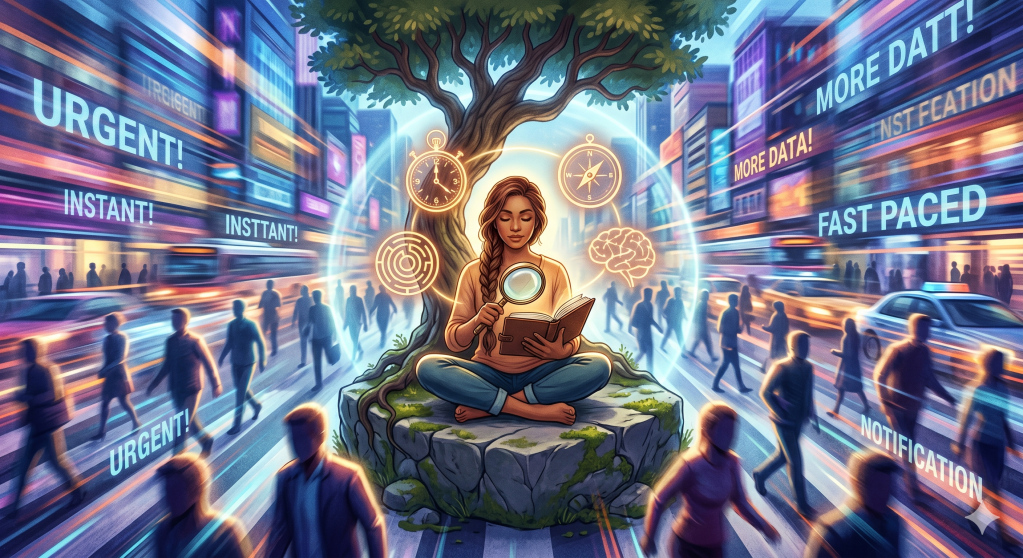
How the speed of modern information culture conflicts with the way human minds actually work — and what cognitive science says about the cost of losing slow thinking.
There’s a particular kind of exhaustion that has become unremarkable in modern life — the feeling of having consumed an enormous amount of information while simultaneously feeling like you haven’t thought about any of it. You’ve scrolled, skimmed, reacted, and moved on. You’ve been busy. You’ve been stimulated. But somewhere between the notifications and the news cycles and the ambient hum of a world that never really quiets down, something got lost. The thinking part. The slow part.
This isn’t a complaint about technology, and it isn’t a call to unplug. It’s an attempt to understand something more fundamental: how the pace of modern information culture interacts with the way human minds actually work — and what happens when the two are badly out of sync.
The tension between fast and slow thinking is not new. Philosophers have wrestled with the difference between impulsive reaction and deliberate reflection for thousands of years. But the social and technological conditions of the past decade have made that tension more acute, more measurable, and, in some ways, more consequential than at any point in recent history. Understanding why requires taking seriously both the science of cognition and the broader cultural forces that have shaped how we relate to information, time, and each other.
The Architecture of Human Thinking
Cognitive science has long recognized that the mind operates across two broad registers. One is fast, automatic, and largely unconscious — the mode that recognizes faces, finishes familiar patterns, and generates immediate emotional responses without being asked. The other is slower, more deliberate, and metabolically expensive: the kind of thinking you use when following a complex argument, weighing a difficult decision, or resisting an impulse you know you’ll regret. Daniel Kahneman’s 2011 book Thinking, Fast and Slow gave these modes their popular names — System 1 and System 2 — and while the terminology has been debated and refined by subsequent researchers, the core observation has held up well.
Both modes are necessary. Fast thinking kept people alive across most of evolutionary history, and the ability to act quickly on incomplete information remains genuinely valuable. The problem isn’t that fast thinking exists. The problem is what happens when an entire information environment is optimized to trigger it, almost exclusively, while providing almost no conditions for the slower kind to take hold.
The Attention Economy and Its Costs
The phrase “attention economy” has been used so often it risks becoming a cliché, but the underlying economic reality it describes is worth examining carefully. Digital platforms — social media feeds, news aggregators, video recommendation engines — generate revenue through advertising. Advertising revenue scales with time on platform. Time on platform scales with engagement. And engagement, as it turns out, is most reliably produced not by content that informs or enriches, but by content that provokes an immediate emotional reaction.
Research on social media engagement patterns has consistently found that content evoking anger, outrage, or anxiety spreads faster and farther than content designed to explain or to calm. A 2018 study by researchers at MIT, published in Science, tracked the spread of true and false news stories on Twitter over more than a decade and found that false stories spread faster, reached more people, and penetrated deeper into social networks than accurate ones. The most shared falsehoods tended to be novel — surprising, counterintuitive, or emotionally charged — while accurate information tended to be more mundane.
This isn’t primarily a story about gullibility. It’s a story about how information architecture interacts with human psychology. When people are presented with a continuous stream of content competing for limited attention, the material that wins tends to be whatever most reliably triggers a fast, reflexive response. The nuanced, the complex, and the slow-to-develop are systematically disadvantaged — not because people don’t value them, but because the competitive environment selects against them.
What Acceleration Does to the Mind
The consequences of living in a high-velocity information environment aren’t purely philosophical. They show up in measurable ways.
Attention, Anxiety, and the Always-On Brain
Research on smartphone use and cognitive performance has documented a phenomenon that might be called the “brain drain” effect. A 2017 study from the University of Texas at Austin found that the mere presence of a smartphone on a desk — even turned face-down, even switched to silent — reduced participants’ available cognitive capacity on tasks requiring sustained attention. The device didn’t need to be active. The habit of attending to it was sufficient to divide the mind.
This might seem trivial, but it points to something significant: the cost of constant availability isn’t just the time spent responding to messages or scrolling through feeds. It’s the background cognitive load of maintaining readiness to do so. The mind that is perpetually braced for interruption is not in the same state as the mind that has been allowed to settle.
Psychologists use the term “attentional residue” to describe the cognitive trace left by incomplete tasks or ongoing concerns. When you switch from a demanding activity to something else, part of your attention lingers on what you left behind. In a normal workday, this effect is manageable. But when the “incomplete task” is an always-updating stream of social content, email, and news — when there is, in principle, always more to check — the residue becomes chronic. Sustained, focused attention becomes harder to achieve even when the conditions for it exist.
The relationship between information acceleration and anxiety is more complex. Some degree of vigilance is adaptive. But research on media consumption and psychological wellbeing has found that high-frequency news consumption — particularly of negative or conflict-driven content — is associated with elevated stress, increased feelings of helplessness, and reduced sense of personal agency. The mechanism appears to involve repeated activation of the brain’s threat-detection systems without corresponding opportunities for resolution or action.
The Loss of Cognitive Slack
Economists use the term “slack” to describe unused capacity in a system — resources that aren’t fully utilized during ordinary operations, and that become available when unusual demands arise. Cognitive scientists have increasingly applied a similar framework to mental life.
A mind with some slack — some capacity that isn’t already allocated to monitoring, responding, and processing — is a mind that can think. It can make unexpected connections, work through problems that don’t have obvious solutions, and engage in the kind of wandering, exploratory cognition that often produces creative insight. Neuroscience research on the brain’s “default mode network” has found that this seemingly idle mental activity is anything but purposeless: it appears to play a role in memory consolidation, social cognition, planning, and the integration of experiences into coherent self-understanding.
This is also where boredom fits into the picture — and it fits in ways that are easy to underestimate. Boredom has a bad reputation, especially in a culture that treats stimulation as the default and its absence as a problem to be solved. But psychologists who study the state have found that it often functions as a gateway. When the mind is under-occupied, it tends to turn inward, to wander, to make associations that more focused attention wouldn’t permit. Many people report that their most original ideas — the solutions that appear in the shower, the connections that surface during a long drive — arrive precisely in those unstimulated moments. A society that has effectively eliminated boredom by making a device available in every idle second may have inadvertently eliminated some of the mental conditions from which genuine originality emerges.
When the information environment fills every available moment — when the commute is for podcasts, the waiting room is for scrolling, and the few minutes before sleep are for one last check of the feed — cognitive slack disappears along with the boredom it might have produced. The mind is always occupied, always processing, but not always thinking in the deeper sense.
Slow Thinking as a Cultural Practice
Recognizing the neurological value of slower cognition raises a harder question: What are the social and institutional conditions that have historically made it possible? And which of those conditions have changed?
The Cultural History of Deliberation
Across many different historical contexts, cultures developed practices explicitly designed to slow down judgment and deepen reflection — meditation, prayer, silent retreats, philosophical dialogue, study circles. These weren’t fringe activities. They were, in many societies, marks of cultivation and wisdom. The relationship between slowness and seriousness was well understood: you didn’t issue a verdict on a complex matter the moment it was raised. You thought about it.
That cultural norm has eroded considerably, and the erosion predates social media. The acceleration of news cycles in the cable television era of the 1980s and 1990s introduced the expectation of immediate reaction and continuous commentary. By the time digital social platforms arrived, the infrastructure of instant opinion was already in place. What the platforms did was democratize and intensify it — extending the pressure to react immediately from professional commentators to virtually everyone with an internet connection.
Reading, Writing, and the Training of the Slow Mind
One of the more thought-provoking arguments in the literature on cognition and culture concerns what extended reading does to the brain. Maryanne Wolf, a cognitive neuroscientist at UCLA who studies literacy and the reading brain, has argued that deep reading — the kind of sustained engagement with complex text that involves tracking arguments across pages and chapters, inhabiting the perspective of characters or thinkers different from oneself, and following chains of reasoning over time — is not a natural capacity. It has to be built, through practice, and it builds specific cognitive habits and neural pathways.
What Wolf calls the “reading circuit” is, in a real sense, a machine for slow thinking. It requires and cultivates patience, the ability to suspend judgment, and the capacity to hold complexity in mind. The question she and others have raised is what happens to that circuit when sustained reading is increasingly displaced by the kind of skimming, scanning, and rapid-fire visual processing that digital media tend to encourage. The answer, the emerging evidence suggests, is that the circuit weakens — not from lack of intelligence, but from lack of practice.
The Social Dimension: Speed and the Collapse of Epistemic Trust
Slow thinking isn’t only an individual cognitive practice. It’s also a social one. And the acceleration of information culture has had consequences not just for individual minds, but for the shared epistemic infrastructure — the institutions, norms, and habits of truth-seeking — that societies depend on.
Why Complexity Gets Simplified
When information moves fast and attention is scarce, complex ideas face a structural disadvantage. A careful, nuanced argument — one that acknowledges uncertainty, distinguishes between what is known and what is speculated, and resists clean narrative closure — is harder to convey in the compressed formats that dominate contemporary media. The simpler version, even if less accurate, travels better.
This creates pressure throughout information ecosystems toward simplification, polarization, and false certainty. Researchers, journalists, and public intellectuals who want to reach audiences have strong incentives to strip away the qualifications and deliver clean, confident takes. Those who resist this pressure often find themselves speaking to smaller audiences, while those who embrace it — even when the content doesn’t warrant the confidence — build larger followings.
The result is a kind of epistemic distortion. The public discourse on complex empirical questions — economic policy, medical science, social research — frequently looks more certain and more divided than the underlying evidence actually supports. The real distribution of expert opinion, which often involves significant uncertainty and genuine ongoing debate, gets compressed into a small number of competing confident positions. This makes it harder for people to reason well about the actual state of knowledge, and easier to mistake tribal affiliation for informed understanding.
The Polarization Loop
Social psychologists have documented a mechanism through which this dynamic becomes self-reinforcing. When people feel that their group identity is under threat — and strong, confident opposing positions tend to produce that feeling — they tend to become more reactive, less open to updating their views, and more likely to seek out information that confirms what they already believe. This is confirmation bias under social pressure, and it’s been observed consistently across a wide range of political and social contexts.
The architecture of social media platforms accelerates this loop. Algorithmic curation, driven by engagement optimization, tends to surface content that provokes strong reactions. Strong reactions tend to be negative reactions to outgroup behavior — things that make you angry about the other side. Anger at the outgroup strengthens identification with the ingroup. Stronger ingroup identification increases sensitivity to outgroup threat. More sensitivity to threat increases engagement with threatening content. And so the cycle runs.
This isn’t conspiracy. Nobody designed these platforms specifically to degrade civic epistemics. But the incentive structures produced that outcome, and by the early 2020s, the evidence that something significant had gone wrong in the information environment was difficult to ignore. Rates of reported trust in institutions, media, science, and democratic processes declined across most developed democracies during this period. The causal picture is complicated — many factors were in play — but the role of information speed and architecture in undermining the slow, deliberative practices that epistemically healthy societies depend on seems hard to dismiss.
The Countermovement: Slowness as Response
By the mid-2010s, a recognizable cultural countermovement had begun to take shape — one that, in various forms, tried to reclaim slower modes of engagement.
Mindfulness Goes Mainstream
The popularization of mindfulness meditation over the past two decades is striking partly because of how mainstream it became. Practices drawn from Buddhist contemplative traditions were adopted by corporations, hospitals, schools, and military organizations. By the early 2020s, the market for meditation apps had grown into a billion-dollar industry — which is either evidence of genuine need or evidence of successful marketing, and probably both.
The scientific literature on mindfulness has its complications. Early enthusiasm sometimes outpaced evidence, and replication challenges in psychological research have meant that some specific claims need to be held more carefully than popular coverage suggested. But the core finding — that deliberate attention practices have measurable effects on stress and emotional reactivity — has been consistent enough to take seriously. What the movement represented culturally, in any case, was a mass acknowledgment that the default pace of contemporary life was imposing real costs. Even in its most commercial forms, it pointed toward something genuine.
The Long Read, the Podcast, and the Return of Long-Form
Alongside the mindfulness trend, there was a parallel development in media: a significant audience appetite for longer, more immersive content emerged alongside — and perhaps partly in reaction to — the dominance of short-form social media.
The success of long-form journalism outlets, the growth of narrative podcasts featuring multi-hour deep dives on complex topics, and the continued strength of the book market (both physical and audio) all suggested that the demand for slow content had not disappeared. It had, perhaps, sharpened. When everything else was short and reactive, things that asked more of you and delivered more in return stood out.
This doesn’t mean a clean victory for depth over speed. The media landscape remained — and remains — one in which short-form content dominates by volume. But the persistence of appetite for serious long-form content is itself meaningful data about what people actually want, as distinct from what algorithmic systems are optimized to deliver.
Living with Fast and Slow: What Actually Helps
Research and cultural observation together suggest some things about how individuals and institutions might navigate the tension between the accelerated information environment and the need for slower, deeper cognition.
Environmental Design Before Willpower
One consistent finding in behavioral science is that environment shapes behavior more reliably than individual willpower. Designing physical and digital environments to reduce friction for slow thinking — and increase friction for impulsive consumption — appears more effective than trying to overcome habits through pure self-discipline.
Practically, this tends to mean things like removing social media applications from the most accessible devices, designating specific times for checking information rather than maintaining continuous availability, keeping reading materials visually and physically available, and creating spaces — even short, regular periods — that are explicitly protected from informational input. These are small environmental adjustments, but the research on habit formation suggests they matter more than they might appear to.
Institutional Cultivation of Deliberation
At the institutional level, organizations that have recognized the cost of accelerated decision-making have experimented with structures designed to slow down consequential choices. Practices like “pre-mortem” analysis — imagining a decision has failed and working backward to identify why — structured devil’s advocacy, and mandatory waiting periods before finalizing important choices all represent attempts to build slower thinking into contexts where fast thinking would be the default.
Educational institutions face a particular version of this challenge: how to cultivate the habits of sustained attention, careful reading, and deliberate reasoning in students whose information environment has been working against exactly those habits.
The Bigger Picture
It’s worth stepping back from the practical and asking what the cultural valuation of speed and slowness says about a society’s deeper commitments.
Speed, in most contemporary contexts, is associated with efficiency, productivity, competitiveness, and relevance. Slowness is associated with lag, falling behind, being out of touch. These are not neutral associations. They reflect a set of values — broadly economic, broadly oriented toward output and performance — that have come to dominate public life in ways that weren’t always assumed and aren’t obviously correct.
The qualities that slow thinking cultivates — careful judgment, genuine understanding, the ability to hold uncertainty without collapsing it prematurely into false certainty, the capacity for empathy that comes from actually inhabiting another perspective rather than skimming its surface — these are not inefficiencies. They are, in many contexts, the most important cognitive capacities human beings have. They are what allow people to make good decisions, build understanding across differences, and engage with genuinely complex problems in ways that don’t make them worse.
The argument for slow thinking isn’t an argument against speed across the board. Fast, automatic cognition is genuinely valuable, and the ability to process information rapidly remains important. The argument is against the systematic marginalization of slower cognition in a media and social environment that selects almost entirely for the fast, the reactive, and the immediate.
Looking Forward
By 2026, the pressures described in this essay have not diminished. If anything, the proliferation of AI-generated content — much of it designed to maximize engagement on the same platforms that drove the original acceleration — has added new layers of complexity to an already difficult information environment. The ability to distinguish careful human reasoning from optimized content production has become a genuine challenge, and the supply of information of every kind, on every topic, continues to grow far faster than any individual’s capacity to evaluate it.
At the same time, there are signs that the conversation about attention, depth, and deliberation has matured. It has moved, somewhat, from being a marginal critique offered by technology skeptics to a more mainstream concern taken seriously by researchers, educators, platform designers, and policymakers. The question is no longer really whether the acceleration of information culture has costs for human cognition — the evidence for that is substantial enough to take seriously. The question is what to do about it, at both the individual and institutional level, in a way that doesn’t require turning back a clock that isn’t going to turn.
That’s a harder question, and it doesn’t have clean answers. What does seem clear is that engaging with it seriously — following the argument, sitting with the uncertainty, resisting the pull toward a simple conclusion — is itself an act of slow thinking. And that’s probably where any meaningful response has to begin.









