
Originally published in September 2023 and comprehensively updated/edited in June 2026.
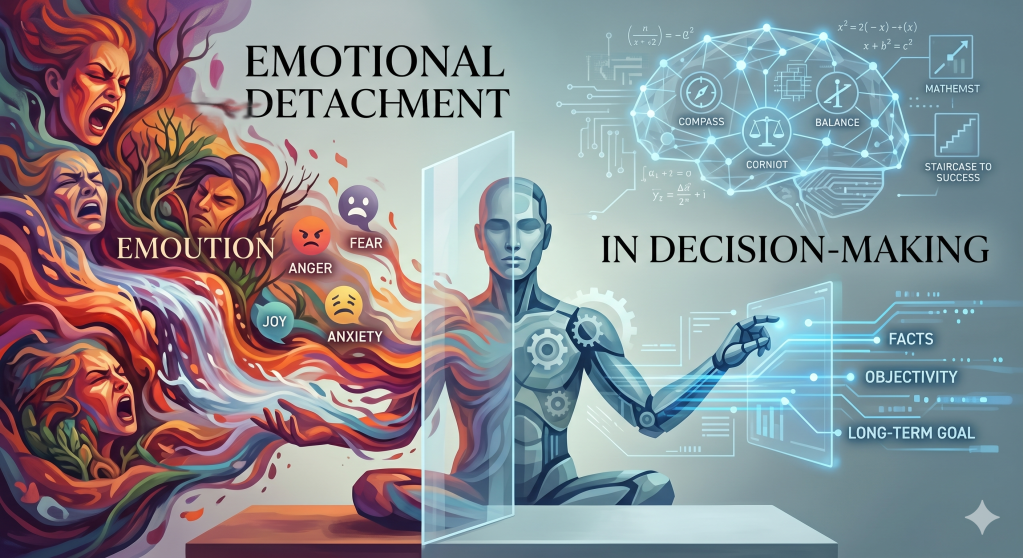
Emotional detachment in decision-making isn’t what neuroscience suggests it is. Discover what research from psychology and brain science reveals about how emotion and reason work together — and when “rational” thinking goes wrong.
There is a particular kind of person who gets held up as the gold standard of rational thinking: the one who doesn’t let feelings get in the way. The surgeon who operates without flinching. The executive who makes layoffs without losing sleep. The investor who sells without sentiment. We tend to admire these figures, or at least respect them, as though the ability to suppress emotion is itself a form of intelligence.
But the science of how humans actually make decisions tells a more complicated story — one that has been building for decades and has only grown more nuanced as neuroscience, psychology, and behavioral economics have matured into serious fields of inquiry. The idea that emotion and reason are opposing forces, and that good decisions require silencing the former in favor of the latter, turns out to be one of the more persistent and consequential myths in how we think about the human mind.
Emotional detachment in decision-making — what it is, when it helps, when it hurts, and why we keep reaching for it — is a topic that sits at the intersection of neuroscience, psychology, and everyday life. Understanding it requires pulling apart some assumptions that have been baked into Western thought for centuries.
The Descartes Problem: Where the Myth Began
The separation of mind and body — reason and feeling — has deep philosophical roots. René Descartes, the 17th-century French philosopher, gave this idea its most influential modern form: the mind as a thing apart, pure and logical, untainted by the messiness of emotion. Feelings were, at best, noise.
That framework didn’t stay in philosophy classrooms. The “rational actor” model that dominated economics for most of the 20th century assumed people make decisions by calmly calculating costs and benefits, free of emotional distortion. The ideal professional, in almost any field, was expected to check emotion at the door.
It’s a seductive framework because it maps onto something real. Panic leads to poor financial decisions. Grief can cloud judgment. Infatuation distorts how we assess risk. The problem was the overcorrection — the leap from “emotions can sometimes mislead us” to “emotions are the enemy of good thinking.”
What Neuroscience Actually Found
The turn away from this model began in earnest with the work of neurologist Antonio Damasio, whose research in the 1980s and 1990s produced findings that challenged the prevailing wisdom in a fundamental way. Damasio studied patients with damage to the prefrontal cortex — specifically the ventromedial prefrontal cortex — who had lost the ability to experience emotion normally. These patients had perfectly intact reasoning abilities by conventional measures: they could analyze problems, hold information in memory, and articulate logical arguments.
But they couldn’t decide anything.
They would spend hours deliberating over trivial choices — what to eat for lunch, which pen to use to sign a form — without arriving at a conclusion. Their personal and professional lives deteriorated. Damasio’s explanation, later formalized as the Somatic Marker Hypothesis and popularized in his 1994 book Descartes’ Error, was that the brain uses emotional signals — what he called somatic markers — as a kind of shorthand guidance system. When we consider a decision, the brain retrieves emotional memories associated with similar past choices. These feelings don’t override reason; they help focus it. Without them, the decision-making process becomes paralyzed by an infinite regression of analysis.
This was a remarkable finding because it inverted the popular assumption. Emotion wasn’t the thing getting in the way of good decisions. In many situations, emotion was what made decision-making possible at all.
Later neuroscience has both confirmed and complicated Damasio’s picture. Researchers including Joseph LeDoux mapped the role of the amygdala — a small almond-shaped structure deep in the brain — in processing emotional responses, particularly fear. The amygdala can trigger a fear response before the cortex has time to consciously process what’s happening. This is the biological basis for jumping at a loud noise before you’ve identified what it is. It’s a fast, rough system, built for survival.
The prefrontal cortex, by contrast, is slower, more deliberate, and more capable of nuance. It’s where longer-term planning, consequence evaluation, and the suppression of impulsive responses happen. Healthy decision-making, in the modern neuroscientific view, involves a dynamic interaction between these systems — not the domination of one over the other.
The Emotional Regulation Spectrum
What most people mean by “emotional detachment” in decision-making isn’t the complete absence of emotion — it’s what psychologists call emotion regulation: the ability to modulate emotional responses so they inform rather than overwhelm judgment.
Emotion regulation is not the same thing as emotional suppression, and this distinction matters enormously. Suppression — simply pushing a feeling down without processing it — tends to backfire. Research by psychologists James Gross and others has consistently shown that suppression doesn’t reduce emotional experience; it just prevents its expression. The emotional state persists, often intensifying, while cognitive resources are drained by the effort of containment. People who rely heavily on suppression tend to make worse decisions under pressure, not better ones.
What works better is something closer to reappraisal — consciously reframing how one thinks about a situation so that the emotional response itself shifts. A surgeon thinking of a patient as a collection of physiological systems to be repaired, rather than a frightened person in pain, is engaging in reappraisal. This approach genuinely modifies the emotional response, freeing up cognitive resources and reducing the distorting effects of intense feeling without eliminating emotional processing entirely.
The difference is important for how we train professionals. In medicine, law, finance, and crisis management, the goal shouldn’t be to produce people who feel nothing — it should be to produce people who can regulate their feelings effectively enough to act clearly under pressure. These are different skills, and they require different kinds of training.
When Detachment Helps — and When It Doesn’t
There are decision environments where emotional distance genuinely improves outcomes. High-stakes medical procedures require a kind of calm focus that would be disrupted by intense emotional engagement with the patient’s suffering. Financial trading in volatile markets often goes worse when traders become emotionally invested in positions they’ve already taken. Legal judgment benefits from a certain coolness toward the parties involved.
But the conditions under which detachment helps are narrower than commonly assumed, and the costs of getting it wrong are significant.
Research in behavioral decision theory, including work by Nobel laureate Daniel Kahneman and Amos Tversky, identified a range of cognitive biases that have nothing to do with emotion — they arise from systematic quirks in how the rational mind processes probability, uncertainty, and time. The planning fallacy (underestimating how long things will take), the availability heuristic (overweighting information that comes to mind easily), and anchoring (over-relying on the first piece of information encountered) all operate in domains where people believe they are thinking most clearly and rationally.
Emotional detachment doesn’t protect against these biases. In some cases, it may enhance them — by eliminating the discomfort that might otherwise signal something is wrong.
There is also the question of what emotions are communicating. Fear, for instance, is often dismissed as irrational in high-stakes professional contexts. But fear is frequently a signal that something important has been noticed, even if it hasn’t been consciously identified. The feeling of unease before signing a contract, the reluctance to board a particular flight, the discomfort in a business negotiation — these sensations may reflect pattern-recognition processes operating below conscious awareness, though they can also be influenced by anxiety, bias, or unrelated emotional states. Dismissing them reflexively isn’t rational, but neither is treating every twinge of discomfort as a signal worth heeding. The skill lies in knowing the difference.
Psychologist Gary Klein, whose research focused on how experts make decisions under pressure — firefighters, military commanders, emergency room doctors — found that experienced professionals rarely make decisions by systematically evaluating all available options. Instead, they recognize situations as instances of familiar patterns and generate responses almost automatically. Emotion plays a central role in this recognition process. The expert’s “gut feeling” is not a failure of rational thinking; it is the distilled product of thousands of hours of experience encoded in emotional memory. Klein documented cases where veteran firefighters felt sudden, unexplained unease about a structure that appeared routine — and pulled their crews out shortly before a floor collapsed. They couldn’t articulate why they were alarmed. The environmental cues were too subtle for conscious processing, but their trained perceptual systems had registered them anyway. The feeling was the signal.
Organizational Culture and the Cult of Detachment
The valorization of emotionless decision-making isn’t just a personal habit — it’s embedded in the culture of many institutions. Corporations, military organizations, certain fields of medicine, and financial institutions have historically rewarded people who project cool analytical distance, and punished those who express emotional engagement.
The effects of this cultural norm are worth examining. On one hand, professional environments that tolerate excessive emotional volatility can become chaotic and prone to reactive decisions. On the other hand, institutions that systematically select for and reward emotional suppression may end up with leaders who are worse decision-makers than they appear, and who are poorly equipped to navigate situations that require empathy, moral reasoning, or the ability to read human dynamics.
Some of the most dramatic organizational failures in recent decades — in finance, in medicine, in technology — have involved environments where a certain kind of cold analytical confidence was so highly valued that dissenting voices, including voices of concern or conscience, were systematically ignored or driven out. The 2008 financial crisis, for example, produced abundant testimony from people who had felt that something was wrong but found their unease dismissed as irrationality by those with greater institutional authority. The problem wasn’t too much emotion. It was the suppression of emotional signals that might have introduced corrective pressure.
The Moral Dimension: Empathy and Ethical Decision-Making
Emotional detachment intersects with ethical decision-making in ways that deserve particular attention. Much of moral philosophy assumes that good ethical reasoning requires stepping back from personal feeling — seeing situations from an impartial perspective, as the philosopher Peter Singer has argued, or applying universal principles regardless of personal ties, as Kant proposed.
There’s merit in this. Nepotism, tribalism, and in-group favoritism are all, in part, products of emotional attachment operating without check. A judge who feels personal sympathy for a defendant cannot deliver impartial justice. A politician who feels intense loyalty to their ethnic or regional community may find it difficult to act for the broader public good.
But the evidence from psychology and neuroscience suggests that purely impartial moral reasoning — emotion stripped away entirely — doesn’t produce better ethical outcomes. It may produce worse ones. Psychopathy, which involves a profound deficit in emotional response, particularly empathy, is not associated with superior moral judgment. Psychopaths do not make more consistently ethical decisions; they make decisions that are unconstrained by the emotional responses that typically regulate harmful behavior toward others.
The neurological evidence suggests that moral decision-making involves the integration of emotional and rational processes. Studies using neuroimaging have found that ethical dilemmas — the classic trolley problem, for instance — activate both emotional and deliberative regions of the brain. People who show reduced emotional activation tend to make decisions that are logically consistent but violate intuitive moral sensibilities. Neither pure logic nor pure emotion reliably produces outcomes that most people would recognize as ethical. The interaction between them seems to matter.
Stress, Detachment, and Cognitive Load
One factor that shapes how emotional detachment affects decision-making is stress. Under low-stress conditions, people have more cognitive resources available and can engage both emotional and analytical processes more flexibly. Under high stress, the picture changes substantially.
Stress activates the body’s threat-response system — cortisol, adrenaline, narrowed attention. These physiological changes were built for immediate physical danger. They are poorly suited to complex multi-variable decisions that require weighing distant consequences, and they push the brain toward faster, more automated responses. Attempts to impose emotional detachment under these conditions can produce a kind of frozen deliberateness — a mechanically rational process that fails to incorporate the intuitive, pattern-matching input that the emotional system would otherwise contribute. The result isn’t calm clear-sightedness. It’s a slower, less adaptive response that feels controlled but is missing important information.
Military and emergency services training has, in recent years, moved toward approaches that acknowledge this dynamic. Rather than trying to eliminate emotional response under pressure, the better programs train people to function with elevated physiological arousal — to make good enough decisions quickly, accepting imperfection, rather than seeking the impossible goal of emotionless clarity.
Individual Differences and the Limits of a Single Model
Not everyone processes emotion in the same way, and individual differences in emotional regulation ability have significant implications for how “detachment” manifests in practice. Research in trait psychology identifies substantial variation in emotional reactivity, empathy, and the ability to regulate affect across individuals. Cultural context also shapes which emotional expressions are appropriate in professional settings, often in ways that map imperfectly onto actual cognitive function.
The image of the ideal decision-maker — calm, analytical, unmoved by feeling — reflects a particular cultural and demographic archetype as much as it reflects any psychological truth. Emotional expressiveness has historically been more pathologized in men than in women in professional contexts, while emotional expressiveness in women has often been used to question their judgment. Neither pattern reflects the actual relationship between emotional expression and decision quality.
What the evidence suggests is that there is no single emotional style that produces optimal decisions across all contexts. Flexibility matters more than the presence or absence of emotional response. People who can move between emotional engagement and analytical distance as the situation demands — who can read the room, feel the weight of a moral choice, and also step back to examine their assumptions — tend to outperform both the chronically detached and the chronically reactive.
Practical Implications: What Good Decision-Making Actually Looks Like
Given everything the science suggests, what does good decision-making in emotionally complex situations actually look like in practice?
It begins with the recognition that emotional responses are data. A feeling of unease, enthusiasm, dread, or excitement in response to a decision isn’t a distraction from thinking — it’s a communication from systems in the brain that have processed information through channels that don’t always surface in conscious reasoning. The first step is learning to notice these signals without immediately being controlled by them.
Reappraisal — the practice of consciously recasting the emotional meaning of a situation — is one of the most well-supported tools for this. A doctor who reframes a difficult conversation with a patient’s family as an opportunity to provide clarity and support, rather than as an ordeal to endure, is genuinely changing both their emotional state and the quality of their engagement. This isn’t suppression; it’s a shift in perspective that alters the emotional response itself.
Structuring decisions to reduce cognitive load helps. Using checklists, decision frameworks, and protocols in high-stakes environments isn’t about removing human judgment — it’s about offloading routine cognitive work so that emotional and deliberative resources can focus on what actually requires them. The aviation industry’s shift toward standardized protocols dramatically reduced crash rates not by making pilots more robotic, but by freeing their attention for the genuinely novel and dangerous.
And creating space between stimulus and response — pausing before a decision, sleeping on it, talking through options with someone who has different knowledge — allows the faster emotional responses time to settle and the slower deliberative system time to engage.
Conclusion: Rethinking the Ideal Mind
The story of emotional detachment in decision-making is, in many ways, a story about a myth that was useful for a while and then stopped being useful, but hasn’t fully been replaced. The myth — that good thinking is cold thinking, that the rational mind works best when freed from feeling — reflected a genuine insight about the dangers of reactive, unregulated emotion. The problem was the overcorrection.
The evidence from neuroscience, psychology, and behavioral science consistently points toward a more integrated picture: the goal is not the elimination of emotional influence, but its thoughtful incorporation. What separates good decision-makers from poor ones, in most of the research, isn’t emotional absence — it’s the flexibility to move between emotional engagement and analytical distance as the situation demands, and the self-awareness to know which mode a given moment requires.
The most important decisions any of us will face — about health, relationships, work, and ethics — will be shaped by both reason and emotion whether we intend that or not. The question isn’t whether feeling belongs in the process. The question is whether we’re paying close enough attention to know what our feelings are actually telling us.









