
Originally published in October 2023 and comprehensively updated/edited in June 2026.
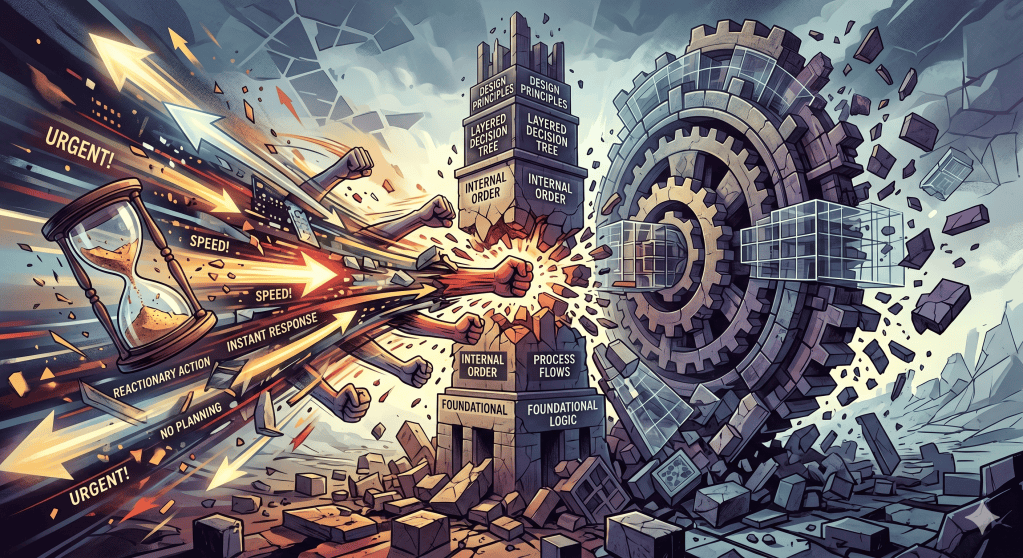
Explore why fast decisions damage complex structures — and what psychology, neuroscience, and behavioral science say about protecting them.
Structural collapse rarely begins with catastrophe. More often it begins with a series of decisions that each seem perfectly reasonable in isolation — a manager who skips a consultation because the timeline is tight, a government that compresses deliberation because the crisis feels urgent, a parent who makes a unilateral call because the moment won’t wait. None of these choices look like destruction when they happen. The damage is in what they accumulate into: a slow erosion of the expectations, relationships, and trust that allow complex systems to function.
This is the central problem with fast decisions. The harm they cause is usually not immediate and usually not obvious. It is structural — meaning it lives in the connections between people and institutions rather than in any single outcome. By the time it becomes visible, it typically looks like something else: a culture problem, a talent problem, a leadership crisis. Its actual origin was procedural.
We live in an era that prizes speed. The cultural pressure to act quickly, respond immediately, and decide before the moment passes has intensified across every domain — business, politics, relationships, technology, medicine. And yet the science of how humans actually make decisions under pressure tells a complicated story, one that should give us pause. Speed is not neutral. When decisions are made too quickly, they tend to bypass the cognitive processes that catch errors, weigh trade-offs, and preserve the integrity of complex systems. Understanding why that happens — and why structures are so vulnerable to it — is the aim of this article.
The Architecture of a Decision
Decision-making is not a single mental act. It is a process — one that, when functioning well, involves gathering information, evaluating options, anticipating consequences, and checking conclusions against prior knowledge and values. Each of those steps takes time. And each one is vulnerable to being skipped when that time is taken away.
The psychologist Daniel Kahneman described this in terms of two systems of thought. System 1 is fast, automatic, and intuitive — the mental equivalent of a reflex. System 2 is slow, deliberate, and analytical — the kind of thinking that requires conscious effort. Under normal circumstances, they work together: System 1 handles the routine, and System 2 gets called in when something is complicated or unfamiliar.
The problem with pressure — whether time pressure, social pressure, or the ambient urgency of a fast-moving environment — is that it suppresses System 2 and hands almost everything over to System 1. This is sometimes adaptive. In a genuine emergency, a fast intuitive response can save a life. But in the complex, interconnected environments where most consequential decisions are made, System 1 is not equipped for the job. It relies on heuristics — mental shortcuts — that work well in familiar situations and fail in novel or high-stakes ones.
How Heuristics Mislead Us
The most well-documented heuristics are also the most dangerous under fast-decision conditions. Availability bias leads people to overweight recent or memorable information at the expense of a more complete picture. Confirmation bias causes people to latch onto evidence that supports what they already believe. The affect heuristic causes decisions to be driven by how something feels rather than what the evidence shows.
None of these are personality flaws. They are features of human cognition — efficient under ordinary conditions, unreliable under pressure. When a decision needs to be made in seconds rather than hours, the mind defaults to these shortcuts. The shortcuts feel like reasoning. They produce conclusions that feel justified. But they are systematically biased in ways that become visible only after the fact, and research has consistently shown that time-constrained decision-making increases reliance on them — particularly when the decision involves trade-offs between competing values or uncertain outcomes.
What “Structure” Actually Means
Structure is not just a physical thing — a building, a budget, an org chart. It is the set of relationships, rules, and expectations that allow a complex system to function coherently over time.
A healthy organizational structure isn’t just a hierarchy of job titles. It is a web of understood roles, established processes, and accumulated trust that allows people to coordinate without constant negotiation. A healthy relationship structure involves not just affection but shared expectations about how conflict will be handled and decisions will be made. Even a democratic institution is really a structure of procedural norms — ways of doing things that have been tested over time and exist to prevent the concentration of power or the silencing of dissent.
What these structures share is that they are built slowly and destroyed quickly. They accumulate through repeated interaction, adjustment, and trust-building. They collapse when a fast decision — made without adequate information, consultation, or reflection — violates one of the core assumptions the structure depends on.
The Role of Trust
Trust is the load-bearing element in almost every human structure, and it is among the first casualties of fast decision-making. Behavioral economists and organizational psychologists have repeatedly documented its asymmetry: it accumulates slowly and erodes quickly.
The mechanism is straightforward. When decisions are made too quickly in positions of authority, they signal what the decision-maker actually values. People who expected to be consulted and weren’t update their model of the relationship. They don’t necessarily say so. They simply stop investing in the informal structures — the candid conversations, the early warnings, the volunteered feedback — that make institutions function. The damage is not in the specific decision. It is in what the decision communicates about every future one.
The Neuroscience of Urgency
When the brain perceives a time threat — a deadline, a demand for an immediate response, the social pressure of eyes on you — it activates the sympathetic nervous system and releases stress hormones including cortisol and norepinephrine. This arousal state has the evolutionary purpose of narrowing attention and accelerating motor responses. For a predator in the environment of early human ancestors, that was exactly what was needed. For a manager deciding whether to restructure a team, or a policymaker responding to a crisis, the same neurological state creates serious problems.
The prefrontal cortex — the region most associated with planning, impulse control, and integration of complex information — is among the brain areas most affected by high stress arousal. Neuroscientist Amy Arnsten at Yale has described this as a “top-down” cognitive impairment: the faculties that exist to override instinct and heuristic are the ones most significantly reduced under pressure. What remains more active is the amygdala-driven system associated with threat response, which is fast and efficient and frequently ill-suited to complex social situations.
The impairment is not simply a general fog. It is specific in ways that matter for decision quality. Under acute stress, attentional scope narrows — people focus on the most salient feature of a situation and become less able to integrate peripheral information that might be important. Working memory, which holds multiple considerations simultaneously and allows them to be weighed against each other, is measurably reduced. Cognitive flexibility — the capacity to shift perspective, consider alternatives, and update conclusions when new information arrives — declines. These are precisely the capabilities that consequential decisions depend on most. What stress leaves relatively intact is the ability to act on the most obvious interpretation of a situation using the most familiar available response. That is useful for escaping immediate physical danger. It is not useful for navigating organizational complexity, family conflict, or institutional crisis.
When people describe making a decision “in the heat of the moment” that they immediately regretted, they are often describing the aftermath of exactly this state. This is not a metaphor. It is a physiological sequence that researchers have documented through neuroimaging and hormonal assays — one that reliably degrades the quality of decision-making in exactly the domains where structure is most fragile.
When Expertise Changes the Equation
It would be inaccurate to conclude that fast decisions are simply bad decisions. The psychologist Gary Klein spent years studying expert decision-makers — firefighters, military commanders, trauma surgeons, airline pilots — and found something that complicates the slow-is-better narrative. Experienced practitioners in high-stakes fields often make rapid decisions that are remarkably good, not because they bypassed careful thinking, but because their accumulated expertise had internalized a form of pattern recognition that made the “slow” cognitive work largely automatic.
Klein called this recognition-primed decision-making: experts match incoming situations to previously experienced patterns, rapidly simulate a course of action, and move — all without the deliberate step-by-step analysis that Kahneman’s System 2 requires. For a veteran emergency physician deciding whether to intubate, or a firefighter reading the color of smoke through a door, speed born of deep expertise is not the enemy of good decisions. It is the mechanism.
The distinction that matters, then, is not simply fast versus slow. It is whether the decision-maker has the expertise to make rapid pattern recognition reliable in that specific domain — and whether the situation genuinely resembles the ones that built that expertise. The damage from fast decisions tends to come when people apply confident rapid judgment to situations that are novel, complex, or outside their actual area of competence — which, in organizational and institutional life, happens constantly. Most leaders are not firefighters reading smoke. They are generalists navigating situations that resist the kind of pattern matching that makes expertise reliable.
The Myth of the Decisive Leader
Culture has not fully absorbed this distinction. In business, politics, and popular culture alike, decisiveness is frequently treated as a virtue in itself. The leader who acts quickly is celebrated. The leader who deliberates is characterized as weak.
Organizational research tells a more complicated story. Leaders who are culturally rewarded for fast decision-making tend to make more errors of overconfidence and are less likely to update their beliefs when presented with contradicting evidence. More critically, they create a cultural norm that makes it harder for anyone around them to slow a decision down — even when slowing down is exactly what the situation requires. The people closest to the information become reluctant to speak up if the expectation is that decisions have already been made. The result is not decisive leadership. It is leadership insulated from the information it most needs.
How Speed Accumulates Into Collapse
A single fast decision rarely destroys a structure outright. What tends to happen is accumulation — a series of individually defensible fast choices that, together, degrade the system’s ability to function.
The pattern typically works like this: under pressure to move quickly, a decision-maker bypasses the usual consultation process and acts unilaterally. The decision may even be correct. But the process violation creates resentment and signals that input is not valued. Over time, team members become less forthcoming with information, because they no longer believe it will be used. The decision-maker, receiving less information, makes the next fast decision with even less to go on. Errors compound. The informal feedback loops that effective organizations depend on — the honest conversations that happen when trust is intact — gradually go quiet.
By the time the structural damage is visible, it looks like a culture problem or a talent problem. Its origin was procedural: the repeated choice to move fast and bypass the slower, more inclusive processes that keep complex human systems coherent.
Family systems researchers have identified similar dynamics in households where one partner’s rapid unilateral decision-making gradually erodes the other’s sense of agency, leading to withdrawal and the eventual collapse of collaborative functioning. Political scientists have analyzed how the compression of legislative deliberation — the drive to act before opposition can organize — produces laws with unintended consequences that destabilize the very institutions they were meant to strengthen. The specific domain changes. The mechanism is the same.
Digital Acceleration and the Speed of Information
The past decade has introduced a powerful accelerant into this already volatile equation, and by October 2023 — when this essay was first drafted — its effects on organizational decision-making had become impossible to ignore. The always-on nature of contemporary communication has compressed the expected response time for nearly every kind of decision, rewriting norms so gradually that most people no longer notice how dramatically they have shifted.
Consider email alone. Two decades ago, a same-day reply was considered prompt. By the mid-2010s, the expectation had compressed to hours. Today, in many workplaces, an email unanswered for more than a few hours reads as avoidance. The modern inbox has become a continuous queue of implicit demands, each one carrying an implied urgency that rarely reflects the actual priority of the underlying issue. Slack and similar messaging platforms have accelerated this further. Their design — the visible “online” indicator, the notification badge, the threading that makes delayed responses conspicuous — creates a low-level pressure toward constant availability that makes genuine reflection feel like negligence.
Social media operates on an even shorter cycle, and with consequences that extend well beyond individual communication. Platforms reward early responses over accurate ones: the first take on a breaking situation receives the most amplification, while corrections and nuanced follow-ups arrive after attention has already moved on. This means that the fast decision — made with the least information, in the most emotionally activated state — is systematically privileged over the careful one. For individuals, this creates reputational risk. For institutions, it creates a pressure to respond to crises on a timeline that the complexity of those crises never actually requires.
The effect on corporate decision cycles has been similarly compressive. Organizations that once built analysis into their strategic processes — allowing days or weeks for information to be gathered, synthesized, and reviewed before a direction was chosen — have increasingly adapted to an environment where any delay is interpreted as hesitation. Real-time dashboards, live performance metrics, and the visibility of competitor moves have created a culture in which the interval between perception and response has shortened to the point where deliberation can feel like a liability.
None of this urgency is entirely manufactured. Some of it reflects genuine competitive pressures and the real costs of delayed response in certain situations. But much of it is a feature of the medium itself rather than the situation — a default tempo imposed by the tools, not required by the problems. The question that rarely gets asked in the moment it most needs to be is whether the urgency belongs to the situation or to the channel through which the situation arrived.
What Protects Structure: The Case for Procedural Friction
What the research supports is not a simple argument for slowness. It is something more specific: that certain categories of decision — those involving complex systems, significant stakes, irreversibility, or multiple affected parties — benefit substantially from procedural protections that impose friction.
These protections have different names in different fields: due process in law, ethics review in medicine, design review in engineering, consultation requirements in organizational management. What they share is that they make it harder to act quickly. That friction is often experienced as bureaucratic or inefficient. In many cases, it is the only thing standing between a fast bad decision and a slower, better one.
Gary Klein, the same researcher who documented expertise-based rapid decision-making, developed a technique he called the pre-mortem: a team imagines that a decision they are about to make has already failed, then works backward to understand why. The intervention surfaces assumptions and risks that would otherwise remain invisible, and it requires almost no time relative to the decisions it improves. The point is not to delay. It is to step briefly outside the urgency that prompted the decision in the first place.
That pause matters physiologically as well as procedurally. Research on sleep and memory consolidation has shown that the brain continues to integrate complex information after active engagement with a problem ends. Decisions made after rest are, in many studies, more accurate than those made immediately — not because more information was gathered, but because existing information had time to settle. Outside of genuine emergencies, the urgency that makes a pause feel impossible is often manufactured rather than real — a product of social expectation or discomfort with unresolved situations, rather than any genuine feature of the problem itself.
Structure as Accumulated Wisdom
There is something worth saying explicitly about why structural collapse matters beyond the immediate damage it causes. Structures — institutional, organizational, relational — are not merely arrangements of roles and rules. They are repositories of accumulated learning. Every procedure and norm encodes, somewhere in its history, a lesson derived from a previous failure.
The reason a company requires multiple approvals for a large expenditure is almost always because, at some point in the past, a single person acting quickly made a large expenditure that went badly. The approval requirement is not arbitrary friction. It is the institutional memory of that error, translated into process. The reason democratic systems include separation of powers and deliberate checks on executive action is because, historically, concentrated power moving quickly has produced catastrophic outcomes. Those constitutional mechanisms were not invented by theorists. They were built by people who had watched fast unchecked power destroy things they valued, and who designed friction into the system specifically to prevent it from happening again.
The same logic operates at the scale of a family, a team, or a relationship. The reason therapeutic frameworks for couples emphasize structured communication — agreed norms for how conflict is raised and resolved — is because fast emotional reactions, without a container to hold them, tend to damage the relational structure they were meant to address. The structure is not the bureaucracy of intimacy. It is the accumulated knowledge that certain conversations go badly without it.
This is what makes fast decisions structurally dangerous in a way that goes beyond the immediate outcome. When a decision bypasses established procedures, it is not only making a choice. It is implicitly declaring that the accumulated wisdom encoded in those procedures is either wrong or irrelevant. Sometimes that declaration is correct — procedures can become outdated, and institutional inertia is a real problem. But the frequency with which fast decision-makers discover that the friction they bypassed was actually protecting something important suggests that this is not the usual case. More often, the friction was information, and the fast decision treated it as noise.
This is why the damage from fast decision-making is so often disproportionate to what any individual choice would seem to warrant. The problem is not merely that the decision is bad. It erodes the framework that exists to prevent bad decisions — and that erosion tends to make the next bad decision more likely.
Looking Forward
The pressure toward faster decisions is not going to reverse itself. The forces driving acceleration — instant communication, algorithmic recommendations, and an information environment that rewards the first response over the best one — are structural features of modern life, not temporary conditions. The question is not whether to operate in this environment, but how to protect the deliberative capacity that fast-moving conditions erode.
The answer, in practice, looks like deliberate institutional design. Organizations that treat structured deliberation as non-negotiable — that build in consultation requirements, adversarial review, and pre-mortem analysis before consequential decisions — tend to maintain more durable structures and make fewer decisions they later have to undo. Individuals who develop the habit of distinguishing between urgency that is real and urgency that is constructed give themselves access to something genuinely rare in contemporary life: the cognitive state in which careful thought is actually possible.
The structures that hold human life together — professional, personal, institutional — represent lessons purchased through experience and preserved through procedure. They are built through time, sustained through process, and undermined through speed. Understanding why fast decisions destroy structure is not an argument for paralysis. It is an argument for recognizing what structures actually are: not obstacles to action, but the accumulated record of what happens when action moves faster than wisdom. The danger of moving too fast is not merely that we make the wrong decision. It is that we bypass the accumulated knowledge designed to keep us from making it — and leave nothing in its place.









