
Originally published in December 2023 and comprehensively updated/edited in June 2026.
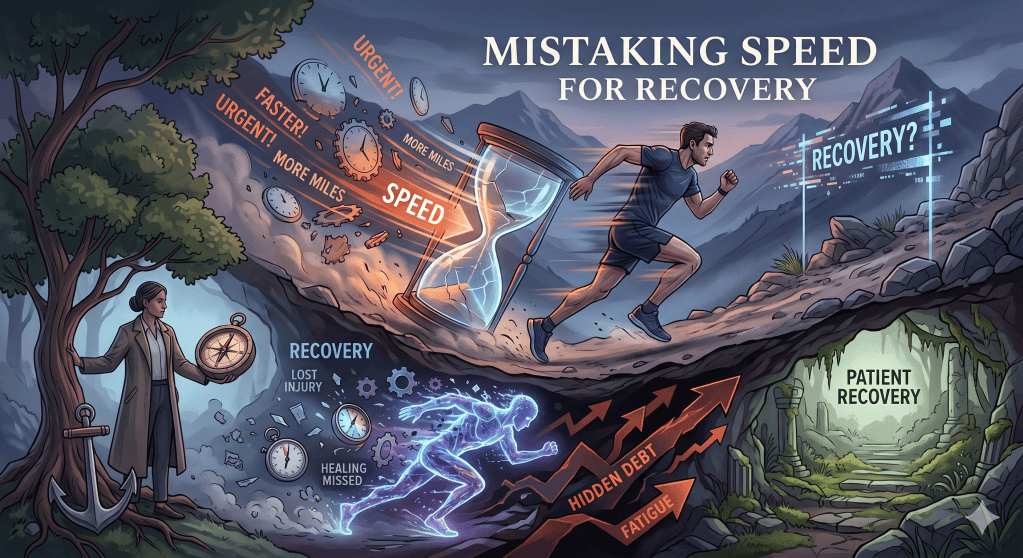
After the pandemic, culture moved fast. But recovery doesn’t follow social timelines. This essay explores the psychology and neuroscience of what genuine healing actually requires — and why speed can be its enemy.
There was a moment somewhere in the spring of 2021 when the mood shifted. Vaccines were rolling out. Restaurants were reopening. People were making plans again — real plans, the kind that involved flights and hotel reservations and hugging people they hadn’t seen in over a year. After more than twelve months of collective suspension, something that felt like relief was finally in the air.
But relief and recovery are not the same thing. And in the years that followed, a growing body of research began to suggest that what many people experienced as “bouncing back” was actually something more complicated — a kind of social and psychological performance of normalcy that ran well ahead of genuine healing. The pandemic left marks that weren’t visible on the surface. And a culture eager to move on created conditions where those marks went largely unexamined.
“Mistaking speed for recovery” is less a clinical diagnosis than a pattern of behavior that played out across millions of individual lives and entire social systems simultaneously. Understanding it means looking at how humans process collective trauma, what happens when social pressure accelerates that process, and what the neuroscience of stress and grief actually tells us about timelines for healing — timelines that are almost always longer and messier than we’d prefer.
The Rush Back to Normal
Why We Wanted Out So Badly
To understand why the return to normal felt so urgent, it helps to understand what the pandemic years actually cost people — not just in terms of loss of life, which was catastrophic, but in terms of the everyday psychological infrastructure most people take for granted.
Human beings are intensely social animals. Neuroscientists have long understood that social connection isn’t a luxury for most people — it’s a biological need. Research by Naomi Eisenberger at UCLA has shown that social exclusion activates the same neural pathways as physical pain. Prolonged isolation, then, isn’t merely unpleasant. For many people, it registers in the body as a genuine form of suffering.
The lockdown periods of 2020 and into 2021 didn’t affect everyone equally. People with stable housing, financial security, and partners or family in the same home experienced something very different from those who were alone, economically precarious, or living in cramped conditions. But across the board, the loss of casual, unplanned social contact — what sociologists call “weak tie” interactions with acquaintances, coworkers, and strangers — turned out to matter more than most people had anticipated. Studies published in journals like Nature Human Behaviour found that these ambient social interactions, the ones we barely notice when they’re present, play a significant role in daily wellbeing and sense of belonging.
So when restrictions lifted, the rush back wasn’t irrational. It was the expression of real, accumulated deprivation. People weren’t being reckless or naïve when they threw themselves into socializing, traveling, and filling their calendars. They were responding to a genuine need.
The problem wasn’t the desire to reconnect. The problem was the assumption, which became almost culturally obligatory, that reconnecting was the same as recovering.
The Cultural Pressure to Be “Back”
Social norms are powerful enough to override individual psychology, and the dominant social norm of 2021 and 2022 was forward momentum. “We’re back” became a kind of collective declaration — a tone set by media coverage, by advertising campaigns, by the way public life resumed and increasingly demanded participation.
This created a particular kind of pressure on individuals who weren’t quite keeping up. If the culture around you insists that the hard part is over, admitting that you’re still struggling becomes an act of social deviance. People reported feeling, as one common framing put it, like they should be over it by now. This “should” is worth examining carefully, because it reflects a set of implicit beliefs about how trauma and grief work — beliefs that don’t hold up especially well under scrutiny.
The sociologist Arlie Hochschild wrote decades ago about “feeling rules” — the unwritten social norms that tell us which emotions are appropriate to express in which contexts, and for how long. Grief, she observed, has always been subject to these rules. Societies have historically prescribed mourning periods precisely because, left unregulated, grief would last longer than most social structures find convenient. What happened after the pandemic lifted looked, in retrospect, like an accelerated version of this dynamic. In many social contexts, the feeling rule became: be relieved, be grateful, be present. Struggling was permitted briefly. After that, it became awkward.
What Recovery Actually Looks Like
The Neuroscience of Trauma and Stress
The word “trauma” gets used loosely in popular discourse, and it’s worth being precise about what it means physiologically. Trauma, in the clinical sense, occurs when an event or sustained situation overwhelms the nervous system’s ability to process and integrate the experience. The result is that the experience doesn’t get stored as ordinary memory — it gets held in a kind of suspended activation, where it can continue to affect mood, behavior, and physical health without necessarily rising to conscious awareness.
Bessel van der Kolk, whose research on trauma and the body has been influential in both clinical and popular settings, has described trauma as fundamentally a disruption in the body’s ability to regulate itself. The stress response system — centered on the hypothalamic-pituitary-adrenal (HPA) axis and the autonomic nervous system — gets stuck in a heightened state. The physiological signature of this is elevated cortisol, hypervigilance, difficulty sleeping, and a nervous system that has trouble distinguishing between present safety and past threat.
What this means practically is that healing from trauma doesn’t happen on a timeline dictated by external circumstances. The fact that the pandemic ended, officially or culturally, did not reset anyone’s nervous system. The nervous system doesn’t track calendar dates. It tracks patterns of safety and threat, and it updates those patterns on its own schedule.
For most people, the pandemic didn’t produce trauma in the full clinical sense — but it produced a sustained period of chronic stress, grief, and uncertainty that left real traces. Chronic stress, even at subclinical levels, has measurable effects on immune function, sleep quality, memory consolidation, and emotional regulation. These effects don’t reverse immediately when the stressor is removed. Recovery, in the neurological sense, is a gradual process that requires something most modern cultures are not good at providing: time, rest, and reduced demand.
The Grief Nobody Named
One of the more overlooked aspects of the pandemic’s psychological toll was the sheer accumulation of loss that people experienced — much of it never formally acknowledged. This goes well beyond the deaths of loved ones, as devastating as those were. People lost routines that had structured their days for years. They lost versions of their lives they had planned — weddings, graduations, milestones that simply didn’t happen as expected. They lost a sense of safety and predictability that most had never consciously valued because it had always been there. Young people lost crucial developmental experiences during years that are, in the research literature, disproportionately formative.
Psychologists have a name for loss that isn’t recognized as loss by the broader social context: disenfranchised grief. The concept was developed by Kenneth Doka in the 1980s to describe the grief that people feel when they’ve lost something society doesn’t fully acknowledge as worth grieving. The grief of losing an ambiguous relationship, for example, or a miscarriage, or a pet. The pandemic created disenfranchised grief on a massive scale — people mourning experiences, expectations, and versions of themselves, without the social rituals or language to make that mourning visible or legitimate.
Grief that isn’t acknowledged tends not to resolve cleanly. It tends to go underground, where it can shape behavior and emotion in ways that are hard to trace back to the source.
The Productivity Trap and the Performance of Wellness
Doing More as a Coping Strategy
One of the more observable behavioral patterns of the post-pandemic period was a kind of manic productivity. The phrase “revenge travel” entered common usage to describe the surge in vacations and experiences that people booked as soon as they could. “Revenge spending” followed. People threw themselves into social lives that were, in some cases, more active than anything they’d managed before 2020. Fitness apps reported surges in use. Restaurant reservations became a competitive sport.
Some of this was straightforwardly joyful, and not everything needs to be pathologized. But a portion of it carried a distinctly compulsive quality — a filling of time and space that functioned as avoidance. Keeping busy is one of the oldest strategies for not having to sit with difficult feelings, and it works, in the short term, remarkably well.
Psychologists sometimes call this “behavioral activation gone sideways” — the principle that doing things can improve mood gets co-opted into using activity as a way of outrunning internal experience. When someone is genuinely recovering, they need some capacity for stillness, for processing, for integration. A calendar packed wall to wall forecloses exactly that space.
This wasn’t simply a matter of individual personality. It was, in part, a response to structural incentives. In the United States especially, the availability of mental health resources remained inadequate relative to demand. Therapy waitlists stretched into months. Psychiatric medication shortages became a documented problem. The systems that might have supported genuine recovery were often inaccessible, leaving many people to manage on their own — and managing on your own tends to look like staying in motion.
The Wellness Industry and Its Limits
Into this gap stepped the wellness industry, which had already been growing steadily for years and accelerated dramatically during and after the pandemic. The market for wellness products and services reached extraordinary valuations, driven in no small part by a population that was, correctly, aware that something was off and looking for solutions they could access without a prescription or a months-long waitlist.
Many of these practices have real supporting evidence. But the deeper issue isn’t whether any given tool works — it’s the framing. The wellness industry positions psychological wellbeing as something you optimize through the right combination of products and habits. What that framing quietly erases is the social and systemic dimension of mental health: the fact that much of what people were struggling with after the pandemic wasn’t a personal optimization problem but a collective wound. And collective wounds don’t resolve through individual routines, however well-designed.
Social Systems and Their Slow Recovery
Institutions Under Strain
The pandemic didn’t just affect individuals. Schools, workplaces, and healthcare systems were destabilized in ways that continued rippling outward long after the acute phase passed. Schools were under pressure to “catch up” — a framing that implied a recovery timeline the research on learning and development didn’t support. Studies in the years following remote learning showed persistent gaps in early reading and mathematics, and simply returning children to classrooms didn’t automatically close them. The expectation that normal operations would restore normal outcomes proved, in many cases, wishful.
Workplace burnout, which had been climbing before the pandemic, continued to show elevated rates in the years after. The same logic applied: returning to office buildings or hybrid arrangements didn’t resolve the sustained organizational stress that had accumulated. The body, the classroom, the institution — all of them recover on slower timelines than the calendar.
The Data That Emerged Over Time
Mental health data from the post-pandemic years painted a picture that complicated the “return to normal” narrative. Rates of anxiety and depression, which had spiked dramatically in 2020, did not return to pre-pandemic baselines as quickly as many had hoped. The Centers for Disease Control and Prevention documented persistent elevations in symptoms, particularly among young people. Emergency department visits for mental health crises, including among children and adolescents, remained elevated years after the acute pandemic period.
Loneliness, too, proved stubborn. Despite — or perhaps partly because of — the explosion of social activity in the years following lockdowns, researchers continued to find high rates of reported loneliness, particularly among adults in their twenties and thirties. This is, on the surface, paradoxical. But it makes more sense when you understand that loneliness is not simply a function of social contact quantity. It’s the experience of feeling disconnected from others, of lacking relationships characterized by genuine intimacy and mutual understanding. Filling a social calendar with surface-level interactions doesn’t necessarily address it.
The U.S. Surgeon General Vivek Murthy made loneliness a public health priority in 2023, publishing an advisory that described an epidemic of loneliness and isolation that predated the pandemic but had been significantly worsened by it. The framing was notable: a Surgeon General treating loneliness as a crisis of the same order as obesity or smoking, with measurable consequences for cardiovascular health, immune function, and mortality risk.
What Genuine Recovery Requires
Time and Permission
Perhaps the most important thing the research on recovery suggests is something culture is reluctant to say plainly: it takes longer than you think it should, and there’s nothing you can do to meaningfully accelerate it past a certain point. The nervous system recovers at its own pace. Grief resolves through a process of internal reorganization that cannot be scheduled. Social trust, once disrupted, rebuilds gradually and through repeated experience, not through declaration.
This runs directly against the dominant cultural messaging, which tends to treat recovery as a project with deliverables and a completion date. The fix-it orientation that characterizes much of contemporary life — the idea that problems are puzzles to be solved rather than experiences to be moved through — sits in tension with what healing actually requires.
Psychologist Susan David has written about “emotional agility,” the capacity to approach your inner experience with curiosity and flexibility rather than trying to manage or suppress it. What she describes as the alternative — what she calls being “hooked” by rigid patterns of thought and behavior — looks a great deal like what many people did in the post-pandemic years: adopting a fixed stance (“I’m fine, I’m moving on”) and organizing their behavior around maintaining it, regardless of what their internal experience was actually telling them.
The Role of Social Connection — Done Differently
It’s worth distinguishing between the kind of social engagement that supports recovery and the kind that substitutes for it. What supports recovery tends to be depth rather than breadth — fewer interactions, but more honest ones. The research on social support consistently finds that it’s not the size of someone’s social network that protects mental health but the quality of a small number of key relationships. Feeling genuinely known by even one or two people is more protective than being surrounded by acquaintances.
The pandemic, for all its damage, had in some ways created conditions for this kind of honesty. People reported, during the acute phase, that conversations had become more genuine, more direct, less burdened by social performance. That dimension of the pandemic experience was worth carrying forward. Some people did. But the cultural momentum of “return to normal” pushed heavily against it, toward the resumption of social performance as usual.
Looking Forward
By 2026, the pandemic has receded far enough in calendar time that many people find it uncomfortable to describe themselves as still affected by it. There’s a version of moving on that is genuine and healthy — the integration of difficult experience into a larger life narrative, the gradual return of capacity and joy. That kind of recovery is real, and many people have achieved something like it.
But there’s also a version of moving on that is essentially a decision to stop paying attention to an unresolved internal process. That version tends to produce what clinicians sometimes describe as delayed presentations — symptoms that surface years after the original stressor, in contexts that make their origin difficult to identify.
The broader social implication is harder to measure but worth considering. A society that collectively mistakes speed for recovery is one that carries unprocessed experience into its institutions, its relationships, and its politics. The psychological residue of collective trauma doesn’t disappear when people stop talking about it. It expresses itself in other ways: in elevated rates of substance use, in relationship instability, in the difficulty many young people report in forming meaningful connections, in the persistent undercurrent of anxiety that colors public life.
Understanding the gap between the pace of cultural recovery and the pace of actual human healing is not an argument for dwelling in the past or for treating difficulty as permanent. It’s an argument for honesty — about what people have been through, about what they actually need, and about the difference between returning to life and renewing it. The two look similar from the outside. From the inside, they feel quite different.
Recovery, real recovery, is not a destination you arrive at by moving fast enough. It’s a process you participate in by paying attention.









