
Originally published in November 2023 and comprehensively updated/edited in June 2026.
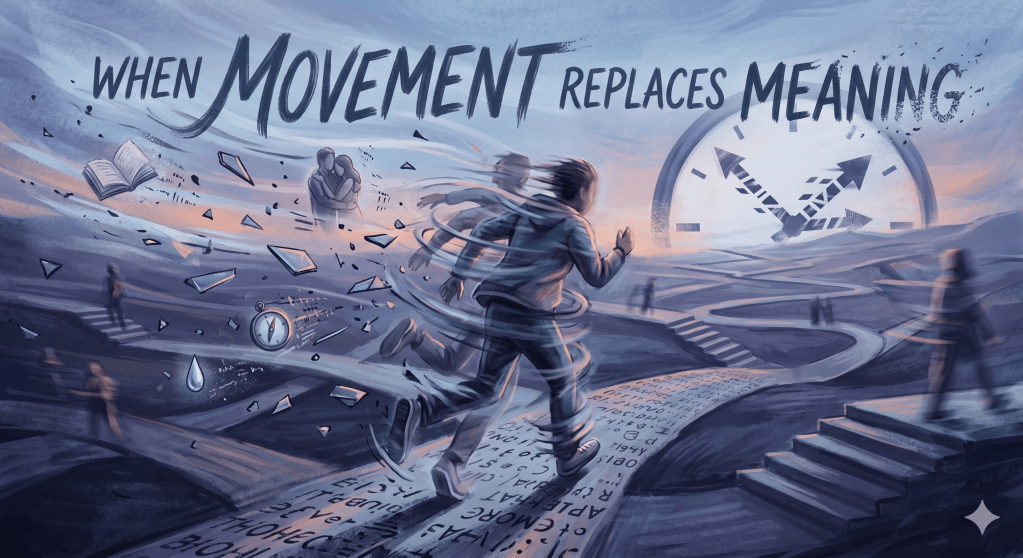
When Movement Replaces Meaning explores why modern life — shaped by the attention economy, pandemic disruption, and social media — left many people feeling busy yet profoundly empty.
There’s a peculiar kind of exhaustion that settles in when you’ve been busy for months but can’t quite articulate what you’ve actually done. You’ve attended the meetings, sent the messages, scrolled the feeds, consumed the content, and kept the calendar packed — yet something feels hollow underneath all that activity. The sensation isn’t laziness. It’s the creeping awareness that motion and meaning are not the same thing, and that modern life has become extraordinarily skilled at substituting one for the other.
This substitution didn’t happen overnight, and it isn’t the product of any single technology or social trend. It emerged gradually from a specific cultural and psychological environment that intensified around the early 2020s — shaped by pandemic disruption, the explosive growth of social media, an attention economy designed to keep people perpetually stimulated, and a broader collapse of the shared rituals and institutions that once organized how people understood their time and purpose. The result was a population that had access to more information and more forms of connection than any previous generation, while simultaneously reporting deeper feelings of aimlessness, dissatisfaction, and fatigue.
Understanding why movement replaced meaning — and what that replacement cost — requires looking at several overlapping forces: the neuroscience of reward and motivation, the psychology of purpose and identity, the sociology of community collapse, and the specific design features of technologies that reshaped daily life faster than human psychology could adapt. Each of these threads is interesting on its own. Together, they explain something important about why so many people in this era felt busy and empty at the same time.
The Dopamine Economy and the Illusion of Progress
To understand how we ended up here, it helps to start with some basic neuroscience — not the oversimplified version that gets passed around social media, but the more nuanced picture that researchers have been building for decades.
What Dopamine Actually Does
The popular account of dopamine is that it’s the brain’s “pleasure chemical” — released when you do something enjoyable, which then motivates you to do it again. This picture is partly right, but it misses something crucial. Neuroscientist Kent Berridge and his colleagues at the University of Michigan spent years distinguishing between two separate systems in the brain: wanting and liking. Dopamine, it turns out, is primarily tied to wanting — to anticipation, seeking, and the motivational drive to pursue a reward — rather than to the pleasure of actually receiving one.
This distinction matters enormously. It means you can be intensely motivated to pursue something without that pursuit delivering any real satisfaction when you get there. The wanting system can fire continuously without the liking system ever being fulfilled. And this is precisely what the attention economy has learned to exploit.
Social media platforms, news feeds, notification systems, and algorithmic content streams are all, at their functional core, wanting machines. They are engineered to keep the anticipation loop running — the next post, the next notification, the next video, the next piece of outrage or beauty or curiosity — without ever delivering the kind of sustained satisfaction that comes from genuine engagement with something meaningful. The scroll never ends because ending would break the loop. The notification badge reappears because absence would let the wanting system go quiet.
Busyness as a Proxy for Progress
The dopamine loop doesn’t just affect leisure time. It reshapes how people relate to work and productivity as well. There’s a well-documented tendency — sometimes called “busyness signaling” in the sociology literature — to treat activity itself as evidence of value. Being busy became, in this period, both a social status marker and a psychological defense mechanism.
Researchers have long understood that humans are poor judges of their own cognitive activity. We experience the effort of thinking as evidence of progress, and we tend to mistake motion for advancement. Checking email produces a feeling of accomplishment that isn’t proportional to any actual outcome. Attending a meeting feels like contributing, regardless of whether the meeting produced anything useful. Keeping a full calendar feels like being important, regardless of whether the calendar items matter.
This cognitive quirk was amplified, in the early 2020s, by working conditions that made genuine deep work increasingly difficult. Remote and hybrid work — which expanded dramatically after 2020 — brought real benefits in flexibility, but also created new pressures around visibility. When your manager can’t see you at your desk, the anxiety of appearing productive can override the actual pursuit of it. The result, as researchers like Cal Newport have documented, is a “hyperactive hive mind” approach to work, characterized by constant communication, fragmented attention, and a substitution of responsiveness for genuine output.
The Collapse of Shared Meaning-Making
Psychological research has consistently shown that human beings derive meaning from three primary sources: relationships with others, engagement with work or activities that use their skills and values, and a sense of belonging to something larger than themselves — a community, a tradition, a shared project or purpose. The period of the early-to-mid 2020s disrupted all three simultaneously, in ways that were both direct and subtle.
What the Pandemic Did to Social Infrastructure
The COVID-19 pandemic’s most visible effects were medical and economic. But its social and psychological effects were at least as significant, and in many ways harder to reverse. Lockdowns and social distancing disrupted not just individual relationships but the entire infrastructure of informal community life — the third places that sociologist Ray Oldenburg had identified decades earlier as essential to social health. The coffee shops, parks, gyms, churches, community centers, and local gathering spots where people maintained weak-tie social connections largely shut down, in some cases for years.
Weak ties — acquaintances rather than close friends — are surprisingly important to psychological wellbeing and to how people find meaning. They expose you to different perspectives, create low-stakes social encounters that accumulate into a sense of belonging, and often serve as bridges to new opportunities and ideas. Strong-tie relationships (close friends, family) are vital, but they can also become insular. The pandemic essentially severed most people’s weak-tie social networks, and rebuilding them afterward proved harder than expected. People had grown accustomed to retreating into tightly controlled social environments, and the habit was difficult to unwind.
The effects on reported loneliness were significant. The U.S. Surgeon General’s advisory on loneliness, released in May 2023, described an epidemic that had been building for decades but accelerated sharply during the pandemic years. The report noted that Americans had been spending less time with friends and in community settings for years, and that the consequences — elevated risks of depression, anxiety, heart disease, and premature death — were comparable in scale to those of smoking.
Identity Without Institutions
The broader cultural shift underway during this period involved a hollowing out of the institutions that traditionally gave people a framework for understanding who they were and why their lives mattered. Religious participation had been declining for decades in most Western countries. Trust in government, media, and scientific institutions had eroded significantly. Local civic organizations, labor unions, and fraternal associations that once provided community scaffolding had been contracting since at least the 1970s, a trend that Robert Putnam had documented at length in his influential 2000 book Bowling Alone — and which had continued unabated in the years since.
What filled that vacuum wasn’t nothing. It was, in large part, online identity and social media community. People found belonging in fandoms, political tribes, wellness movements, hobby communities, and the parasocial connections formed with content creators and influencers. These connections weren’t meaningless — many provided genuine value — but they had a characteristically different structure from the institutions they replaced. They tended to be more voluntary, more fragmented, more focused on consumption than participation, and more dependent on platforms whose algorithms rewarded engagement over depth.
The sociologist Sherry Turkle, whose work on technology and identity stretches back to the 1980s, described this shift as one from being with others to performing for them. The self that social media cultivated was less a private interior self that occasionally expressed itself publicly, and more an ongoing public performance that increasingly came to define the interior. Who you were became inseparable from how you presented yourself online — which in turn meant that the self was perpetually subject to external evaluation, and perpetually anxious about it.
The Attention Economy’s Design Problem
None of what happened in this period was accidental. The specific features of the technology environment — the algorithmic feeds, the notification systems, the infinite scroll, the engagement-maximizing design — were deliberately engineered to capture and hold attention, because attention, in the advertising model, is the commodity being sold. Understanding this isn’t a conspiracy theory; it’s documented in the design histories of these platforms and in the accounts of people who built them.
What “Engagement” Actually Measures
The word “engagement,” in the context of social media and content platforms, sounds positive — even wholesome. Engaged people are attentive, involved, participating. But what the platforms actually measured and optimized for was something more specific: the behavioral signal that a user was continuing to interact with the app. And the emotions that most reliably produce continued interaction, research has shown, are not joy or learning or connection. They are outrage, anxiety, and social comparison.
A widely discussed Facebook emotional contagion study demonstrated that the emotional content users encountered could shape their own emotional states — and that this was something the platform could and did manipulate. Later research by scholars including Jonathan Haidt and Jean Twenge documented correlations between heavy social media use and rising rates of depression, anxiety, and poor self-image, particularly among adolescent girls. The causal direction of these correlations remains contested among researchers — some argue the data shows causation, others maintain the relationship is more complex — but the patterns themselves are not seriously in dispute.
What is less often discussed is the subtler effect on the capacity for sustained attention and genuine engagement. The design of algorithmically curated feeds — short items, rapid context switching, constant novelty — is well suited to the wanting brain and poorly suited to the kinds of cognitive activities that people consistently report finding most meaningful. Psychologist Mihaly Csikszentmihalyi spent decades researching what he called flow — the state of deep, absorbed engagement that people describe as among the most satisfying experiences of their lives. Flow requires sustained attention on a challenging task, and it’s essentially incompatible with constant interruption and novelty-seeking. The technology environment of the early 2020s was, in many respects, the enemy of flow.
The Attention Fragmentation Problem
There’s a painful irony buried in all of this. The technologies that filled people’s days with constant activity were, by most measures, making them less productive in ways that mattered. Research on interruptions and context-switching is fairly consistent: recovering full concentration after an interruption takes significantly longer than most people assume — often 20 minutes or more — and the modern working environment, with its constant messaging and notification culture, makes sustained attention enormously difficult. People feel busy because they are constantly responding, reacting, and communicating. But the cognitive work that produces genuine insight, quality, and innovation requires something different: protected time, reduced stimulation, and the tolerance for the discomfort that precedes understanding.
Meaning, Purpose, and the Research Behind Them
Against this backdrop, psychological research on meaning and purpose becomes especially relevant. What does it actually mean to live a meaningful life, and what are the conditions that make it possible?
The Psychology of Purpose
Researchers distinguish between two related but distinct concepts: meaning, which refers to the sense that one’s life makes sense, matters, and is part of a larger whole; and purpose, which refers to having clear, long-term goals that one is actively working toward. Both are associated with substantially better outcomes — not just psychological wellbeing, but physical health, cognitive resilience in aging, and what researchers call post-traumatic growth.
Viktor Frankl, the Austrian psychiatrist who survived the Nazi concentration camps and developed the psychological framework known as logotherapy, argued that the search for meaning was the central motivation of human life — not pleasure, not power, but the need to find significance in one’s existence. His insights, shaped by extreme circumstances, have held up surprisingly well in subsequent research. Meaning isn’t a luxury; it appears to be something the human psyche requires, and its absence produces specific and recognizable forms of suffering.
What’s notable about meaning, as researchers understand it, is that it isn’t primarily found through consumption or passive experience. It tends to emerge from contribution — from doing things that matter to others, from engaging with challenges that use your capacities, from participating in relationships and communities that extend beyond the self. In other words, meaning comes from the kinds of activities that a constant-stimulation, fragmented-attention culture makes hardest to sustain.
The Difference Between Pleasure and Fulfillment
Aristotle drew a distinction between hedonia — the pursuit of pleasure and positive feeling — and eudaimonia — living well in a deeper sense, which he understood as the full exercise of distinctly human capacities in pursuit of good ends. Modern psychology has rediscovered this distinction and found it empirically useful. Hedonic wellbeing (feeling good, feeling happy) and eudaimonic wellbeing (sense of meaning, purpose, growth) are related but distinct, and they don’t always move together.
Research published in journals including the Journal of Positive Psychology and Psychological Science has found, somewhat counterintuitively, that the activities people most associate with happiness in the moment — passive leisure, entertainment consumption, social media browsing — tend to contribute less to eudaimonic wellbeing than activities that are effortful, socially connective, or skill-developing. This doesn’t mean passive leisure is harmful; rest is necessary. But when passive consumption becomes the dominant mode of daily life, something is lost.
The cultural environment of the early-to-mid 2020s made the path of least resistance overwhelmingly hedonic — or more precisely, pseudo-hedonic, since much of the content consumption of this era didn’t even produce genuine pleasure, only stimulation and the restless seeking of more stimulation. The path toward eudaimonic wellbeing — the building of skills, the deepening of relationships, the engagement with genuinely difficult and meaningful work — required more friction, more patience, and more tolerance for discomfort than the environment rewarded.
Signals of Discontent
By the early 2020s, the cumulative effects of these forces were visible across multiple indicators. They weren’t always interpreted correctly — each symptom was often attributed to a single cause — but together they pointed to a coherent underlying pattern.
The rise of “quiet quitting” — doing the minimum required at work rather than investing emotionally in one’s job — was widely reported in 2022 and often framed as laziness or entitlement. A more accurate reading recognized it as a rational response to environments where busyness was demanded regardless of purpose. People who had stopped believing their work meant something stopped pretending otherwise.
“Doom scrolling” entered common usage to describe the compulsive consumption of distressing news — a behavior linked to anxiety and a paradoxical feeling of being informed without being empowered. People knew, in extraordinary detail, about disasters occurring everywhere in the world, but felt no clearer about what they could do about any of it.
The wellness industry, meanwhile, expanded dramatically — meditation apps, therapy platforms, breathwork content, somatic practices. This growth reflected genuine need. But there was something revealing in the fact that the primary consumer response to a meaning crisis was individual self-optimization rather than collective action. The problem was social; the marketed solutions were personal.
What Comes After the Substitution
The story of movement replacing meaning isn’t static. The years since the initial drafting of this essay have produced some evidence of adjustment — both by individuals seeking different ways of living and by broader cultural currents pushing back against the logic of constant stimulation.
There has been a notable and documented increase in interest in practices that require sustained attention: craft hobbies, long-form reading, in-person community participation, outdoor activity. The sourdough baking and puzzle-building of pandemic lockdowns were easy to mock, but they reflected something genuine — a hunger for engagement with tangible, slow, difficult things. That hunger didn’t disappear when the lockdowns ended.
Research on “digital minimalism” — the deliberate reduction of low-value digital activity in favor of more intentional engagement — has found measurable benefits for wellbeing and attention. This isn’t about being anti-technology; it’s about recognizing that not all uses of technology serve the same purposes, and that some forms of digital consumption crowd out activities that are more deeply satisfying. The people who reported the highest wellbeing, across multiple studies, weren’t those who used technology the least or the most, but those who used it most intentionally.
Institutional design has also begun, slowly and imperfectly, to respond. Age restrictions on social media platforms, greater transparency about algorithmic curation, and workplace policies protecting time for focused work reflect a growing recognition that the environment shapes behavior, and that reshaping the environment is a legitimate response to population-level psychological distress.
None of this represents a reversal of the underlying forces — the economic incentives of the attention economy remain largely intact, and the cultural pressures toward busyness and performance persist. But the conversation has shifted. There is broader awareness that activity and meaning diverge, that the substitution of one for the other has costs, and that the costs are distributed unequally.
The Longer View
What the period examined in this essay offers, in retrospect, is something like a natural experiment in what happens to a population when the usual sources of meaning are disrupted simultaneously, and a powerful technological infrastructure rushes to fill the vacuum with stimulation. The results were instructive, if not comfortable.
Human beings need not just to be occupied but to feel that their occupation matters. They need to belong to things larger than themselves, to develop and use their capacities, to participate in relationships that are genuinely mutual rather than performative. These needs aren’t cultural preferences that technology can simply replace; they appear to be fairly deep features of human psychology, shaped by evolutionary pressures and expressed in consistent ways across cultures.
The attention economy, for all its sophistication, fundamentally misunderstood what it was competing with. It offered stimulation in place of engagement, novelty in place of depth, and the feeling of connection in place of connection itself. And for a while — for a long while — this substitution was difficult to detect precisely because it was so total. When everyone around you is busy and empty, busyness and emptiness can feel like the natural condition of life rather than a specific historical situation that can be examined, understood, and changed.
Understanding how movement came to replace meaning is, in that sense, a first step toward reversing the substitution. Not through nostalgia for institutions that had their own failures and exclusions, and not through a rejection of technology that provides genuine value, but through a clearer-eyed understanding of what human life actually requires — and a willingness to organize time and attention around those requirements rather than around the path of least resistance.
The challenge facing modern life may not be a shortage of movement but a shortage of meaning. We have become extraordinarily efficient at staying occupied. The harder task is remembering that a full calendar, a busy inbox, and a constant stream of stimulation were never the things we were ultimately seeking. Movement keeps us in motion. Meaning tells us where we are going.









