
Originally published in April 2024 and comprehensively updated/edited in June 2026.
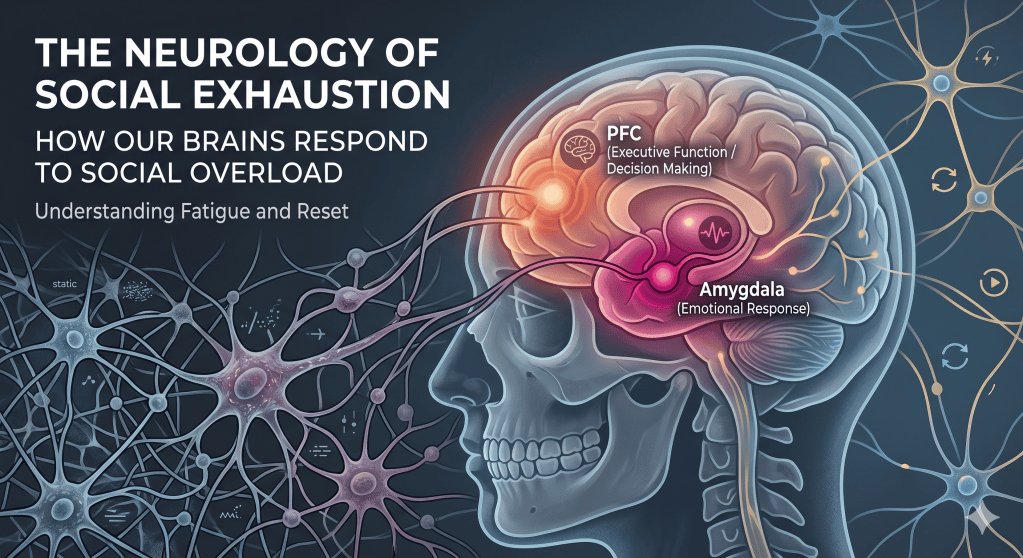
The neurology of social exhaustion explained — why the brain tires from social interaction, what depletes it, and what the science says about recovery.
There is a particular kind of tired that has nothing to do with sleep. You’ve been at a party for two hours, or on back-to-back video calls, or navigating a difficult conversation with someone you care about, and suddenly you feel like a phone battery that someone forgot to charge. The social world — which you entered willingly, maybe even eagerly — has become something you need to escape. Your thoughts go quiet and sticky. Small talk feels like lifting furniture.
Most people recognize this feeling. Fewer know what’s actually happening inside the brain when it arrives.
Social exhaustion isn’t weakness, introversion, or a character flaw. It’s a neurobiological event — the result of specific brain systems running hard, burning through resources, and eventually demanding rest. Understanding the neurology of social exhaustion doesn’t just explain why people feel drained after social interaction; it illuminates something deeper about how the human brain handles one of its most complex and demanding jobs: being around other people.
Why the Social Brain Works So Hard
The human brain devotes an extraordinary amount of real estate to understanding other people. There’s an entire network of interconnected regions — often called the “social brain” — that fires up whenever you’re in the presence of others or even just thinking about them. This includes areas like the medial prefrontal cortex (which processes information about the self and others), the temporoparietal junction (which helps you take another person’s perspective), the superior temporal sulcus (involved in reading facial expressions and biological movement), and the amygdala (which monitors the emotional significance of social signals).
When you’re in a social situation, all of these regions are working simultaneously. You’re tracking faces, reading tone of voice, monitoring your own reactions, adjusting what you say based on what you think the other person is feeling, and managing the constant low-level question of how you’re being perceived. This is not a simple task. In computational terms, it’s massively parallel processing — many streams of information running at once, each requiring attention and integration.
The default mode network, a set of brain regions that activates when you’re not focused on a specific external task, is heavily involved here too. It’s the network you use when you’re daydreaming, reflecting on your past, or imagining other people’s thoughts and feelings. Social interaction essentially keeps the default mode network continuously engaged, which is metabolically expensive. Brain tissue uses glucose at a high rate, and the default mode network is also metabolically active, requiring substantial ongoing energy consumption.
None of this means the brain is poorly designed for social life — quite the opposite. Humans are among the most socially complex animals on Earth, and the brain evolved over millions of years to handle exactly this kind of activity. The point is that social engagement has a real cost. It draws on finite cognitive and metabolic resources, and those resources can run low.
The Role of Cognitive Load and Emotional Labor
Social exhaustion is closely tied to two overlapping concepts: cognitive load and emotional labor. Understanding each one helps explain why some interactions leave you feeling energized while others leave you reaching for a dark room and silence.
Cognitive Load: The Mental Weight of Social Navigation
Cognitive load refers to the total amount of mental effort being used at any given moment. The brain’s working memory — the system that holds and manipulates information in the short term — has a limited capacity. When that capacity gets maxed out, performance suffers and fatigue sets in.
Social interaction loads working memory in ways that aren’t always obvious. You’re tracking conversational threads, remembering what was said ten minutes ago, predicting how your words will land, suppressing inappropriate thoughts or reactions, and continuously updating your model of what the other person is thinking. In a group setting, this multiplies. Every additional person in the room adds another stream of information to monitor.
Research on cognitive load consistently shows that tasks requiring inhibition — actively holding back a response — are particularly draining. Social situations are full of inhibition demands. Not laughing at the wrong moment. Not interrupting. Not saying the thing you’re actually thinking. Each of these small acts of self-regulation draws on the prefrontal cortex, the brain’s executive control center, and collectively they add up to significant mental fatigue.
The brain isn’t only processing information during social interaction, though; it’s also constantly regulating behavior and emotion. That second layer of effort has its own costs.
Emotional Labor: The Cost of Managing Your Own Feelings
The sociologist Arlie Hochschild introduced the concept of emotional labor in the 1980s to describe the work of managing one’s emotions to fulfill the requirements of a job — flight attendants projecting warmth, bill collectors projecting firmness. The concept has since expanded far beyond the workplace. Any time you manage your internal emotional state to meet the expectations of a social situation, you’re doing emotional labor.
At a neurological level, emotional regulation is costly. The prefrontal cortex, which exerts top-down control over the amygdala and other emotional processing regions, has to work continuously to modulate reactions. Studies using neuroimaging have found that voluntary emotion regulation increases activation in prefrontal regions and can reduce activation in the amygdala — but this control is not free. It consumes resources, and sustained emotional regulation is one of the more reliably exhausting things a person can do.
This is part of why certain social contexts are more draining than others. A dinner with close friends, where you can be relatively unguarded and express genuine reactions, costs less than a work event where you’re managing impressions, suppressing frustrations, and performing enthusiasm you may not feel. The content of the conversation matters far less than the degree to which you’re having to monitor and regulate your own emotional output.
What Depletes, and What Restores
For a long time, psychologists talked about a concept called “ego depletion” — the idea that self-control draws on a finite resource, like a muscle that gets tired. Early research in this area, led by Roy Baumeister in the 1990s and 2000s, suggested that acts of willpower and self-regulation used up a kind of mental fuel, and that once it was spent, subsequent tasks requiring self-control became harder.
The ego depletion model has been heavily debated since then. Replication studies have had mixed results, and the original glucose-based mechanism — the idea that the brain literally runs low on blood sugar after self-control tasks — has not held up consistently. What has held up is something more nuanced: self-regulation does seem to have limits, but those limits are influenced by motivation, perceived costs, and beliefs about capacity as much as by any single depleting resource.
For understanding social exhaustion, this matters because it suggests the experience isn’t purely mechanical. The same social situation can feel more or less draining depending on how much you want to be there, how safe you feel, and what you believe about your own capacity to handle it. Someone who dreads a work party will likely feel more drained by it than someone who genuinely enjoys their colleagues — even if the external demands of the situation are identical.
The Nervous System’s Role
Beyond the brain’s cognitive systems, the autonomic nervous system plays a key role in social exhaustion. The autonomic nervous system has two main modes: the sympathetic system, which activates the body’s stress and arousal response, and the parasympathetic system, which promotes rest and recovery.
Social interaction — especially with strangers, authority figures, or in high-stakes situations — activates the sympathetic system to varying degrees. Heart rate rises slightly. Cortisol, the stress hormone, increases. The body enters a state of heightened alertness. This isn’t necessarily unpleasant; moderate sympathetic activation can feel like engagement or excitement. But sustained activation takes a toll.
Stephen Porges’ polyvagal theory adds another layer to this picture. Porges argues that humans have a third branch of the autonomic nervous system — the ventral vagal system — that specifically supports social engagement. When this system is active, people feel calm, connected, and able to communicate. When it’s not — when threat is perceived, or when someone is running on empty — the social engagement system essentially goes offline, and interaction becomes harder and more draining. The theory has generated both significant interest and debate among researchers, but the core observation it captures is real: social ease requires a certain physiological state, and when the body is stressed or depleted, that state becomes hard to maintain.
Introversion, Sensitivity, and Individual Differences
The neurology of social exhaustion doesn’t affect everyone equally. Individual differences in how quickly and deeply people become socially drained are significant, and they’re partly rooted in neurobiology.
The introversion-extroversion dimension is the most widely discussed. The psychologist Hans Eysenck proposed in the 1960s that introverts have higher baseline levels of cortical arousal, meaning their nervous systems are closer to being overstimulated at any given moment. Social interaction adds stimulation. For an introvert already running near their arousal ceiling, the added input of a party or a meeting pushes them into uncomfortable territory more quickly than it would for an extrovert with more headroom.
More recent work has complicated this picture without displacing it. Studies using neuroimaging have found differences in how introverts and extroverts process dopamine — the neurotransmitter associated with reward and motivation. Extroverts appear to have more reactive dopamine systems: social situations, which carry the potential for social rewards, activate their reward circuitry more strongly. For introverts, the same social stimulation may generate less of a dopamine kick, meaning the cost-benefit ratio of social engagement tips differently. The relationship is complex and individual studies do not always find identical patterns, but reward sensitivity appears to play an important role in these personality differences.
Sensory processing sensitivity is another relevant trait. Roughly 15 to 20 percent of the population scores high on measures of this trait, which is associated with deeper processing of stimuli — noticing subtleties, being more affected by others’ emotions, processing information more thoroughly before acting. Highly sensitive people tend to find stimulating environments more overwhelming more quickly, and social interaction, with its constant stream of subtle signals to process, is one of the more stimulating environments there is. This isn’t a disorder; it’s a normal dimension of variation. But it helps explain why some people find social exhaustion a more frequent companion than others.
Social Exhaustion in a High-Contact World
Understanding the neurology of social exhaustion becomes particularly relevant when you consider how the structure of modern life keeps changing the demands placed on the social brain.
The shift to open-plan offices that gained momentum in the 2010s, the proliferation of meetings and collaboration software, the always-on nature of social media — all of these represent increases in the ambient level of social demands people navigate. A person in an open-plan office is never fully off-duty from social monitoring. Peripheral conversations, faces in motion, the awareness of being observed — all of it feeds into the brain’s social processing systems whether you want it to or not. The same applies to smartphones. Notifications are, at their core, social signals. They demand acknowledgment, carry emotional valence, and pull the social brain into a state of low-grade vigilance.
Video calls have attracted particular attention. There’s a reason “Zoom fatigue” became a widely recognized phenomenon during and after the pandemic years. Research published in 2021 by Jeremy Bailenson at Stanford identified several reasons why video calls are disproportionately draining. Close-up eye contact, sustained for long periods, activates threat responses in ways that don’t typically happen in person, where gaze naturally breaks and moves. Seeing your own face continuously is cognitively unusual and seems to increase self-monitoring in ways that are tiring. The delays and compression artifacts in video calls make the social brain work harder to read faces and synchronize interaction timing. The result is that a two-hour video call feels significantly more exhausting than a two-hour in-person conversation covering the same content.
None of this means digital communication is inherently harmful — clearly it provides enormous social benefit. But the form in which social interaction arrives matters neurologically, and not all formats are equivalent in their demands.
Recovery: What Actually Helps
If social exhaustion is a real neurobiological phenomenon, then recovery from it deserves to be taken seriously rather than dismissed as antisocial preference or introvert dramatics.
Solitude and quiet are the most obvious forms of recovery, and they work for fairly straightforward reasons. When you’re alone and in a low-stimulation environment, the social brain’s monitoring systems can wind down. Default mode network activity can shift from social simulation to quieter forms of self-reflection or mental wandering. The sympathetic nervous system can hand the reins back to the parasympathetic. Cortisol drops.
Sleep is the most powerful recovery mechanism of all. During sleep, the brain consolidates memories, clears metabolic waste, and restores the prefrontal cortex’s capacity for executive function and self-regulation. Sleep deprivation specifically impairs the prefrontal-amygdala regulation pathway, making emotional control harder and social interaction more costly the next day. This creates a loop: social exhaustion can disrupt sleep (it’s hard to wind down when still mentally processing social events), and disrupted sleep makes the next round of social interaction more draining.
Nature exposure has a well-documented restorative effect on cognitive resources. Attention restoration theory, developed by Rachel and Stephen Kaplan in the 1980s and 1990s, proposes that natural environments allow the directed attention system — the effortful, top-down attention used in demanding cognitive tasks — to rest, while involuntary attention is gently engaged by natural stimuli. Subsequent research has supported this framework, finding that time in natural settings reduces cortisol, lowers heart rate, and improves performance on tasks requiring sustained attention and cognitive control.
Physical exercise is another well-supported recovery strategy, with the caveat that it works better for mental fatigue than as an immediate intervention — the benefits accrue over time, particularly the effects of regular aerobic exercise on prefrontal function, emotional regulation, and stress response.
What doesn’t work particularly well is passive screen consumption as a form of rest. Scrolling social media feels restful because it’s low effort, but it continues to engage the social brain — tracking faces, reading emotional cues, forming social judgments. It’s the mental equivalent of resting a tired arm by switching which arm you’re using to carry the weight.
Worth noting is that recovery from social exhaustion doesn’t always require solitude. For many people, low-demand social connection — sitting quietly with a partner, spending time with a close friend without any pressure to perform or entertain, being around trusted people without the expectation of conversation — can be just as restorative as being alone. This circles back to the emotional labor framework: what the brain needs to recover from is not other people per se, but the sustained effort of monitoring, regulating, and performing. When genuine ease is possible with someone else in the room, the social brain’s burden lifts in much the same way it would in solitude.
What Social Exhaustion Tells Us
The neurology of social exhaustion points toward something that might seem counterintuitive at first: the experience of feeling socially drained is, in many ways, evidence of the brain working as designed. The social brain is extraordinarily capable, but that capability comes with metabolic and cognitive costs. Exhaustion is the signal that those costs have been met and the system needs recovery.
What’s changed in recent decades isn’t human neurobiology — it’s the social environment. The quantity, intensity, and format of social demands people navigate have increased substantially, without a corresponding increase in the time or space available for recovery. The expectation that one should be available, engaged, and socially responsive across multiple platforms and contexts simultaneously represents a novel set of demands on a brain that evolved in a very different social environment — one with smaller groups, more predictable social structure, and natural rhythms of engagement and solitude.
Framing social exhaustion as a neurological reality rather than a personality quirk has practical value. It shifts the conversation from judgment — who is resilient enough, outgoing enough, dedicated enough — toward accommodation. Different people have different neurobiological thresholds for social stimulation. Social exhaustion happens on a spectrum. It can be managed, but only if it’s recognized as something real rather than something to push through indefinitely.
As our collective understanding of the social brain continues to grow, one of the more useful applications may simply be this: learning to recognize the signals our own neurology sends us, and taking them seriously enough to act on them.









