
Originally published in April 2024 and comprehensively updated/edited in June 2026.
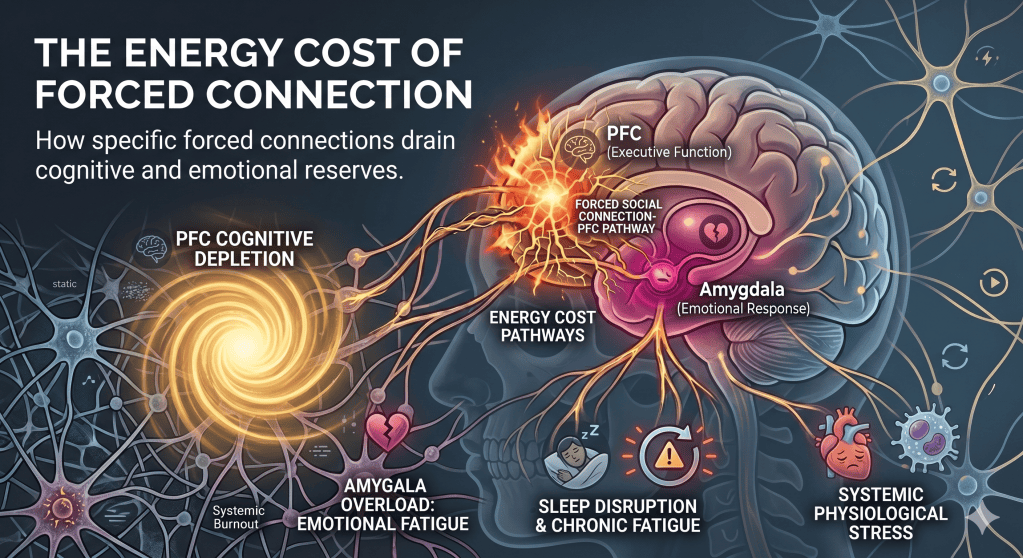
Exploring the psychology and neuroscience of why enforced social connection during the pandemic era left so many people feeling depleted — and what research tells us about genuine versus obligatory belonging.
There is a specific kind of exhaustion that has no good name in the English language. It is not the tiredness that follows a long run or a short night’s sleep. It is the depletion that settles in after hours of being relentlessly, performatively present — after smiling through video calls that could have been emails, typing cheerful responses into group chats you never asked to join, and maintaining the emotional labor of seeming available and engaged when every instinct is pulling you toward quiet.
Most people who lived through the early 2020s know this feeling. The pandemic era compressed several competing social forces into a short window: the sudden removal of in-person contact, the immediate substitution of digital alternatives, and an unspoken cultural pressure to make it all look effortless. Zoom happy hours replaced after-work drinks. Digital retreats replaced office camaraderie. The technology kept the connections alive, technically, but something about the arrangement felt costly in ways that were hard to articulate at the time.
That cost is now better understood. Researchers across psychology, neuroscience, and behavioral science have spent the years since building a clearer picture of what happens to the human nervous system when social connection is engineered rather than organic — when it is required rather than chosen. The findings are nuanced, but they converge on a central insight: not all social contact is equal, and the energy demanded by forced connection is meaningfully different from the energy exchanged in genuine encounter.
This is an examination of that difference — what causes it, what it does to people, and what it revealed about the relationship between technology, belonging, and the limits of social design.
The Architecture of Belonging
To understand what went wrong with enforced togetherness, it helps to understand what social connection is actually doing in the human brain under normal conditions.
Human beings are, by any measure, among the most social animals on earth. The degree of cooperation required to build civilization — to coordinate labor, share knowledge across generations, and maintain complex political structures — demanded a nervous system finely tuned to the presence of others. Evolution delivered one. The brain does not merely tolerate social interaction; it is structured around it.
The Social Brain and Its Expectations
Neuroscientists have documented what is sometimes called the “social brain network” — a cluster of interconnected regions that activate when people think about other people, predict their behavior, and navigate interpersonal dynamics. These regions are so central to human cognition that they appear to be the brain’s “default” state, the network that activates when you are not focused on a task and your mind begins to wander. A significant portion of spontaneous thought, research suggests, involves other people and social relationships.
This wiring creates a deep expectation: social contact should feel like coming home to something the brain was built for. And under the right conditions, it does. Research consistently shows that quality social relationships are among the strongest predictors of subjective well-being and longevity. A landmark 2010 meta-analysis by Julianne Holt-Lunstad and colleagues, examining data from over 300,000 participants, found that adequate social relationships were associated with a 50 percent increase in survival odds — a magnitude comparable to quitting smoking.
But “adequate social relationships” is doing significant work in that sentence. The research distinguishes sharply between the quantity of social contact and its quality, and even more importantly, between contact that feels autonomous and contact that feels obligatory.
When Connection Becomes Obligation
The psychological concept of self-determination theory, developed by researchers Edward Deci and Richard Ryan over several decades, identifies autonomy as one of three core psychological needs — alongside competence and relatedness. The theory holds that human beings flourish when they act from genuine choice rather than external pressure. This applies not just to work and hobbies but to social life itself.
When social interaction is chosen freely, it tends to satisfy the need for relatedness. When it is externally imposed, it can paradoxically undermine that same need even as it technically fulfills it. You are present, but you are not there by choice. The connection is still there, but it is wrapped in an experience of reduced autonomy — and the nervous system registers the difference.
This is not a subtle distinction. Studies on prosocial behavior have found that people who help others out of genuine motivation report increased well-being afterward, while people who help out of guilt or social pressure often report feeling depleted. The act is identical; the phenomenology is not.
Zoom Fatigue and the Science of Mediated Presence
The specific exhaustion associated with video calls became notable enough during the pandemic that researchers named it: Zoom fatigue. It entered the popular vocabulary fast, but the underlying science took longer to catch up.
What Makes Video Calls Cognitively Expensive
In early 2021, Stanford communications professor Jeremy Bailenson published a conceptual paper in the journal Technology, Mind, and Behavior identifying four mechanisms he believed were driving video call fatigue. His analysis has since been cited widely and remains one of the clearest frameworks for understanding why a technology designed to replicate presence can be so draining.
The first mechanism is excessive eye contact. In a typical in-person meeting, you make eye contact with the person speaking, look away, glance at notes, shift your gaze. On a video call, faces are large, close, and constant. The grid of faces stares back at you regardless of who is talking. The brain interprets sustained direct eye contact as a signal of heightened social or emotional intensity — intimacy, conflict, or both. Hours of it, even with friendly colleagues, creates a low-grade state of alert that compounds over the course of a day.
The second is self-view. On most video platforms, you can see yourself in a small thumbnail throughout the call. This is almost entirely without precedent in normal social life — you do not see your own face during a conversation. Research on what psychologists call “objective self-awareness” suggests that seeing yourself consistently activates self-evaluation processes, which tend to be cognitively demanding and mood-deflating.
The third mechanism is reduced mobility. In-person meetings allow people to shift, walk to a whiteboard, lean back. Video calls pin people to a fixed position in front of a camera. Research in embodied cognition suggests that physical movement is tightly coupled with cognitive and emotional processing — that the body is not merely the vehicle for the mind but an active participant in thinking and feeling. Restricting movement restricts more than just posture.
The fourth is cognitive load from nonverbal processing. Human communication relies heavily on cues that video calls either distort or eliminate entirely — spatial context, ambient sound, peripheral motion, subtle postural shifts. The brain, which evolved to process rich social environments, compensates by working harder. It is like driving in thick fog: the road is still there, but the effort required to navigate it is substantially higher.
The Particular Burden of Being Always Reachable
Beyond video calls, the pandemic period also accelerated a pre-existing trend that carries its own cognitive costs: the collapse of the boundary between being available and being at work or at home.
Smartphones had already begun eroding this boundary before 2020, but the shift to remote work made it structural. Slack channels, group texts, shared calendars, and notification-heavy tools created an environment in which the expectation of availability — not just during meetings, but across the waking day — became ambient. To be connected was to be reachable. To be reachable was to be, in some attenuated sense, always “on.”
The psychological literature on attention and cognitive load is relevant here. Research on what Gloria Mark and colleagues at UC Irvine have examined over many years consistently finds that interruptions — even brief ones — carry significant costs. It takes an average of roughly 23 minutes to return to a task after a major interruption. Fragmented attention is not just inconvenient; it is metabolically expensive. The brain consumes glucose when switching contexts, and repeated switching over a long day produces the kind of fatigue that does not resolve with a short break.
Introverts, Extroverts, and the Myth of Universal Exhaustion
The experience of pandemic social life was not uniform. Personality psychology offers a useful lens for understanding why some people found enforced togetherness more draining than others — and why the recovery from it looked different across individuals.
The Introversion-Extroversion Spectrum
The distinction between introversion and extroversion is one of the most replicated findings in personality science, and it maps loosely onto how people respond to social stimulation. The psychophysiological account, originally developed by Hans Eysenck, holds that extroverts have a lower baseline level of cortical arousal and therefore seek out stimulating environments — including social ones — to reach an optimal level of activation. Introverts, conversely, tend to reach that optimal level more quickly and find sustained high stimulation depleting rather than energizing.
This is a simplification of a genuinely complex finding, and researchers have cautioned against treating introversion and extroversion as fixed categories with predictable effects. But the core observation holds: people differ meaningfully in how much social stimulation they find rewarding versus costly, and those differences are partly biological.
What made the pandemic social environment unusual is that it simultaneously reduced the kind of unstructured, low-stakes social contact that introverts tend to manage well — a passing conversation in a hallway, a brief lunch — while dramatically increasing the kind of structured, high-stakes digital contact that tends to be more demanding for everyone. Many people who identified as introverts discovered that what they had actually been avoiding was not social contact per se, but specific kinds of it.
Social Fitness and the Atrophy Effect
There is also evidence that social skills, like physical skills, require regular practice to maintain. The concept is sometimes called “social fitness,” and it suggests that the capacity for comfortable social interaction is not simply a personality trait but a practiced competency.
The long stretches of isolation many people experienced during lockdowns created conditions in which this fitness could atrophy. When social contact resumed — gradually, then suddenly — many people reported that interactions that had previously felt effortless now required deliberate effort. Conversations ran dry faster. Crowds felt overwhelming. The re-entry into social life, even welcome and chosen re-entry, often felt more costly than people expected.
This experience had a name in popular discourse — “social rust” — and while it lacks a precise clinical definition, the underlying phenomenon is recognized in the research. Social anxiety disorders increased during and after the pandemic period, particularly among younger people who were at formative stages of social development. The muscles, so to speak, had not been used.
The Paradox of Digital Togetherness
One of the stranger features of the pandemic social environment was the coexistence of unprecedented connectivity with widespread loneliness. Both things were true simultaneously, and understanding how requires unpacking what connection actually requires.
Why Quantity Cannot Substitute for Quality
The loneliness research is fairly clear on this point. Loneliness, as defined by Cacioppo and Patrick in their foundational 2008 book on the subject, is not the same as being alone. It is the perception of social isolation — the subjective sense that one’s social needs are not being met. This means that a person can feel profoundly lonely in the middle of a crowd, and conversely that solitude can feel entirely comfortable when chosen freely and when other social needs are being met elsewhere.
The digital socializing of the pandemic period delivered quantity without necessarily delivering quality. Screens allowed people to see each other’s faces and hear each other’s voices, but many of the cues that signal deep social presence — physical proximity, shared physical environments, accidental contact, the synchronization of breathing and gesture that researchers call “behavioral entrainment” — were absent. The result was social contact that was real but incomplete, and that often left people with the strange sense of having just spent two hours with people and still feeling alone.
The Role of Passive Consumption
Social media use during this period added another layer. People who were isolated from in-person contact often spent more time scrolling through social platforms — a behavior that the research on social media and well-being has consistently found to be associated with lower mood outcomes compared to active, direct communication.
The distinction between passive and active use matters. Studies, including work by Ethan Kross and colleagues at the University of Michigan, have found that passive scrolling — reading other people’s posts without interacting — tends to produce envy and downward social comparison, while active use — messaging, commenting, direct communication — tends to be associated with more neutral or positive effects. The pandemic pushed many people toward exactly the wrong side of this distinction: too much scrolling, not enough genuine exchange.
What the Research Tells Us About Recovery
The science of social connection offers some guidance on what helps restore the sense of genuine belonging after periods of forced, artificial, or depleted contact.
The Importance of Chosen Contact
The most consistent finding across the relevant literature is also the most intuitive: social contact is most restorative when it is freely selected rather than assigned. That principle, established in the self-determination research discussed earlier, has a practical edge that becomes visible when you look at how institutions responded to the social deficits of remote work. Organizations that scheduled more mandatory social events — virtual happy hours, enforced team-building exercises, required camera-on meetings — were, according to this research, likely making things worse for at least some portion of their workforce. Adding social obligation to a population already experiencing social exhaustion is not a remedy. It is more of the same thing.
The Restorative Properties of Physical Space
There is also evidence that physical environments play a meaningful role in social restoration. Research in environmental psychology has long established the concept of “restorative environments” — spaces that allow the directed attention system to rest and recover. Nature settings are the most studied, but the principle extends more broadly to any environment that is characterized by fascination, coherence, and a sense of being away from demanding stimuli.
The relevance here is that the home, which served as the site of almost all activity during lockdowns — work, socializing, recreation, rest — is poorly suited to being a restorative environment when it cannot be separated from the demands associated with it. The kitchen table that is also your office is also the place where Zoom meetings happen and is also where you try to eat a meal and decompress. The collapse of spatial differentiation removed an important mechanism for psychological recovery.
Connection in Small Doses
Finally, the research suggests that the volume of social contact is less important than its texture. Small, genuine interactions — a real conversation with one person, a brief but warm exchange with a neighbor, an hour with a close friend rather than four hours at a large gathering — tend to deliver more of what the social brain actually needs than extended periods of managed togetherness.
This finding tracks with what many people reported finding most sustaining during the pandemic’s worst periods: not the large virtual events, but the small, unexpected moments of real contact. A text conversation that ran longer than expected. A walk with one other person. A phone call, not a video call, where the lack of a camera paradoxically made the exchange feel more honest and less effortful.
Looking Forward
The energy cost of forced connection is not a problem that ended with the pandemic. The technologies and workplace norms that emerged during the crisis outlasted it, making these dynamics relevant long after the emergency phase had passed. If anything, the mechanisms that produced the exhaustion have intensified since then. Hybrid work models have created new ambiguity around availability expectations. Social media platforms have continued to evolve in ways that optimize for engagement rather than connection quality. The vocabulary of wellness — “staying connected,” “being present,” “bringing your whole self” — has continued to expand in workplaces in ways that sometimes function as a demand rather than an invitation.
The broader cultural reckoning with digital life that gathered pace in the mid-2020s drew directly on the social experiments of the pandemic period. The widespread reports of burnout, disconnection, and social exhaustion produced by the enforced togetherness of lockdown contributed to growing public interest in what might be called intentional social design — the idea that the conditions of social life matter as much as the fact of it.
This is not a new insight. Anthropologists and sociologists have long understood that human beings do not simply need contact; they need contact that is embedded in meaningful context, that respects the rhythms of individual need, and that allows for the kind of genuine presence that cannot be scheduled or mandated. The pandemic was, among other things, a very large natural experiment that confirmed what careful research had been suggesting for decades.
The findings do not argue for less connection. They argue for better connection — and for a more honest accounting of the difference between being together and merely being present at the same time. Those are not the same thing. The energy costs of confusing them are real, and the science increasingly allows us to explain why.









