
Originally published in October 2024 and comprehensively updated/edited in June 2026.
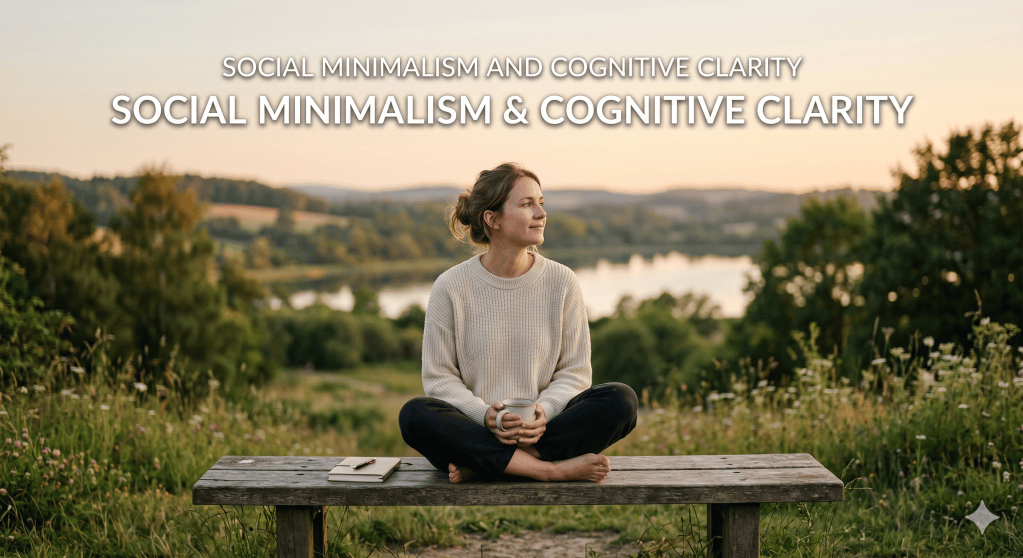
Social minimalism is reshaping how people manage attention and relationships. Explore the psychology and neuroscience behind why less social input often means greater cognitive clarity.
There is a particular kind of exhaustion that has become ordinary. It isn’t the tiredness that follows physical labor or a long day of work. It’s the feeling of having been constantly available — replied to, scrolled through, reacted to, notified, and refreshed — without having said or done anything that felt meaningful. For a growing number of people, that exhaustion became the starting point for a different kind of choice: less. Fewer platforms, fewer contacts, fewer obligations to respond. What emerged from that impulse has a name now — social minimalism — and the science behind why it seems to work is more interesting than the trend itself.
The years leading into the mid-2020s produced a confluence of pressures that made this shift almost inevitable. The social media platforms that had defined the 2010s matured into something different: optimized for engagement above almost everything else, and increasingly effective at it. Smartphones had become extensions of identity and attention. The pandemic compressed years of digital adoption into months, and when public life reopened, many people found they had lost the appetite for the social rhythms they once thought they wanted back. The result was not a mass retreat from technology, but a quieter, more deliberate renegotiation of it.
Social minimalism sits at the intersection of behavior, psychology, and neuroscience. Understanding why it resonates — and why cognitive clarity so often follows it — requires looking at what happens inside the brain when it is constantly social, and what happens when it is allowed, finally, to rest.
The Attention Economy and Its Costs
The phrase “attention economy” was popularized long before most people had a smartphone, but it only became viscerally meaningful in the years when the infrastructure of that economy became inescapable. Social media is engineered to engage fast, reactive thinking — and that comes at the expense of the slower, deliberate kind that most people need to do anything they consider genuinely worthwhile.
The problem with spending most of your waking hours in reactive mode is not just that it’s tiring. It actively degrades the capacity for the other kind of thinking. Research from Stanford psychologist Clifford Nass and his colleagues showed that people who regularly engage in heavy media multitasking — switching between streams of information rather than focusing on one — perform worse on tasks requiring the ability to filter irrelevant information, manage working memory, and switch tasks efficiently. The irony is that multitaskers appeared to be worse at the very cognitive skills multitasking supposedly develops.
This is partly about cognitive load, a concept rooted in educational psychology and the work of John Sweller. Every piece of information the brain has to hold in mind, evaluate, or respond to draws from a limited pool of mental resources. When that pool is consistently near empty — perpetually replenished just enough to keep you scrolling, but never enough to feel restored — the costs accumulate in ways that are easy to miss because they never quite peak. You don’t feel overwhelmed. You just feel slightly off, slightly scattered, slightly less like yourself.
The social dimension adds its own layer of complexity. Human beings evolved as intensely social creatures, and the brain devotes enormous resources to navigating social information — reading faces, interpreting tone, tracking reputation, managing relationships. This social processing runs deep, and much of it happens not during active tasks but during the brain’s quieter moments — a point we’ll return to shortly.
What has changed is the scale. A social world that once encompassed perhaps 150 people — roughly the number anthropologist Robin Dunbar famously associated with stable human social groups — has expanded, for many people, into thousands of weak connections, public audiences, and algorithmic strangers. The brain’s social machinery likely did not evolve for this scale of social exposure. It treats a viral post the same way it might treat a shift in social standing within a small community: with urgency, with vigilance, with a stress response calibrated for a world that no longer exists.
What Social Minimalism Actually Means
Social minimalism is not about isolation. It is not the same as social anxiety or misanthropy, and it shouldn’t be confused with either. The term describes a deliberate reduction in the number and intensity of social connections and social media inputs, with the aim of investing more energy into fewer, more meaningful interactions.
The practice takes different forms for different people. Some delete certain apps and keep others. Some mute or unfollow large portions of their feeds without leaving platforms entirely. Some establish strict time windows for checking messages. Others leave group chats, decline non-essential invitations, or simply become slower to respond. What these behaviors share is intentionality — not a passive drift toward withdrawal, but an active decision about where social energy goes.
This is distinct from what psychologists call social withdrawal in a clinical sense, which is typically involuntary and associated with depression, anxiety, or avoidance. Social minimalism, when practiced as a conscious strategy, is closer to what researchers studying recovery and well-being call “autonomy-supportive behavior” — acting in ways that reflect your own values and needs rather than external pressures. That distinction matters both for outcomes and for how the behavior should be understood.
The overlap with the broader minimalism movement is real but partial. Marie Kondo’s philosophy of keeping only what “sparks joy” resonated so widely because it offered a framework for making deliberate choices in a world of excess. Social minimalism applies similar logic to relationships and attention, with the same intuition that subtraction can be a form of enrichment. But where physical minimalism is essentially a one-time reorganization, social minimalism is an ongoing negotiation — because people, platforms, and social norms don’t stop making demands the way old furniture does.
The Neuroscience of Quiet
The concept of cognitive clarity is, at its core, about what the brain can do when it isn’t overwhelmed. Understanding this requires a brief look at what neuroscientists have learned about the brain at rest versus the brain under persistent social load.
The default mode network (DMN) is most active when external demands are low. Despite being called a “resting” network, it is anything but idle — this is when the brain processes experiences, consolidates memories, generates creative insights, and works through unresolved social and emotional material. The neuroscientist Matthew Lieberman has argued that the DMN is fundamentally social in nature: when we’re not focused on a task, the brain defaults to thinking about people — their intentions, their feelings, our relationships with them. This is not a bug. For most of human history, it was essential. Many researchers now believe the DMN is central to what we think of as introspection and self-understanding.
When external inputs are constant and demanding — as they are when a person is perpetually connected — opportunities for the kinds of internally directed cognition associated with DMN activity may become less frequent. The processing it would otherwise do gets interrupted. Some researchers have drawn connections between reduced DMN activity and the kinds of emotional dysregulation and difficulty with perspective-taking that many heavy social media users report, though the direction of causality in this research is still being worked out. What is clearer is that uninterrupted time — time away from reactive, external demands — appears to be necessary for certain kinds of cognitive and emotional processing that simply don’t happen any other way.
This helps explain why so many people who pull back from heavy social engagement report not just feeling calmer, but feeling clearer. More able to think in extended chains of reasoning. More able to sit with a feeling or a problem without immediately reaching for a distraction. More present in physical conversations. These are not mystical benefits. They are what happens when a brain that was operating in a permanently interrupted state gets time to complete its background processes.
The role of stress hormones here is also worth noting. The social vigilance associated with heavy digital engagement may contribute to maintaining low-grade activation of stress systems — not the acute spike of a genuine threat, but a chronic low-level hum that keeps the body’s resources slightly mobilized and slightly on edge. Researchers have found associations between heavy social media use and elevated cortisol levels, particularly in contexts where social comparison is frequent or where social feedback (likes, comments, follower counts) is uncertain. Reducing those inputs tends, for many people, to allow those stress systems to actually down-regulate — a process that takes longer than a single quiet afternoon but becomes more accessible when the inputs sustaining the activation are reduced.
Social Comparison and the Quiet Cost of Constant Visibility
Leon Festinger’s social comparison theory, introduced in 1954, proposed that human beings have a drive to evaluate their own opinions and abilities by comparing themselves to others. This was originally framed as a mostly neutral or adaptive tendency — comparing ourselves to others helps us calibrate our understanding of reality. But the digital environment introduced a new variable that Festinger couldn’t have anticipated: constant, curated, asymmetric comparison at scale.
On social media, people see a highly edited version of others’ lives: the vacation, not the debt that funded it; the achievement, not the years of effort behind it; the confident opinion, not the private uncertainty. Research has consistently found that passive scrolling — consuming others’ content without active engagement — is more reliably associated with negative mood and lower self-evaluation than active interaction. The comparison being made is not between real people but between a person’s authentic inner life and a stranger’s highlight reel, and the brain doesn’t always know the difference.
This is particularly significant because of what psychologists call “upward social comparison” — comparing oneself to people who appear better off in some relevant way. Such comparisons sometimes motivate, but they more often generate envy, dissatisfaction, and a diminished sense of one’s own life. When these comparisons happen hundreds of times a day, through the passive accumulation of a scrolled feed, their aggregate effect on mood and self-perception can be substantial, even when no single comparison feels meaningful.
Reducing social media input therefore reduces the volume of unsolicited social comparison, often dramatically. This is one of the more consistent findings in research on social media breaks: people report improvements in mood and self-esteem relatively quickly after reducing their use, even when they don’t expect to. A 2018 study from the University of Pennsylvania by psychologist Melissa Hunt and her colleagues found that limiting social media use to thirty minutes per day led to significant reductions in loneliness and depression compared to a control group — not because social media was making people deeply miserable, but because its removal allowed a baseline of more stable self-regard to reassert itself.
The Quality Versus Quantity Problem in Relationships
One of the more counterintuitive aspects of social minimalism is that reducing social activity can sometimes improve the quality of social life rather than diminishing it. This sounds paradoxical, but the research on relationship quality and well-being suggests it makes sense.
Decades of social science research has found that the number of close relationships a person maintains is a far weaker predictor of well-being than the quality of those relationships. Julianne Holt-Lunstad, a researcher at Brigham Young University who has studied social connection and health extensively, has found that social isolation is genuinely harmful to health outcomes — comparable in effect size to smoking. But the research also consistently shows that it is the subjective feeling of being known and supported, not the raw count of social ties, that drives those health benefits.
The challenge is that time and emotional energy are finite. A person maintaining active relationships with 200 loosely connected acquaintances — responding to posts, attending optional events, managing group chats — may be investing social energy in ways that actually crowd out the deeper contact that research suggests matters most. Social minimalism, in this framing, is less about withdrawing from people than about redirecting finite resources toward connections where they produce something.
There is also evidence that the nature of conversation changes when it isn’t happening through text on a phone. In-person interaction involves a richness of communication — tone, facial expression, physical presence, shared attention — that text-based digital communication strips away. Research on loneliness has found that people can feel profoundly lonely while being technically very socially active, if most of their interaction is thin in this way. Fewer, richer conversations may leave people feeling more genuinely connected than constant but shallow contact.
This is not an argument against digital communication, which is genuinely valuable in many contexts. It’s a description of a trade-off that many people were making without realizing they were making it — and that social minimalism, as a practice, tends to make visible.
Attention as a Resource Worth Managing
There is a broader frame within which social minimalism sits: the idea that attention is a resource, and that how it is spent determines, to a large degree, the texture of a life. This is not a new idea — William James wrote about it in 1890 — but it has taken on renewed urgency in an environment explicitly designed to extract as much attention as possible.
The psychologist Mihaly Csikszentmihalyi spent decades studying what he called “flow” — states of deep engagement in which attention is completely absorbed by a challenging, meaningful task. Flow states are associated with high levels of reported well-being, sense of meaning, and creative productivity. They are also, crucially, incompatible with interruption. A flow state requires sustained, focused attention over time, and it is precisely this kind of attention that an environment of constant notification and social checking makes difficult to achieve.
When people reduce their social and digital load, they often report being able to access flow states more easily. Not because they’ve changed their abilities, but because they’ve reduced the interruptions that prevent those states from forming. The cognitive clarity that social minimalism practitioners frequently describe is, in many cases, the experience of an attention that can finally complete a thought, pursue an interest, or absorb itself in something without being pulled away.
This connects to research on “attention residue” from organizational psychologist Sophie Leroy. Her work found that when people switch from one task to another before fully completing the first, part of their attention remains on the unfinished task — a residue that reduces performance on whatever they’re doing now. The social environment of constant connectivity creates something like perpetual attention residue: you’re always somewhat attending to conversations, contexts, and threads that haven’t resolved. Reducing that load allows more of a person’s available attention to actually be where they are.
When the Pendulum Swings: Cultural Shifts in Progress
By the mid-2020s, there were signs that the cultural conversation around social media and attention was shifting in ways that seemed structural rather than cyclical. Early evidence suggested that younger cohorts were beginning to show different patterns than their predecessors — not necessarily abandoning platforms, but using them differently, with more deliberateness and more apparent skepticism toward parasocial engagement and performative sharing.
In the United States and several European countries, legislation targeting the design practices of social media platforms — infinite scroll, variable reward notifications, algorithmic amplification of outrage — was advancing through legislatures with more traction than in previous years. Whether these regulatory efforts would succeed in altering the fundamental incentive structures of platforms remained an open question, but their presence reflected a broader cultural reckoning with what the attention economy had produced.
At the same time, the workplace conversation about deep work, focus, and the cost of constant availability had moved from the margins — where it lived in Cal Newport’s early writing and the scattered practice of “digital sabbaths” — toward something more mainstream. Organizations began to experiment with asynchronous communication norms, no-meeting blocks, and email-free periods, often finding productivity effects that aligned with what researchers had been suggesting for years.
What this suggests is that social minimalism, as a personal practice, exists within a larger social shift: a gradual renegotiation of the terms under which technology mediates human attention and connection. The individual and the structural are not independent. People making personal decisions to reduce their social load are participating in — and contributing to — a broader cultural reassessment.
The Limits of Minimalism and What It Can’t Solve
It would be a mistake to present social minimalism as a cure or a complete answer. The research on social isolation is clear that genuine disconnection is harmful, and there are populations for whom reduced social engagement is not a chosen practice but an imposed reality with real consequences for health and longevity. For those people — the elderly living alone, people with limited mobility, those in communities with few in-person social opportunities — the enthusiasm for digital reduction needs to be understood carefully, because digital connection is sometimes the most available form of connection.
There is also the question of what drives excessive social media use in the first place. For some people, compulsive checking and heavy social media engagement are expressions of underlying anxiety, loneliness, or need for validation that won’t be resolved by deleting apps. Removing the behavior without addressing what’s driving it can simply displace the symptom. Social minimalism as a surface-level intervention is not a substitute for addressing the conditions — psychological, relational, economic — that make compulsive digital engagement feel necessary.
And there are legitimate concerns about access and equity embedded in who gets to choose minimalism. Knowledge workers with schedule flexibility can protect their deep work time in ways that service workers with no control over their hours cannot. The rhetorical celebration of “unplugging” sometimes carries implicit class assumptions about whose attention is worth protecting and whose is merely for sale.
These are real limitations. Acknowledging them doesn’t undermine the core insight — that deliberate, autonomy-driven reductions in social and digital load tend to produce cognitive and emotional benefits — but it does prevent that insight from being mistaken for a universal prescription.
Conclusion: The Value of Chosen Quiet
What social minimalism ultimately represents is a practical response to a specific historical problem: the mismatch between the social and attentional demands of a digital environment engineered for maximum engagement and the cognitive architecture of a human brain that was not designed to be always on.
The evidence suggests that deliberate reduction — of platforms, of passive consumption, of social obligations undertaken out of habit rather than choice — tends to produce genuine improvements in mood, attention, self-regard, and relationship quality. These are not small benefits. They are connected to outcomes that matter: the ability to think clearly, the capacity for deep engagement with meaningful work, the experience of being genuinely present with people you care about.
The deeper significance of this trend may be less about any individual’s decision to delete an app and more about what those decisions, in aggregate, signal. They represent a cultural working-out of what technology is actually for — not a rejection of connection, but an insistence that connection be worth something. That attention be given rather than extracted. That quiet be understood not as absence, but as the condition in which a great deal of what matters most actually happens.
As the platforms that defined the 2010s continue to evolve, as regulation and cultural expectation reshape the norms of digital engagement, and as new technologies arrive with their own claims on human attention, the question social minimalism poses will remain relevant: what is this for, and what is it costing? That is not a question technology can answer. It remains, as it always has been, a human one.









