
Originally published in September 2024 and comprehensively updated/edited in June 2026.
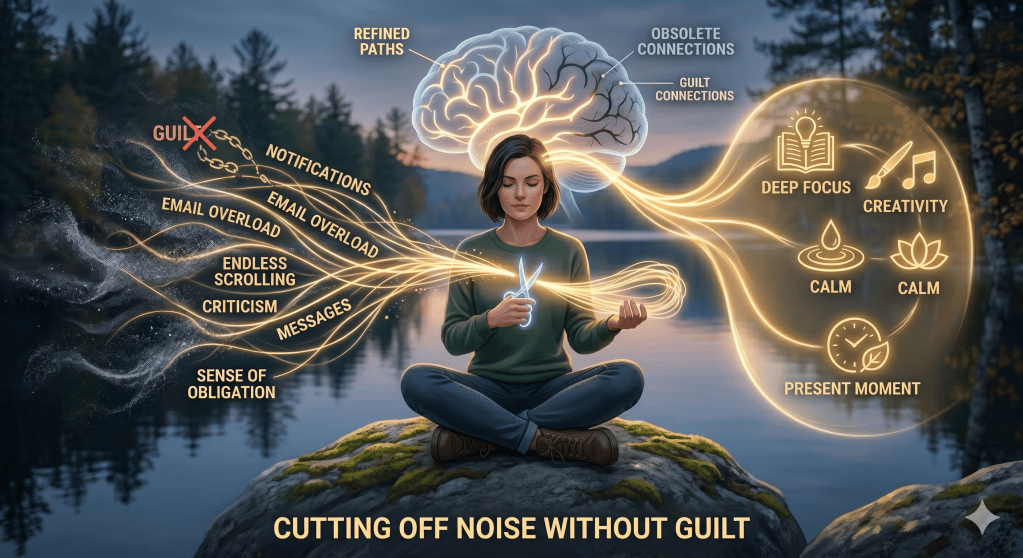
Why do we feel guilty for tuning out? Explore the psychology, neuroscience, and science behind cutting off noise — and why protecting your attention matters.
There was a particular kind of exhaustion that became common in the years following the pandemic — not the tiredness that comes from working too hard or sleeping too little, but something harder to name. People were worn out from paying attention. From the relentless scroll, the group chats that never went quiet, the news that arrived in waves with nowhere near enough time to process one crisis before the next one landed. Many began quietly doing something that felt almost transgressive: they started cutting things off. Muting notifications. Leaving conversations on read. Unfollowing friends. Stepping back from communities they had once found energizing.
And then came the guilt.
This piece is about that guilt — where it comes from, why it persists, and what science and psychology have to say about the very human need to manage how much input we allow into our lives. Cutting off noise without guilt is not about becoming cold or indifferent. It’s about understanding a real cognitive and emotional need, and learning to meet it without feeling like you’re doing something wrong.
The Information Environment We Actually Live In
To understand why so many people feel overwhelmed and then guilty for trying to do something about it, it helps to look at the environment that produced both feelings.
The years between 2020 and 2026 were, by almost any measure, extraordinarily loud. The COVID-19 pandemic pushed enormous portions of daily life online all at once — work, socializing, entertainment, politics, family. People who might previously have gotten their news from a newspaper in the morning and a television broadcast in the evening were now living inside a continuous information stream with no natural stopping points. Social media platforms, which had been designed with engagement as the core metric, surfaced the most emotionally activating content with algorithmic precision. Outrage, fear, and controversy often generated more engagement than calmer content, which meant algorithms frequently amplified emotionally activating material.
Researchers studying social media have noted for years that many platforms exploit what psychologists call variable reward schedules — the same reinforcement pattern that makes slot machines compelling. You don’t know what you’ll find when you open an app, and that unpredictability keeps you coming back. In 2024 and 2025, as several major platforms restructured their content algorithms to favor short-form video and reactive commentary, the volume and pace of that stimulation increased further. The result was an environment where attention was under constant competitive pressure.
This matters because attention is not an infinite resource.
What Neuroscience Says About Cognitive Load
The brain processes information using a system of limited capacity. Working memory — the mental space where we hold and manipulate information in the short term — can only manage a small number of items at once. Early cognitive psychology suggested that number was somewhere around seven, but more recent research has revised it downward considerably, with current estimates placing the active capacity closer to four meaningful chunks of information at a time.
What this means practically is that an environment saturated with competing signals doesn’t just feel overwhelming — it creates real cognitive interference. When the brain is forced to constantly triage incoming information (Is this urgent? Do I need to respond? Is this threatening?), it draws on the same neural resources needed for focused thinking, emotional regulation, and decision-making. Neuroscientists call this cognitive load, and when it’s chronically high, performance on all those other tasks degrades.
This shows up in what psychologists describe as decision fatigue — the well-documented finding that the quality of decisions tends to decline as the number of decisions made in a given period increases. Barack Obama famously reduced his daily clothing choices to limit unnecessary cognitive overhead; Steve Jobs did the same. While these are high-profile examples, the underlying principle applies broadly. Every notification that requires assessment, every message that seems like it might need a reply, every news alert that arrives during a moment of concentration is a small withdrawal from a finite account.
There’s also the matter of the default mode network, a set of brain regions that activates when we’re not focused on a specific task — when we’re daydreaming, reflecting, or letting the mind wander. Research by neuroscientist Marcus Raichle and others has shown that this network plays an important role in consolidating memories, processing emotions, and generating creative insight. In simple terms: the mind needs downtime to do some of its most important work. Constant stimulation doesn’t just feel bad — it crowds out processes the brain genuinely needs.
Social Connection and the Pressure to Stay Available
Here’s where the guilt comes in.
Human beings are social creatures in a very deep, biological sense. Research in social neuroscience, much of it pioneered by the late John Cacioppo, has demonstrated that chronic loneliness and social isolation carry real health costs — elevated stress hormones, disrupted sleep, increased cardiovascular risk. The need to belong is not a preference or a personality trait. It’s wired in.
That biology interacts with the norms that digital communication has created in complicated ways. The rise of smartphone culture introduced an implicit expectation that people would be reachable, nearly all the time. Leaving a message unanswered for more than a few hours began to feel like a slight. Being offline during a crisis — even a minor social crisis — started to register as abandonment. Group chats developed their own gravitational pull, and dropping out of one felt like a statement.
Sociologist Sherry Turkle, who has spent decades studying the relationship between technology and human connection, described this in her work as a kind of tethering — the sense that the phone has become a prosthetic extension of the social self, and that putting it down is not a neutral act but one that requires justification. For many people, the guilt that comes with reducing their digital availability is not irrational. It’s a response to genuine social expectations that have shifted in a relatively short period of time.
This creates a real tension: the same nervous system that suffers under information overload is also wired to seek belonging — and belonging, in the current environment, often feels contingent on being available. The result is that many people oscillate between drowning in input and feeling guilty for surfacing.
The Psychology of Boundaries in the Digital Age
The word boundary gets overused to the point of meaninglessness, but the underlying concept is useful. In psychology, a boundary is essentially a limit on what you allow to enter your psychological or emotional space. Healthy boundary-setting is associated with better mental health outcomes, more sustainable relationships, and greater sense of personal agency.
What’s interesting about digital-age boundary-setting is that it often doesn’t feel like a neutral act of self-management — it feels like rejection. When you mute someone’s notifications, or step back from a community, or decide you’re not going to follow the news for a week, there’s frequently a layer of anticipatory guilt. You imagine the person noticing, the community feeling your absence, the story you might miss.
Psychologists have a term for this: fear of missing out, or FOMO, which has been studied fairly extensively since researcher Andrew Przybylski and colleagues published foundational work on the concept in 2013. FOMO is linked to lower feelings of competence, autonomy, and relatedness — and it tends to push people toward continued social media use even when that use leaves them feeling worse rather than better. The guilt about cutting off isn’t imagined. It’s often driven by a real fear that stepping back will cost something.
But there’s a distinction worth drawing here between what actually costs something and what only feels like it does. Research on the social consequences of reduced digital availability is more ambiguous than the anxiety around it suggests. Studies on “digital detox” behaviors — periods of intentional disconnection — have generally found that people overestimate how much others notice their absence, and underestimate their own capacity to reconnect when they choose to. The perceived social cost is often larger than the actual one.
The Role of Social Comparison
One underappreciated driver of the guilt around reducing engagement is social comparison. Psychologist Leon Festinger’s social comparison theory, developed in the 1950s, holds that humans evaluate their own opinions and abilities by comparing themselves to others. In the pre-digital era, this comparison happened in a relatively local frame — neighbors, coworkers, people you actually knew. Social media expanded that comparison frame to include thousands of people simultaneously, many of whom are presenting curated, optimized versions of their lives.
The relevance here is this: when you see peers who appear to be staying fully engaged, reading everything, commenting on everything, participating in every conversation, stepping back can feel like a personal failing — like you’re somehow less capable or less committed than everyone else. What social comparison theory would predict, and what research on social media behavior tends to confirm, is that this perception is systematically distorted. Most people are managing similar levels of overwhelm; the ones who appear fully engaged are often performing engagement rather than experiencing it comfortably.
Why Cutting Off Can Be a Form of Care
There is a well-established psychological concept called compassion fatigue, originally developed in the context of caregiving professions — nurses, social workers, therapists — who are exposed to others’ suffering over extended periods. The term describes a gradual diminishment in the capacity for empathy and emotional responsiveness that occurs when a person is chronically overloaded with distress that they feel responsible for addressing.
What researchers and clinicians have observed in recent years is that the conditions for compassion fatigue no longer require a caregiving profession. The information environment delivers suffering at scale: humanitarian crises, political failures, personal tragedies, community conflicts — all arriving in the same feed, in rapid succession, with an implicit call to respond. The result is that many ordinary people are experiencing something that looks functionally similar to compassion fatigue without ever having been professional caregivers.
This matters because the guilt narrative around cutting off noise often frames disengagement as selfishness. But the psychology suggests something more nuanced. A person who has depleted their emotional reserves through chronic overexposure is not better positioned to help, connect, or contribute — they’re worse positioned. The familiar instruction given on airplanes to put on your own oxygen mask before assisting others captures something real about the relationship between self-regulation and effective engagement.
Stepping back, in this framing, isn’t abandonment. It’s maintenance.
Attention as a Resource Worth Managing
Selective Attention as a Skill
Cognitive psychology has long recognized that selective attention — the ability to focus on relevant information while filtering out the irrelevant — is both a crucial cognitive skill and one that can be trained. What has changed in the current environment is that the default state of most digital platforms works against selective attention. Algorithms surface the most engaging content regardless of relevance to your actual priorities. Notification systems interrupt regardless of context. The technology is designed, in aggregate, to capture attention rather than support its selective use.
This doesn’t mean individuals are helpless. But it does mean that cutting off noise is not a passive action — it requires deliberate design of your information environment. This might mean choosing which channels to monitor and which to leave alone, setting specific times for email or social media rather than treating them as always-on, or simply removing applications that reliably produce more cost than benefit. These are not dramatic gestures. They’re forms of environmental design that align your external conditions with your internal goals.
What the Research Suggests About Stepping Back
The empirical literature on deliberate disengagement from digital noise is still developing, but the findings that exist are reasonably consistent. People who take intentional breaks from social media — not as punishment or avoidance, but as deliberate practice — tend to report improvements in mood, concentration, and sense of time adequacy. A study published in the Journal of Social and Clinical Psychology in 2018 found that limiting social media use to thirty minutes per day produced significant reductions in loneliness and depression over three weeks, compared to a control group that continued normal usage.
Research on news consumption tells a similar story. A 2022 study in the journal Health Communication found that people who consumed high amounts of news reported higher levels of stress, anxiety, and feelings of helplessness — but that many continued consuming at high levels because they felt an obligation to stay informed. The researchers described this as a form of functional overextension: people engaging in behavior they experienced as harmful because they believed stopping would be irresponsible.
This belief — that constant attention to the news cycle is a civic duty — deserves examination. Being informed matters. Being continuously exposed to the same story in twenty different iterations, with escalating emotional framing, does not make you better informed. It makes you more anxious and, paradoxically, often less able to engage thoughtfully with what you’ve consumed.
When Cutting Off Goes Too Far
It’s worth naming the limits of this argument. There is a meaningful difference between managing information intake deliberately and retreating into comfortable ignorance. Social withdrawal, when it becomes a chronic pattern rather than a restorative practice, is associated with increased loneliness and mental health difficulties. The point isn’t to stop engaging with the world. It’s to engage on terms that sustain you rather than deplete you.
The distinction between restorative retreat and avoidance is partly about the quality of what replaces the noise. If stepping back from social media means spending more time in direct conversation with people you care about, in activities that restore energy, or in reflective thinking — that’s restorative. If it means numbing out with passive consumption of something equally draining, the calculus is different.
Living With Less Noise, Without the Guilt
The guilt that accompanies cutting off noise is real, and it isn’t without some legitimate basis. We do have obligations to the people in our lives, and genuine engagement with the world around us matters. But the guilt is also, in many cases, systematically inflated by the very systems that profit from our continued attention — platforms whose business models depend on keeping us engaged, notification structures designed to make absence feel costly, social comparison dynamics that make everyone else look more capable of keeping up.
Understanding the mechanisms behind both the noise and the guilt doesn’t make them disappear. But it changes the frame. Reducing your information load isn’t a moral failure. It isn’t selfishness or avoidance or indifference. It’s a response to a genuine mismatch between what the current environment demands and what the human nervous system can sustain. The research in neuroscience, psychology, and behavioral science all points in the same direction: attention is a finite and valuable resource, the conditions for its depletion have rarely been as aggressive as they are now, and protecting it is a reasonable and legitimate priority.
The people who seem to navigate this most effectively don’t make sweeping proclamations about going offline. They make practical decisions, repeatedly, about what gets their attention and what doesn’t. They allow themselves to be temporarily unreachable without interpreting that as a character flaw. They recognize that a well-rested, focused, emotionally regulated version of themselves is more valuable to everyone around them than a depleted version that stayed constantly available.
That’s not a revolutionary insight. But it’s one that’s surprisingly easy to lose sight of when the noise is loud enough — which, for most of us, is most of the time.
What Comes Next
The broader cultural reckoning with information overload is still in progress. There are signs of structural movement — some workplaces have introduced policies limiting after-hours digital contact, some schools are revisiting smartphone access with a seriousness that wasn’t present a decade ago — but structural change is slow, and the conditions you live in right now are the ones you have to navigate.
For most people, the most practical shift isn’t a sweeping life change. It’s a quieter one: deciding, deliberately and without excessive guilt, that you don’t have to be available to everything all the time. That you can care about people and the world while also protecting the cognitive and emotional resources that make that care sustainable. That the discomfort of stepping back is usually smaller than it feels from the inside.
Cutting off noise without guilt isn’t about becoming unreachable or indifferent. It’s about recognizing that attention, once given, can’t be retrieved — and that choosing carefully where it goes is not a luxury but a necessity.









