
Originally published in February 2025 and comprehensively updated and edited in June 2026.
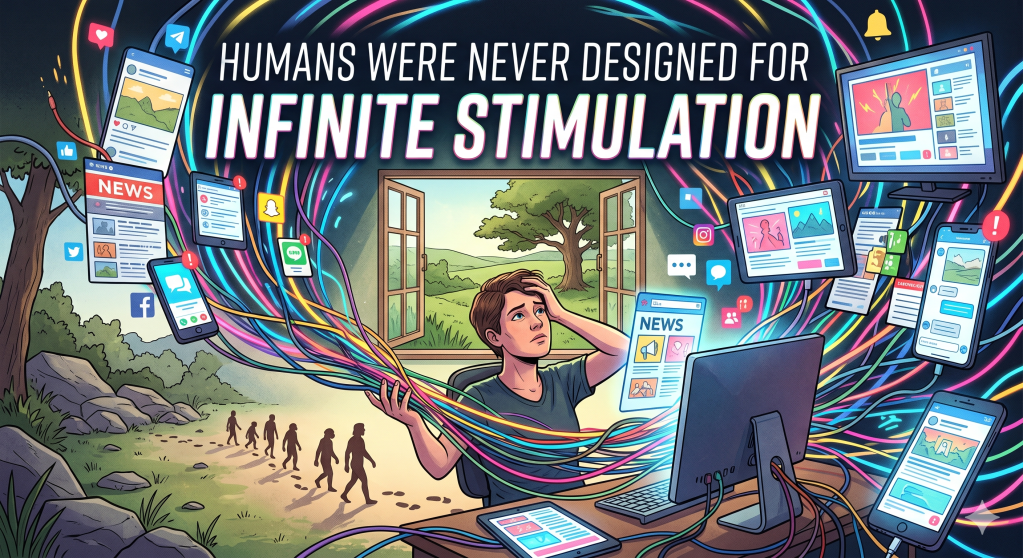
Humans evolved in a world of scarce information and slow social feedback. Here’s what infinite digital stimulation actually does to the brain — and why it matters.
There is a peculiar restlessness spreading through modern life. People scroll through their phones while watching television. They switch between tasks dozens of times an hour, unable to focus on any one thing for more than a few minutes. They feel bored the moment stimulation slows, anxious when nothing is demanding their attention. Sleep is harder to come by. Conversation feels effortful. Sitting quietly has become almost unbearable for many people.
None of this is a character flaw. It is, in many ways, the predictable consequence of an environment that the human brain was never built to handle. Across the past two decades, the architecture of daily life has been redesigned — largely by the technology industry — to deliver a near-constant stream of novelty, reward, and social feedback. The human nervous system, refined over hundreds of thousands of years in a very different world, is now being asked to operate inside systems optimized to capture and retain attention at unprecedented scale.
Understanding what is happening — and why — requires looking at how the brain actually works, what it was shaped to do, and what happens when the environment it evolved for is replaced by something radically different.
The Brain Was Built for Scarcity
For most of human history, information was scarce. Novelty was rare. Social feedback arrived slowly, in person, and in limited quantities. A person in a pre-industrial village might encounter a small circle of familiar people each day, hear a handful of pieces of news each week, and experience genuine excitement or surprise perhaps a few times a month. The pace of stimulation was slow by almost any modern standard.
This is the environment in which the human brain’s reward system was shaped. At the center of that system is dopamine — a neurotransmitter that most people think of as the “pleasure chemical,” though that description is only partly accurate. Dopamine is more precisely a signal of anticipation and reward prediction. It fires not just when you receive something rewarding, but when you encounter a cue that something rewarding might be coming. It is the neurological engine of seeking.
Research by neuroscientist Wolfram Schultz and others has clarified how this works: the brain learns to predict rewards, and dopamine spikes in response to those predictions — especially when the reward is uncertain. This is why variable reward schedules, the kind built into slot machines and social media feeds alike, are so compelling. When you don’t know whether the next scroll will bring something exciting or nothing at all, the anticipation itself becomes stimulating. The brain keeps seeking because the uncertainty keeps the dopamine loop running.
In a world of scarcity, this system was enormously useful. It pushed people to explore, to forage, to seek social connection, to try new things. The problem is that it was calibrated for an environment where truly compelling stimuli were relatively rare. Today, that same system operates inside an environment engineered to trigger it continuously.
Novelty is a significant part of why. The brain evolved to notice new things because novelty often carried survival value — a new food source, an unfamiliar sound, a change in the social order could all matter in ways that the familiar and routine could not. This orientation toward the new was adaptive in a world where genuinely new things were infrequent. Digital platforms exploit this bias by ensuring that almost every swipe, scroll, or refresh produces something different. The result is a stream of novelty far denser than anything our ancestors encountered, continuously pulling attention toward the next piece of information before the current one has been fully processed. The dopamine loop and the novelty bias reinforce each other, which helps explain why these platforms can feel so difficult to put down even when they aren’t delivering anything particularly satisfying.
The Architecture of Infinite Stimulation
The phrase “infinite scroll” was coined as a design feature, not a warning label. When Aza Raskin introduced the concept at a social media company in the late 2000s, the goal was simple: remove the natural stopping point. Before infinite scroll, a page had a bottom. You’d reach it, decide whether to click “next,” and that small moment of friction gave you an opportunity to ask yourself whether you actually wanted to continue. Infinite scroll eliminated that pause. The content just kept coming.
This was not an accident or an afterthought. The business model of most major social media platforms depends on maximizing what the industry calls “engagement” — a polite term for the total amount of time and attention users give to the platform. More time meant more advertising revenue. The result was an arms race, driven by algorithmic optimization and behavioral data, to build digital environments that were as psychologically compelling as possible.
The techniques that emerged drew heavily on behavioral psychology. Variable reward schedules, as mentioned above. Social validation metrics — likes, shares, follower counts — that trigger the same social-status circuitry humans evolved to care deeply about. Notification systems designed to create urgency and interrupt whatever else you were doing. Autoplay features that removed the conscious choice to continue watching. Recommendation algorithms that learned, with remarkable precision, what content kept each individual user engaged the longest.
By the early 2020s, the average person in a high-income country was spending somewhere between four and seven hours per day on a smartphone. A substantial portion of that time was devoted to social media and short-form video — content formats specifically optimized for rapid consumption and continuous novelty.
What Overstimulation Does to the Brain
The concept of neuroplasticity — the brain’s ability to reorganize itself in response to experience — is often discussed in hopeful terms. Learning a new skill, practicing mindfulness, acquiring a language: all of these reshape the brain in ways we generally consider positive. But plasticity works in every direction. The brain changes in response to whatever it repeatedly does, not just the things we consciously choose to practice.
When the brain is subjected to constant rapid stimulation, certain adaptations appear to follow. Attention researchers, including those who study what psychologist Gloria Mark has called “attention residue,” have documented that frequent task-switching impairs the ability to focus deeply on any single thing. Mark’s research at UC Irvine found that after an interruption, it takes an average of more than twenty minutes to return to the original task with full focus — and that in modern work environments, people are interrupted or self-interrupt every few minutes.
The implications compound over time. If you spend years training your attention system on rapid, fragmented stimulation, you are, in effect, practicing distraction. The neural pathways associated with sustained focus get less use; those associated with scanning and switching get more. This doesn’t necessarily mean permanent damage — the brain retains plasticity throughout life — but it does mean that the experience of trying to focus on something slow and demanding becomes increasingly uncomfortable.
There is also the question of what psychologists call “baseline stimulation levels.” The brain adapts to whatever level of stimulation it regularly receives, adjusting its sensitivity accordingly. This is why people who spend hours each day on fast-paced social media often report that reading a book, having a slow conversation, or sitting in nature feels tedious or even anxious rather than peaceful. The contrast between their adapted baseline and the lower stimulation of those activities has grown uncomfortably wide.
The Social Brain Under Pressure
Humans are deeply social animals. The size and complexity of the human neocortex appears to be linked, at least in part, to the demands of navigating complex social environments — a theory proposed by anthropologist Robin Dunbar and supported by comparative research across primate species. Social information — who is allied with whom, who has status, what others think of you — is among the most cognitively engaging content the human brain processes.
Social media platforms exploit this directly. The endless stream of social information they provide — status updates, photographs, opinions, arguments, relationship developments — is exactly the kind of content the social brain evolved to find compelling. But the quantity and pace of that information is entirely without historical precedent.
Consider what the “social feed” of a typical social media user actually contains. At any given moment, they might be processing the emotional expressions of hundreds or thousands of people simultaneously — acquaintances, celebrities, strangers, public figures — each sharing fragments of their inner lives in rapid succession. They are monitoring social signals, comparing themselves to others, tracking conflict and harmony, and navigating in-group and out-group dynamics. And they are doing all of this not occasionally, over weeks and months, but continuously, in real time, for hours each day.
Psychologist Jean Twenge, whose longitudinal research on generational differences has examined mental health data spanning several decades, has documented significant increases in rates of anxiety, depression, and loneliness particularly among adolescents and young adults beginning around 2012 — roughly when smartphone adoption reached saturation and social media use became near-universal among younger demographics. The causal relationship is debated among researchers; correlation does not automatically imply causation, and the precise magnitude of social media’s contribution to mental health changes remains an active area of scientific inquiry. But the timing, and the consistency of the findings across multiple data sources, has led a growing number of researchers to take the connection seriously.
What is less debated is the psychological phenomenon of social comparison, documented extensively since Leon Festinger’s foundational work in the 1950s. People evaluate themselves partly by comparing themselves to others, and the valence of those comparisons affects mood and self-perception. Social media creates conditions for social comparison at a scale and frequency that simply didn’t exist before. The result, for many users, is a kind of chronic low-grade dissatisfaction — a persistent sense of inadequacy generated by exposure to carefully curated representations of other people’s lives.
Attention as a Finite Resource
Attention is not unlimited. Cognitive load researchers have long argued that working memory has limited capacity — and when incoming information exceeds that capacity, performance, learning, and decision-making begin to degrade. Every notification, every context switch, every interruption imposes a cognitive cost. The cost of any individual interruption may be small, but across a day filled with dozens or hundreds of such events, the cumulative effect is substantial. People end their days feeling mentally exhausted not because they did a great deal of focused work, but because their cognitive resources were depleted by a constant demand to process, sort, and react to incoming information.
This kind of exhaustion is qualitatively different from the tiredness that comes from deep, sustained intellectual effort. The latter tends to be accompanied by a sense of accomplishment, of having genuinely engaged with something. The former — attention fatigue from fragmented stimulation — tends to produce a feeling of hollowness, of having been very busy while accomplishing very little. Research by psychologist Mihaly Csikszentmihalyi on the experience of “flow” — the state of deep engagement with a challenging task — suggests that this kind of focused immersion is among the most reliable sources of genuine satisfaction. Conditions of infinite stimulation systematically undermine the ability to enter it.
The Sleep Problem
Among the clearest and most well-documented consequences of modern digital habits is disrupted sleep. The relationship between screens, particularly at night, and sleep quality is one of the more robustly supported findings in this space.
Light in the blue spectrum, which LED screens emit in significant quantities, suppresses the production of melatonin — the hormone that signals to the body that it is time to sleep. Charles Czeisler and colleagues at Harvard have documented this effect in detail: exposure to bright screen light in the hours before bed delays the timing of the circadian clock, making it harder to fall asleep and altering the structure of sleep itself. This is a physiological response, not a matter of willpower.
But the light is only part of the problem. The content of social media, news feeds, and video platforms is specifically designed to be engaging — and engagement is neurologically incompatible with the kind of mental quieting that sleep requires. The dopaminergic arousal generated by scrolling or watching keeps the nervous system in a state of alert readiness that is the opposite of what sleep needs. People report lying in bed, phone in hand, telling themselves they will stop in five minutes, for an hour or more.
The downstream effects of chronic sleep disruption are broad and well-established. Cognitive performance degrades. Emotional regulation becomes harder. The risk of anxiety and depression increases. Metabolic and cardiovascular health are affected over time. Sleep is not a passive state; it is when the brain consolidates memories, clears metabolic waste products, and restores the neurochemical balance that supports mood and motivation. Systematically shortening or fragmenting it carries real costs.
Short Attention Spans and the Question of Causation
It has become common to claim that human attention spans have been shrinking — a claim often supported by citing a widely circulated Microsoft Canada report from 2015 that suggested the average human attention span had dropped to eight seconds, shorter than a goldfish. That statistic, it turns out, was largely fabricated, or at least based on a significant misrepresentation of what “attention span” means and how it was measured. Attention researchers have pushed back on the claim, noting that “attention span” is not a single measurable trait and that the evidence for a global shortening of it is considerably more complicated than the popular narrative suggests.
What the evidence does support is more specific and arguably more interesting: the ability to sustain focus on a task you find unrewarding, in the presence of more immediately stimulating alternatives, appears to have become harder for many people. This is not exactly a shortening of attention span — people can still focus deeply on things they find genuinely engaging for extended periods. What may be changing is the threshold of stimulation required before something feels engaging enough to focus on.
This is a meaningful distinction. It suggests that the challenge is not an absolute diminishment of human cognitive capacity but rather a recalibration of the brain’s expectations about what stimulation should feel like. The person who struggles to read a book for an hour but can watch a three-hour film without difficulty is not demonstrating a short attention span in any simple sense. They are demonstrating that sustained attention is available, but that it now requires a higher level of stimulus richness to deploy.
What the Body Knows
The consequences of infinite stimulation are not confined to the mind. The body’s stress response — the autonomic nervous system, the hypothalamic-pituitary-adrenal axis, the regulation of cortisol — is activated by the same kinds of cues that social media and constant connectivity provide.
Uncertainty activates stress. Social threat — criticism, exclusion, status loss — activates stress. The inability to resolve a problem activates stress. Interruption and fragmentation of effort activate stress. Social media consistently provides all of these: social uncertainty, comparison, conflict, unresolved arguments, the ambient presence of bad news. The result, for heavy users, is a chronic low-level activation of the stress response that may contribute to the elevated rates of anxiety that have been documented across multiple countries over the past decade.
The polyvagal theory, developed by neuroscientist Stephen Porges, suggests that the human nervous system operates in different modes depending on perceived safety. In conditions of chronic threat or uncertainty — including social uncertainty — the system shifts toward defensive states that impair connection, creativity, and the capacity for deep engagement. It is not a theory without critics, and some of its more popular applications have outrun the research, but the broader point — that the nervous system responds to social and environmental cues in ways that affect cognition and behavior — is well-supported by a wider evidence base.
The Irony of Connection
Perhaps the deepest irony of the age of infinite stimulation is that the technologies most associated with it were built, and are often experienced, as tools of connection. Social media, messaging platforms, and content feeds are framed as ways of bringing people closer — to friends, to information, to community. For many people, in many circumstances, they do exactly that.
And yet something has gone wrong at scale. The loneliness epidemic — documented by researchers like Vivek Murthy, who served as U.S. Surgeon General and devoted significant attention to the public health dimensions of social isolation — did not improve with the rise of social media. By many measures, it worsened. The number of close friends people report having has declined. The frequency of in-person social interaction has fallen. People report feeling more isolated even as they are technically more connected than at any point in human history.
This is not simply a paradox. It reflects something genuine about the nature of human connection. The bonds that provide the deepest psychological benefits — the kind associated with better health outcomes, longer lives, and genuine resilience in difficult circumstances — are built through shared experience over time, through vulnerability, through the slow accumulation of mutual understanding. These bonds require sustained attention and presence, the very capacities that infinite stimulation erodes.
Digital connection is not without value. But it is, in many cases, a different kind of thing than the in-person, sustained, attentive human contact that the social nervous system evolved in the context of. Using it as a substitute, rather than a supplement, appears to leave real needs unmet.
Where This Leaves Us
None of what is described here is inevitable or irreversible. The brain’s plasticity, which helps explain how these patterns develop, also means that different habits of attention, different relationships with technology, and different environments can shift things in other directions. Research on mindfulness practices, for instance, has documented measurable changes in the structure and function of brain regions associated with attention and emotional regulation. The same brain that adapts to fragmented stimulation can adapt, with practice, toward greater capacity for sustained focus.
The broader cultural conversation about technology and attention has also matured considerably since the first wave of alarm about smartphones in the early 2010s. The framing has shifted, gradually, from moral panic toward something more nuanced: a recognition that these are real phenomena with real costs, but that the goal is not to reject technology wholesale, which would be both impractical and unnecessary. The goal is to develop a more intentional relationship with it — one shaped by understanding what the human nervous system actually needs rather than by what algorithms are optimized to extract from it.
That understanding starts with a basic fact: the human brain was never designed for infinite stimulation. It was built for an environment of scarcity, periodic challenge, and deep social connection within small groups. It is capable of remarkable adaptation, but adaptation is not the same as optimization. When the environment changes faster than evolution can track — and the past two decades represent exactly that kind of abrupt shift — the result is a system doing the best it can in conditions it was never prepared for.
The restlessness, the fragmented attention, the difficulty sitting still, the chronic low-grade anxiety: these are not signs of weakness. They are the expected outputs of a very capable machine running in the wrong environment. Understanding that is the beginning of thinking clearly about what to do next.









